Download Free Sample
Kindly complete the form below to receive a free sample of this Report
GCC Compression Therapy Market Research Report: Size, Share, Trend Analysis By Product Type (Compression Garments, Compression Bandages, Compression Pumps, Compression Hosiery), By Applications (Chronic Venous Insufficiency, Lymphedema, Sports Injuries, Post-Surgical Recovery), By End-user (Hospitals, Ambulatory Surgical Centers, Home Care Settings, Rehabilitation Centers), andBy Distribution Channel (Online Pharmacies, Retail Pharmacies, Hospital Pharmacies, Medical Supply Stores) - Growth Outlook & Industry Forecast 2025 To 2035
As per Market Research Future analysis, the GCC compression therapy market size was estimated at 150.17 USD Million in 2024. The GCC compression therapy market is projected to grow from 159.44 USD Million in 2025 to 290.0 USD Million by 2035, exhibiting a compound annual growth rate (CAGR) of 6.1% during the forecast period 2025 - 2035
The GCC compression therapy market is experiencing robust growth driven by health awareness and technological advancements.
| 2024 Market Size | 150.17 (USD Million) |
| 2035 Market Size | 290.0 (USD Million) |
| CAGR (2025 - 2035) | 6.17% |
Medi USA (US), Sigvaris (CH), Juzo (DE), BSN Medical (DE), 3M (US), Lohmann & Rauscher (DE), Tactile Medical (US), Compression Therapy (US), Venosan (CH)
Our Impact
Enabled $4.3B Revenue Impact for Fortune 500 and Leading Multinationals
Partnering with 2000+ Global Organizations Each Year
30K+ Citations by Top-Tier Firms in the Industry
The compression therapy market is experiencing notable growth within the GCC region, driven by an increasing awareness of health and wellness among the population. This heightened consciousness has led to a greater demand for products that aid in the management of various medical conditions, such as venous disorders and lymphedema. Furthermore, the rise in lifestyle-related ailments has prompted healthcare professionals to recommend compression therapy as a viable treatment option. As a result, manufacturers are focusing on innovation and product development to meet the evolving needs of consumers, which appears to be a key factor in the market's expansion. In addition, the regulatory environment in the GCC is becoming more supportive of medical devices, including compression therapy products. This shift is likely to encourage investment and foster a competitive landscape among local and international players. The integration of advanced technologies, such as smart textiles and wearable devices, is also anticipated to enhance the effectiveness of compression therapy solutions. Overall, the compression therapy market in the GCC is poised for continued growth, driven by a combination of consumer demand, regulatory support, and technological advancements.
There is a growing recognition of the importance of health and wellness in the GCC region. This trend is leading to increased demand for compression therapy products, as individuals seek effective solutions for managing various health conditions. Healthcare professionals are increasingly recommending these therapies, contributing to a broader acceptance among the population.
The compression therapy market is witnessing a surge in innovation, particularly with the introduction of advanced materials and smart technologies. These developments enhance the functionality and comfort of compression garments, making them more appealing to consumers. As a result, manufacturers are investing in research and development to create more effective products.
The regulatory landscape in the GCC is evolving to better accommodate medical devices, including compression therapy solutions. This supportive environment is likely to facilitate market entry for new products and encourage investment from both local and international companies. Enhanced regulations may also improve product quality and safety.
The demographic shift towards an aging population in the GCC is likely to bolster the compression therapy market. As individuals age, they become more susceptible to various health issues, including venous disorders and circulatory problems. The World Health Organization estimates that by 2030, the number of people aged 60 and above in the GCC will double, leading to an increased demand for healthcare services, including compression therapy. This demographic trend suggests that healthcare providers will need to focus on offering specialized compression solutions to cater to the unique needs of older adults, thereby driving market growth.
The increasing healthcare expenditure in the GCC countries is a significant driver for the compression therapy market. Governments in the region are investing heavily in healthcare infrastructure and services, with spending projected to reach $100 billion by 2025. This investment is likely to enhance access to advanced medical treatments, including compression therapy. As healthcare facilities expand and improve, the availability of compression therapy products is expected to rise, facilitating greater adoption among patients. This trend indicates a positive outlook for the compression therapy market, as more individuals gain access to necessary therapeutic options.
The rising prevalence of chronic diseases such as diabetes and cardiovascular disorders in the GCC region is a notable driver for the compression therapy market. As these conditions often lead to complications like venous insufficiency and lymphedema, the demand for effective treatment options is escalating. According to health statistics, the incidence of diabetes in the GCC is projected to reach 20% by 2030, which may significantly increase the need for compression therapy solutions. This trend indicates a growing market for compression garments and devices designed to alleviate symptoms associated with these chronic conditions, thereby enhancing the overall market landscape.
There is a noticeable shift towards preventive healthcare in the GCC, which is influencing the compression therapy market. As individuals become more health-conscious, they are increasingly seeking preventive measures to avoid chronic conditions. Compression therapy is recognized for its role in preventing venous disorders and improving circulation, making it an attractive option for health-conscious consumers. This growing awareness is likely to drive demand for compression products, as more people incorporate them into their wellness routines. The compression therapy market stands to benefit from this trend, as it aligns with the broader movement towards proactive health management.
Technological advancements in the design and functionality of compression therapy products are propelling the market forward. Innovations such as smart textiles and adjustable compression levels are enhancing the effectiveness and comfort of these products. The introduction of wearable technology that monitors health metrics is also gaining traction, potentially revolutionizing the way compression therapy is administered. As manufacturers invest in research and development, the compression therapy market is expected to see a surge in new and improved products. This trend indicates a dynamic market landscape, where innovation plays a crucial role in meeting the evolving needs of consumers.
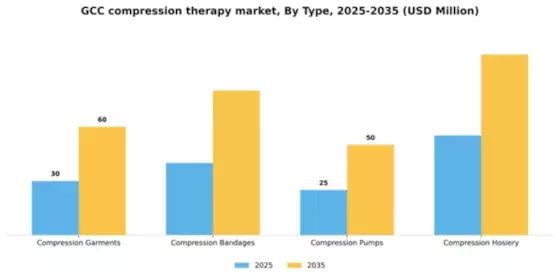
The GCC compression therapy market is characterized by a diverse range of segment values, with compression garments holding the largest market share. These products have gained significant traction among consumers due to increasing awareness of health conditions requiring compression therapy. Conversely, compression bandages are emerging as the fastest-growing segment, driven by their versatility and effectiveness in a variety of medical settings, particularly in post-surgery recovery and sports medicine.
In recent years, the growth trend for compression pumps and hosiery has remained steady, yet they have not matched the rapid rise of compression bandages. The increased prevalence of venous diseases, coupled with an aging population, has bolstered the demand for compression garments. Technological advancements and innovative product designs are key drivers, pushing both established and emerging companies to enhance their offerings in the GCC compression therapy market.
Compression Garments (Dominant) vs. Compression Bandages (Emerging)
Compression garments are recognized as the dominant force in the GCC compression therapy market, offering a wide range of products tailored for various medical needs and lifestyle preferences. These garments are designed to provide consistent pressure on the limbs, aiding in blood circulation and reducing swelling. In contrast, compression bandages are emerging as a pivotal product, known for their adaptability and ease of use. They cater to a broad spectrum of applications, from injury recovery to chronic venous insufficiency treatments. Both segments exhibit unique characteristics, with garments focusing on prolonged wear and specialized design, while bandages prioritize functionality and can be more easily applied. As awareness of the benefits of compression therapy grows, both segments are poised for continued development.
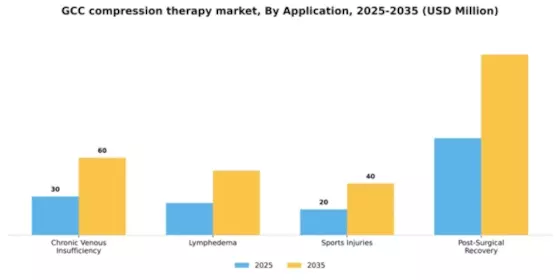
In the GCC compression therapy market, Chronic Venous Insufficiency holds the largest market share, dominating the application segment due to its prevalent nature among populations suffering from venous disorders. Lymphedema is gaining traction as the fastest-growing segment, often driven by increased awareness and diagnosis of lymphatic conditions. The post-surgical recovery and sports injuries segments also contribute to the overall market, albeit at a smaller scale.
The growth trends in the GCC compression therapy market are primarily fueled by an aging population, rising incidence of chronic diseases, and increasing focus on preventive healthcare measures. Innovations in compression therapy products, alongside improved healthcare infrastructure, significantly contribute to this upward trend. Healthcare professionals' recommendations on the benefits of compression therapy for recovery and management further bolster market growth, positioning these application segments favorably for the future.
Chronic Venous Insufficiency: Dominant vs. Lymphedema: Emerging
Chronic Venous Insufficiency (CVI) is recognized as the dominant application segment within the GCC compression therapy market, characterized by its chronic nature and impact on quality of life. It significantly benefits from well-established treatment protocols and product adaptations tailored to patient needs. On the other hand, Lymphedema is emerging as a promising segment, driven by increasing awareness and advancements in treatment options. This segment is rapidly evolving with the development of specialized devices and customized garments, indicating a shift towards personalized healthcare solutions. Both segments exhibit unique characteristics, where CVI provides a stable revenue foundation while Lymphedema is set to experience accelerated growth, responding to a dynamic healthcare landscape.
In the GCC compression therapy market, hospitals constitute the largest sector, holding a significant share due to their comprehensive facilities and advanced medical technology. Ambulatory surgical centers and rehabilitation centers also play crucial roles, yet they contribute less to the overall market share compared to large hospitals. Home care settings are rapidly gaining traction as patients prefer receiving therapy in familiar environments while healthcare systems focus on reducing hospital stays, enhancing the appeal of home care solutions.
The growth trends within the end user segment reflect a shift towards more personalized care options. The demand for home care settings is driven by an aging population requiring long-term care, coupled with advancements in medical technology that facilitate treatment outside conventional healthcare institutions. Hospitals continue to evolve, integrating innovative therapies and technologies to maintain leadership, but the surge in home care solutions is positioning this segment as the fastest-growing within the market.
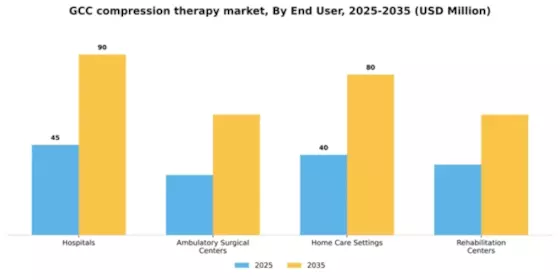
Hospitals (Dominant) vs. Home Care Settings (Emerging)
Hospitals remain the dominant end user segment in the GCC compression therapy market due to their extensive resources and integrations of cutting-edge technologies that provide a wide array of treatment options. They typically feature specialized departments focused on rehabilitation and therapy, ensuring optimal patient care. On the other hand, home care settings are emerging rapidly as a significant alternative, appealing particularly to patients seeking comfort and convenience. These settings empower patients to manage their treatment plans in familiar environments. The increasing adoption of telehealth and portable therapy devices supports this growth, allowing for effective management of chronic conditions without the need for extensive hospital visits. This dual growth illustrates a significant transformation in patient care dynamics within the GCC region.
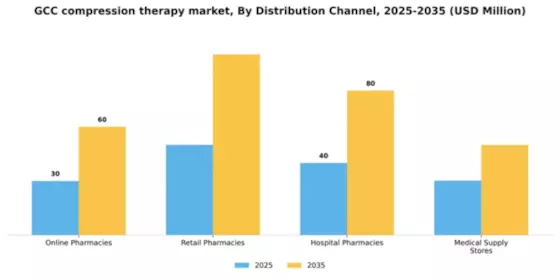
In the GCC compression therapy market, Retail Pharmacies hold a significant market share, providing consumers with easy access to a range of compression therapy products. This segment benefits from the established trust and relationships that pharmacies have with their customers, leading to consistent sales and support from healthcare professionals. Online Pharmacies, while currently smaller in market share, are rapidly gaining traction among consumers due to the convenience of online shopping and the increasing trend toward e-commerce in healthcare.
Growth trends in the market are being influenced by the rise in chronic diseases and the aging population, which boosts the demand for compression therapy products. The shift towards online platforms for purchasing such therapy aids is facilitated by advancements in technology and consumer preferences for quick and accessible healthcare solutions. Retail Pharmacies continue to thrive due to their established networks, but Online Pharmacies are emerging as a vital force in the market, catering to a tech-savvy consumer base.
Retail Pharmacies (Dominant) vs. Online Pharmacies (Emerging)
Retail Pharmacies dominate the distribution landscape of the GCC compression therapy market by providing a reliable avenue for purchasing compression products. They are typically preferred by consumers for their immediate availability and personalized service, enabling customers to consult with pharmacists directly. In contrast, Online Pharmacies are considered emerging players, appealing particularly to younger demographics who prioritize convenience and often seek detailed product information online. The dynamic growth of Online Pharmacies is supported by efficient delivery services and the ability to browse a wider range of products compared to traditional retail outlets. As both segments evolve, Retail Pharmacies maintain a significant presence while Online Pharmacies continue to expand their influence, making the market competitive and responsive to consumer needs.
Get more detailed insights about GCC Compression Therapy Market Request Free Sample
The compression therapy market exhibits a dynamic competitive landscape, characterized by a blend of innovation and strategic positioning among key players. Companies such as Medi USA (US), Sigvaris (CH), and Juzo (DE) are at the forefront, leveraging their strengths in product development and market penetration. Medi USA (US) focuses on expanding its product line to include advanced materials that enhance comfort and efficacy, while Sigvaris (CH) emphasizes sustainability in its manufacturing processes, appealing to environmentally conscious consumers. Juzo (DE) is known for its commitment to personalized solutions, which positions it favorably in a market increasingly driven by consumer preferences for tailored healthcare solutions. Collectively, these strategies contribute to a competitive environment that prioritizes innovation and responsiveness to market demands.Key business tactics within the compression therapy market include localizing manufacturing and optimizing supply chains to enhance efficiency and reduce costs. The market structure appears moderately fragmented, with several players vying for market share. This fragmentation allows for diverse offerings, yet the influence of major companies remains significant, as they set trends and standards that smaller entities often follow. The collective actions of these key players shape the market dynamics, fostering an environment where innovation is crucial for maintaining competitive advantage.
In October Medi USA (US) announced the launch of a new line of compression garments designed specifically for athletes, aiming to enhance performance and recovery. This strategic move not only diversifies their product portfolio but also taps into the growing trend of health and wellness among sports enthusiasts. By addressing this niche market, Medi USA (US) positions itself as a leader in performance-oriented compression solutions, potentially increasing its market share in a competitive segment.
In September Sigvaris (CH) unveiled a partnership with a leading technology firm to integrate smart textiles into their compression products. This collaboration aims to develop garments that monitor physiological parameters, thereby providing users with real-time feedback on their health. The strategic importance of this initiative lies in its potential to revolutionize the user experience, aligning with the increasing demand for digital health solutions and personalized care.
In August Juzo (DE) expanded its distribution network in the GCC region by partnering with local healthcare providers. This strategic action is indicative of Juzo's commitment to enhancing accessibility to its products, thereby increasing brand visibility and consumer trust. By establishing strong local partnerships, Juzo (DE) not only strengthens its market presence but also aligns itself with regional healthcare initiatives, which may lead to increased sales and customer loyalty.
As of November current trends in the compression therapy market are increasingly defined by digitalization, sustainability, and the integration of artificial intelligence. Strategic alliances among companies are shaping the competitive landscape, fostering innovation and collaboration. The shift from price-based competition to a focus on technological advancement and supply chain reliability is evident. Companies that prioritize these aspects are likely to differentiate themselves in a crowded market, ensuring long-term success and adaptability in an ever-evolving industry.

The GCC Compression Therapy Market is currently experiencing notable developments with an increasing focus on advanced therapeutic solutions.
In September 2023, DJO Global announced the expansion of its product offerings, introducing new compression technologies aimed at enhancing patient care, particularly for those suffering from lymphedema.
Additionally, in August 2023, Smith and Nephew launched a series of innovative compression devices targeting post-operative recovery, reflecting the rising demand for efficient wound care. The regional market is witnessing significant growth due to increasing awareness about chronic venous diseases and effective treatment options.
Recent reports highlighted a growth trend in the market valuation of companies such as Medi and Sigvaris, attributed to their strategic investments and product innovations. In 2022, Jobst successfully implemented a series of marketing campaigns to promote its compression garments, resulting in increased brand visibility across major GCC countries.
Furthermore, the industry saw a strategic acquisition when 3M acquired a key compression therapy brand, enhancing its portfolio in the GCC market and further supporting its growth trajectory. Overall, these developments underscore a proactive approach within the industry, reshaping patient management and treatment options in the GCC region.
The Compression Therapy Market is projected to grow at a 6.17% CAGR from 2025 to 2035, driven by increasing awareness of chronic venous diseases and advancements in product technology.
New opportunities lie in:
By 2035, the market is expected to achieve substantial growth, driven by innovation and strategic partnerships.
| MARKET SIZE 2024 | 150.17(USD Million) |
| MARKET SIZE 2025 | 159.44(USD Million) |
| MARKET SIZE 2035 | 290.0(USD Million) |
| COMPOUND ANNUAL GROWTH RATE (CAGR) | 6.17% (2025 - 2035) |
| REPORT COVERAGE | Revenue Forecast, Competitive Landscape, Growth Factors, and Trends |
| BASE YEAR | 2024 |
| Market Forecast Period | 2025 - 2035 |
| Historical Data | 2019 - 2024 |
| Market Forecast Units | USD Million |
| Key Companies Profiled | Medi USA (US), Sigvaris (CH), Juzo (DE), BSN Medical (DE), 3M (US), Lohmann & Rauscher (DE), Tactile Medical (US), Compression Therapy (US), Venosan (CH) |
| Segments Covered | Type, Application, End User, Distribution Channel |
| Key Market Opportunities | Integration of advanced materials and smart technology enhances effectiveness in the compression therapy market. |
| Key Market Dynamics | Rising demand for advanced compression therapy solutions driven by regulatory support and increasing awareness of chronic venous disorders. |
| Countries Covered | GCC |
The market valuation was $150.17 Million in 2024.
The projected valuation for 2035 is $290.0 Million.
The expected CAGR is 6.17% during the forecast period 2025 - 2035.
Compression hosiery had the highest valuation at $55.17 Million in 2024.
Key applications include post-surgical recovery, chronic venous insufficiency, lymphedema, and sports injuries.
Retail pharmacies are projected to perform best, with a valuation range of $50.0 - $100.0 Million.
Key players include Medi USA, Sigvaris, Juzo, BSN Medical, and 3M.
The valuation range for compression pumps is $25.0 - $50.0 Million.
Compression bandages had a valuation range of $40.0 - $80.0 Million, indicating strong market presence.
The market is expected to grow steadily, reaching $290.0 Million by 2035, driven by a CAGR of 6.17%.



Kindly complete the form below to receive a free sample of this Report

“This is really good guys. Excellent work on a tight deadline. I will continue to use you going forward and recommend you to others. Nice job”


“Thanks. It’s been a pleasure working with you, please use me as reference with any other Intel employees.”


“Thanks for sending the report it gives us a good global view of the Betaïne market.”


“Thank you, this will be very helpful for OQS.”


“We found the report very insightful! we found your research firm very helpful. I'm sending this email to secure our future business.”


“I am very pleased with how market segments have been defined in a relevant way for my purposes (such as "Portable Freezers & refrigerators" and "last-mile"). In general the report is well structured. Thanks very much for your efforts.”


“I have been reading the first document or the study, ,the Global HVAC and FP market report 2021 till 2026. Must say, good info! I have not gone in depth at all parts, but got a good indication of the data inside!”


“We got the report in time, we really thank you for your support in this process. I also thank to all of your team as they did a great job.”


“The Automotive 48V ECU Components Procurement Intelligence Study” was a complex project, but the Market Research Future (MRFR) team handled it with quality, agility, and customer-centricity. They delivered all requested data on time and within the agreed scope. The team, including Shubhendra Anand and Rahul Gotadki, was always readily available to clarify questions and swiftly implement necessary adjustments, driving the project to a successful conclusion within a very demanding timeframe.
I would also like to specifically commend Akshay Agarwal for his responsiveness and support at every stage—from our initial inquiry on May 6th through to final delivery on June 18th. His dedication made the entire process seamless.”



