Download Free Sample
Kindly complete the form below to receive a free sample of this Report
GCC Hepatitis Test Solution Diagnosis Market Research Report By Test Type (Serological Tests, Nucleic Acid Tests, Direct Antigen Tests, Rapid Diagnostic Tests), By Technology (ELISA, PCR, Gene Sequencing, Immunoassays), By End User (Hospitals, Diagnostic Laboratories, Research Institutions, Home Care) and By Sample Type (Blood Samples, Urine Samples, Saliva Samples) - Growth & Industry Forecast 2025 To 2035
As per Market Research Future analysis, the GCC hepatitis test-solution diagnosis market size was estimated at 58.52 USD Million in 2024. The GCC hepatitis test-solution-diagnosis market is projected to grow from 61.84 USD Million in 2025 to 107.44 USD Million by 2035, exhibiting a compound annual growth rate (CAGR) of 5.6% during the forecast period 2025 - 2035
The GCC hepatitis test-solution-diagnosis market is experiencing robust growth driven by technological advancements and increased public awareness.
| 2024 Market Size | 58.52 (USD Million) |
| 2035 Market Size | 107.44 (USD Million) |
| CAGR (2025 - 2035) | 5.68% |
Abbott Laboratories (US), Roche Diagnostics (CH), Siemens Healthineers (DE), Thermo Fisher Scientific (US), Bio-Rad Laboratories (US), Ortho Clinical Diagnostics (US), Hologic (US), Cepheid (US)
Our Impact
Enabled $4.3B Revenue Impact for Fortune 500 and Leading Multinationals
Partnering with 2000+ Global Organizations Each Year
30K+ Citations by Top-Tier Firms in the Industry
The hepatitis test-solution-diagnosis market is currently experiencing notable developments, driven by a combination of increasing awareness regarding hepatitis infections and advancements in diagnostic technologies. The rising prevalence of hepatitis B and C in the region has prompted healthcare authorities to prioritize screening and early detection. This focus is reflected in various public health initiatives aimed at educating populations about the risks associated with these viral infections. Furthermore, the integration of innovative testing methods, such as point-of-care testing and molecular diagnostics, appears to enhance the efficiency and accuracy of hepatitis diagnosis, thereby improving patient outcomes. In addition, the regulatory landscape in the GCC is evolving to support the introduction of new diagnostic solutions. Governments are likely to implement policies that facilitate the approval and distribution of advanced testing kits, which may lead to increased market competition. The collaboration between public health organizations and private sector entities is also fostering an environment conducive to research and development. As a result, the hepatitis test-solution-diagnosis market is poised for growth, with a focus on improving accessibility and affordability of testing services across the region.
The hepatitis test-solution-diagnosis market is witnessing a surge in technological innovations. New diagnostic tools, including rapid tests and molecular assays, are being developed to enhance the speed and accuracy of hepatitis detection. These advancements are likely to improve patient management and treatment outcomes, as timely diagnosis is crucial for effective intervention.
Public health initiatives aimed at raising awareness about hepatitis are becoming more prevalent in the region. These campaigns are designed to educate communities about the importance of screening and early detection. As awareness grows, it is expected that more individuals will seek testing, thereby driving demand in the hepatitis test-solution-diagnosis market.
The regulatory environment in the GCC is evolving to better accommodate innovative hepatitis testing solutions. Governments are likely to streamline approval processes for new diagnostic products, which may encourage the entry of advanced testing technologies into the market. This regulatory support could enhance competition and improve the overall quality of hepatitis diagnostics.
Government initiatives aimed at combating hepatitis are significantly influencing the hepatitis test-solution-diagnosis market. In the GCC, various health ministries have launched programs to enhance screening and treatment for hepatitis. For instance, funding allocations for hepatitis awareness and testing campaigns have increased, with some countries committing millions of $ to improve healthcare infrastructure. These initiatives not only promote public health but also stimulate the market for diagnostic solutions. The financial support from governments encourages the development and distribution of advanced testing technologies, which may lead to a more robust market landscape. As a result, the hepatitis test-solution-diagnosis market is likely to benefit from these strategic investments.
The growing demand for preventive healthcare is a significant driver for the hepatitis test-solution-diagnosis market. As populations in the GCC become more health-conscious, there is an increasing emphasis on early detection and prevention of diseases, including hepatitis. This shift in consumer behavior is prompting healthcare providers to offer more comprehensive screening programs. The market is likely to see a rise in demand for hepatitis testing as individuals seek proactive measures to safeguard their health. Additionally, the integration of hepatitis testing into routine health check-ups may become more common, further boosting the market. This trend indicates a potential for sustained growth in the hepatitis test-solution-diagnosis market as preventive healthcare gains traction.
The increasing incidence of hepatitis infections in the GCC region is a primary driver for the hepatitis test-solution-diagnosis market. Reports indicate that the prevalence of hepatitis B and C is notably high, with estimates suggesting that around 2.5 million individuals are living with chronic hepatitis B in the GCC. This alarming statistic underscores the urgent need for effective testing solutions. As healthcare providers and governments recognize the importance of early diagnosis, the demand for innovative testing solutions is likely to rise. Consequently, this trend may lead to increased investments in diagnostic technologies, thereby propelling the market forward. The hepatitis test-solution-diagnosis market is expected to expand as healthcare systems strive to address this public health challenge.
Technological innovations in testing methods are reshaping the hepatitis test-solution-diagnosis market. The introduction of rapid diagnostic tests and point-of-care testing devices has revolutionized the way hepatitis is diagnosed. These advancements allow for quicker results and increased accessibility, particularly in remote areas of the GCC. The market is witnessing a shift towards more user-friendly and efficient testing solutions, which could enhance patient compliance and early detection rates. Furthermore, the integration of digital health technologies, such as telemedicine, is likely to facilitate remote consultations and follow-ups, thereby expanding the reach of hepatitis testing. This trend suggests a promising future for the hepatitis test-solution-diagnosis market as it adapts to the evolving healthcare landscape.
Increased collaboration between public and private sectors is emerging as a key driver for the hepatitis test-solution-diagnosis market. Partnerships between government health agencies and private diagnostic companies are fostering innovation and improving access to testing solutions. These collaborations often result in the development of tailored testing programs that address specific regional needs. For instance, joint initiatives may focus on high-risk populations, ensuring that testing is both accessible and effective. This synergy not only enhances the capabilities of the hepatitis test-solution-diagnosis market but also promotes a more integrated approach to public health. As these partnerships continue to evolve, they are likely to create new opportunities for growth and advancement in the market.
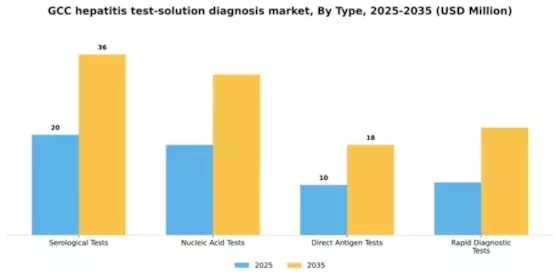
In the GCC hepatitis test-solution-diagnosis market, the distribution of market share among the various testing types illustrates a competitive landscape. Serological tests currently hold the largest market share due to their established protocols and widespread acceptance in routine diagnostics. Nucleic acid tests, while currently smaller in market size, are rapidly gaining traction as they offer more accurate results, pushing the demand upwards. The growth trends for these test types are shaped by advances in technology and an increasing focus on early disease detection. The rapid adoption of nucleic acid tests can be attributed to their sensitivity in identifying viral infections at an early stage, thus driving their emergence as the fastest-growing segment. Furthermore, the growing prevalence of hepatitis and increased awareness about the disease among patients and healthcare providers fuel this growth.
Serological Tests (Dominant) vs. Rapid Diagnostic Tests (Emerging)
Serological tests dominate the GCC hepatitis test-solution-diagnosis market due to their reliability and cost-effectiveness, making them a first-line approach for hepatitis screening. They utilize the body's immune response to detect the presence of antibodies, ensuring high accuracy in diagnosing infections. On the other hand, rapid diagnostic tests are emerging as a promising alternative, particularly in low-resource settings where quick results are crucial. These tests provide a fast turnaround time, enabling prompt decision-making for treatment. While serological tests remain dominant, the flexibility, ease of use, and speed offered by rapid diagnostic tests are leading to increased adoption, especially during public health emergencies.
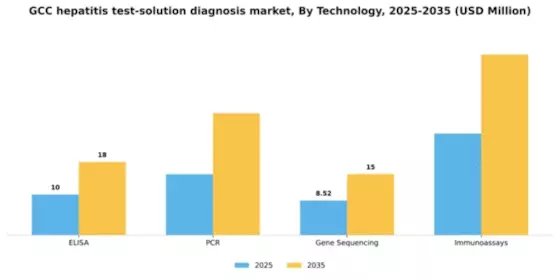
In the GCC hepatitis test-solution-diagnosis market, the technology segment shows a varied distribution among ELISA, PCR, Gene Sequencing, and Immunoassays. ELISA is currently the largest segment, commanding a significant share due to its widespread adoption in laboratory settings for hepatitis diagnostics. Conversely, PCR has emerged as a rapidly growing segment, driven by its sensitivity and quick turnaround time for results, making it crucial for timely diagnosis and treatment decisions. The growth trends within the technology segment are predominantly influenced by advancements in diagnostic techniques and an increasing focus on early detection of hepatitis infections. Additionally, the rising awareness of hepatitis-related diseases and initiatives promoting regular testing bolster the market. With innovative technologies and their improved efficiency, the GCC hepatitis test-solution-diagnosis market is witnessing a shift towards more precise and rapid testing methodologies, especially in PCR and Gene Sequencing, which are becoming essential in clinical environments.
Technology: ELISA (Dominant) vs. PCR (Emerging)
ELISA remains the dominant technology in the GCC hepatitis test-solution-diagnosis market, appreciated for its reliability and cost-effectiveness in serological testing. It is primarily used for screening and identifying hepatitis infections, thus capturing a significant market share. On the other hand, PCR is emerging as a vital tool due to its ability to detect viral RNA with high accuracy, making it indispensable for diagnosing active infections. As healthcare providers increasingly prioritize rapid diagnosis, the demand for PCR technology is surging. This transition signifies a broader trend in the diagnostic landscape, where rapid and precise testing can significantly impact patient outcomes and management.
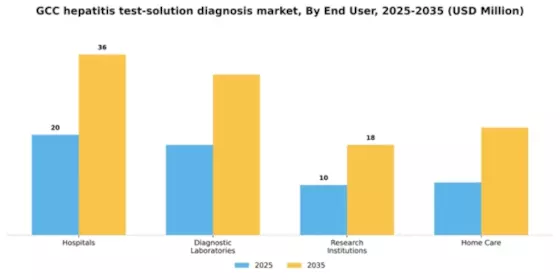
The market share distribution in the GCC hepatitis test-solution-diagnosis market reflects a significant dominance of hospitals, which cater to a wide array of patient needs and rely heavily on diagnostic testing. Hospitals benefit from their capacity to integrate various hepatitis testing solutions into comprehensive care frameworks, allowing them to achieve a substantial market position. Meanwhile, diagnostic laboratories are emerging as a crucial segment, capturing an increasing share due to their specialized services and ability to provide rapid, accurate results. The growth trends in this segment indicate a robust increase in demand driven by rising prevalence rates of hepatitis and the need for more efficient testing solutions. Hospitals are likely to continue their dominance as they enhance their diagnostic capabilities. In contrast, the fastest-growing segment, diagnostic laboratories, is propelled by technological advancements and an increasing focus on preventive healthcare, making early diagnosis more accessible and efficient for patients.
Hospitals (Dominant) vs. Diagnostic Laboratories (Emerging)
In the GCC hepatitis test-solution-diagnosis market, hospitals remain the dominant force due to their extensive resources and comprehensive treatment services. They offer integrated testing as part of their patient care protocols, which enhances their market appeal. On the other hand, diagnostic laboratories are emerging as a key player, navigating the market with specialized offerings and innovative testing technologies. This segment adapts quickly to evolving healthcare demands, emphasizing speed and accuracy. The focus on improving diagnostic processes positions these laboratories to grow rapidly, appealing to health care providers looking for reliable testing solutions. Both segments play essential roles in the market, with hospitals leading the charge while diagnostic laboratories capture new opportunities.
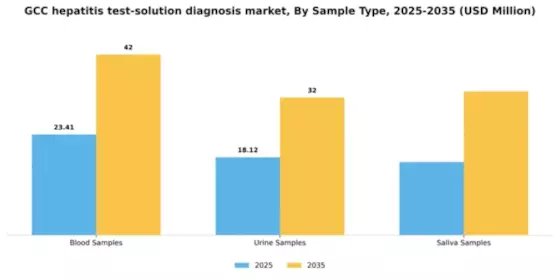
In the GCC hepatitis test-solution-diagnosis market, Blood Samples hold a dominant market share due to their established reliability and widespread acceptance among healthcare providers. As the most common sample type, Blood Samples account for a significant portion of the testing procedures, catering to both routine checks and advanced diagnostics, reinforcing their prevalence in the market. Urine Samples, while smaller in market share, have gained traction for offering less invasive testing options and greater patient comfort, thus attracting a growing segment of users. The growth trends in the GCC hepatitis test-solution-diagnosis market indicate a noticeable rise in the uptake of Urine Samples, attributed to increasing awareness about hepatitis and the convenience of sample collection. The shift towards non-invasive testing methods is being driven by both medical professionals advocating for patient-friendly solutions and patients seeking less discomforting alternatives. As research and development continue to enhance the accuracy of Urine Samples, this segment is poised to expand rapidly, creating opportunities for innovation and investment in diagnostic technologies.
Blood Samples (Dominant) vs. Urine Samples (Emerging)
Blood Samples are characterized by their robustness and high accuracy in diagnosing hepatitis, making them the preferred choice among healthcare professionals in the GCC hepatitis test-solution-diagnosis market. Their dominance is further supported by the infrastructure available in medical facilities, allowing for efficient processing and analysis. On the other hand, Urine Samples are emerging as a viable alternative due to their non-invasive nature, appealing to patients who prioritize comfort. This shift is fostering innovations in testing methodologies, promising to enhance the diagnostic capabilities while catering to a more diverse patient demographic. The ongoing developments in urine analysis technology are expected to elevate their market presence, offering potential for substantial growth in the coming years.
Get more detailed insights about GCC Hepatitis Test Solution Diagnosis Market Request Free Sample
The hepatitis test-solution-diagnosis market is currently characterized by a dynamic competitive landscape, driven by increasing awareness of hepatitis infections and the need for rapid diagnostic solutions. Key players such as Abbott Laboratories (US), Roche Diagnostics (CH), and Siemens Healthineers (DE) are at the forefront, leveraging innovation and strategic partnerships to enhance their market presence. Abbott Laboratories (US) focuses on developing advanced diagnostic technologies, while Roche Diagnostics (CH) emphasizes its extensive portfolio of molecular diagnostics. Siemens Healthineers (DE) is investing in digital health solutions, indicating a trend towards integrated healthcare systems that streamline testing processes and improve patient outcomes. The market structure appears moderately fragmented, with several players competing for market share through localized manufacturing and optimized supply chains. Companies are increasingly localizing their production to reduce costs and improve responsiveness to regional demands. This strategy not only enhances supply chain efficiency but also allows for better alignment with local regulatory requirements, thereby fostering a more competitive environment among key players. In October 2025, Abbott Laboratories (US) announced the launch of a new point-of-care hepatitis C test, which is expected to significantly reduce the time to diagnosis. This strategic move is crucial as it aligns with the growing demand for rapid testing solutions, particularly in remote and underserved areas. The introduction of this test could potentially enhance Abbott's market share by addressing a critical gap in the current diagnostic landscape. In September 2025, Roche Diagnostics (CH) expanded its collaboration with local healthcare providers in the GCC region to enhance access to its hepatitis testing solutions. This partnership is strategically important as it not only broadens Roche's distribution network but also strengthens its position in a competitive market by ensuring that its products are readily available to healthcare facilities that require reliable diagnostic tools. In August 2025, Siemens Healthineers (DE) unveiled a new AI-driven diagnostic platform aimed at improving the accuracy and speed of hepatitis testing. This innovation reflects a broader trend towards the integration of artificial intelligence in healthcare, which could potentially revolutionize diagnostic processes. By investing in AI technology, Siemens Healthineers is likely positioning itself as a leader in the market, appealing to healthcare providers seeking cutting-edge solutions. As of November 2025, the competitive trends in the hepatitis test-solution-diagnosis market are increasingly defined by digitalization, sustainability, and the integration of AI technologies. Strategic alliances among key players are shaping the landscape, fostering innovation and enhancing product offerings. The shift from price-based competition to a focus on technological advancement and supply chain reliability is evident, suggesting that future competitive differentiation will hinge on the ability to innovate and adapt to evolving market demands.

The GCC Hepatitis Test Solution Diagnosis Market has witnessed significant developments recently. In recent months, there has been a surge in demand for hepatitis diagnostics due to increased awareness and government initiatives across Gulf Cooperation Council nations. Companies like bioMérieux SA and Abbott Laboratories are expanding their product offerings, introducing advanced diagnostic solutions tailored to local healthcare needs. Furthermore, in April 2023, Quidel Corporation announced a strategic partnership with regional healthcare institutions to enhance hepatitis testing capabilities, reflecting the increasing focus on infectious disease management in the GCC.
Growth in the market valuation was largely attributed to advancements in point-of-care testing technologies, driving up the accessibility of hepatitis diagnostics. Additionally, in June 2023, Merck and Co. Inc. and Siemens Healthineers engaged in discussions regarding potential collaborations to enhance diagnostic frameworks for infectious diseases within the region. The market dynamics have also been influenced by rising healthcare investments from GCC governments aimed at bolstering healthcare infrastructure post-pandemic. Major key players such as Grifols SA and Hologic Inc. continue to innovate, further propelling the demand for hepatitis testing solutions across the region.
The Hepatitis Test Solution Diagnosis Market is projected to grow at 5.68% CAGR from 2025 to 2035, driven by technological advancements, increasing awareness, and rising prevalence of hepatitis.
New opportunities lie in:
By 2035, the market is expected to achieve substantial growth, enhancing diagnostic capabilities and accessibility.
| MARKET SIZE 2024 | 58.52(USD Million) |
| MARKET SIZE 2025 | 61.84(USD Million) |
| MARKET SIZE 2035 | 107.44(USD Million) |
| COMPOUND ANNUAL GROWTH RATE (CAGR) | 5.68% (2025 - 2035) |
| REPORT COVERAGE | Revenue Forecast, Competitive Landscape, Growth Factors, and Trends |
| BASE YEAR | 2024 |
| Market Forecast Period | 2025 - 2035 |
| Historical Data | 2019 - 2024 |
| Market Forecast Units | USD Million |
| Key Companies Profiled | Abbott Laboratories (US), Roche Diagnostics (CH), Siemens Healthineers (DE), Thermo Fisher Scientific (US), Bio-Rad Laboratories (US), Ortho Clinical Diagnostics (US), Hologic (US), Cepheid (US) |
| Segments Covered | Type, Technology, End User, Sample Type |
| Key Market Opportunities | Emergence of rapid diagnostic tests enhances accessibility in the hepatitis test-solution-diagnosis market. |
| Key Market Dynamics | Rising demand for rapid hepatitis diagnostics drives innovation and competition among regional healthcare providers. |
| Countries Covered | GCC |
The market valuation was $58.52 Million in 2024.
The projected valuation for 2035 is $107.44 Million.
The expected CAGR during this period is 5.68%.
Key players include Abbott Laboratories, Roche Diagnostics, Siemens Healthineers, and Thermo Fisher Scientific.
The main segments include Type, Technology, End User, and Sample Type.
The valuation of serological tests was $20.0 Million in 2024.
The nucleic acid tests segment is projected to grow to $32.0 Million by 2035.
The expected valuation for immunoassays is $44.44 Million by 2035.
The hospitals segment had a valuation of $20.0 Million in 2024.
The projected valuation for blood samples is $42.0 Million by 2035.


Kindly complete the form below to receive a free sample of this Report

“This is really good guys. Excellent work on a tight deadline. I will continue to use you going forward and recommend you to others. Nice job”


“Thanks. It’s been a pleasure working with you, please use me as reference with any other Intel employees.”


“Thanks for sending the report it gives us a good global view of the Betaïne market.”


“Thank you, this will be very helpful for OQS.”


“We found the report very insightful! we found your research firm very helpful. I'm sending this email to secure our future business.”


“I am very pleased with how market segments have been defined in a relevant way for my purposes (such as "Portable Freezers & refrigerators" and "last-mile"). In general the report is well structured. Thanks very much for your efforts.”


“I have been reading the first document or the study, ,the Global HVAC and FP market report 2021 till 2026. Must say, good info! I have not gone in depth at all parts, but got a good indication of the data inside!”


“We got the report in time, we really thank you for your support in this process. I also thank to all of your team as they did a great job.”


“The Automotive 48V ECU Components Procurement Intelligence Study” was a complex project, but the Market Research Future (MRFR) team handled it with quality, agility, and customer-centricity. They delivered all requested data on time and within the agreed scope. The team, including Shubhendra Anand and Rahul Gotadki, was always readily available to clarify questions and swiftly implement necessary adjustments, driving the project to a successful conclusion within a very demanding timeframe.
I would also like to specifically commend Akshay Agarwal for his responsiveness and support at every stage—from our initial inquiry on May 6th through to final delivery on June 18th. His dedication made the entire process seamless.”



