×
Request Free Sample ×

Kindly complete the form below to receive a free sample of this Report

* Please use a valid business email

Leading companies partner with us for data-driven Insights

clients tt-cursor
Hero Background

GCC Regulatory Technology Market

ID: MRFR/ICT/59892-HCR
200 Pages
Aarti Dhapte
October 2025

GCC Regulatory Technology Market Research Report By Technology (Artificial Intelligence, Machine Learning, Blockchain, Natural Language Processing, Data Analytics), By Solution Type (Compliance Management, Risk Management, Fraud Prevention, Data Governance), By Deployment Type (Cloud-Based, On-Premise, Hybrid) and By End Use (Financial Services, Healthcare, Manufacturing, Energy, Telecommunications)- Forecast to 2035

Share:
Download PDF ×

We do not share your information with anyone. However, we may send you emails based on your report interest from time to time. You may contact us at any time to opt-out.

GCC Regulatory Technology Market Infographic
Purchase Options

GCC Regulatory Technology Market Summary

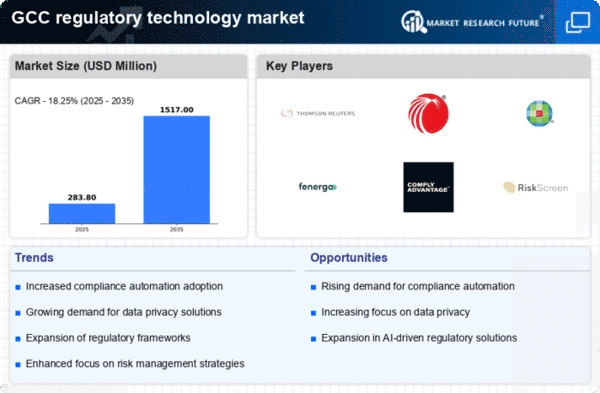
As per MRFR analysis, the GCC regulatory technology market Size was estimated at 240.0 USD Million in 2024. The regulatory technology market industry is projected to grow from 283.8 USD Million in 2025 to 1517.0 USD Million by 2035, exhibiting a compound annual growth rate (CAGR) of 18.25% during the forecast period 2025 - 2035.

Key Market Trends & Highlights

The GCC regulatory technology market is experiencing robust growth driven by technological advancements and regulatory demands.

  • The market is witnessing increased adoption of AI and automation, enhancing compliance processes.
  • Data privacy and security concerns are driving organizations to invest in regulatory technology solutions.
  • Collaboration with regulatory authorities is becoming more prevalent, fostering a proactive compliance culture.
  • Rising compliance requirements and digital transformation initiatives are key drivers propelling market expansion.

Market Size & Forecast

2024 Market Size 240.0 (USD Million)
2035 Market Size 1517.0 (USD Million)
CAGR (2025 - 2035) 18.25%

Major Players

Thomson Reuters (CA), LexisNexis (US), Wolters Kluwer (NL), Fenergo (IE), ComplyAdvantage (GB), RiskScreen (GB), Amlify (US), Trulioo (CA), SAS (US)

GCC Regulatory Technology Market Trends

The regulatory technology market is currently experiencing a transformative phase, driven by the increasing complexity of compliance requirements and the need for enhanced operational efficiency. In the GCC region, regulatory bodies are adopting advanced technologies to streamline processes, reduce risks, and ensure adherence to evolving regulations. This shift is largely influenced by the digitalization of financial services and the growing emphasis on transparency and accountability. As organizations seek to navigate the intricate landscape of regulations, the demand for innovative solutions that facilitate compliance is on the rise. Moreover, the regulatory technology market is witnessing a surge in investment as stakeholders recognize the potential of technology to mitigate compliance challenges. The integration of artificial intelligence, machine learning, and data analytics into compliance frameworks is becoming more prevalent. This trend not only enhances the accuracy of compliance monitoring but also enables organizations to respond proactively to regulatory changes. As the GCC continues to enhance its regulatory environment, the market for regulatory technology is poised for substantial growth, reflecting a broader commitment to fostering a robust and resilient financial ecosystem.

Increased Adoption of AI and Automation

The regulatory technology market is seeing a notable shift towards the integration of artificial intelligence and automation tools. These technologies are being utilized to streamline compliance processes, reduce human error, and enhance data analysis capabilities. Organizations are increasingly relying on AI-driven solutions to monitor transactions and identify potential compliance risks more effectively.

Focus on Data Privacy and Security

As data breaches and privacy concerns become more prevalent, the regulatory technology market is placing greater emphasis on data protection measures. Companies are investing in solutions that ensure compliance with stringent data privacy regulations. This trend reflects a growing awareness of the importance of safeguarding sensitive information in an increasingly digital landscape.

Collaboration with Regulatory Authorities

There is a rising trend of collaboration between technology providers and regulatory authorities in the GCC region. This partnership aims to create frameworks that facilitate compliance while fostering innovation. By working together, stakeholders can develop solutions that not only meet regulatory requirements but also support the growth of the financial sector.

GCC Regulatory Technology Market Drivers

Rising Compliance Requirements

The regulatory technology market is experiencing a surge in demand due to the increasing complexity of compliance requirements across various sectors in the GCC. Governments are implementing stricter regulations to ensure transparency and accountability, which necessitates advanced technological solutions. For instance, the financial sector is witnessing a notable rise in compliance costs, estimated to reach $10 billion by 2026. This trend compels organizations to invest in regulatory technology to streamline compliance processes and mitigate risks associated with non-compliance. As a result, the regulatory technology market is poised for substantial growth, driven by the need for efficient compliance management solutions.

Growing Demand for Transparency

The regulatory technology market is increasingly influenced by the growing demand for transparency from stakeholders, including consumers, investors, and regulatory bodies. In the GCC, there is a heightened expectation for organizations to demonstrate accountability and ethical practices. This demand is prompting businesses to adopt regulatory technology solutions that enhance transparency in their operations. The market for transparency-focused compliance solutions is projected to grow by 20% over the next few years. As organizations strive to meet these expectations, the regulatory technology market is likely to expand, driven by the need for tools that facilitate transparent reporting and compliance.

Emergence of Fintech Innovations

The emergence of fintech innovations is reshaping the regulatory technology market in the GCC. As fintech companies proliferate, they are introducing novel business models that challenge traditional regulatory frameworks. This dynamic environment necessitates the development of regulatory technology solutions that can adapt to the unique challenges posed by fintech. The regulatory technology market is expected to witness a growth rate of 15% annually, driven by the need for compliance solutions tailored to the fintech sector. This trend highlights the importance of regulatory technology in ensuring that innovative financial services operate within established regulatory boundaries.

Digital Transformation Initiatives

The ongoing digital transformation initiatives across the GCC are significantly impacting the regulatory technology market. Organizations are increasingly adopting digital solutions to enhance operational efficiency and improve regulatory compliance. The GCC region is projected to invest approximately $30 billion in digital transformation by 2025, which includes investments in regulatory technology. This shift towards digitalization is fostering innovation in compliance solutions, enabling businesses to adapt to evolving regulations more effectively. Consequently, the regulatory technology market is likely to expand as companies seek to leverage technology to navigate the complexities of regulatory frameworks.

Increased Focus on Risk Management

The regulatory technology market is benefiting from an intensified focus on risk management within organizations in the GCC. As businesses face growing uncertainties and potential regulatory penalties, there is a pressing need for robust risk assessment and management tools. The market for risk management solutions is expected to grow at a CAGR of 12% over the next five years. This trend indicates that organizations are prioritizing the implementation of regulatory technology to enhance their risk management capabilities. By adopting advanced analytics and reporting tools, companies can better identify, assess, and mitigate risks associated with regulatory compliance.


Market Segment Insights

By Technology: Artificial Intelligence (Largest) vs. Machine Learning (Fastest-Growing)

In the GCC regulatory technology market, Artificial Intelligence commands the largest market share with its capability to streamline compliance processes and enhance data-driven decisions. This segment has seen a significant uptake as regulatory bodies increasingly rely on AI to simplify complex regulatory requirements. Conversely, Machine Learning is gaining rapid traction, driven by its ability to improve efficiency and automate risk assessment processes, making it a vital tool for firms looking to stay compliant in a fast-evolving regulatory landscape. The growth of these technology segments is propelled by digital transformation across the region, where organizations seek to leverage innovative solutions for better regulatory compliance. Machine Learning is particularly set to grow exponentially as firms adopt more advanced analytical tools to predict compliance risk and automate monitoring. The rise in cyber threats and the need for stringent data protection regulations continue to drive investment in both Artificial Intelligence and Machine Learning, solidifying their importance in the GCC regulatory technology market.

Artificial Intelligence: Dominant vs. Machine Learning: Emerging

Artificial Intelligence is currently the dominant technology within the GCC regulatory technology market, lauded for its capability to analyze vast datasets and provide actionable insights for compliance professionals. Companies employing AI can reduce manual oversight and improve accuracy in regulatory reporting. Meanwhile, Machine Learning represents an emerging force, poised for significant growth due to its ability to adapt and learn from new data patterns, making it invaluable for predictive compliance. As regulatory environments become more complex, the demand for machine learning solutions, which enhance predictive analytics and risk management, is expected to surge. Together, these technologies not only complement each other but also redefine compliance strategies in the GCC regulatory technology market.

By Solution Type: Compliance Management (Largest) vs. Risk Management (Fastest-Growing)

In the GCC regulatory technology market, the Compliance Management segment holds the largest share, reflecting a strong emphasis on adhering to regulatory requirements and standards. This segment's prominence is driven by heightened scrutiny from regulatory bodies and the increasing complexity of compliance landscapes. However, the Risk Management segment is rapidly gaining traction, as organizations seek to proactively identify and mitigate potential risks associated with regulatory compliance. The growth of the Risk Management segment is fueled by the rising frequency of regulatory changes and the need for businesses to adapt swiftly. Companies are investing in advanced technologies that provide them with analytics and insights into potential risks. Both segments are integral to the overall regulatory technology landscape, with Compliance Management continuing to lead while Risk Management emerges as an essential component of a comprehensive compliance strategy.
Compliance Management (Dominant) vs. Fraud Prevention (Emerging)

The Compliance Management segment is characterized by its robust frameworks that help organizations navigate complex regulatory environments, ensuring adherence to laws and standards. This segment remains dominant due to the comprehensive solutions it offers, which include automated reporting and compliance monitoring tools. In contrast, the Fraud Prevention segment is considered emerging, as it gains traction amid increasing concerns over fraudulent activities. Solutions in this domain focus on detecting and preventing anomalies in transactions, enhancing the overall security posture. As businesses prioritize safeguarding their operations against fraud, the Fraud Prevention segment is expected to experience significant growth, leveraging advanced technologies like AI and machine learning to bolster its effectiveness and adaptability in the market.

By Deployment Type: Cloud-Based (Largest) vs. On-Premise (Fastest-Growing)

In the GCC regulatory technology market, the deployment type segment is characterized by a notable distribution of cloud-based, on-premise, and hybrid solutions. Currently, cloud-based solutions lead the market significantly with the largest share, owing to their flexibility and scalability. On-premise solutions, while historically more popular among regulated industries for their control, are seeing a decline in preference as organizations move towards more agile cloud environments. Hybrid solutions are present but represent a smaller segment of the market as businesses prioritize cloud adaptation. Growth trends within this segment are heavily influenced by the increasing demand for digital transformation and regulatory compliance across various sectors in the GCC. The rise of cloud technology, bolstered by improved cybersecurity measures, is driving organizations to adopt cloud-based solutions rapidly. On-premise systems, although labeled as the fastest-growing due to a niche retention among certain sectors, are adapting to incorporate hybrid models as compliance demands change. This shift indicates a dynamic landscape with businesses seeking to leverage technological advancements while meeting regulatory requirements.

Cloud-Based (Dominant) vs. On-Premise (Emerging)

Cloud-based deployment in the GCC regulatory technology market is dominant, characterized by its ability to provide scalable, cost-effective solutions that allow for rapid deployment and flexibility. Companies adopting cloud technology benefit from features like enhanced data analytics, real-time compliance insights, and reduced infrastructure costs. Meanwhile, the on-premise segment is emerging as organizations still dependent on traditional systems gradually shift towards cloud solutions, albeit at a slower pace. On-premise systems offer greater control and security, appealing to industries with stringent compliance requirements. However, as businesses in the GCC regulatory tech space evolve, the pressure to innovate and integrate with cloud solutions remains a vital challenge, compelling even the most traditional establishments to reconsider their deployment strategies.

By End Use: Financial Services (Largest) vs. Healthcare (Fastest-Growing)

The market share distribution among the end-use segments in the GCC regulatory technology market reveals that financial services take the lead, significantly overshadowing other sectors in terms of adoption and reliance on regulatory technologies. Healthcare follows closely as an emerging sector, showing robust interest as regulations become increasingly stringent. Both sectors are essential in ensuring compliance, yet the financial services sector commands a more substantial share attributed to its complexities and the need for robust risk management frameworks. Growth trends in the GCC regulatory technology market are driven by the advancing technological landscape and evolving regulatory requirements. Financial services maintain their dominance as institutions prioritize compliance solutions to mitigate risks and enhance reporting capabilities. In contrast, the healthcare sector is recognized as the fastest-growing segment, where innovations in patient data management and regulatory compliance are gaining traction. The ongoing emphasis on digital transformation across sectors propels investments in regulatory technologies as organizations strive to remain competitive and compliant.

Financial Services: Dominant vs. Healthcare: Emerging

Financial services play a dominant role in the GCC regulatory technology market due to the complexity of regulations governing banking, investments, and insurance. This sector has a robust infrastructure ready to integrate advanced technologies that enhance compliance and reporting processes. Conversely, healthcare represents an emerging segment, increasingly adopting regulatory technology to address challenges related to patient data protection and compliance with health regulations. As healthcare providers adapt to new regulations and digitalize operations, the adoption of regulatory technology is expected to flourish. Both segments have unique characteristics influencing their market positions, with financial services emphasizing risk management and healthcare focusing on data integrity and patient confidentiality.

Get more detailed insights about GCC Regulatory Technology Market

Key Players and Competitive Insights

The regulatory technology market is currently characterized by a dynamic competitive landscape, driven by the increasing complexity of compliance requirements and the growing demand for efficient risk management solutions. Key players such as Thomson Reuters (CA), LexisNexis (US), and Fenergo (IE) are strategically positioning themselves through innovation and regional expansion. Thomson Reuters (CA) focuses on enhancing its compliance solutions through advanced analytics, while LexisNexis (US) emphasizes partnerships to broaden its service offerings. Fenergo (IE) is actively pursuing digital transformation initiatives to streamline client onboarding processes, collectively shaping a competitive environment that prioritizes technological advancement and customer-centric solutions.

The market structure appears moderately fragmented, with a mix of established players and emerging startups. Key business tactics include localizing services to meet regional regulatory demands and optimizing supply chains to enhance service delivery. The influence of major players is significant, as they set industry standards and drive innovation, while smaller firms often focus on niche markets or specialized solutions.

In October 2025, Thomson Reuters (CA) announced a strategic partnership with a leading AI firm to integrate machine learning capabilities into its compliance software. This move is likely to enhance the accuracy and efficiency of compliance processes, positioning Thomson Reuters (CA) as a frontrunner in leveraging AI for regulatory solutions. The integration of AI could potentially reduce compliance costs for clients, thereby increasing market share.

In September 2025, LexisNexis (US) launched a new suite of tools aimed at automating regulatory reporting for financial institutions. This initiative reflects a growing trend towards automation in compliance, suggesting that LexisNexis (US) is keen on addressing the operational challenges faced by its clients. By streamlining reporting processes, the company may enhance client satisfaction and retention, further solidifying its market position.

In August 2025, Fenergo (IE) expanded its operations into the GCC region, establishing a local office to better serve clients in the area. This strategic move indicates a commitment to regional growth and a recognition of the unique regulatory challenges faced by businesses in the GCC. By localizing its services, Fenergo (IE) is likely to improve its responsiveness to client needs, thereby enhancing its competitive edge.

As of November 2025, the regulatory technology market is witnessing trends such as increased digitalization, a focus on sustainability, and the integration of AI technologies. Strategic alliances are becoming more prevalent, as companies seek to combine strengths and enhance their service offerings. Looking ahead, competitive differentiation is expected to evolve, with a shift from price-based competition to a focus on innovation, technological advancements, and supply chain reliability. This transition may redefine how companies compete, emphasizing the importance of delivering value through cutting-edge solutions.

Key Companies in the GCC Regulatory Technology Market market include

Industry Developments

The GCC Regulatory Technology Market has seen significant developments recently, with a growing focus on compliance solutions amid tightening regulations. In September 2023, Thomson Reuters launched a new analytics platform tailored for the GCC financial sector, aimed at enhancing regulatory compliance and reporting efficiency. Similarly, in August 2023, Fenergo expanded its operations in the region, providing seamless onboarding solutions that align with local regulations. 

Moreover, the market witnessed rising valuations, driven by increased investments in compliance technology, as companies like DocuSign and Actico integrated advanced features to meet the evolving demands of financial institutions. Notably, in July 2023, Bae Systems announced a strategic partnership with Quantexa to combine their capabilities in risk analysis and compliance automation. 

Mergers and acquisitions are gaining momentum, with DocuSign reportedly acquiring a small compliance tech firm in June 2023, further solidifying its presence in the GCC. The region is experiencing a robust shift towards digital solutions that empower organizations to address regulatory challenges effectively, fueled by government initiatives supportive of technological innovation in the finance sector over the past few years.

Future Outlook

GCC Regulatory Technology Market Future Outlook

The regulatory technology market is poised for growth at 18.25% CAGR from 2024 to 2035, driven by increasing compliance demands, technological advancements, and enhanced risk management strategies.

New opportunities lie in:

  • Development of AI-driven compliance monitoring tools
  • Integration of blockchain for secure transaction auditing
  • Creation of customizable regulatory reporting platforms

By 2035, the market is expected to achieve substantial growth, reflecting evolving regulatory landscapes.

Market Segmentation

GCC Regulatory Technology Market End Use Outlook

  • Financial Services
  • Healthcare
  • Manufacturing
  • Energy
  • Telecommunications

GCC Regulatory Technology Market Technology Outlook

  • Artificial Intelligence
  • Machine Learning
  • Blockchain
  • Natural Language Processing
  • Data Analytics

GCC Regulatory Technology Market Solution Type Outlook

  • Compliance Management
  • Risk Management
  • Fraud Prevention
  • Data Governance

GCC Regulatory Technology Market Deployment Type Outlook

  • Cloud-Based
  • On-Premise
  • Hybrid

Report Scope

MARKET SIZE 2024240.0(USD Million)
MARKET SIZE 2025283.8(USD Million)
MARKET SIZE 20351517.0(USD Million)
COMPOUND ANNUAL GROWTH RATE (CAGR)18.25% (2024 - 2035)
REPORT COVERAGERevenue Forecast, Competitive Landscape, Growth Factors, and Trends
BASE YEAR2024
Market Forecast Period2025 - 2035
Historical Data2019 - 2024
Market Forecast UnitsUSD Million
Key Companies Profiled["Thomson Reuters (CA)", "LexisNexis (US)", "Wolters Kluwer (NL)", "Fenergo (IE)", "ComplyAdvantage (GB)", "RiskScreen (GB)", "Amlify (US)", "Trulioo (CA)", "SAS (US)"]
Segments CoveredTechnology, Solution Type, Deployment Type, End Use
Key Market OpportunitiesIntegration of artificial intelligence in compliance processes enhances efficiency and reduces operational risks.
Key Market DynamicsGrowing regulatory compliance demands drive innovation and competition in the regulatory technology market across the GCC region.
Countries CoveredGCC

Leave a Comment

FAQs

What is the expected market size of the GCC Regulatory Technology Market in 2024?

The GCC Regulatory Technology Market is expected to be valued at 189.6 million USD in 2024.

What is the projected market value of the GCC Regulatory Technology Market by 2035?

By 2035, the market is projected to reach a value of 480.0 million USD.

What is the expected compound annual growth rate (CAGR) for the GCC Regulatory Technology Market from 2025 to 2035?

The expected CAGR for the market from 2025 to 2035 is 8.811 percent.

Who are the major players in the GCC Regulatory Technology Market?

Key players in the market include Thomson Reuters, Fenergo, DocuSign, and Actico among others.

What is the market value for Artificial Intelligence in the GCC Regulatory Technology Market in 2024?

The Artificial Intelligence segment is expected to be valued at 45.0 million USD in 2024.

What will be the market value for Machine Learning in the GCC Regulatory Technology Market by 2035?

By 2035, the Machine Learning segment is projected to reach 100.0 million USD.

What is the expected market size for the Blockchain technology segment in the GCC Regulatory Technology Market by 2035?

The Blockchain segment is expected to be valued at 85.0 million USD in 2035.

What are the growth opportunities for the GCC Regulatory Technology Market?

Emerging technologies like Artificial Intelligence and Machine Learning present significant growth opportunities.

How does the GCC Regulatory Technology Market address regulatory compliance challenges?

The market provides solutions that utilize technology to enhance compliance processes and reduce risks.

What trends are influencing the GCC Regulatory Technology Market's growth rate?

Trends such as increased regulatory scrutiny and the adoption of digital technologies are influencing the market's growth.

Download Free Sample

Kindly complete the form below to receive a free sample of this Report

Compare Licence

×
Features License Type
Single User Multiuser License Enterprise User
Price $4,950 $5,950 $7,250
Maximum User Access Limit 1 User Upto 10 Users Unrestricted Access Throughout the Organization
Free Customization
Direct Access to Analyst
Deliverable Format
Platform Access
Discount on Next Purchase 10% 15% 15%
Printable Versions