×
Request Free Sample ×

Kindly complete the form below to receive a free sample of this Report

* Please use a valid business email

Leading companies partner with us for data-driven Insights

clients tt-cursor
Hero Background

Japan Regulatory Technology Market

ID: MRFR/ICT/59891-HCR
200 Pages
Aarti Dhapte
October 2025

Japan Regulatory Technology Market Research Report By Technology (Artificial Intelligence, Machine Learning, Blockchain, Natural Language Processing, Data Analytics), By Solution Type (Compliance Management, Risk Management, Fraud Prevention, Data Governance), By Deployment Type (Cloud-Based, On-Premise, Hybrid) and By End Use (Financial Services, Healthcare, Manufacturing, Energy, Telecommunications)- Forecast to 2035

Share:
Download PDF ×

We do not share your information with anyone. However, we may send you emails based on your report interest from time to time. You may contact us at any time to opt-out.

Japan Regulatory Technology Market Infographic
Purchase Options

Japan Regulatory Technology Market Summary

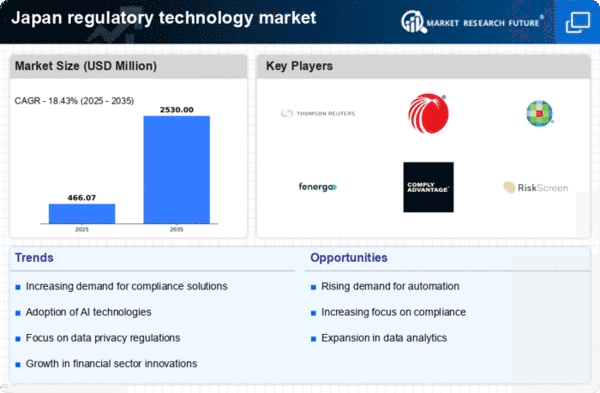
As per MRFR analysis, the regulatory technology market size was estimated at 393.54 USD Million in 2024. The regulatory technology market is projected to grow from 466.07 USD Million in 2025 to 2530.0 USD Million by 2035, exhibiting a compound annual growth rate (CAGR) of 18.43% during the forecast period 2025 - 2035.

Key Market Trends & Highlights

The Japan regulatory technology market is experiencing robust growth driven by technological advancements and regulatory pressures.

  • The market is witnessing increased adoption of AI and automation, enhancing compliance processes.
  • Data privacy and security concerns are prompting organizations to invest in regulatory technology solutions.
  • Blockchain technology integration is becoming a focal point for improving transparency and accountability.
  • Regulatory compliance pressure and growing cybersecurity concerns are key drivers fueling market expansion.

Market Size & Forecast

2024 Market Size 393.54 (USD Million)
2035 Market Size 2530.0 (USD Million)
CAGR (2025 - 2035) 18.43%

Major Players

Thomson Reuters (CA), LexisNexis (US), Wolters Kluwer (NL), Fenergo (IE), ComplyAdvantage (GB), RiskScreen (GB), Amlify (US), RegTech Solutions (AU)

Japan Regulatory Technology Market Trends

The regulatory technology market is experiencing notable growth, driven by the increasing complexity of compliance requirements and the need for organizations to streamline their operations. In Japan, businesses are increasingly adopting innovative technologies to enhance their compliance processes, reduce risks, and improve efficiency. This trend is largely influenced by the evolving regulatory landscape, which necessitates a proactive approach to compliance management. As organizations seek to navigate these challenges, the demand for regulatory technology solutions is expected to rise, fostering a competitive environment among service providers. Moreover, the emphasis on data protection and privacy regulations is shaping the regulatory technology market in Japan. With the implementation of stringent laws, companies are compelled to invest in technologies that ensure compliance with data handling and privacy standards. This shift not only enhances organizational resilience but also builds trust with consumers. As the regulatory environment continues to evolve, the regulatory technology market is likely to witness further advancements, with a focus on automation, artificial intelligence, and machine learning to facilitate compliance efforts. The future appears promising, as organizations recognize the value of integrating regulatory technology into their operational frameworks, ultimately leading to improved compliance outcomes and reduced operational risks.

Increased Adoption of AI and Automation

Organizations are increasingly leveraging artificial intelligence and automation within the regulatory technology market to enhance compliance processes. These technologies facilitate real-time monitoring and analysis of regulatory changes, allowing businesses to adapt swiftly to new requirements. As a result, companies can minimize compliance risks and improve operational efficiency.

Focus on Data Privacy and Security

The regulatory technology market is witnessing a heightened emphasis on data privacy and security measures. With the introduction of stringent regulations, businesses are prioritizing solutions that ensure compliance with data protection laws. This trend reflects a broader commitment to safeguarding consumer information and maintaining trust in the digital landscape.

Integration of Blockchain Technology

Blockchain technology is emerging as a transformative force within the regulatory technology market. Its potential to enhance transparency and traceability in compliance processes is gaining traction among organizations. By utilizing blockchain, businesses can create immutable records of transactions, thereby simplifying audits and ensuring adherence to regulatory standards.

Japan Regulatory Technology Market Drivers

Growing Cybersecurity Concerns

In Japan, the regulatory technology market is being propelled by escalating concerns regarding cybersecurity threats. As organizations digitize their operations, the risk of data breaches and cyberattacks has surged, prompting a demand for robust regulatory technology solutions. In 2025, it is estimated that cybercrime will cost Japanese businesses over $30 billion annually, highlighting the critical need for effective compliance measures. Regulatory technology solutions that focus on cybersecurity compliance are becoming essential for organizations to protect sensitive data and maintain customer trust. This trend indicates a shift towards integrated compliance solutions that encompass both regulatory adherence and cybersecurity measures, thereby driving growth in the regulatory technology market.

Regulatory Compliance Pressure

The regulatory technology market in Japan is experiencing heightened pressure from both domestic and international regulatory bodies. This pressure compels organizations to adopt advanced compliance solutions to meet stringent regulations. In 2025, the Japanese Financial Services Agency (FSA) has intensified its scrutiny on financial institutions, leading to an increased demand for regulatory technology solutions. Companies are investing in compliance software to ensure adherence to laws such as the Financial Instruments and Exchange Act. This trend is expected to drive the market's growth, as organizations seek to mitigate risks associated with non-compliance, which can result in substantial fines and reputational damage. The regulatory technology market is projected to grow at a CAGR of 15% from 2025 to 2030, reflecting the urgency for compliance solutions.

Technological Advancements in Fintech

The regulatory technology market is significantly influenced by rapid technological advancements within the fintech sector in Japan. Innovations such as machine learning and big data analytics are being integrated into compliance solutions, enhancing their effectiveness. As of 2025, the fintech industry in Japan is valued at approximately $20 billion, with a substantial portion allocated to regulatory technology. This investment is driven by the need for real-time monitoring and reporting capabilities, which are essential for maintaining compliance in a fast-paced financial environment. The synergy between fintech and regulatory technology is likely to foster a more robust compliance framework, thereby propelling the market forward. Companies are increasingly recognizing the value of investing in regulatory technology to streamline operations and reduce compliance costs.

Increased Focus on Environmental Regulations

The regulatory technology market in Japan is witnessing a surge in demand due to an increased focus on environmental regulations. The Japanese government has implemented stricter environmental laws aimed at reducing carbon emissions and promoting sustainability. As of 2025, companies are required to comply with the new Greenhouse Gas Emissions Act, which mandates comprehensive reporting and monitoring of emissions. This regulatory landscape compels organizations to adopt regulatory technology solutions that facilitate compliance with environmental standards. The market is likely to expand as businesses seek to integrate sustainability into their operations while ensuring adherence to evolving regulations. This trend not only supports regulatory compliance but also enhances corporate social responsibility initiatives.

Rising Demand for Transparency and Accountability

The regulatory technology market is being driven by a rising demand for transparency and accountability among businesses in Japan. Stakeholders, including consumers and investors, are increasingly advocating for clear reporting and ethical practices. In 2025, the Japanese government has introduced new guidelines that require companies to disclose their compliance practices and risk management strategies. This regulatory shift is prompting organizations to invest in regulatory technology solutions that enhance transparency and facilitate better reporting. The emphasis on accountability is likely to foster a culture of compliance, thereby driving growth in the regulatory technology market. Companies that prioritize transparency are expected to gain a competitive edge, as they build trust with stakeholders and mitigate risks associated with non-compliance.


Market Segment Insights

By Technology: Artificial Intelligence (Largest) vs. Machine Learning (Fastest-Growing)

In the Japan regulatory technology market, the distribution of market share among different technology segments reveals that Artificial Intelligence holds the largest segment share, reflecting its vital role in compliance and risk management. Machine Learning is emerging quickly, capturing attention due to its ability to analyze vast datasets and improve decision-making processes. The integration of these technologies is reshaping the regulatory landscape, leading to enhanced operational efficiencies. Growth trends indicate a rapid expansion of Machine Learning, driven by increasing demand for automation in regulatory processes. The rise in data-driven decision-making is a key factor enabling the swift adoption of these technologies. Additionally, compliance complexities are prompting organizations to seek advanced solutions, further accelerating the market growth for both Artificial Intelligence and Machine Learning within the Japan regulatory technology market.

Technology: Artificial Intelligence (Dominant) vs. Machine Learning (Emerging)

Artificial Intelligence stands out as the dominant force within the Japan regulatory technology market, widely recognized for its capabilities in automating compliance tasks and enhancing decision-making. It encompasses a variety of applications, such as risk assessment and regulatory reporting. In contrast, Machine Learning is viewed as an emerging trend, characterized by its ability to learn from data, allowing organizations to adapt to evolving regulatory requirements. This technology supports predictive analytics and real-time insights, which are crucial for maintaining compliance in an increasingly complex regulatory environment. Together, these technologies are transforming the operational approaches of businesses, fostering innovation and efficiency.

By Solution Type: Compliance Management (Largest) vs. Fraud Prevention (Fastest-Growing)

The market for solution types in the Japan regulatory technology market shows a diverse distribution among key segments. Compliance Management emerges as the largest segment, dominating market shares due to the increasing regulatory complexities businesses face. Risk Management and Data Governance also hold significant shares, reflecting the heightened focus on organizational compliance and data responsibility in today's environment. Growth trends indicate that Fraud Prevention is rapidly emerging as the fastest-growing segment, propelled by an uptick in digital transactions and associated compliance requirements. The adoption of advanced technologies for fraud detection and prevention is driving this surge, underscoring the need for businesses to strengthen their compliance frameworks amidst evolving threats.

Compliance Management (Dominant) vs. Risk Management (Emerging)

Compliance Management, as the dominant player in the Japan regulatory technology market, offers comprehensive frameworks for organizations to adhere to laws and regulations effectively. Its focus on minimizing legal risks, enforcement of policies, and aligning with regulatory changes ensures businesses maintain operational integrity. Conversely, Risk Management is an emerging solution type that equips organizations with critical tools to identify, assess, and mitigate potential risks. As industries navigate a complex regulatory landscape, Risk Management complementarily supports Compliance Management by offering proactive strategies to address potential exposures, making it increasingly vital in the overall regulatory approach.

By Deployment Type: Cloud-Based (Largest) vs. On-Premise (Fastest-Growing)

In the segment of deployment types within the Japan regulatory technology market, Cloud-Based solutions hold the largest market share, reflecting a significant preference among organizations for flexible and scalable solutions that enhance operational efficiency. On the other hand, On-Premise deployment is seen as the fastest-growing segment as businesses that prioritize data security and control make a shift towards this traditional approach, highlighting a varied preference landscape among enterprises. Growth trends indicate that the demand for Cloud-Based technologies continues to be driven by digital transformation initiatives, with businesses seeking agility and cost-efficiency. Alternatively, the rise of data privacy regulations is fueling the growth of the On-Premise segment, as companies are increasingly concerned about compliance and security risks associated with third-party data handling. The Hybrid deployment model also experiences growth, serving as a bridge for organizations uncertain about fully committing to one deployment type over another.

Cloud-Based (Dominant) vs. On-Premise (Emerging)

Cloud-Based solutions are dominant in the Japan regulatory technology market, offering scalability and ease of access that significantly cater to the modern business environment. They enable organizations to quickly adapt to regulatory changes with minimal upfront investment. This flexibility has led to widespread adoption across various sectors. In contrast, On-Premise deployment is emerging as a viable alternative, particularly for organizations requiring stringent data control and security. These businesses benefit from customized solutions tailored to their specific compliance needs, allowing for better integration with legacy systems. The shift towards more regulatory matters and data protection ensures that the On-Premise deployment type is gaining traction, supported by its ability to provide greater autonomy.

By End Use: Financial Services (Largest) vs. Healthcare (Fastest-Growing)

The Japan regulatory technology market exhibits significant variation in market share among end-use segments. Financial Services holds the largest market share, underscoring its pivotal role in regulatory compliance and risk management. Conversely, the Healthcare segment, while smaller, is emerging rapidly due to regulatory changes and increased focus on patient data protection. This dynamic creates a competitive landscape that compels technology providers to tailor solutions across diverse sectors. Growth trends in this market are significantly driven by evolving regulations and digital transformation across industries. The Financial Services sector continues to invest heavily in compliance technologies to mitigate risk and enhance operational efficiency. Meanwhile, the Healthcare sector is experiencing accelerated growth, propelled by heightened regulatory compliance efforts related to patient data security and the proliferation of health technology innovations, marking it as the fastest-growing segment in the market.

Financial Services: Dominant vs. Healthcare: Emerging

The Financial Services segment is characterized by its structured frameworks and established compliance protocols that necessitate ongoing investment in regulatory technology. This segment is dominated by major players who provide integrated solutions for risk management, compliance auditing, and reporting. In contrast, the Healthcare sector is emerging with new regulatory challenges that demand innovative solutions. Companies in this segment are focusing on developing technologies that ensure privacy and compliance with healthcare standards, creating a robust ecosystem for future growth. The difference in maturity between these segments illustrates the broader dynamics at play in the Japan regulatory technology market, highlighting a shift towards more agile and responsive regulatory solutions particularly in healthcare.

Get more detailed insights about Japan Regulatory Technology Market

Key Players and Competitive Insights

The regulatory technology market in Japan is currently characterized by a dynamic competitive landscape, driven by the increasing complexity of compliance requirements and the growing demand for efficient risk management solutions. Major players such as Thomson Reuters (CA), LexisNexis (US), and Wolters Kluwer (NL) are strategically positioned to leverage their extensive data analytics capabilities and technological innovations. These companies are focusing on enhancing their product offerings through digital transformation initiatives, partnerships, and regional expansions, which collectively shape a competitive environment that is both robust and evolving.

Key business tactics within this market include localizing services to meet specific regulatory needs and optimizing supply chains to enhance operational efficiency. The competitive structure appears moderately fragmented, with a mix of established firms and emerging players vying for market share. The influence of key players is significant, as they set industry standards and drive innovation, thereby impacting the overall market dynamics.

In October 2025, Thomson Reuters (CA) announced the launch of a new AI-driven compliance tool aimed at automating regulatory reporting processes. This strategic move is likely to enhance their competitive edge by providing clients with faster and more accurate compliance solutions, thereby addressing a critical pain point in the regulatory landscape. The integration of AI technology into their offerings may also signal a broader trend towards automation in the industry.

In September 2025, LexisNexis (US) expanded its partnership with a leading Japanese financial institution to enhance its risk assessment capabilities. This collaboration is indicative of a strategic focus on deepening relationships with local entities, which could facilitate better understanding of regional compliance challenges. Such partnerships may enable LexisNexis to tailor its solutions more effectively, thereby strengthening its market position.

In August 2025, Wolters Kluwer (NL) acquired a niche regulatory technology firm specializing in environmental compliance solutions. This acquisition appears to be a strategic effort to diversify their portfolio and address the growing demand for sustainability-related compliance tools. By integrating these capabilities, Wolters Kluwer may enhance its value proposition to clients who are increasingly prioritizing environmental regulations.

As of November 2025, current trends in the regulatory technology market include a pronounced shift towards digitalization, sustainability, and the integration of AI technologies. Strategic alliances are becoming increasingly important, as they allow companies to pool resources and expertise to tackle complex regulatory challenges. Looking ahead, competitive differentiation is likely to evolve from traditional price-based competition to a focus on innovation, technological advancements, and the reliability of supply chains. This shift may redefine how companies position themselves in the market, emphasizing the need for agility and responsiveness to changing regulatory landscapes.

Key Companies in the Japan Regulatory Technology Market market include

Industry Developments

Recent developments in the Japan Regulatory Technology Market indicate a substantial focus on compliance and risk management solutions, especially amid an increasingly complex regulatory landscape. In October 2023, Fujitsu Limited launched a new platform aimed at enhancing regulatory compliance and streamlining reporting processes for financial institutions, showcasing continued innovation in this sector. Meanwhile, NTT Data announced a partnership with Daiichi Life Holdings to leverage data analytics for improved regulatory compliance and risk assessment, indicating a trend towards collaboration among major players.

In the mergers and acquisitions landscape, in August 2023, SoftBank Group acquired a significant stake in a promising regtech startup, enhancing its offerings in the regulatory technology space. On a broader note, the Japan Regulatory Technology Market is expected to grow, with estimates suggesting a valuation increase driven by ongoing digital transformation initiatives across various industries. Notably, the adoption of artificial intelligence and machine learning technologies is influencing both compliance processes and operational efficiencies in the sector, as organizations strive to meet regulatory demands effectively.

Future Outlook

Japan Regulatory Technology Market Future Outlook

The Regulatory Technology Market in Japan is poised for growth at 18.43% CAGR from 2024 to 2035, driven by technological advancements, regulatory compliance needs, and increased digitalization.

New opportunities lie in:

  • Development of AI-driven compliance monitoring tools
  • Integration of blockchain for secure transaction reporting
  • Creation of customizable regulatory reporting platforms

By 2035, the market is expected to achieve substantial growth and innovation.

Market Segmentation

Japan Regulatory Technology Market End Use Outlook

  • Financial Services
  • Healthcare
  • Manufacturing
  • Energy
  • Telecommunications

Japan Regulatory Technology Market Technology Outlook

  • Artificial Intelligence
  • Machine Learning
  • Blockchain
  • Natural Language Processing
  • Data Analytics

Japan Regulatory Technology Market Solution Type Outlook

  • Compliance Management
  • Risk Management
  • Fraud Prevention
  • Data Governance

Japan Regulatory Technology Market Deployment Type Outlook

  • Cloud-Based
  • On-Premise
  • Hybrid

Report Scope

MARKET SIZE 2024 393.54(USD Million)
MARKET SIZE 2025 466.07(USD Million)
MARKET SIZE 2035 2530.0(USD Million)
COMPOUND ANNUAL GROWTH RATE (CAGR) 18.43% (2024 - 2035)
REPORT COVERAGE Revenue Forecast, Competitive Landscape, Growth Factors, and Trends
BASE YEAR 2024
Market Forecast Period 2025 - 2035
Historical Data 2019 - 2024
Market Forecast Units USD Million
Key Companies Profiled Thomson Reuters (CA), LexisNexis (US), Wolters Kluwer (NL), Fenergo (IE), ComplyAdvantage (GB), RiskScreen (GB), Amlify (US), RegTech Solutions (AU)
Segments Covered Technology, Solution Type, Deployment Type, End Use
Key Market Opportunities Integration of artificial intelligence in compliance processes enhances efficiency in the regulatory technology market.
Key Market Dynamics Rising regulatory compliance demands drive innovation and competition in Japan's regulatory technology market.
Countries Covered Japan

Leave a Comment

FAQs

What is the expected market size of the Japan Regulatory Technology Market in 2024?

The Japan Regulatory Technology Market is expected to be valued at 497.7 million USD in 2024.

What will the market size of the Japan Regulatory Technology Market be by 2035?

By 2035, the market is projected to reach 1250.0 million USD.

What is the compound annual growth rate (CAGR) for the Japan Regulatory Technology Market from 2025 to 2035?

The expected CAGR for the Japan Regulatory Technology Market during this period is 8.732%.

What are the key players in the Japan Regulatory Technology Market?

Major players include Orix Corporation, Fujitsu Limited, and Hitachi Solutions among others.

How much is the Artificial Intelligence segment expected to be valued in 2035?

The Artificial Intelligence segment is projected to be valued at 320.0 million USD in 2035.

What is the market size of the Machine Learning segment in 2024?

The Machine Learning segment is expected to be worth 90.0 million USD in 2024.

How much growth is anticipated for the Blockchain segment by 2035?

The Blockchain segment is expected to grow to 200.0 million USD by 2035.

What will be the value of the Data Analytics segment in 2035?

The Data Analytics segment is projected to be valued at 230.0 million USD in 2035.

What is driving the growth of the Japan Regulatory Technology Market?

The growth is largely driven by advancements in technology and increasing regulatory demands.

How does the current global scenario affect the Japan Regulatory Technology Market?

The global scenario influences the market by altering regulatory requirements and compliance needs.

Download Free Sample

Kindly complete the form below to receive a free sample of this Report

Compare Licence

×
Features License Type
Single User Multiuser License Enterprise User
Price $4,950 $5,950 $7,250
Maximum User Access Limit 1 User Upto 10 Users Unrestricted Access Throughout the Organization
Free Customization
Direct Access to Analyst
Deliverable Format
Platform Access
Discount on Next Purchase 10% 15% 15%
Printable Versions