Increased Focus on Cost Reduction Strategies
In the route optimization-software market, the emphasis on cost reduction strategies is becoming increasingly pronounced. Companies are under pressure to minimize expenses while maintaining service quality, prompting them to seek out software solutions that can enhance operational efficiency. By optimizing routes, businesses can significantly reduce fuel consumption and vehicle wear, leading to lower overall costs. In the GCC region, where fuel prices can fluctuate, the potential savings from effective route optimization are particularly appealing. As organizations strive to remain competitive, the adoption of advanced software tools that facilitate cost-effective logistics operations is likely to gain momentum, driving growth in the route optimization-software market.
Rising Demand for Efficient Logistics Solutions
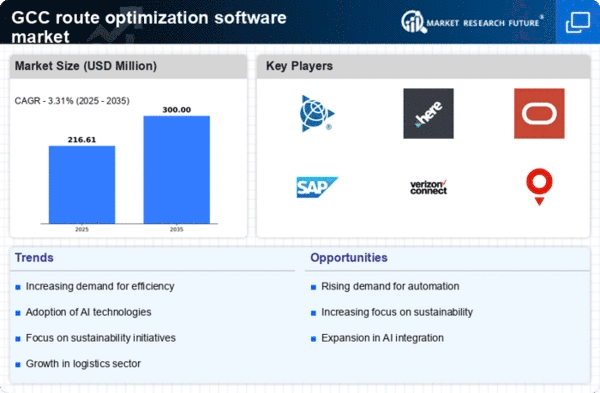
The route optimization-software market is experiencing a surge in demand driven by the need for efficient logistics solutions across various sectors. Companies are increasingly recognizing the importance of optimizing delivery routes to reduce operational costs and improve service levels. In the GCC region, logistics costs can account for up to 30% of total expenses, making route optimization a critical focus area. As businesses strive to enhance their supply chain efficiency, the adoption of advanced software solutions that facilitate real-time route planning and management is likely to grow. This trend is further supported by the increasing complexity of logistics networks, which necessitates sophisticated tools to navigate and optimize routes effectively.
Emergence of Advanced Analytics and Machine Learning
The emergence of advanced analytics and machine learning technologies is reshaping the route optimization-software market. These innovations enable businesses to analyze vast amounts of data and derive actionable insights for route planning. By leveraging predictive analytics, companies can anticipate traffic patterns, weather conditions, and other variables that may impact delivery times. In the GCC region, where urbanization and population growth are accelerating, the ability to adapt to changing conditions is crucial. As organizations increasingly recognize the value of data-driven decision-making, the integration of advanced analytics into route optimization solutions is likely to enhance their effectiveness. This trend suggests a promising future for the route optimization-software market as businesses seek to harness the power of data.
Growth of E-commerce and Last-Mile Delivery Services
The rapid growth of e-commerce in the GCC region is significantly impacting the route optimization-software market. As online shopping continues to gain traction, businesses are increasingly focused on enhancing their last-mile delivery capabilities. Efficient route optimization is essential for meeting customer expectations regarding delivery speed and reliability. According to recent estimates, the e-commerce sector in the GCC is projected to reach $28 billion by 2025, further intensifying the competition among logistics providers. Consequently, the demand for software solutions that can optimize delivery routes and reduce transit times is likely to rise. This trend underscores the importance of leveraging technology to streamline operations and improve customer satisfaction.
Government Initiatives Supporting Digital Transformation
Government initiatives in the GCC region are playing a pivotal role in promoting digital transformation across industries, including the route optimization-software market. Various national strategies aim to enhance the efficiency of transportation and logistics sectors through the adoption of innovative technologies. For instance, investments in smart infrastructure and digital platforms are expected to facilitate the integration of route optimization solutions. As governments prioritize the development of smart cities and sustainable transport systems, the route optimization-software market is likely to benefit from increased funding and support. This alignment with national objectives may lead to a more favorable regulatory environment, encouraging businesses to invest in advanced software solutions.
























Leave a Comment