×
Request Free Sample ×

Kindly complete the form below to receive a free sample of this Report

* Please use a valid business email

Leading companies partner with us for data-driven Insights

clients tt-cursor
Hero Background

Germany Route Optimization Software Market

ID: MRFR/ICT/60014-HCR
200 Pages
Aarti Dhapte
October 2025

Germany Route Optimization Software Market Research Report By Deployment Type (Cloud-Based, On-Premise, Hybrid), By End User (Transportation and Logistics, Retail, Healthcare, Government), By Features (Real-Time Tracking, Traffic Analysis, Multi-Stop Routing, Route Analytics, Mobile Compatibility) and By Application (Fleet Management, Last-Mile Delivery, Field Service Management)-Forecast to 2035

Share:
Download PDF ×

We do not share your information with anyone. However, we may send you emails based on your report interest from time to time. You may contact us at any time to opt-out.

Germany Route Optimization Software Market Infographic
Purchase Options

Germany Route Optimization Software Market Summary

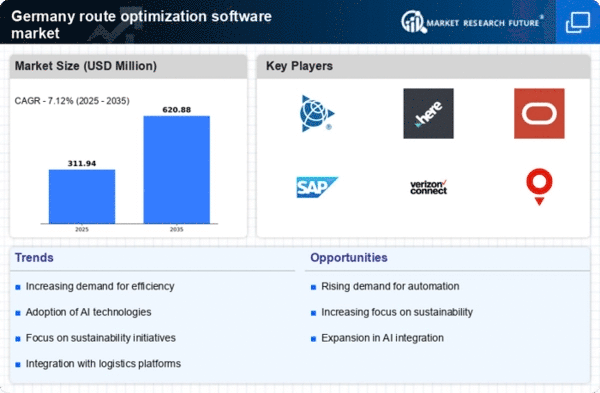
As per MRFR analysis, the route optimization-software market size was estimated at 291.21 USD Million in 2024. The route optimization-software market is projected to grow from 311.94 USD Million in 2025 to 620.88 USD Million by 2035, exhibiting a compound annual growth rate (CAGR) of 7.12% during the forecast period 2025 - 2035.

Key Market Trends & Highlights

The Germany route optimization-software market is experiencing robust growth driven by technological advancements and evolving logistics needs.

  • The market is witnessing increased adoption of AI technologies to enhance routing efficiency.
  • Sustainability is becoming a focal point, with companies seeking eco-friendly logistics solutions.
  • Real-time data utilization is gaining traction, enabling better decision-making in transportation.
  • The rising demand for efficient logistics solutions and government initiatives supporting digital transformation are key drivers of market growth.

Market Size & Forecast

2024 Market Size 291.21 (USD Million)
2035 Market Size 620.88 (USD Million)
CAGR (2025 - 2035) 7.12%

Major Players

Trimble (US), HERE Technologies (NL), Oracle (US), SAP (DE), Verizon Connect (US), TomTom (NL), Fleet Complete (CA), Samsara (US)

Germany Route Optimization Software Market Trends

the route optimization-software market is experiencing notable growth, driven by the increasing demand for efficient logistics and transportation solutions. Companies are increasingly recognizing the importance of optimizing routes to reduce operational costs and improve service delivery. This trend is particularly evident in sectors such as e-commerce and freight transport, where timely deliveries are crucial for customer satisfaction. Furthermore, advancements in technology, including artificial intelligence and machine learning, are enhancing the capabilities of route optimization software, allowing for more sophisticated algorithms that can analyze vast amounts of data in real-time. As a result, businesses are better equipped to make informed decisions regarding their logistics operations. In addition, the regulatory environment in Germany is evolving, with a focus on sustainability and reducing carbon emissions. This has led to a growing emphasis on green logistics, prompting companies to adopt route optimization solutions that not only improve efficiency but also minimize environmental impact. The integration of electric vehicles into fleets is also influencing the route optimization-software market, as these vehicles require specific routing considerations to maximize their range and efficiency. Overall, the landscape of the route optimization-software market is dynamic, with technological advancements and regulatory changes shaping its future direction.

Increased Adoption of AI Technologies

The integration of artificial intelligence in route optimization software is becoming more prevalent. AI algorithms enhance decision-making processes by analyzing traffic patterns, weather conditions, and historical data. This leads to more accurate route planning and improved delivery times, which are essential for businesses aiming to enhance customer satisfaction.

Focus on Sustainability

There is a growing trend towards sustainability within the route optimization-software market. Companies are increasingly seeking solutions that not only optimize routes but also reduce carbon footprints. This shift is driven by regulatory pressures and consumer demand for environmentally friendly practices, prompting businesses to adopt greener logistics strategies.

Real-Time Data Utilization

The use of real-time data is transforming the route optimization-software market. Companies are leveraging live traffic updates, GPS tracking, and other data sources to make immediate adjustments to routes. This capability allows for greater flexibility and responsiveness, ultimately leading to enhanced operational efficiency.

Germany Route Optimization Software Market Drivers

Integration of IoT in Transportation Systems

The integration of Internet of Things (IoT) technologies into transportation systems is emerging as a key driver for the route optimization-software market in Germany. IoT devices enable real-time tracking of vehicles and shipments, providing valuable data that can be utilized for route optimization. This integration allows companies to make informed decisions based on live traffic conditions, weather patterns, and vehicle performance. As the IoT ecosystem expands, the demand for software solutions that can effectively analyze and utilize this data is likely to increase. The route optimization-software market is expected to benefit from this trend, as businesses seek to leverage IoT capabilities to enhance their operational efficiency and reduce costs.

Rising Demand for Efficient Logistics Solutions

The route optimization-software market in Germany is experiencing a notable surge in demand for efficient logistics solutions. This trend is driven by the increasing need for businesses to streamline their supply chain operations and reduce transportation costs. According to recent data, logistics costs account for approximately 7.5% of the GDP in Germany, highlighting the critical importance of optimizing routes to enhance operational efficiency. Companies are increasingly adopting software solutions that provide real-time route planning and optimization capabilities, which can lead to significant savings in fuel consumption and time. As the logistics sector continues to evolve, the route optimization-software market is expected to expand, catering to the growing need for innovative solutions that enhance delivery performance and customer satisfaction.

Focus on Cost Reduction and Operational Efficiency

In the competitive landscape of the German logistics industry, there is a pronounced focus on cost reduction and operational efficiency, which is driving the route optimization-software market. Companies are increasingly recognizing that optimizing delivery routes can lead to substantial savings in fuel costs and labor expenses. The potential for reducing operational costs by up to 20% through effective route planning is compelling for many businesses. As a result, the adoption of route optimization software is becoming a strategic priority for organizations aiming to enhance their profitability. This trend is likely to continue, with the market expected to grow as more companies seek to implement solutions that align with their cost-saving objectives.

Growing E-commerce Sector and Last-Mile Delivery Needs

The rapid growth of the e-commerce sector in Germany is significantly influencing the route optimization-software market. With online shopping becoming increasingly popular, businesses are facing heightened pressure to optimize last-mile delivery operations. Efficient route planning is essential for meeting customer expectations regarding delivery speed and reliability. As e-commerce sales continue to rise, companies are investing in route optimization software to enhance their delivery capabilities. This trend is expected to drive market growth, as businesses seek to improve their logistics efficiency and reduce delivery times. The route optimization-software market is likely to see a substantial increase in demand, potentially reaching a market value of €500 million by 2027.

Government Initiatives Supporting Digital Transformation

In Germany, government initiatives aimed at promoting digital transformation are significantly impacting the route optimization-software market. The German government has launched various programs to encourage the adoption of digital technologies across industries, including logistics and transportation. These initiatives often provide financial incentives and support for companies investing in advanced software solutions. As a result, businesses are increasingly integrating route optimization software into their operations to comply with regulatory requirements and improve efficiency. The market is projected to grow as more companies recognize the benefits of digital tools in enhancing their logistics capabilities, potentially leading to a 15% increase in software adoption rates over the next few years.


Market Segment Insights

By Deployment Type: Cloud-Based (Largest) vs. On-Premise (Fastest-Growing)

In the Germany route optimization-software market, the deployment type segment is predominantly influenced by cloud-based solutions, which hold a significant share of the market. This preference is primarily driven by the scalability, cost-effectiveness, and ease of integration that cloud solutions offer to businesses. On-premise solutions, while being robust, cater to a niche market of clients requiring customized and secure deployments, representing a smaller yet growing portion of the segment. Looking ahead, hybrid solutions are poised to gain considerable traction, combining the benefits of both cloud and on-premise deployments. The rising demand for flexibility in operations and data management is becoming a crucial driver for growth in this segment. Companies are increasingly seeking hybrid models to leverage the best of both worlds, allowing them to navigate the evolving technology landscape while ensuring data security and compliance.

Cloud-Based (Dominant) vs. On-Premise (Emerging)

Cloud-based deployment remains the dominant force in the Germany route optimization-software market, appealing to businesses of all sizes due to its flexibility and lower upfront costs. These solutions allow organizations to access advanced features and updates without substantial infrastructure investments. Conversely, on-premise deployments serve a more specialized market segment, often preferred by larger organizations that prioritize data control, security, and customization. Although historically slower in adoption, on-premise solutions are emerging as companies recognize the need for tailored applications capable of handling unique logistics challenges. As a result, both deployment types are strategically positioned to complement each other, catering to the diverse needs of the market.

By End User: Transportation and Logistics (Largest) vs. Retail (Fastest-Growing)

In the Germany route optimization-software market, the distribution of market share among end user segments reveals that Transportation and Logistics holds the largest share, capitalizing on the increased demand for efficient supply chain management. This segment has seen significant adoption of route optimization tools, driven by the need to enhance delivery efficiency and reduce operational costs. In contrast, Retail has emerged as the fastest-growing segment, fueled by the surge in e-commerce and the necessity for streamlined logistics in last-mile delivery services. Growth trends in the end user segments are primarily dictated by technological advancements and market demands. The Transportation and Logistics sector is experiencing steady growth as companies seek to optimize their fleet management operations. Meanwhile, the Retail sector is expanding rapidly due to changing consumer shopping habits necessitating quicker and more efficient delivery solutions. Factors such as increased urbanization and the rise in on-demand service requests are further propelling the adoption of route optimization software in these sectors.

Transportation and Logistics (Dominant) vs. Retail (Emerging)

The Transportation and Logistics segment is the dominant player in the Germany route optimization-software market, characterized by established logistics companies integrating sophisticated routing solutions to streamline their operations. This segment typically features robust technology implementations that enhance route efficiency, reduce fuel consumption, and improve overall supply chain visibility. In contrast, Retail represents an emerging segment where businesses are beginning to realize the importance of route optimization to meet consumer expectations for faster shipping and delivery. Retailers are increasingly adopting these solutions to manage their logistics effectively, responding to the growth of online shopping and the demand for quick fulfillment, which positions them as a key driver for market evolution.

By Features: Real-Time Tracking (Largest) vs. Multi-Stop Routing (Fastest-Growing)

In the Germany route optimization-software market, Real-Time Tracking has emerged as the largest segment, dominating market share due to its critical importance in enhancing operational efficiency and customer satisfaction. Following closely are Multi-Stop Routing and Traffic Analysis, which cater to specific logistic needs, while Route Analytics and Mobile Compatibility provide additional features that enhance user experience and adaptability to technology advancements. Growth trends in this segment are fueled by the increasing demand for efficient logistics solutions driven by e-commerce and the need for real-time data analytics. Companies are prioritizing features like Traffic Analysis and Multi-Stop Routing to optimize their operational workflows. The integration of AI and machine learning in route optimization tools is also contributing to the accelerated growth of segments, ensuring businesses can respond swiftly to changing road conditions and customer requirements.

Real-Time Tracking (Dominant) vs. Multi-Stop Routing (Emerging)

Real-Time Tracking is recognized as the dominant feature in the Germany route optimization-software market, characterized by its ability to provide immediate updates on vehicle locations. This feature significantly enhances fleet efficiency, allowing managers to make informed decisions on the fly. In contrast, Multi-Stop Routing is rapidly becoming an emerging feature, appealing to businesses that require complex route planning through multiple destinations. This feature is instrumental in optimizing delivery times and reducing operational costs, making it increasingly popular among logistics providers who seek to improve service levels without compromising on costs.

By Application: Fleet Management (Largest) vs. Last-Mile Delivery (Fastest-Growing)

In the Germany route optimization-software market, the Fleet Management segment commands the largest share, reflecting its critical role in enhancing operational efficiency and reducing costs for transportation companies. Conversely, Last-Mile Delivery has emerged as the fastest-growing segment, driven by the increasing demand for timely and efficient delivery solutions in urban areas. This shift signifies a transformation in logistics priorities, highlighting the importance of optimizing last-mile operations for customer satisfaction. The growth trends within these segments are underpinned by advancements in technology, such as real-time tracking and AI-based routing algorithms. The rising e-commerce industry is particularly influencing Last-Mile Delivery, with businesses seeking innovative ways to meet consumer expectations. Meanwhile, Fleet Management continues to evolve, integrating telematics and data analytics that help fleet operators minimize downtime and maximize asset utilization, thereby sustaining its dominant position in the market.

Fleet Management (Dominant) vs. Last-Mile Delivery (Emerging)

Fleet Management, as the dominant segment, focuses on optimizing vehicle operations, maintenance scheduling, and driver performance. Its comprehensive solutions help businesses minimize operational costs and enhance efficiency. The introduction of telematics has revolutionized this segment, enabling real-time data analysis and improved decision-making. In contrast, Last-Mile Delivery represents an emerging segment, driven by the surge in online shopping. This area emphasizes speed, customer satisfaction, and route efficiency. Companies are investing in innovative technologies, such as drones and autonomous vehicles, to refine their last-mile strategies. Both segments play vital roles in shaping the logistics landscape, yet their challenges and solutions differ significantly, reflecting diverse customer needs and market dynamics.

Get more detailed insights about Germany Route Optimization Software Market

Key Players and Competitive Insights

The route optimization-software market in Germany is characterized by a dynamic competitive landscape, driven by technological advancements and increasing demand for efficiency in logistics and transportation. Key players such as Trimble (US), HERE Technologies (NL), and SAP (DE) are at the forefront, each adopting distinct strategies to enhance their market positioning. Trimble (US) focuses on innovation through continuous development of its software solutions, aiming to integrate advanced analytics and machine learning capabilities. HERE Technologies (NL) emphasizes partnerships with automotive manufacturers to embed its mapping and routing technologies directly into vehicles, thereby expanding its reach. SAP (DE) leverages its extensive enterprise resource planning (ERP) ecosystem to offer integrated solutions that streamline supply chain operations, thus enhancing customer value. Collectively, these strategies contribute to a competitive environment that is increasingly reliant on technological integration and customer-centric solutions.

In terms of business tactics, companies are localizing their operations to better serve the German market, optimizing supply chains to reduce costs and improve service delivery. The market appears moderately fragmented, with several players vying for market share, yet the influence of major companies is substantial. This competitive structure allows for a diverse range of offerings, catering to various customer needs while fostering innovation through competition.

In October 2025, HERE Technologies (NL) announced a strategic partnership with a leading automotive manufacturer to enhance real-time traffic data integration into its routing software. This move is likely to bolster HERE's position in the market by providing users with more accurate and timely information, thereby improving route efficiency and reducing travel times. Such partnerships are indicative of a broader trend towards collaboration between software providers and hardware manufacturers, which may redefine user experiences in the coming years.

In September 2025, Trimble (US) launched a new version of its route optimization software that incorporates AI-driven predictive analytics. This development is significant as it allows users to anticipate traffic patterns and adjust routes proactively, potentially leading to cost savings and improved delivery times. The integration of AI into route optimization reflects a growing trend towards leveraging advanced technologies to enhance operational efficiency.

In August 2025, SAP (DE) expanded its logistics capabilities by acquiring a smaller software firm specializing in route optimization. This acquisition is expected to enhance SAP's existing offerings, allowing for a more comprehensive suite of tools that address the complexities of modern supply chains. Such strategic moves highlight the importance of mergers and acquisitions in consolidating capabilities and expanding market reach.

As of November 2025, the competitive trends in the route optimization-software market are increasingly defined by digitalization, sustainability, and the integration of AI technologies. Strategic alliances are becoming more prevalent, as companies recognize the value of collaboration in enhancing their technological capabilities. Looking ahead, competitive differentiation is likely to evolve from traditional price-based competition towards a focus on innovation, technological advancement, and supply chain reliability. This shift suggests that companies that prioritize these areas will be better positioned to thrive in an increasingly complex market.

Key Companies in the Germany Route Optimization Software Market market include

Industry Developments

The Germany Route Optimization Software Market has seen significant developments recently. A surge in demand for efficient logistics solutions has driven notable growth in the sector, with companies like SAP and HERE Technologies enhancing their offerings to meet these needs. In August 2023, Dynafleet introduced new features aimed at improving fleet efficiency, reflecting the market's shift towards sustainability and operational efficiency.

Additionally, in September 2023, a merger was announced between Mapbox and CleverReach, aiming to integrate advanced mapping technologies with marketing automation, which is expected to enhance user experience in logistics management. The market is also witnessing significant investments, as Verizon Connect expanded its operations in Germany to cater to the increasing need for automated route optimization solutions.

This comes at a time when Germany's government is pushing for advanced digital solutions in transportation logistics, creating a conducive environment for further innovation. Growth has also been evident as OptimoRoute and Geotab reported substantial year-on-year revenue increases during 2022. As companies adapt their technologies, the efficiency of route optimization is anticipated to improve significantly, reinforcing Germany's role as a leader in the logistics and transportation sector.

Future Outlook

Germany Route Optimization Software Market Future Outlook

The Route Optimization Software Market is projected to grow at a 7.12% CAGR from 2024 to 2035, driven by advancements in AI, demand for efficiency, and sustainability initiatives.

New opportunities lie in:

  • Integration of AI-driven predictive analytics for enhanced route planning.
  • Development of mobile applications for real-time route adjustments.
  • Partnerships with logistics firms to offer tailored optimization solutions.

By 2035, the market is expected to achieve substantial growth, driven by technological advancements and strategic partnerships.

Market Segmentation

Germany Route Optimization Software Market End User Outlook

  • Transportation and Logistics
  • Retail
  • Healthcare
  • Government

Germany Route Optimization Software Market Features Outlook

  • Real-Time Tracking
  • Traffic Analysis
  • Multi-Stop Routing
  • Route Analytics
  • Mobile Compatibility

Germany Route Optimization Software Market Application Outlook

  • Fleet Management
  • Last-Mile Delivery
  • Field Service Management

Germany Route Optimization Software Market Deployment Type Outlook

  • Cloud-Based
  • On-Premise
  • Hybrid

Report Scope

MARKET SIZE 2024 291.21(USD Million)
MARKET SIZE 2025 311.94(USD Million)
MARKET SIZE 2035 620.88(USD Million)
COMPOUND ANNUAL GROWTH RATE (CAGR) 7.12% (2024 - 2035)
REPORT COVERAGE Revenue Forecast, Competitive Landscape, Growth Factors, and Trends
BASE YEAR 2024
Market Forecast Period 2025 - 2035
Historical Data 2019 - 2024
Market Forecast Units USD Million
Key Companies Profiled Trimble (US), HERE Technologies (NL), Oracle (US), SAP (DE), Verizon Connect (US), TomTom (NL), Fleet Complete (CA), Samsara (US)
Segments Covered Deployment Type, End User, Features, Application
Key Market Opportunities Integration of artificial intelligence enhances efficiency in the route optimization-software market.
Key Market Dynamics Rising demand for efficient logistics solutions drives innovation in route optimization-software amidst regulatory pressures.
Countries Covered Germany

Leave a Comment

FAQs

What is the expected market size of the Germany Route Optimization Software Market in 2024?

The Germany Route Optimization Software Market is expected to be valued at 436.5 million USD in 2024.

What will the market value be by 2035?

By 2035, the Germany Route Optimization Software Market is projected to reach a value of 996.6 million USD.

What is the expected CAGR for the Germany Route Optimization Software Market from 2025 to 2035?

The expected CAGR for the Germany Route Optimization Software Market from 2025 to 2035 is 7.794%.

Which deployment type holds the largest market value in 2024?

In 2024, Cloud-Based deployment holds the largest market value at 180 million USD.

What is the market size for On-Premise deployment in 2024?

The market size for On-Premise deployment in 2024 is 150 million USD.

What is the projected market value for Cloud-Based deployment by 2035?

By 2035, the market value for Cloud-Based deployment is expected to grow to 420 million USD.

Who are the key players in the Germany Route Optimization Software Market?

Key players in the market include Routific, SAP, Dynafleet, Locus.sh, and TomTom.

What is the market size for Hybrid deployment in 2024?

The Germany Route Optimization Software Market for Hybrid deployment is valued at 106.5 million USD in 2024.

What will the market size for On-Premise deployment be by 2035?

The market size for On-Premise deployment is projected to reach 320 million USD by 2035.

What are the factors driving growth in the Germany Route Optimization Software Market?

Factors driving growth in the market include increased demand for efficiency in logistics and advancements in technology.

Download Free Sample

Kindly complete the form below to receive a free sample of this Report

Compare Licence

×
Features License Type
Single User Multiuser License Enterprise User
Price $4,950 $5,950 $7,250
Maximum User Access Limit 1 User Upto 10 Users Unrestricted Access Throughout the Organization
Free Customization
Direct Access to Analyst
Deliverable Format
Platform Access
Discount on Next Purchase 10% 15% 15%
Printable Versions