Increased Focus on Cost Reduction
Cost reduction remains a critical driver for the route optimization-software market in Japan. Businesses are under constant pressure to minimize expenses while maintaining service quality. The implementation of route optimization software can lead to substantial savings, with studies indicating potential reductions in fuel costs by up to 20% and labor costs by 15%. As companies strive to enhance their bottom line, the demand for software solutions that provide real-time data analytics and route planning capabilities is likely to increase. This focus on cost efficiency is propelling the growth of the route optimization-software market, as organizations recognize the financial benefits of adopting such technologies.
Adoption of Advanced Analytics and AI
The integration of advanced analytics and artificial intelligence (AI) into route optimization software is transforming the market landscape in Japan. Companies are increasingly leveraging these technologies to gain insights into routing efficiencies and customer preferences. The route optimization-software market is likely to see a growth rate of 12% as businesses adopt AI-driven solutions that offer predictive analytics and machine learning capabilities. These advancements allow for more accurate forecasting of delivery times and better resource allocation. As organizations recognize the competitive advantage provided by data-driven decision-making, the demand for sophisticated route optimization software is expected to rise, further propelling market growth.
Rising Demand for Efficient Logistics
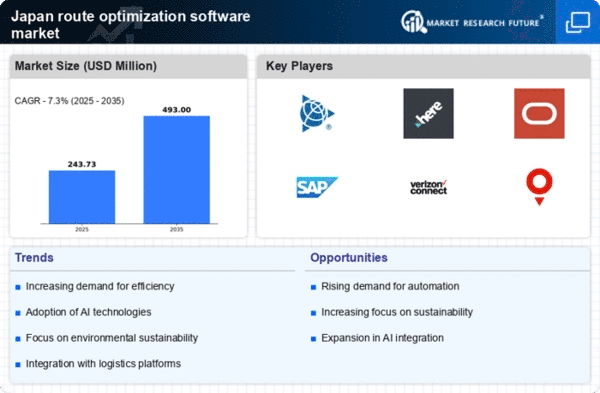
The route optimization-software market in Japan is experiencing a notable surge in demand driven by the need for efficient logistics solutions. As e-commerce continues to expand, companies are increasingly seeking ways to streamline their delivery processes. In 2025, the logistics sector in Japan is projected to grow by approximately 5.2%, indicating a robust market for software that enhances route planning and reduces operational costs. This growth is further fueled by the increasing complexity of supply chains, necessitating advanced software solutions that can adapt to dynamic conditions. Consequently, businesses are investing in route optimization software to improve delivery times and customer satisfaction, thereby solidifying its importance in the logistics landscape.
Growing Urbanization and Traffic Congestion
The rapid urbanization in Japan is contributing to increased traffic congestion, which in turn drives the need for effective route optimization solutions. As urban areas expand, the complexity of navigating through congested streets becomes a significant challenge for logistics and transportation companies. The route optimization-software market is poised to benefit from this trend, as businesses seek to mitigate delays and improve delivery efficiency. In major cities like Tokyo and Osaka, traffic congestion is expected to worsen, prompting a projected increase in the adoption of route optimization software by 10% in the coming years. This software enables companies to analyze traffic patterns and adjust routes accordingly, thereby enhancing operational efficiency.
Government Initiatives for Smart Transportation
Government initiatives aimed at promoting smart transportation systems are significantly influencing the route optimization-software market in Japan. The Japanese government has been actively investing in infrastructure and technology to enhance transportation efficiency. For instance, the implementation of the Smart Mobility Strategy aims to integrate advanced technologies into public transport and logistics. This strategy is expected to increase the adoption of route optimization software by 15% over the next few years, as companies align with government policies to improve operational efficiency. Such initiatives not only encourage innovation but also create a favorable regulatory environment for the growth of the route optimization-software market.
























Leave a Comment