Request Free Sample ×

Kindly complete the form below to receive a free sample of this Report

* Please use a valid business email

Leading companies partner with us for data-driven Insights

clients tt-cursor
Hero Background

Genset Market

ID: MRFR/EnP/1177-CR
248 Pages
Chitranshi Jaiswal
Last Updated: May 22, 2026
Global Genset Market Research Report: Information by Fuel Type (Diesel, Gas, Biofuels, Gasoline, Fuel Cell, Producer Gas, Others), By Application (Standby, Prime & Continuous, Peak Shaving), By Power Rating (Below 50 kVA, 50–500 kVA, above 500 kVA), By Mobility (Stationery, Portable), By Phase (Single Phase, Multiple Phase), By End User (Residential, Commercial, Industrial, Utilities)By Region (North America, Europe, Asia Pacific, South America, Middle East & Africa) - Industry Forecast to 2035
Download PDF ×

We do not share your information with anyone. However, we may send you emails based on your report interest from time to time. You may contact us at any time to opt-out.

⚠ STRAIT OF HORMUZ CRISIS ALERT
13 Million Barrels/Day at Risk | 31% of Global Seaborne Oil Flow | Qatar LNG Halted — Oil, Natural Gas, Power Generation & Energy Security Markets Disrupted, Insurance Withdrawn, $80–100+ Price Scenarios Active | Get Crisis-Adjusted Production, Pricing & Security Analysis

Genset Market Summary

As per Market Research Future analysis, Global Genset Market was valued at USD 50,848.9 million in 2024. The Sonobuoy Industry is projected to grow from USD 53,821.8 million in 2025 to USD 97,651.0 million by 2035, exhibiting a compound annual growth rate (CAGR) of 6.84% during the forecast period (2025 - 2035). The global genset market comprises the production, distribution, and deployment of generator sets designed to provide reliable electrical power across a wide range of applications. A genset typically integrates an internal combustion engine with an alternator to convert mechanical energy into electricity, ensuring continuity of operations in situations where grid power is unavailable or unstable. These systems are used for power purposes, making them essential across residential, commercial, and industrial and utility sectors

Key Market Trends & Highlights

The Global Genset Market is trend is that gensets are no longer just “backup” machines but are embedded into resilience and continuity strategies for critical facilities.

  • The expansion of data centers and 5G/edge‑network rollouts is a structurally important trend. Data centers demand near‑zero‑downtime power, making gensets a mandatory component of their backup layers, often backed by lithium‑ion batteries or UPS system.
  • Dense urban environments, local noise and zoning rules are pushing the adoption of sound‑attenuated enclosures, low‑sound‑level gensets, and remote‑mount configurations that allow placement away from occupied spaces.
  • Diesel remains dominant because of its high energy density, fuel availability, and proven reliability in harsh conditions.
  • Perhaps the most strategic trend is the integration of gensets into hybrid power systems and microgrids.

Market Size & Forecast

2024 Market Size 50,848.9 (USD Million)
2035 Market Size 97,651.0 (USD Million)
CAGR (2025 - 2035) 6.84%

Major Players

Caterpillar, Cummins, Generac, Atlas Copco, MTU Onsite Energy, KOHLER, Wärtsilä, HIMOINSA, Sterling & Wilson, Mahindra Powerol, Yanmar, and Aksa Power Generation.

Our Impact
Enabled $4.3B Revenue Impact for Fortune 500 and Leading Multinationals
Partnering with 2000+ Global Organizations Each Year
30K+ Citations by Top-Tier Firms in the Industry

Genset Market Trends

The Genset Market is undergoing a significant transformation, driven by rising global energy demand, increasing grid instability, and the expanding need for reliable backup and continuous power solutions. Industries are increasingly adopting advanced generator technologies to ensure uninterrupted operations across critical sectors such as healthcare, manufacturing, data centers, and commercial facilities. As power outages become more frequent and the need for resilient infrastructure grows, gensets are becoming an essential component of operational continuity strategies worldwide. A notable shift is emerging toward cleaner and smarter generator systems. Organizations are moving beyond traditional diesel gensets and showing strong interest in gas-based, hybrid, and renewable-integrated power solutions. This transition is driven by environmental regulations, emission reduction goals, and the growing emphasis on sustainable energy practices. The integration of digital monitoring, automation, and remote management tools is also reshaping the genset landscape as companies seek efficient, predictive, and intelligent power solutions.

Expansion into emerging markets

The expansion of genset deployment across emerging markets represents a major opportunity, primarily driven by persistent electricity access gaps and unreliable grid infrastructure. According to the International Energy Agency, nearly 675 million people globally still lacked access to electricity as of 2023, with a significant concentration in Sub-Saharan Africa and parts of South Asia. Even in electrified regions, grid instability and frequent outages remain a challenge, particularly in rural and semi-urban areas. This structural deficit in reliable power supply creates sustained demand for gensets as both primary and backup power sources. Consequently, gensets play a crucial bridging role in ensuring energy access for households, small enterprises, and public infrastructure.

Focus on Sustainability and Emissions Compliance

With stricter global emission standards and heightened awareness of environmental impact, companies are prioritizing low-emission gensets, hybrid systems, and gas-powered alternatives. This trend underscores the increasing importance of sustainability and regulatory compliance in power generation strategies.

Integration with Smart & Emerging Technologies

The Genset Market is witnessing growing integration with smart technologies—including IoT monitoring, predictive maintenance, load management automation, and hybrid renewable-genset systems. These advancements enhance operational efficiency, reliability, and real-time performance insights, supporting modern energy management goals.

Furthermore, microgrid development and distributed energy systems are influencing market direction. Businesses and communities are increasingly adopting decentralized power models, where gensets work alongside renewable energy systems to deliver stable, cost-efficient, and flexible power. This trend reflects a broader move toward energy independence, resilience, and flexible load management. As global energy infrastructure continues to evolve, the Genset Market is positioned to expand substantially, driven by technological innovation, sustainability demands, and the rising need for dependable power across diverse applications.

Genset Market Drivers

Expanding Applications in Data Centers

The Genset Market is experiencing a surge in demand for backup power solutions, particularly in sectors such as healthcare, telecommunications, and data centers. The increasing frequency of power outages and the need for uninterrupted power supply are driving this trend. Recent statistics indicate that the market for backup generators is expected to grow at a rate of 8% annually over the next five years. This demand is further fueled by the expansion of urban infrastructure and the growing reliance on technology. As businesses seek to mitigate risks associated with power disruptions, the genset market is likely to see a robust increase in sales and innovations tailored to backup power applications.

Growing Demand for Reliable Power Supply

The growing demand for reliable power supply is a fundamental driver of the global genset market. According to the International Energy Agency (IEA), global electricity demand recorded a strong growth of 4.3% in 2024 and is projected to increase at an annual rate of approximately 4% through 2027. This sustained rise reflects increasing electrification across industries, urban expansion, and digital transformation.
 
However, in many regions, power generation and grid infrastructure development have not kept pace with this demand, resulting in supply gaps. As a result, gensets are increasingly deployed to ensure continuity of operations during power shortages and peak load conditions.
 
A detailed assessment of global electricity generation trends further reinforces this demand-supply imbalance. Coal-based generation, which remains a dominant energy source, increased from 10,275 TWh in 2021 to 10,704 TWh in 2024, indicating steady reliance on conventional baseload power. Similarly, gas-based generation rose from 6,557 TWh in 2021 to 6,777 TWh in 2024, reflecting incremental capacity additions.

Rising Investment in Infrastructure Development and Commercial Industry

The ongoing digital transformation, driven by rapid advancements in artificial intelligence (AI), machine learning, and cloud computing, has substantially increased the global demand for reliable and continuous power supply, thereby accelerating the growth of the global genset market. Data centers, which serve as the backbone of the digital economy, have expanded significantly in both number and capacity to accommodate the rising volume of data processing and storage needs. As of March 2025, the United States leads with approximately 5,426 operational data centers, followed by Germany (529), the United Kingdom (523), and France (322). This concentration of digital infrastructure in developed economies underscores the growing need for dependable power solutions to ensure uninterrupted data flow, operational stability, and network resilience.

Market Segment Insights

By Fuel Type: Diesel (largest market) vs Gas (fastest growing)

Based on Fuel type, the Global Genset Market has been segmented into Diesel, Gas, Biofuels, Gasoline, Fuel Cell, Producer Gas, Others. Diesel remains the dominant fuel source globally, its established supply chain and energy-dense properties make it indispensable for heavy-duty industrial applications, construction, and emergency power backup in critical facilities like hospitals and data centers. Natural gas-based units are the fastest-growing sub-segment, driven by urban air-quality norms and expanding gas infrastructure, these generators are becoming mainstream in Europe, China, and the U.S. for continuous and combined heat & power (CHP) operations.

By Application: Peak Shaving (largest market) vs Standby (fastest-growing)

Based on Application, the Global Genset Market has been segmented into Standby, Prime & Continuous, Peak Shaving. Used to offset power demand during peak hours and reduce grid costs. Adoption is particularly strong in Europe and North America under industrial demand-response programs. The industrial sector dominates revenue share, encompassing oil & gas, mining, cement, chemical processing, and heavy equipment manufacturing.

By Power Rating: above 500 kVA (largest market) vs 50–500 kVA (fastest-Growing)

Based on Power Ratings, the Global Genset Market has been segmented into Below 50 kVA, 50–500 kVA, above 500 kVA. The above 500 kVA segment dominates the market in terms of value, growing from USD 20,997.8 million in 2019 to USD 53,127.0 million by 2035, at a CAGR of 6.64%. The 50–500 kVA segment represents a significant share of the market, expanding from USD 14,699.7 million in 2019 to USD 39,181.7 million by 2035, at a CAGR of 7.00%.

By Mobility: Stationery (largest market) vs Portable (fastest-Growing)

Based on Mobility, the Global Genset Market has been segmented into Stationery, Portable. Represent majority of global installations. Primarily used for industrial, commercial, and institutional applications where uninterrupted and automated backup power is critical. Witnessing strong growth driven by residential and outdoor applications, portable models are evolving with inverter technology, compact form factors, and dual-fuel capabilities.

By Phase: Multiple Phase (largest market) vs Single Phase (fastest-Growing)

Based on Phase, the Global Genset Market has been segmented into Single Phase, Multiple Phase. These gensets are widely used in industrial, commercial, and utility-scale applications, where higher load capacity and operational efficiency are required. The segment’s growth is driven by industrialization, expansion of data centers, and large infrastructure projects. The single-phase segment is expected to grow from USD 13,546.1 million in 2019 to USD 31,095.2 million by 2035, at a CAGR of 5.97%.

By End User: Commercial (largest market) vs Industrial (fastest-Growing)

Based on End user, the Global Genset Market has been segmented into Residential, Commercial, Industrial, Utilities. Increasing reliance on digitization and data infrastructure, along with stringent uptime requirements, is further accelerating genset deployment across commercial applications. The industrial segment is projected to grow steadily from USD 11,941.9 million in 2019 to USD 28,639.7 million by 2035, registering a CAGR of 6.28%.

Get more detailed insights about Genset Market

Regional Insights

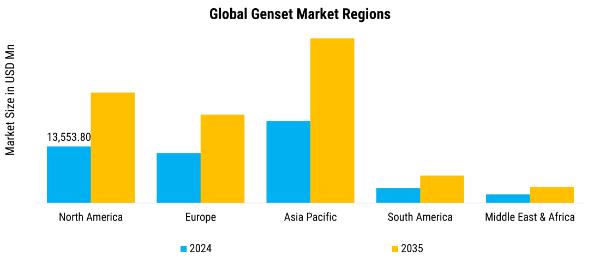
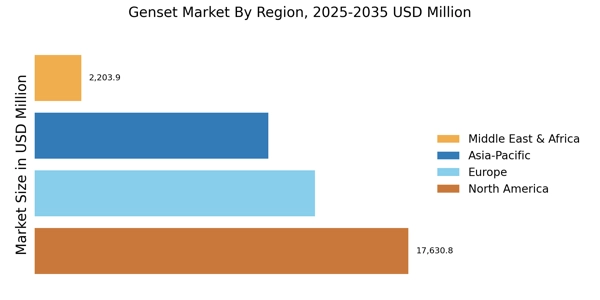
Global Genset Market Segments By Regions

North America: Expanding industrial manufacturing

North America holds a consolidated market share supported by resilient backup power requirements in industrial manufacturing, data centers, and healthcare. The U.S. leads innovation in gas and hybrid generators aligned with decarbonization goals. Wildfire-related disruptions and severe weather events drive sustained demand for residential standby units.

Europe: Strong Production gaining momentum

Europe is characterized by mature technology adoption and stringent emission standards. The shift toward natural gas and dual-fuel systems is gaining momentum, particularly across Germany, the UK, and France. Partnerships between EU utilities and generator OEMs are enabling hybrid and microgrid deployments under renewable integration initiatives.

Asia Pacific: expanding industrialization

Asia-Pacific is the largest and fastest-growing region due to expanding industrialization and urban population growth. China, India, Japan, and ASEAN nations are major production and consumption hubs. Telecom expansion, construction booms, and smart city projects further boost demand for mid-range and high-power ranges.

South America: Protection of infrastructure development

South America is a Generator adoption correlates with infrastructure development and industrial growth, particularly in Brazil, Argentina, and Chile. Lack of stable power infrastructure and increasing oil & gas projects encourage investment in both diesel and gas-based power solutions.

Middle East & Africa: Emerging off-grid industrial activities

MEA commands a significant share in prime power applications due to oilfield and off-grid industrial activities. GCC countries are early adopters of hybrid and gas systems, while Sub-Saharan Africa experiences consistent generator imports to support mining, humanitarian, and construction projects.

Genset Market Regional Image

Key Players and Competitive Insights

Many global, regional, and local vendors characterize the Global Genset Market. The market is highly competitive, with all the players competing to gain market share. Intense competition, rapid advances in Fuel, frequent changes in government policies, and environmental regulations are key factors that confront market growth. The vendors compete based on cost, product quality, reliability, and government regulations. Vendors must provide cost-efficient, high-quality products to survive and succeed in an intensely competitive market.
 
The major players in the market Include Caterpillar, Cummins, Generac, Atlas Copco, MTU Onsite Energy, KOHLER, Wärtsilä, HIMOINSA, Sterling & Wilson, Mahindra Powerol, Yanmar, and Aksa Power Generation, strategic market developments and decisions to improve operational effectiveness.

Key Companies in the Genset Market include

Industry Developments

  • April 2025: Kirloskar Oil Engines Ltd. developed the Optiprime Dual Core 1000 kVA genset, one of the most compact in its class, featuring multi-fuel capability and advanced efficiency optimization for industrial and data center applications.
  • December 2025: Mitsubishi Electric Corporation and Mitsubishi Heavy Industries, Ltd. announced that they have each signed a contract for an absorption-type company split with MTG Co., LTD, which has been established as a preparatory company to integrate the two firms' power-generator systems.
  • November 2025: Caterpillar Inc. has launched of four new models of natural-gas generator sets that deliver improved power density, fuel efficiency and emissions performance combined with Caterpillar’s renowned reliability and support.

Future Outlook

Genset Market Future Outlook

The Global Genset Market is projected to grow at a 6.84% CAGR from 2025 to 2035, driven by increasing demand for high-performance computing and enhanced security features.

New opportunities lie in:

  • Expansion into emerging markets    

  • Integration of smart technology for enhanced performance

  • Growth in off-grid power solution

By 2035, the Genset Market is expected to evolve into a critical pillar of global energy infrastructure, supporting reliable power generation, grid stability, and sustainable hybrid systems across diverse industries and regions.

Market Segmentation

Global Genset Market by Phase Outlook

  • Single Phase
  • Multiple Phase

Global Genset Market by End User Outlook

  • Residential
  • Commercial
  • Industrial
  • Utilities

Global Genset Market by Mobility Outlook

  • Portable
  • Stationary

Global Genset Market by Fuel Type Outlook

  • Diesel
  • Gas
  • Biofuels
  • Gasoline
  • Fuel Cell
  • Producer Gas
  • Others

Global Genset Market by Application Outlook

  • Standby
  • Prime & Continuous
  • Peak Shaving

Global Genset Market by Power Rating Outlook

  • Below 50 kVA
  • 50–500 kVA
  • Above 500 kVA

Report Scope

Market Size in 2024

  50,848.9 (USD Million)

Market Size in 2025

53,821.8 (USD Million)

Market CAGR (2025-2035)

 97,651.0 (USD Million)

Compound Annual Growth Rate (CAGR)

6.84% (2025 - 2035)

Report Coverage

Revenue Forecast, Competitive Landscape, Growth Factors, and Trends

Base Year

2024

Market Forecast Period

2025 - 2035

Historical Data

2019 - 2023

Market Forecast Units

USD Million

Key Companies Profiled

Caterpillar, Cummins, Generac, Atlas Copco, MTU Onsite Energy, KOHLER, Wärtsilä, HIMOINSA, Sterling & Wilson, Mahindra Powerol, Yanmar, and Aksa Power Generation.

Segments Covered

By Fuel Type, By Application, By Power Rating, By Mobility, By Phase, By End User

Key Market Opportunities

  • ·       Expansion into emerging markets      
  • ·       Integration of smart technology for enhanced performance           
  • ·       Growth in off-grid power solution.

Key Market Dynamics

  • ·       Growing demand for reliable power supply
  • ·       Rising adoption of renewable energy sources
  • ·       Increasing industrialization and urbanization.

Region Covered

North America, Europe, Asia Pacific, South America, Middle East & Africa.

FAQs

How much is the Global Genset Market?

The Genset Market was valued at approximately 44077.11 USD Million in 2024.

What is the projected market valuation for the Genset Market in 2035?

The Genset Market is projected to reach a valuation of around 80598.21 USD Million by 2035.

What is the expected CAGR for the Genset Market during the forecast period 2025 - 2035?

The expected CAGR for the Genset Market during the forecast period 2025 - 2035 is 5.64%.

Which companies are considered key players in the Genset Market?

Key players in the Genset Market include Caterpillar, Cummins, Generac, Kohler, MTU Onsite Energy, Honda, Atlas Copco, Wärtsilä, and Perkins.

What are the main segments of the Genset Market based on fuel type?

The main segments based on fuel type include Diesel, Natural Gas, and CNG, with valuations of 26434.0, 11000.0, and 6643.11 USD Million respectively in 2024.

How does the Genset Market segment by power rating?

The Genset Market segments by power rating include Up to 100KVA, 100-350KVA, 350-1000KVA, and Above 1000KVA, with respective valuations of 11000.0, 15000.0, 12000.0, and 6067.11 USD Million in 2024.

What applications are driving growth in the Genset Market?

Applications driving growth in the Genset Market include Agriculture, Construction, Forestry, Industrial, Pumps, and Power Generation, with Power Generation leading at 20077.11 USD Million in 2024.

What is the market size for portable and stationary gensets?

In 2024, the market size for portable gensets was 17600.0 USD Million, while stationary gensets reached 26477.11 USD Million.

Which end-user segments are prominent in the Genset Market?

Prominent end-user segments in the Genset Market include Industrial, Commercial, and Residential, with Industrial valued at 17630.0 USD Million in 2024.

What trends are influencing the Genset Market's growth?

Trends influencing the Genset Market's growth include increasing demand for reliable power sources and advancements in fuel technology, potentially enhancing market dynamics.
Author
Author
Author Profile
Chitranshi Jaiswal LinkedIn
Team Lead - Research
Chitranshi is a Team Leader in the Chemicals & Materials (CnM) and Energy & Power (EnP) domains, with 6+ years of experience in market research. She leads and mentors teams to deliver cross-domain projects that equip clients with actionable insights and growth strategies. She is skilled in market estimation, forecasting, competitive benchmarking, and both primary & secondary research, enabling her to turn complex data into decision-ready insights. An engineer and MBA professional, she combines technical expertise with strategic acumen to solve dynamic market challenges. Chitranshi has successfully managed projects that support market entry, investment planning, and competitive positioning, while building strong client relationships. Certified in Advanced Excel & Power BI she leverages data-driven approaches to ensure accuracy, clarity, and impactful outcomes.
Leave a Comment

Research Approach

Secondary Research

The secondary research process involved comprehensive analysis of energy regulatory databases, power generation standards, peer-reviewed engineering journals, and authoritative energy organizations. Key sources included the US Environmental Protection Agency (EPA) Tier 4 Final emissions standards, US Department of Energy (DOE) and Energy Information Administration (EIA) power infrastructure data, European Commission Stage V emission regulations, International Energy Agency (IEA) World Energy Outlook, World Bank Global Tracking Framework for electrification statistics, International Electrotechnical Commission (IEC) standards, Institute of Electrical and Electronics Engineers (IEEE) power generation standards, Electrical Generating Systems Association (EGSA) industry statistics, China Ministry of Ecology and Environment emission norms, Central Pollution Control Board (CPCB) India generator emission standards, Bureau of Indian Standards (BIS) for reciprocating engines, VDMA (German Mechanical Engineering Industry Association) power systems data, Japan Industrial Standards (JIS) Committee, SAE International technical papers, and national energy ministry reports from key markets including Saudi Arabia's Ministry of Energy and Nigeria's Federal Ministry of Power. These sources were used to collect installed capacity statistics, regulatory compliance data, emission standard evolution, fuel consumption trends, and market landscape analysis for diesel gensets, natural gas gensets, hybrid generators, and alternative fuel technologies across <75kVA, 75-375kVA, 375-750kVA, and >750kVA power ratings.


Primary Research

To gather both qualitative and quantitative insights, supply-side and demand-side stakeholders were interviewed during the primary research phase. CEOs, VPs of manufacturing, heads of regulatory compliance, and commercial directors from engine manufacturers, alternator suppliers, and generator set OEMs (Cummins, Caterpillar, Kohler, Generac, MTU Friedrichshafen, and Mitsubishi Heavy Industries) were examples of supply-side sources. Chief engineers from healthcare facilities, procurement leads from mining and construction firms, facility managers from data centers and telecom tower operators, and heads of power infrastructure from manufacturing and oil and gas facilities were examples of demand-side sources. Primary research established product development schedules, validated market segmentation, and collected information on hybrid adoption patterns, maintenance service agreements, fuel transition plans, and rental versus buy preferences.

Primary Respondent Breakdown:

• By Designation: C-level Primaries (28%), Director Level (35%), Others (37%)

• By Region: North America (32%), Europe (30%), Asia-Pacific (28%), Rest of World (10%)


Market Size Estimation

Global market valuation was derived through revenue mapping and installed base analysis. The methodology included:

• Identification of 40+ key manufacturers across North America, Europe, Asia-Pacific, Middle East, and Africa

• Product mapping across diesel, natural gas, hybrid, and alternative fuel generator sets

• Power rating segmentation analysis across <75kVA, 75-375kVA, 375-750kVA, and >750kVA categories

• Mobility assessment covering stationary standby, prime power, and portable rental applications

• Analysis of reported and modeled annual revenues specific to generator set portfolios

• Coverage of manufacturers representing 72-78% of global market share in 2024

• Extrapolation using bottom-up (unit shipments × ASP by country/region) and top-down (manufacturer revenue validation) approaches to derive segment-specific valuations for standby power, prime power, and peak shaving applications

Download Free Sample

Kindly complete the form below to receive a free sample of this Report