Growing Focus on Multilingual Support
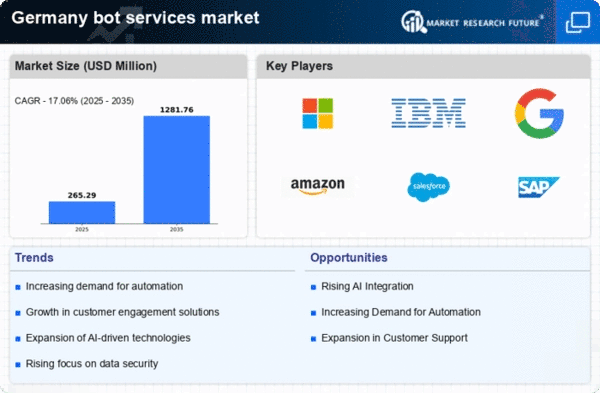
As the bot services market evolves, there is a growing emphasis on providing multilingual support to cater to Germany's diverse population. Businesses are recognizing the importance of engaging customers in their preferred languages, which is driving the development of multilingual bots. This trend is particularly relevant in urban areas with high immigrant populations. Current projections indicate that the demand for multilingual bot services could increase by 25% over the next few years. The bot services market is thus likely to expand as companies invest in technologies that facilitate communication across language barriers, ultimately enhancing customer reach and satisfaction.
Rising Demand for Customer Engagement
The bot services market in Germany experiences a notable surge in demand for enhanced customer engagement solutions. Businesses are increasingly recognizing the necessity of providing immediate responses to customer inquiries, which is driving the adoption of chatbots and virtual assistants. According to recent data, approximately 60% of companies in Germany have integrated some form of bot technology to improve customer interaction. This trend is likely to continue as organizations seek to enhance user experience and streamline communication processes. The bot services market is thus positioned to grow as companies invest in technologies that facilitate real-time engagement, ultimately leading to higher customer satisfaction and retention rates.
Advancements in Natural Language Processing
The bot services market in Germany is significantly influenced by advancements in natural language processing (NLP) technologies. These innovations enable bots to understand and respond to human language more effectively, enhancing user interactions. As NLP capabilities improve, the accuracy and relevance of bot responses are expected to increase, which may lead to broader adoption across various sectors. Current estimates suggest that the integration of advanced NLP in bot services could enhance user satisfaction rates by over 40%. Consequently, the bot services market is poised for expansion as businesses leverage these technological advancements to provide more intuitive and effective customer service.
Cost Efficiency and Operational Optimization
In the context of the bot services market, organizations in Germany are increasingly motivated by the potential for cost efficiency and operational optimization. By automating routine tasks through bots, companies can significantly reduce labor costs and improve productivity. Reports indicate that businesses utilizing bot services have observed a reduction in operational costs by up to 30%. This financial incentive is compelling, particularly for small and medium-sized enterprises (SMEs) that are looking to maximize their resources. The bot services market is thus likely to see continued growth as more organizations recognize the financial benefits of implementing automated solutions.
Integration with Business Intelligence Tools
The integration of bot services with business intelligence tools is emerging as a critical driver in the bot services market. In Germany, organizations are increasingly utilizing bots to analyze data and generate insights that inform decision-making processes. This integration allows for real-time data analysis, enabling businesses to respond swiftly to market changes. Approximately 45% of companies in Germany are expected to adopt such integrated solutions by 2026. The bot services market stands to benefit from this trend, as organizations seek to harness the power of data-driven insights to enhance operational efficiency and strategic planning.