×
Request Free Sample ×

Kindly complete the form below to receive a free sample of this Report

* Please use a valid business email

Leading companies partner with us for data-driven Insights

clients tt-cursor
Hero Background

South Korea Bot Services Market

ID: MRFR/ICT/60166-HCR
200 Pages
Aarti Dhapte
October 2025

South Korea Bot Services Market Research Report By Application (Customer Support, E-commerce, Finance, Healthcare), By Bot Type (Text Bots, Voice Bots, Social Media Bots), By Deployment Model (Cloud-based, On-premises, Hybrid), and By End Use Sector (Retail, Banking, Telecommunications, Travel)- Forecast to 2035

Share:
Download PDF ×

We do not share your information with anyone. However, we may send you emails based on your report interest from time to time. You may contact us at any time to opt-out.

South Korea Bot Services Market Infographic
Purchase Options

South Korea Bot Services Market Summary

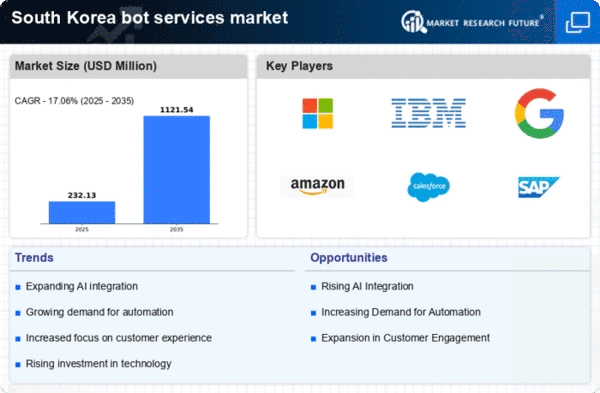
As per MRFR analysis, the South Korea bot services market size was estimated at 198.3 USD Million in 2024. The South Korea bot services market is projected to grow from 232.13 USD Million in 2025 to 1121.54 USD Million by 2035, exhibiting a compound annual growth rate (CAGR) of 17.06% during the forecast period 2025 - 2035.

Key Market Trends & Highlights

The South Korea bot services market is experiencing robust growth. This growth is driven by technological advancements and evolving consumer expectations.

  • The market is witnessing increased adoption of AI technologies, enhancing operational efficiency.
  • A strong focus on customer experience is shaping the development of bot services across various sectors.
  • Integration with other technologies is becoming a key trend, particularly in the retail and healthcare segments.
  • Rising demand for automation and government support initiatives are major drivers propelling market growth.

Market Size & Forecast

2024 Market Size 198.3 (USD Million)
2035 Market Size 1121.54 (USD Million)
CAGR (2025 - 2035) 17.06%

Major Players

Microsoft (US), IBM (US), Google (US), Amazon (US), Salesforce (US), SAP (DE), Nuance Communications (US), LivePerson (US), Zendesk (US)

South Korea Bot Services Market Trends

The bot services market in South Korea is experiencing notable growth, driven by advancements in artificial intelligence and increasing demand for automation across various sectors. Businesses are increasingly adopting these services to enhance customer engagement, streamline operations, and reduce costs. The integration of chatbots and virtual assistants into customer service frameworks appears to be a key factor in this expansion. Moreover, the rise of e-commerce and digital platforms has further accelerated the need for efficient communication tools, allowing companies to respond to consumer inquiries promptly and effectively. In addition, the South Korean government is actively promoting the development of AI technologies, which may contribute to the evolution of the bot services market. Initiatives aimed at fostering innovation and supporting startups in the tech sector suggest a favorable environment for growth. As organizations continue to recognize the potential benefits of implementing bot services, the market is likely to witness further advancements and diversification in offerings, catering to a wide range of industries and consumer needs.

Increased Adoption of AI Technologies

The bot services market is witnessing a surge in the adoption of artificial intelligence technologies. Companies are leveraging AI to create more sophisticated and responsive bots, enhancing user experience and operational efficiency. This trend indicates a shift towards more intelligent systems capable of understanding and processing natural language.

Focus on Customer Experience

There is a growing emphasis on improving customer experience through personalized interactions. Businesses are utilizing bot services to provide tailored responses and support, which may lead to higher customer satisfaction and loyalty. This trend reflects a broader strategy to enhance engagement and retention.

Integration with Other Technologies

The integration of bot services with other emerging technologies, such as machine learning and data analytics, is becoming increasingly prevalent. This convergence allows for more effective data utilization and insights, enabling businesses to refine their strategies and improve service delivery.

South Korea Bot Services Market Drivers

Rising Demand for Automation

The bot services market in South Korea is experiencing a notable surge in demand for automation across various sectors. Businesses are increasingly recognizing the efficiency and cost-effectiveness that automation brings to operations. In 2025, the market is projected to grow by approximately 15%, driven by the need for streamlined processes and reduced operational costs. Companies are leveraging bot services to handle repetitive tasks, allowing human resources to focus on more strategic initiatives. This shift not only enhances productivity but also improves service delivery, making automation a key driver in the bot services market. As organizations continue to invest in technology, the integration of bots into customer service, sales, and support functions is likely to expand, further solidifying the role of automation in the market.

Evolving Consumer Expectations

Consumer expectations in South Korea are evolving rapidly, with a growing preference for instant and personalized services. The bot services market is responding to this shift by offering solutions that enhance customer engagement and satisfaction. In 2025, it is estimated that 70% of consumers will prefer interacting with bots for customer service inquiries, reflecting a significant change in behavior. This trend indicates that businesses must adapt to meet these expectations, driving the demand for sophisticated bot services that can provide tailored responses and support. As companies strive to improve customer experiences, the integration of advanced AI technologies into bot services is likely to become a focal point, further propelling the growth of the market.

Increased Focus on Data Security

As the bot services market in South Korea continues to grow, there is an increasing focus on data security and privacy. Businesses are becoming more aware of the potential risks associated with deploying bots, particularly in handling sensitive customer information. In 2025, it is anticipated that 60% of companies will prioritize data security measures when implementing bot services. This heightened awareness is driving the development of secure bot solutions that comply with regulatory standards and protect user data. Consequently, the emphasis on data security is likely to shape the bot services market, as organizations seek to build trust with consumers while leveraging automation to enhance operational efficiency.

Technological Advancements in AI

Technological advancements in artificial intelligence are significantly influencing the bot services market in South Korea. Innovations in natural language processing and machine learning are enabling bots to understand and respond to customer inquiries more effectively. In 2025, the market is projected to witness a growth rate of 20% due to these advancements, as businesses seek to implement more intelligent and responsive bot solutions. The ability of bots to learn from interactions and improve over time enhances their utility in various applications, from customer support to sales. As companies increasingly adopt these technologies, the bot services market is likely to expand, driven by the demand for smarter, more capable automation solutions.

Government Support and Initiatives

The South Korean government actively promotes the adoption of advanced technologies. This includes bot services through various initiatives and funding programs. In 2025, government investments in digital transformation are expected to reach over $1 billion. This investment aims to enhance the competitiveness of local businesses. This support fosters innovation and encourages companies to integrate bot services into their operations. By providing grants and incentives, the government aims to stimulate growth in the bot services market, which is anticipated to benefit from increased research and development activities. Furthermore, regulatory frameworks are being established to ensure the ethical use of AI and automation, creating a conducive environment for the expansion of the bot services market.


Market Segment Insights

By Application: Customer Support (Largest) vs. E-commerce (Fastest-Growing)

In the South Korea bot services market, the distribution of market share among application segments is diverse, with Customer Support dominating the landscape. This segment benefits from a strong customer demand for automated assistance, which enhances user experience and operational efficiency. E-commerce follows closely, gaining traction as online shopping continues to flourish. Other segments like Finance and Healthcare also hold essential positions, yet they do not match the prominence of these primary applications. Growth trends indicate that the E-commerce segment is experiencing rapid adoption, fueled by the increasing reliance on digital solutions and automated processes. Drivers include changing consumer behaviors and an emphasis on enhancing customer interaction. Meanwhile, Customer Support remains vital, as businesses consistently seek ways to reduce response times and improve service quality, thereby reinforcing its lasting significance in the market.

Customer Support: Dominant vs. E-commerce: Emerging

Customer Support continues to be the dominant application in the South Korea bot services market, leveraging advancements in AI and machine learning to create efficient interaction channels. Companies in this segment are focused on optimizing user experience, with many integrating chatbots into their customer service platforms to handle inquiries and resolve issues promptly. On the other hand, E-commerce is an emerging contender characterized by its rapid evolution and adaptation to consumer needs. This segment utilizes bots for personalized shopping experiences, customer engagement, and seamless transaction processes. Both segments demonstrate a strong commitment to innovation, although Customer Support leads in established market presence while E-commerce capitalizes on the growth of online retail.

By Bot Type: Text Bots (Largest) vs. Voice Bots (Fastest-Growing)

In the South Korea bot services market, the distribution of market share among bot types reveals that Text Bots dominate with a significant portion, reflecting their established presence and usability across various industries. Voice Bots, while currently a smaller segment, are showing a remarkable growth trajectory as more enterprises implement voice-assisted technologies to enhance customer engagement. The growth trends within this segment are driven by the increasing demand for automated services that improve customer interaction and operational efficiency. Innovations in natural language processing and machine learning are propelling Voice Bots to the forefront, allowing them to become the fastest-growing category. This evolution signifies a shift toward more interactive and human-like communication, appealing to businesses aiming to provide superior customer experiences.

Text Bots (Dominant) vs. Voice Bots (Emerging)

Text Bots have established themselves as the dominant force in the market, known for their efficiency and ease of integration into various customer service platforms. They cater to a wide array of applications, from customer support to lead generation, making them invaluable for many businesses. Conversely, Voice Bots are emerging with unique characteristics that set them apart; they leverage voice recognition technology to engage users more interactively, promoting a seamless experience. As businesses increasingly recognize the potential of voice interactivity, Voice Bots are positioned to grow rapidly, appealing to tech-savvy consumers and aligning with the trend toward personalized service.

By Deployment Model: Cloud-based (Largest) vs. Hybrid (Fastest-Growing)

In the South Korea bot services market, the cloud-based deployment model leads the segment with a significant market share due to its scalability and flexibility. This model attracts businesses aiming for cost efficiency and ease of integration with existing systems, making it the preferred choice among various organizations. Conversely, the on-premises segment has seen a decline as companies pivot towards more modern solutions, while the hybrid model is gaining traction.

Cloud-based (Dominant) vs. Hybrid (Emerging)

Cloud-based services dominate the deployment model segment in the South Korea bot services market, providing organizations with unparalleled scalability and adaptability. This model supports rapid deployment, enabling companies to leverage advanced technologies without the overhead of physical infrastructure. On the other hand, the hybrid deployment model is emerging as a popular choice among organizations seeking to balance performance and security. It allows firms to utilize cloud solutions while retaining essential data on-premises, addressing concerns related to compliance and data protection. This dual approach caters to diverse operational needs, leading to a significant growth trajectory in the coming years.

By End Use Sector: Retail (Largest) vs. Banking (Fastest-Growing)

In the South Korea bot services market, the retail sector holds the largest share, showcasing its importance in engaging customers and enhancing the shopping experience. This segment leverages bots for personalized recommendations and efficient customer service, significantly influencing consumer behavior. Meanwhile, the banking sector emerges as a crucial player, capitalizing on automation to streamline operations and improve customer interactions. This ability to adapt and innovate positions banking as a key growth driver within the market. The growth trends for these segments are driven by increasing consumer expectations and the ongoing shift towards digitalization. Retail continues to dominate due to the rise of e-commerce, while banking sees rapid expansion in automating financial services. Factors such as enhanced user experience, cost-efficiency, and the proliferation of mobile technology catalyze growth. As both sectors evolve, they underscore the necessity for businesses to adopt bot technologies to stay competitive.

Retail: Dominant vs. Banking: Emerging

The retail sector remains dominant in the South Korea bot services market, characterized by its profound investment in customer engagement and service automation. Retailers are harnessing chatbots to provide personalized experiences, making it an essential aspect of their strategies to drive sales and customer satisfaction. On the other hand, the banking sector, while categorized as emerging, is rapidly gaining traction by integrating bots to enhance efficiency in handling queries, transactions, and customer support. This sector is witnessing a swift uptake in bot technology due to the need for increased operational efficiency and improved customer service, indicating a strong potential for future growth.

Get more detailed insights about South Korea Bot Services Market

Key Players and Competitive Insights

The bot services market in South Korea is characterized by a dynamic competitive landscape, driven by rapid technological advancements and increasing demand for automation across various sectors. Major players such as Microsoft (US), IBM (US), and Google (US) are strategically positioning themselves through innovation and partnerships, which collectively enhance their market presence. Microsoft (US) focuses on integrating AI capabilities into its bot services, while IBM (US) emphasizes its Watson platform to deliver tailored solutions. Google (US) leverages its cloud infrastructure to provide scalable bot services, indicating a trend towards cloud-based solutions that enhance operational efficiency.

The market structure appears moderately fragmented, with a mix of established players and emerging startups. Key business tactics include localizing services to cater to the unique needs of South Korean consumers and optimizing supply chains to ensure timely delivery of services. This competitive structure allows for a diverse range of offerings, enabling companies to differentiate themselves through specialized services and localized support.

In October 2025, Microsoft (US) announced a partnership with a leading South Korean telecommunications company to enhance its bot services with localized language processing capabilities. This strategic move is likely to improve user experience and engagement, positioning Microsoft (US) as a frontrunner in the market. The collaboration underscores the importance of regional partnerships in adapting global technologies to local contexts.

In September 2025, IBM (US) launched an upgraded version of its Watson Assistant, incorporating advanced natural language processing features tailored for the South Korean market. This enhancement is expected to significantly improve customer interactions, suggesting that IBM (US) is committed to maintaining its competitive edge through continuous innovation. The focus on localized features may attract more businesses seeking to enhance customer service through AI-driven solutions.

In August 2025, Google (US) expanded its bot services portfolio by introducing a new suite of tools designed specifically for e-commerce platforms in South Korea. This initiative reflects Google's strategy to tap into the growing online retail sector, indicating a shift towards industry-specific solutions. By aligning its offerings with market demands, Google (US) is likely to strengthen its foothold in the competitive landscape.

As of November 2025, current trends in the bot services market include a strong emphasis on digitalization, AI integration, and sustainability. Strategic alliances are increasingly shaping the competitive environment, as companies recognize the value of collaboration in enhancing service offerings. Looking ahead, competitive differentiation is expected to evolve, with a shift from price-based competition to a focus on innovation, technology, and supply chain reliability. This transition may redefine how companies engage with customers, ultimately driving growth in the bot services market.

Key Companies in the South Korea Bot Services Market market include

Industry Developments

The GPT-4-powered chatbot "AskUp," which is integrated into KakaoTalk and has OCR-based document understanding (also known as "ChatGPT with eyes"), was released in March 2023 by the South Korean AI startup Upstage. It quickly grew into AskUp Biz for enterprise use cases and LINE Messenger in May 2023 for a wider regional reach, gaining almost 30,000 subscribers in just three days of debut.

In order to improve performance and comprehension of Korean, AskUp was formally merged with Upstage's Solar model (their proprietary tiny LLM) within Kakao's AI services in January 2024.

Concurrently, in October 2024, Kakao Corp declared its intention to introduce "Kanana," a stand-alone AI messenger software with group and personal chat agents intended for profound conversational customisation, with a beta release date of early 2025.

In October 2023, Naver finally released the beta version of its generative AI chatbot "CLOVA X," breaking into the Korean bot services market and adding support for Japanese.With Upstage's AskUp, Kakao's AI integration and Kanana, and Naver's CLOVA X leading the way in advanced, Korean-language-first conversational AI for consumer and enterprise applications, these initiatives highlight the robust innovation present in South Korea's bot services ecosystem.

Future Outlook

South Korea Bot Services Market Future Outlook

The Bot Services Market is projected to grow at a 17.06% CAGR from 2024 to 2035. This growth is driven by advancements in AI, increased automation, and demand for customer engagement solutions.

New opportunities lie in:

  • Development of AI-driven customer support bots for e-commerce platforms.
  • Integration of bots in healthcare for patient management and appointment scheduling.
  • Creation of multilingual bots to enhance global customer service capabilities.

By 2035, the bot services market is expected to achieve substantial growth, driven by innovation and diverse applications.

Market Segmentation

South Korea Bot Services Market Bot Type Outlook

  • Text Bots
  • Voice Bots
  • Social Media Bots

South Korea Bot Services Market Application Outlook

  • Customer Support
  • E-commerce
  • Finance
  • Healthcare

South Korea Bot Services Market End Use Sector Outlook

  • Retail
  • Banking
  • Telecommunications
  • Travel

South Korea Bot Services Market Deployment Model Outlook

  • Cloud-based
  • On-premises
  • Hybrid

Report Scope

MARKET SIZE 2024 198.3(USD Million)
MARKET SIZE 2025 232.13(USD Million)
MARKET SIZE 2035 1121.54(USD Million)
COMPOUND ANNUAL GROWTH RATE (CAGR) 17.06% (2024 - 2035)
REPORT COVERAGE Revenue Forecast, Competitive Landscape, Growth Factors, and Trends
BASE YEAR 2024
Market Forecast Period 2025 - 2035
Historical Data 2019 - 2024
Market Forecast Units USD Million
Key Companies Profiled Microsoft (US), IBM (US), Google (US), Amazon (US), Salesforce (US), SAP (DE), Nuance Communications (US), LivePerson (US), Zendesk (US)
Segments Covered Application, Bot Type, Deployment Model, End Use Sector
Key Market Opportunities Integration of artificial intelligence in bot services enhances customer engagement and operational efficiency.
Key Market Dynamics Rising demand for AI-driven customer support bots enhances competitive dynamics in the bot services market.

Countries Covered South Korea

Leave a Comment

FAQs

What is the expected market size of the South Korea Bot Services Market in 2024?

The South Korea Bot Services Market is expected to be valued at approximately 198.45 million USD in the year 2024.

What will the market size of the South Korea Bot Services Market be in 2035?

By 2035, the market is projected to reach a total value of around 791.43 million USD.

What is the expected CAGR for the South Korea Bot Services Market from 2025 to 2035?

The expected compound annual growth rate (CAGR) for the market from 2025 to 2035 is 13.4%.

What are the key applications contributing to the South Korea Bot Services Market?

The primary applications in the market include customer support, e-commerce, finance, and healthcare.

How much is the customer support segment valued at in 2024?

The customer support segment of the South Korea Bot Services Market is valued at approximately 62.45 million USD in 2024.

What will the market size of the e-commerce application be by 2035?

The e-commerce application in the South Korea Bot Services Market is expected to reach around 182.59 million USD by 2035.

Which companies are the major players in the South Korea Bot Services Market?

Some of the key players in the market include Naver, Aibridge, SK Telecom, Daumsoft, and LG CNS.

What is the projected market size for the finance application in 2024?

The finance application segment is projected to be valued at about 47.0 million USD in 2024.

How much is the healthcare application expected to grow by 2035?

The healthcare application segment is expected to grow to approximately 171.93 million USD by 2035.

What is the expected market growth rate for specific segments within the South Korea Bot Services Market?

Each segment is experiencing robust growth, reflecting increasing adoption rates and technological advancements in the industry.

Download Free Sample

Kindly complete the form below to receive a free sample of this Report

Compare Licence

×
Features License Type
Single User Multiuser License Enterprise User
Price $4,950 $5,950 $7,250
Maximum User Access Limit 1 User Upto 10 Users Unrestricted Access Throughout the Organization
Free Customization
Direct Access to Analyst
Deliverable Format
Platform Access
Discount on Next Purchase 10% 15% 15%
Printable Versions