×
Request Free Sample ×

Kindly complete the form below to receive a free sample of this Report

* Please use a valid business email

Leading companies partner with us for data-driven Insights

clients tt-cursor
Hero Background

Japan Bot Services Market

ID: MRFR/ICT/60168-HCR
200 Pages
Aarti Dhapte
October 2025

Japan Bot Services Market Research Report By Application (Customer Support, E-commerce, Finance, Healthcare), By Bot Type (Text Bots, Voice Bots, Social Media Bots), By Deployment Model (Cloud-based, On-premises, Hybrid), and By End Use Sector (Retail, Banking, Telecommunications, Travel)- Forecast to 2035

Share:
Download PDF ×

We do not share your information with anyone. However, we may send you emails based on your report interest from time to time. You may contact us at any time to opt-out.

Japan Bot Services Market Infographic
Purchase Options

Japan Bot Services Market Summary

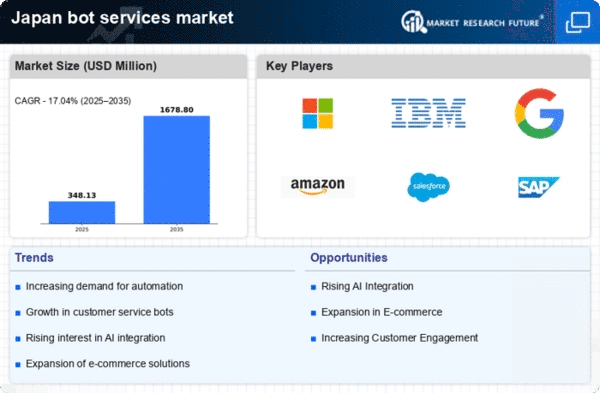
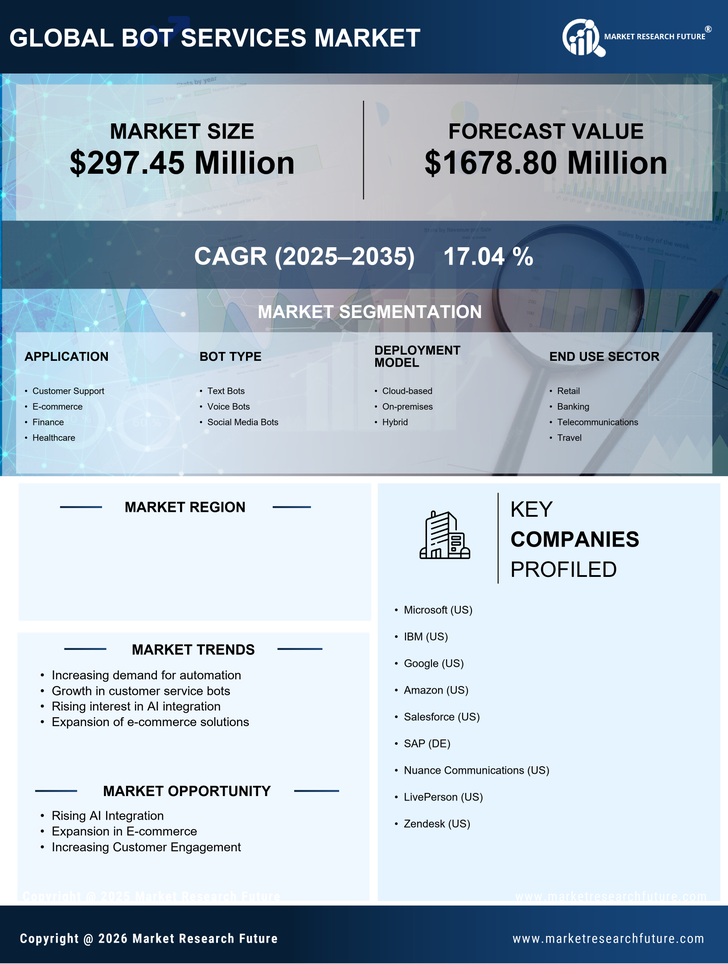
As per MRFR analysis, the bot services market size was estimated at 297.45 USD Million in 2024. The bot services market is projected to grow from 348.13 USD Million in 2025 to 1678.8 USD Million by 2035, exhibiting a compound annual growth rate (CAGR) of 17.04% during the forecast period 2025–2035.

Key Market Trends & Highlights

The Japan bot services market is experiencing robust growth driven by technological advancements and increasing demand for automation.

  • The market is witnessing increased adoption across various industries, particularly in customer service and e-commerce.
  • Personalization is becoming a focal point, as businesses strive to enhance user experiences through tailored interactions.
  • Regulatory compliance and security are gaining prominence, influencing the development and deployment of bot services.
  • Technological advancements in AI and rising demand for customer support automation are key drivers propelling market growth.

Market Size & Forecast

2024 Market Size 297.45 (USD Million)
2035 Market Size 1678.8 (USD Million)
CAGR (2025–2035) 17.04%

Major Players

Microsoft (US), IBM (US), Google (US), Amazon (US), Salesforce (US), SAP (DE), Nuance Communications (US), LivePerson (US), Zendesk (US)

Japan Bot Services Market Trends

The bot services market is experiencing notable growth, driven by advancements in artificial intelligence and machine learning technologies. Organizations are increasingly adopting these services to enhance customer engagement and streamline operations. The integration of chatbots into various sectors, including retail, finance, and healthcare, appears to be a key factor in this expansion. Companies are leveraging these tools to provide real-time support, improve user experience, and reduce operational costs. As businesses recognize the potential of automation, the demand for sophisticated bot services continues to rise. Moreover, the regulatory environment in Japan is evolving to support the adoption of digital solutions, including bot services. Government initiatives aimed at promoting technological innovation and digital transformation are likely to further stimulate market growth. The focus on enhancing cybersecurity measures and ensuring data privacy is also becoming increasingly important. As organizations navigate these challenges, they are likely to invest in bot services that comply with regulatory standards while delivering effective solutions. This trend suggests a promising future for the bot services market, as businesses seek to balance innovation with compliance and security.

Increased Adoption Across Industries

Various sectors are increasingly integrating bot services to enhance operational efficiency and customer interaction. This trend indicates a shift towards automation, where businesses utilize chatbots for tasks ranging from customer support to data collection.

Focus on Personalization

There is a growing emphasis on personalized user experiences within the bot services market. Companies are leveraging data analytics to tailor interactions, thereby improving customer satisfaction and engagement.

Regulatory Compliance and Security

As the bot services market expands, adherence to regulatory frameworks is becoming crucial. Organizations are prioritizing security measures to protect user data, ensuring compliance with local laws and regulations.

Japan Bot Services Market Drivers

Technological Advancements in AI

The bot services market in Japan is experiencing a surge due to rapid advancements in artificial intelligence (AI) technologies. Innovations in natural language processing (NLP) and machine learning are enhancing the capabilities of bots, making them more efficient and user-friendly. As a result, businesses are increasingly adopting these technologies to improve customer interactions and streamline operations. In 2025, the market is projected to grow by approximately 15%, driven by the demand for smarter, more responsive bots. This trend indicates that companies are recognizing the potential of AI-driven solutions to enhance customer satisfaction and operational efficiency, thereby solidifying the bot services market's position in various sectors.

Focus on Multilingual Capabilities

The bot services market in Japan is increasingly focusing on multilingual capabilities to cater to a diverse customer base. With Japan being a hub for international business, the ability to communicate in multiple languages is becoming essential. Companies are investing in bots that can understand and respond in various languages, thereby enhancing user experience and accessibility. This trend is likely to drive market growth, as businesses aim to reach a broader audience. In 2025, it is projected that multilingual bots will account for approximately 30% of the market, reflecting the importance of inclusivity in customer interactions within the bot services market.

Integration with E-commerce Platforms

The bot services market in Japan is witnessing a notable increase in integration with e-commerce platforms. As online shopping continues to gain traction, businesses are leveraging bots to enhance the shopping experience. In 2025, it is anticipated that over 40% of e-commerce transactions will involve bot interactions, indicating a significant shift in consumer behavior. This integration allows for personalized recommendations, order tracking, and customer inquiries, thereby improving overall customer satisfaction. The growing reliance on bots in the e-commerce sector underscores their importance in the bot services market, as companies seek to optimize their online presence and drive sales.

Rising Demand for Customer Support Automation

The bot services market in Japan is significantly influenced by the growing demand for automated customer support solutions. Businesses are increasingly seeking to enhance their customer service capabilities while reducing operational costs. In 2025, it is estimated that around 60% of customer interactions will be managed by bots, reflecting a shift towards automation in customer service. This trend suggests that organizations are prioritizing efficiency and responsiveness, leading to a robust growth trajectory for the bot services market. As companies strive to meet customer expectations for immediate assistance, the integration of bots into customer support frameworks is becoming a strategic imperative.

Increased Investment in Digital Transformation

The bot services market in Japan is benefiting from a broader trend of increased investment in digital transformation initiatives. Organizations are recognizing the need to modernize their operations and enhance customer engagement through digital solutions. In 2025, it is expected that spending on digital transformation will exceed ¥10 trillion, with a significant portion allocated to bot services. This investment indicates a strategic shift towards adopting innovative technologies to improve efficiency and customer satisfaction. As companies embrace digital transformation, the bot services market is likely to experience substantial growth, driven by the demand for advanced automation and enhanced customer interactions.

Market Segment Insights

By Application: Customer Support (Largest) vs. E-commerce (Fastest-Growing)

The Japan bot services market has a diverse application landscape, with Customer Support holding the largest market share. This segment is driven by the increasing demand for automating customer interactions and providing timely assistance. E-commerce, while currently smaller, is rapidly gaining traction due to the growth of online shopping and the need for customer engagement through chatbots. Growth trends indicate that Customer Support will continue to dominate the market, fueled by advancements in AI and Natural Language Processing. Meanwhile, E-commerce is emerging as the fastest-growing segment, with businesses increasingly leveraging chatbots to enhance user experience and streamline transactions. Other segments like Finance and Healthcare are also evolving, but their growth rates are not as pronounced as that of E-commerce and Customer Support.

Customer Support: Dominant vs. E-commerce: Emerging

In the Japan bot services market, Customer Support stands as the dominant segment due to its critical role in enhancing customer service efficiency and satisfaction. Businesses are investing in chatbot solutions that can handle inquiries, complaints, and support requests around the clock, thus reducing operational costs. On the other hand, E-commerce is an emerging segment reflecting the shift towards digital transactions. The integration of chatbots in E-commerce platforms improves customer engagement, aids in product discovery, and facilitates transactions seamlessly. As online shopping behavior evolves, the adoption of chatbots in E-commerce is expected to accelerate, positioning it as a vital player in this market.

By Bot Type: Text Bots (Largest) vs. Voice Bots (Fastest-Growing)

In the Japan bot services market, Text Bots currently hold the largest market share, capitalizing on their extensive applications in customer service and information dissemination. Conversely, Voice Bots are rapidly gaining traction, particularly in scenarios demanding enhanced user interaction, showing a significant upward trend in adoption rates. Recent growth in the Japan bot services market can be attributed to technological advancements and the increasing demand for automation across various sectors. Businesses are integrating these bots to enhance user experiences and streamline operations. Besides, the proliferation of smart devices and voice-activated technologies has spurred interest in Voice Bots, marking them as the fastest-growing segment in the market.

Text Bots (Dominant) vs. Voice Bots (Emerging)

Text Bots represent the dominant value in the Japan bot services market, characterized by their ability to deliver instantaneous replies and handle numerous queries simultaneously. Their versatility across industries such as retail, finance, and telecommunications allows them to cater to diverse customer needs, enhancing overall engagement. In comparison, Voice Bots, classified as an emerging segment, are becoming increasingly popular due to the rise of voice search and AI technology. They offer a unique interactive experience for customers, making them invaluable in sectors such as hospitality and telecommunication. As businesses evolve to incorporate more personalized communication, the potential for Voice Bots is immense, signaling a transformative shift in how consumers interact with brands.

By Deployment Model: Cloud-based (Largest) vs. On-premises (Fastest-Growing)

In the Japan bot services market, the deployment model segment demonstrates a diverse distribution among its key values. Cloud-based solutions hold a significant share, driven by the increasing adoption of cloud technologies and the demand for scalable services. On the other hand, on-premises solutions, although currently smaller in market share, are witnessing robust growth as organizations prioritize data security and control. Growth trends in this segment are influenced by several factors. The rising shift towards hybrid cloud strategies is encouraging businesses to adopt a mix of deployment models. Additionally, enhanced internet connectivity and the demand for real-time customer interactions are propelling the growth of cloud-based deployments. Conversely, the emerging need for customized solutions is boosting on-premises deployments, especially in industries handling sensitive data.

Cloud-based (Dominant) vs. On-premises (Emerging)

The cloud-based deployment model is regarded as the dominant force within the Japan bot services market. It allows organizations to leverage the scalability and flexibility of cloud solutions, making it easier to implement and manage bot services without hefty infrastructure investments. Features such as automatic updates, global accessibility, and reduced maintenance costs contribute to its popularity. In contrast, on-premises solutions are gaining traction as an emerging choice. Many businesses are opting for on-premises deployments to ensure data sovereignty and security, which is crucial in certain sectors like finance and healthcare. This model allows for customization and greater control over the bot services, appealing to organizations that have stringent compliance and security requirements.

By End Use Sector: Retail (Largest) vs. Banking (Fastest-Growing)

The market share distribution within the end use sector of the Japan bot services market reveals that retail holds the largest segment, catering to a vast array of consumer needs. The significant adoption of bots in retail has transformed customer interactions, allowing for personalized shopping experiences and streamlined services. Meanwhile, banking is emerging as a critical sector, witnessing robust growth as financial institutions increasingly leverage bots for customer service and operational efficiency. In terms of growth trends, the retail sector is characterized by its adaptation to technology, leading to enhanced customer engagement and retention. On the other hand, the banking sector is experiencing the fastest growth, driven by a demand for round-the-clock customer support and security features provided by bot solutions. This trend is fueled by the increasing need for automation in financial services to respond quickly to customer inquiries and facilitate seamless transactions.

Retail: Dominant vs. Banking: Emerging

The retail segment of the Japan bot services market is highly established, distinguished by its extensive use of chatbots and virtual assistants to engage customers effectively. This segment has optimized its sales processes and customer interactions through automation, enabling businesses to offer tailored experiences and improve overall operational efficiency. Conversely, the banking segment is identified as a fast-emerging area, showing significant potential for growth. It focuses on enhancing customer service through bots, which provide essential financial advice, transaction support, and 24/7 accessibility. The ongoing digital transformation in finance, coupled with rising consumer expectations for immediate support, positions banking as a rapidly expanding opportunity in the Japan bot services market.

Get more detailed insights about Japan Bot Services Market

Key Players and Competitive Insights

The bot services market in Japan is characterized by a dynamic competitive landscape, driven by rapid technological advancements and increasing demand for automation across various sectors. Key players such as Microsoft (US), IBM (US), and Google (US) are strategically positioned to leverage their extensive resources and expertise in artificial intelligence (AI) and machine learning. These companies focus on innovation and partnerships to enhance their service offerings, thereby shaping a competitive environment that emphasizes technological superiority and customer-centric solutions. The collective strategies of these firms indicate a trend towards digital transformation, with an emphasis on integrating AI capabilities into existing platforms to improve user experience and operational efficiency.

In terms of business tactics, companies are increasingly localizing their services to better cater to the unique needs of the Japanese market. This localization often involves optimizing supply chains and enhancing customer support through regional partnerships. The market structure appears moderately fragmented, with several players vying for market share, yet dominated by a few key firms that significantly influence pricing and service standards. The competitive dynamics suggest that while there is room for smaller entrants, the established players maintain a stronghold through innovation and brand loyalty.

In October 2025, Microsoft (US) announced the launch of its new AI-driven customer service platform tailored specifically for the Japanese market. This strategic move is likely to enhance Microsoft's competitive edge by providing localized solutions that address the specific needs of Japanese businesses, thereby fostering deeper customer engagement and satisfaction. The introduction of this platform underscores Microsoft's commitment to leveraging AI technology to streamline customer interactions and improve service delivery.

In September 2025, IBM (US) expanded its partnership with a leading Japanese telecommunications company to integrate advanced chatbot solutions into their customer service operations. This collaboration is indicative of IBM's strategy to enhance its market presence in Japan by aligning with local firms that possess extensive market knowledge. The partnership aims to optimize customer service efficiency and reduce operational costs, reflecting IBM's focus on delivering tailored solutions that resonate with local businesses.

In August 2025, Google (US) unveiled a new suite of tools designed to enhance chatbot functionalities for Japanese enterprises. This initiative is significant as it demonstrates Google's intent to solidify its position in the bot services market by providing innovative solutions that cater to the evolving demands of Japanese consumers. The introduction of these tools is expected to facilitate better customer interactions and drive adoption among businesses seeking to improve their digital engagement strategies.

As of November 2025, the competitive trends in the bot services market are increasingly defined by digitalization, sustainability, and the integration of AI technologies. Strategic alliances among key players are shaping the landscape, fostering innovation and enhancing service delivery. The shift from price-based competition to a focus on technological advancement and supply chain reliability is evident, suggesting that future competitive differentiation will hinge on the ability to innovate and adapt to changing market demands.

Key Companies in the Japan Bot Services Market market include

Industry Developments

Users can engage with generative AI for tasks like searching, translation, image analysis, content summarization, and planning with LINE AI Assistant, which launched as a paid and free feature within LINE Messenger throughout Japan in February 2024. It provides up to five free AI responses daily, with an optional JPY 990/month subscription for unlimited access and capabilities.

An internal AI chatbot called "MCGPT" was piloted by Mitsubishi Corporation in May 2024. It was developed on Microsoft Azure OpenAI Service and integrated with Azure Cosmos DB and Synapse Analytics to support more than a dozen departments. It accelerated the automation of Japanese-language text in business workflows and customized generative AI for enterprise use.

With governance regulations in place and all data safeguarded within Japanese Azure tenants, Kawasaki Kisen Kaisha ("K" LINE) started utilizing AIplicity Chat, a conversational assistant developed by ChatGPT and hosted on Azure OpenAI, for internal operations across Japanese offices in August 2023.

Under the leadership of LINE, NTT Communications, AWS, Microsoft, and Google platforms, these initiatives demonstrate how Japan's bot services ecosystem is developing with consumer-facing AI chat assistants (LINE), secure enterprise deployment (bots powered by Azure), and native Japanese-language generative AI adoption across corporate and internal workflows.

Future Outlook

Japan Bot Services Market Future Outlook

The Bot Services Market in Japan is projected to grow at a 17.04% CAGR from 2024 to 2035, driven by advancements in AI, increased automation, and demand for customer engagement solutions.

New opportunities lie in:

  • Integration of AI-driven analytics for personalized customer interactions.
  • Development of multilingual support bots to enhance user experience.
  • Expansion of bot services into healthcare for patient management and support.

By 2035, the bot services market is expected to achieve substantial growth, reflecting evolving consumer needs and technological advancements.

Market Segmentation

Japan Bot Services Market Bot Type Outlook

  • Text Bots
  • Voice Bots
  • Social Media Bots

Japan Bot Services Market Application Outlook

  • Customer Support
  • E-commerce
  • Finance
  • Healthcare

Japan Bot Services Market End Use Sector Outlook

  • Retail
  • Banking
  • Telecommunications
  • Travel

Japan Bot Services Market Deployment Model Outlook

  • Cloud-based
  • On-premises
  • Hybrid

Report Scope

MARKET SIZE 2024 297.45(USD Million)
MARKET SIZE 2025 348.13(USD Million)
MARKET SIZE 2035 1678.8(USD Million)
COMPOUND ANNUAL GROWTH RATE (CAGR) 17.04% (2024 - 2035)
REPORT COVERAGE Revenue Forecast, Competitive Landscape, Growth Factors, and Trends
BASE YEAR 2024
Market Forecast Period 2025 - 2035
Historical Data 2019 - 2024
Market Forecast Units USD Million
Key Companies Profiled Microsoft (US), IBM (US), Google (US), Amazon (US), Salesforce (US), SAP (DE), Nuance Communications (US), LivePerson (US), Zendesk (US)
Segments Covered Application, Bot Type, Deployment Model, End Use Sector
Key Market Opportunities Integration of artificial intelligence in customer service enhances efficiency in the bot services market.
Key Market Dynamics Rising demand for automation in customer service drives innovation in bot services across various industries.
Countries Covered Japan

Leave a Comment

FAQs

What is the projected market size of the Japan Bot Services Market in 2024?

The Japan Bot Services Market is expected to be valued at 297.68 million USD in 2024.

How much is the Japan Bot Services Market expected to grow by 2035?

By 2035, the Japan Bot Services Market is projected to reach a value of 1570.0 million USD.

What is the expected CAGR for the Japan Bot Services Market between 2025 and 2035?

The expected CAGR for the Japan Bot Services Market from 2025 to 2035 is 16.319%.

Which applications are driving growth in the Japan Bot Services Market?

The major applications driving growth include Customer Support, E-commerce, Finance, and Healthcare.

What is the market value for Customer Support in the Japan Bot Services Market in 2024?

The market value for Customer Support is projected to be 89.0 million USD in 2024.

How much is the Healthcare application expected to be worth in 2035?

The Healthcare application in the Japan Bot Services Market is expected to be valued at 410.0 million USD by 2035.

Who are the key players in the Japan Bot Services Market?

Key players include Google, Amazon Web Services, IBM, CyberAgent, and Rakuten.

What market size is expected for the E-commerce application in 2024?

The E-commerce application is expected to be valued at 75.0 million USD in 2024.

What potential challenges exist for the growth of the Japan Bot Services Market?

Challenges could stem from technological advancements and regulatory hurdles within the market.

What is the market value for Finance in the Japan Bot Services Market by 2035?

The Finance application is anticipated to reach a value of 300.0 million USD by 2035.

Download Free Sample

Kindly complete the form below to receive a free sample of this Report

Compare Licence

×
Features License Type
Single User Multiuser License Enterprise User
Price $4,950 $5,950 $7,250
Maximum User Access Limit 1 User Upto 10 Users Unrestricted Access Throughout the Organization
Free Customization
Direct Access to Analyst
Deliverable Format
Platform Access
Discount on Next Purchase 10% 15% 15%
Printable Versions