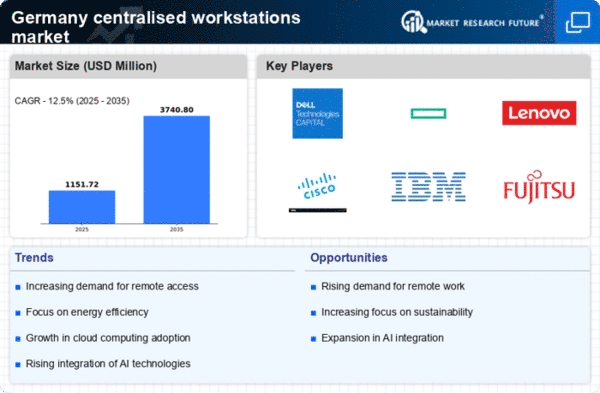
The centralised workstations market in Germany is characterized by a dynamic competitive landscape, driven by technological advancements and increasing demand for efficient computing solutions. Key players such as Dell Technologies (US), Hewlett Packard Enterprise (US), and Lenovo (CN) are at the forefront, each adopting distinct strategies to enhance their market presence. Dell Technologies (US) focuses on innovation and customer-centric solutions, while Hewlett Packard Enterprise (US) emphasizes partnerships and digital transformation initiatives. Lenovo (CN) appears to be leveraging its global supply chain to optimize production and reduce costs, thereby enhancing its competitive edge. Collectively, these strategies contribute to a competitive environment that is both collaborative and competitive, fostering innovation and efficiency.
In terms of business tactics, companies are increasingly localizing manufacturing to mitigate supply chain disruptions and enhance responsiveness to market demands. The market structure is moderately fragmented, with several key players exerting influence over various segments. This fragmentation allows for niche players to thrive, while larger corporations leverage their scale to optimize operations and drive down costs. The collective influence of these key players shapes the market dynamics, creating a competitive yet collaborative atmosphere.
In October 2025, Dell Technologies (US) announced a strategic partnership with a leading cloud service provider to enhance its cloud-based workstation offerings. This move is significant as it aligns with the growing trend towards hybrid work environments, allowing Dell to provide integrated solutions that cater to the evolving needs of businesses. The partnership is likely to bolster Dell's market position by expanding its service capabilities and enhancing customer engagement.
In September 2025, Hewlett Packard Enterprise (US) launched a new line of energy-efficient workstations aimed at reducing carbon footprints. This initiative reflects the increasing emphasis on sustainability within the industry. By prioritizing eco-friendly solutions, HPE not only addresses regulatory pressures but also appeals to environmentally conscious consumers, potentially increasing its market share in a competitive landscape.
In August 2025, Lenovo (CN) unveiled its latest AI-driven workstation series, designed to optimize performance for data-intensive applications. This strategic move underscores Lenovo's commitment to innovation and positions the company as a leader in integrating advanced technologies into its product offerings. The introduction of AI capabilities is likely to attract a broader customer base, particularly in sectors such as engineering and design, where computational power is paramount.
As of November 2025, the centralised workstations market is witnessing trends such as digitalization, sustainability, and AI integration, which are reshaping competitive dynamics. Strategic alliances are becoming increasingly important, as companies seek to enhance their technological capabilities and market reach. The competitive differentiation is expected to evolve, shifting from price-based competition to a focus on innovation, technology, and supply chain reliability. This transition indicates a future where companies that prioritize technological advancements and sustainable practices are likely to gain a competitive advantage.




















Leave a Comment