×
Request Free Sample ×

Kindly complete the form below to receive a free sample of this Report

* Please use a valid business email

Leading companies partner with us for data-driven Insights

clients tt-cursor
Hero Background

US Centralised Workstations Market

ID: MRFR/ICT/13462-HCR
100 Pages
Garvit Vyas
October 2025

US Centralized Workstations Market Research Report: By Type (1-to-1 Workstations, 1-to-Many Workstations), By Operating System (Windows Centralized Workstations, Linux Centralized Workstations, Unix Centralized Workstations), By Enterprise Size (Large Enterprise, Small and Medium-Sized Enterprise) and By Application (Healthcare, Education, Banking and Finance, Manufacturing, Media & Entertainment, Engineering & Design) - Forecast to 2035

Share:
Download PDF ×

We do not share your information with anyone. However, we may send you emails based on your report interest from time to time. You may contact us at any time to opt-out.

US Centralised Workstations Market Infographic
Purchase Options

US Centralised Workstations Market Summary

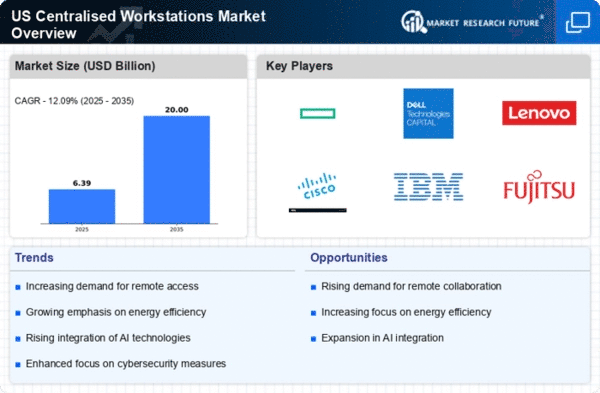
As per MRFR analysis, the US centralised workstations market Size was estimated at 5.7 USD Billion in 2024. The US centralised workstations market is projected to grow from 6.39 USD Billion in 2025 to 20.0 USD Billion by 2035, exhibiting a compound annual growth rate (CAGR) of 12.09% during the forecast period 2025 - 2035.

Key Market Trends & Highlights

The US centralised workstations market is experiencing a robust shift towards enhanced collaboration and advanced technology integration.

  • The largest segment in the US centralised workstations market is the enterprise segment, driven by the need for scalable IT solutions.
  • The fastest-growing segment is the education sector, reflecting an increasing demand for remote work solutions.
  • There is a notable emphasis on data security and compliance as organizations prioritize safeguarding sensitive information.
  • Key market drivers include the growing need for enhanced collaboration and the rising focus on cost efficiency.

Market Size & Forecast

2024 Market Size 5.7 (USD Billion)
2035 Market Size 20.0 (USD Billion)
CAGR (2025 - 2035) 12.09%

Major Players

Hewlett Packard Enterprise (US), Dell Technologies (US), Lenovo Group (CN), Cisco Systems (US), IBM Corporation (US), Fujitsu Limited (JP), Oracle Corporation (US), Supermicro Computer (US)

US Centralised Workstations Market Trends

the centralised workstations market is evolving rapidly., driven by advancements in technology and changing workplace dynamics. Organizations are increasingly adopting centralized systems to enhance efficiency and streamline operations. This shift appears to be influenced by the growing demand for remote access and collaboration tools, which facilitate seamless communication among teams. As businesses seek to optimize their resources, the integration of high-performance computing and virtualization technologies is becoming more prevalent. This trend suggests a potential for increased productivity and cost savings, as firms leverage centralized workstations to manage workloads more effectively. In addition, the emphasis on data security and compliance is shaping the landscape of the centralised workstations market. Companies are prioritizing secure access to sensitive information, which is leading to the implementation of robust security measures within centralized systems. This focus on safeguarding data not only protects organizational assets but also builds trust with clients and stakeholders. As the market continues to evolve, it is likely that innovations in hardware and software will further enhance the capabilities of centralized workstations, making them an integral part of modern business infrastructure.

Increased Demand for Remote Work Solutions

the centralised workstations market is seeing increased demand for remote work solutions.. Organizations are investing in technologies that enable employees to access centralized systems from various locations, thereby enhancing flexibility and productivity. This trend indicates a shift towards more adaptable work environments.

Focus on Data Security and Compliance

As data breaches become more prevalent, the centralised workstations market emphasizes security measures.. Companies are implementing advanced protocols to protect sensitive information stored within centralized systems. This focus on compliance not only safeguards data but also fosters trust among clients.

Integration of Advanced Technologies

the centralised workstations market increasingly integrates advanced technologies such as artificial intelligence and machine learning.. These innovations are enhancing the functionality of centralized systems, allowing for improved data analysis and decision-making processes. This trend suggests a move towards more intelligent and responsive work environments.

US Centralised Workstations Market Drivers

Rising Focus on Cost Efficiency

Cost efficiency remains a pivotal driver in the centralised workstations market. Organizations are continually seeking ways to optimize their operational expenses, and centralised workstations offer a viable solution. By consolidating resources and minimizing hardware costs, companies can achieve substantial savings. Reports suggest that businesses can reduce IT expenditures by up to 30% through the implementation of centralized systems. This financial incentive is particularly appealing in the current economic climate, where budget constraints are prevalent. As a result, the centralised workstations market is likely to witness increased adoption as firms prioritize cost-effective solutions.

Demand for Scalable IT Solutions

The centralised workstations market is being propelled by the growing demand for scalable IT solutions. As businesses expand, their IT infrastructure must adapt to accommodate increased workloads and user demands. Centralised workstations provide a flexible framework that allows organizations to scale their operations without significant investments in new hardware. This adaptability is crucial for companies aiming to remain competitive in a rapidly evolving market. Furthermore, the ability to easily integrate additional resources into existing systems enhances the appeal of centralised workstations, making them a preferred choice for many US enterprises.

Growing Need for Enhanced Collaboration

The centralised workstations market is experiencing a notable shift towards enhanced collaboration tools. As organizations increasingly adopt hybrid work models, the demand for centralized systems that facilitate seamless communication and collaboration among remote and on-site employees is rising. This trend is reflected in a survey indicating that 75% of companies in the US are investing in technologies that support collaborative work environments. Centralised workstations provide integrated platforms that allow teams to share resources, access data, and communicate effectively, thereby improving productivity. The market is projected to grow as businesses recognize the value of fostering teamwork and innovation through centralized solutions.

Emphasis on Data Management and Analytics

Data management and analytics are becoming increasingly critical in the centralised workstations market. Organizations are recognizing the importance of leveraging data to drive decision-making and improve operational efficiency. Centralised workstations facilitate the collection, storage, and analysis of vast amounts of data, enabling businesses to gain valuable insights. A recent study indicates that companies utilizing centralized data solutions experience a 20% increase in operational efficiency. This emphasis on data-driven strategies is likely to fuel the growth of the centralised workstations market as firms seek to harness the power of data for competitive advantage.

Integration of Cloud Computing Technologies

The integration of cloud computing technologies is significantly influencing the centralised workstations market. As more organizations migrate to cloud-based solutions, the demand for centralized systems that can effectively manage cloud resources is increasing. Centralised workstations enable users to access applications and data from any location, enhancing flexibility and productivity. The cloud computing market in the US is projected to reach $500 billion by 2025, indicating a robust growth trajectory. This trend suggests that the centralised workstations market will continue to evolve, driven by the need for efficient cloud integration and management.


Market Segment Insights

By Type: 1-to-1 Workstations (Largest) vs. 1-to-Many Workstations (Fastest-Growing)

In the US centralised workstations market, the 1-to-1 workstations segment leads the market with significant share, catering primarily to users who require dedicated resources and personalized setups. This segment has established a robust presence due to its intensive application in various sectors including design, engineering, and financial services. On the other hand, the 1-to-Many workstations segment has been gaining traction as organizations seek to optimize resource utilization and collaborative work environments. This shift is driven by the need for flexibility and efficiency, appealing to a broader range of businesses. Growth trends in the US centralised workstations market indicate a strong preference for 1-to-Many workstations, which are poised to experience rapid expansion over the next few years. Factors such as increased remote working policies and the rise of collaborative projects are propelling this segment forward. As more companies prioritize efficient workforce management, the demand for 1-to-Many workstations is expected to surge, solidifying its position as the fastest-growing segment within the market.

1-to-1 Workstations (Dominant) vs. 1-to-Many Workstations (Emerging)

The 1-to-1 workstations segment remains dominant due to its customization capabilities and high-performance requirements, making it ideal for professionals in resource-intensive fields. Users benefit from personalized configurations that enhance productivity and operational effectiveness. Conversely, the 1-to-Many workstations segment is emerging as a flexible solution for teams needing shared resources, promoting collaboration and cost-efficiency. This segment is tailored for environments where multiple users access the same workstation, thereby maximizing resource utilization while adapting to the dynamic needs of modern workplaces. With evolving workplace strategies, both segments play crucial roles in shaping the future of work environments.

By Operating System: Windows Centralized Workstations (Largest) vs. Linux Centralized Workstations (Fastest-Growing)

The market distribution among operating systems for centralized workstations is prominently led by Windows Centralized Workstations, capturing a significant share due to its extensive user base and established compatibility across various applications. Following this, Linux Centralized Workstations is rapidly gaining traction, particularly among enterprise users seeking flexibility and customization. Unix Centralized Workstations and other niche systems comprise the smaller segments, yet they cater efficiently to specific industries with specialized needs. The growth trends indicate that Windows Centralized Workstations continue to dominate the market, driven by continuous advancements in features and user experience. In contrast, the rising demand for Linux Centralized Workstations can be attributed to a shift towards open-source solutions and increased security concerns among organizations. This trend highlights a broader movement towards diversification in technological choices, reflecting the market's evolution in response to changing user requirements.

Windows Centralized Workstations (Dominant) vs. Linux Centralized Workstations (Emerging)

Windows Centralized Workstations are characterized by their extensive compatibility with a wide array of applications, providing a user-friendly interface that appeals to a broad audience. This segment leads in market share, supported by continuous updates and robust support networks. Conversely, Linux Centralized Workstations are emerging as a valuable alternative, particularly appealing to tech-savvy users and organizations emphasizing customization and security. With a growing community and an expanding ecosystem of applications, Linux operating systems are increasingly preferred for their reliability and cost-effectiveness. Both paths highlight distinct user preferences and the dynamic nature of the operating system landscape in centralized workstations.

By Enterprise Size: Large Enterprises (Largest) vs. Small and Medium-Sized Enterprises (SME) (Fastest-Growing)

In the US centralised workstations market, large enterprises have established themselves as the dominant players, holding significant market share due to their substantial purchasing power and extensive IT infrastructure. Meanwhile, small and medium-sized enterprises (SMEs) are rapidly increasing their share, driven by the need for competitive technology to enhance operational efficiency and productivity. As SMEs continue to recognize the value of centralized workstations, they are shifting their budgets towards adopting these solutions, resulting in a dynamic marketplace where both segments play crucial roles. The growth trends for these segments reflect divergent paths influenced by changing business needs. Large enterprises benefit from economies of scale, investing heavily in advanced centralized workstations to support their complex operations. Conversely, SMEs experience a faster adoption rate, motivated by the need to digitalize and optimize their processes. This increasing urgency has led SMEs to favor flexible, scalable workstation solutions, thus propelling their growth in the market. The synergy between these segments creates a competitive landscape that fosters innovation and development across the board.

Large Enterprises (Dominant) vs. Small and Medium-Sized Enterprises (SME) (Emerging)

Large enterprises typically possess comprehensive IT strategies, allowing them to invest substantially in advanced centralized workstation solutions. Their established presence means they often require robust systems to handle extensive data and a large user base, leading to increased operational efficiency. In contrast, small and medium-sized enterprises (SMEs) are increasingly recognized as an emerging force in the market. They tend to have more flexible requirements and are quicker to adopt newer technologies that enhance productivity. SMEs are leveraging centralized workstations to level the playing field against larger competitors, emphasizing affordability and adaptability. This emerging segment is characterized by a growing willingness to invest in technology, indicating a significant shift in focus towards maximizing operational efficiency through innovative solutions.

By Application: Healthcare (Largest) vs. Education (Fastest-Growing)

In the US centralised workstations market, the distribution of market share among the applications reveals that Healthcare is the largest segment, driven by the increasing need for advanced medical technologies and efficient patient management systems. Education follows as a significant segment, with growing demand for interactive learning environments that require robust centralized workstations to cater to both educators and students. Growth trends in this segment are influenced by several factors. The Healthcare segment experiences continuous growth due to the integration of telemedicine and electronic health records, thereby necessitating sophisticated workstations. Conversely, the Education sector is rapidly evolving, fueled by advancements in e-learning technologies and digital classrooms, marking it as the fastest-growing area within the market.

Healthcare: Dominant vs. Education: Emerging

The Healthcare segment plays a dominant role in the US centralised workstations market, characterized by the need for high-performance systems that support complex medical applications. This segment demands workstations capable of processing large amounts of data, integrating advanced imaging technologies, and facilitating secure patient information management. Meanwhile, the Education segment is emerging as a vital player, driven by digital transformation efforts across educational institutions. The focus here is on enhancing the learning experience through interactive technology and centralized resources, positioning it to capture a larger market share as schools and universities increasingly adopt these systems.

Get more detailed insights about US Centralised Workstations Market

Key Players and Competitive Insights

The centralised workstations market is currently characterized by a dynamic competitive landscape, driven by rapid technological advancements and increasing demand for efficient computing solutions. Key players such as Hewlett Packard Enterprise (US), Dell Technologies (US), and Cisco Systems (US) are strategically positioning themselves through innovation and partnerships. For instance, these companies are focusing on enhancing their product offerings with integrated solutions that cater to the evolving needs of businesses, thereby shaping a competitive environment that emphasizes technological superiority and customer-centric approaches.

In terms of business tactics, companies are increasingly localizing manufacturing and optimizing supply chains to enhance operational efficiency. The market appears moderately fragmented, with several key players exerting substantial influence. This structure allows for a diverse range of offerings, enabling companies to cater to specific customer needs while fostering competition that drives innovation and service quality.

In October 2025, Hewlett Packard Enterprise (US) announced a strategic partnership with a leading cloud service provider to enhance its centralised workstation solutions. This collaboration aims to integrate advanced cloud capabilities into their offerings, thereby enabling customers to leverage scalable resources and improve operational flexibility. Such a move underscores HPE's commitment to digital transformation and positions it favorably in a market increasingly leaning towards cloud-based solutions.

Similarly, in September 2025, Dell Technologies (US) launched a new line of centralised workstations designed specifically for remote work environments. This initiative reflects Dell's focus on addressing the growing demand for remote computing solutions, particularly in sectors that require high-performance capabilities. By aligning its product development with market trends, Dell is likely to strengthen its competitive edge and enhance customer satisfaction.

Moreover, in August 2025, Cisco Systems (US) expanded its portfolio by introducing advanced security features in its centralised workstation offerings. This strategic enhancement aims to address rising concerns regarding cybersecurity in an increasingly digital workspace. By prioritizing security, Cisco not only differentiates its products but also aligns with the broader industry trend towards safeguarding data integrity and privacy.

As of November 2025, the competitive trends in the centralised workstations market are heavily influenced by digitalization, sustainability, and AI integration. Strategic alliances are becoming pivotal in shaping the landscape, as companies seek to combine strengths and resources to innovate effectively. Looking ahead, competitive differentiation is expected to evolve, with a notable shift from price-based competition towards innovation, technology, and supply chain reliability. This transition suggests that companies that prioritize these aspects will likely emerge as leaders in the market.

Key Companies in the US Centralised Workstations Market market include

Industry Developments

There have been significant developments in the US Centralized Workstations Market recently. Notably, in August 2023, Dell announced an expansion of its high-performance computing solutions in response to increasing demand from research institutions and enterprises. This strategic move aims to enhance their market valuation, leveraging advancements in data analytics and AI capabilities. Similarly, in September 2023, IBM reported a 12% increase in its cloud revenue, attributing this growth to rising adoption of centralized workstations among enterprises looking to optimize workflows.

In terms of mergers and acquisitions, in July 2023, Oracle acquired a prominent analytics software firm, enhancing its capabilities in centralized data solutions. Furthermore, NVIDIA's partnership with Microsoft, established in March 2023, aimed at optimizing their workstation offerings for AI workloads, has redefined industry benchmarks. Companies like Hewlett Packard Enterprise and Lenovo are also seeing positive market responses to their recent innovations in workstations targeting remote operations.

Over the last couple of years, the market has witnessed further investments in advanced GPU technology, emphasizing a trend towards enhancing computational power in centralized workstations, which is crucial for industries demanding high performance and efficiency in data handling.

Future Outlook

US Centralised Workstations Market Future Outlook

the Centralised Workstations Market is expected to grow at a 12.09% CAGR from 2024 to 2035., driven by technological advancements and increasing demand for efficient computing solutions.

New opportunities lie in:

  • Development of AI-integrated workstation solutions
  • Expansion into remote work infrastructure services
  • Partnerships with cloud service providers for enhanced scalability

By 2035, the market is expected to achieve substantial growth, reflecting evolving technological needs.

Market Segmentation

US Centralised Workstations Market Type Outlook

  • 1-to-1 Workstations
  • 1-to-Many Workstations

US Centralised Workstations Market Application Outlook

  • Healthcare
  • Education
  • Banking and Finance
  • Manufacturing
  • Media & Entertainment
  • Engineering & Design
  • Others

US Centralised Workstations Market Enterprise Size Outlook

  • Large Enterprises
  • Small and Medium-Sized Enterprise (SME)

US Centralised Workstations Market Operating System Outlook

  • Windows Centralized Workstations
  • Linux Centralized Workstations
  • Unix Centralized Workstations
  • Others

Report Scope

MARKET SIZE 2024 5.7(USD Billion)
MARKET SIZE 2025 6.39(USD Billion)
MARKET SIZE 2035 20.0(USD Billion)
COMPOUND ANNUAL GROWTH RATE (CAGR) 12.09% (2024 - 2035)
REPORT COVERAGE Revenue Forecast, Competitive Landscape, Growth Factors, and Trends
BASE YEAR 2024
Market Forecast Period 2025 - 2035
Historical Data 2019 - 2024
Market Forecast Units USD Billion
Key Companies Profiled Hewlett Packard Enterprise (US), Dell Technologies (US), Lenovo Group (CN), Cisco Systems (US), IBM Corporation (US), Fujitsu Limited (JP), Oracle Corporation (US), Supermicro Computer (US)
Segments Covered Type, Operating System, Enterprise Size, Application
Key Market Opportunities Integration of advanced virtualization technologies enhances efficiency in the centralised workstations market.
Key Market Dynamics Rising demand for high-performance computing drives innovation and competition in the centralised workstations market.
Countries Covered US

Leave a Comment

FAQs

What is the expected market size of the US Centralized Workstations Market in 2024?

The US Centralized Workstations Market is expected to be valued at 5.75 billion USD in 2024.

What will be the market size by the year 2035?

By 2035, the market is projected to reach a value of 20.62 billion USD.

What is the expected compound annual growth rate (CAGR) for the US Centralized Workstations Market from 2025 to 2035?

The market is expected to grow at a CAGR of 12.31% during the forecast period from 2025 to 2035.

Which segment of the market has the highest projected value in 2035?

The 1-to-Many Workstations segment is expected to be valued at 12.38 billion USD in 2035.

What is the anticipated market value of 1-to-1 Workstations in 2035?

The market for 1-to-1 Workstations is forecasted to reach 8.24 billion USD by 2035.

What are some of the key players in the US Centralized Workstations Market?

Major players in the market include Apple, IBM, Microsoft, and Dell among others.

How does the market value of 1-to-Many Workstations compare to 1-to-1 Workstations in 2024?

In 2024, the 1-to-Many Workstations market is valued at 3.45 billion USD, while the 1-to-1 Workstations market is valued at 2.3 billion USD.

What are some emerging trends affecting the US Centralized Workstations Market?

Key trends include increased demand for remote work solutions and advancements in cloud technologies.

What challenges might the US Centralized Workstations Market face in the coming years?

Challenges may include competition from evolving technology and fluctuating demand for hardware.

What is the impact of the current global economic environment on the US Centralized Workstations Market?

The global economic environment can influence market dynamics through changes in supply chains and technology investments.

Download Free Sample

Kindly complete the form below to receive a free sample of this Report

Compare Licence

×
Features License Type
Single User Multiuser License Enterprise User
Price $4,950 $5,950 $7,250
Maximum User Access Limit 1 User Upto 10 Users Unrestricted Access Throughout the Organization
Free Customization
Direct Access to Analyst
Deliverable Format
Platform Access
Discount on Next Purchase 10% 15% 15%
Printable Versions