×
Request Free Sample ×

Kindly complete the form below to receive a free sample of this Report

* Please use a valid business email

Leading companies partner with us for data-driven Insights

clients tt-cursor
Hero Background

Germany Ultrasound Gastroscopes Market

ID: MRFR/HC/52351-HCR
200 Pages
Rahul Gotadki
October 2025

Germany Ultrasound Gastroscope Market Research Report: By Product Type (Optic Ultrasound Gastroscopes, Others), By Application (Oncology, Others), By Procedure (Upper Endoscopic Ultrasound, Others), andBy End-user (Hospitals and Clinics, Others)- Forecast to 2035

Share:
Download PDF ×

We do not share your information with anyone. However, we may send you emails based on your report interest from time to time. You may contact us at any time to opt-out.

Germany Ultrasound Gastroscopes Market Infographic
Purchase Options

Germany Ultrasound Gastroscopes Market Summary

As per MRFR analysis, the Germany ultrasound gastroscopes market size was estimated at 63.03 USD Million in 2024. The Germany ultrasound gastroscopes market is projected to grow from 68.16 USD Million in 2025 to 149.3 USD Million by 2035, exhibiting a compound annual growth rate (CAGR) of 8.15% during the forecast period 2025 - 2035.

Key Market Trends & Highlights

The Germany ultrasound gastroscopes market is poised for growth driven by technological advancements and increasing healthcare demands.

  • Technological advancements in imaging techniques are enhancing the capabilities of ultrasound gastroscopes.
  • The largest segment in the market is the diagnostic ultrasound gastroscopes, while the fastest-growing segment is therapeutic ultrasound gastroscopes.
  • Regulatory support and training initiatives are fostering a conducive environment for market expansion.
  • Rising demand for minimally invasive procedures and an aging population are key drivers propelling market growth.

Market Size & Forecast

2024 Market Size 63.03 (USD Million)
2035 Market Size 149.3 (USD Million)
CAGR (2025 - 2035) 8.15%

Major Players

Olympus Corporation (JP), Fujifilm Holdings Corporation (JP), Medtronic plc (IE), Boston Scientific Corporation (US), Pentax Medical (JP), Conmed Corporation (US), Hoya Corporation (JP), Smith & Nephew plc (GB)

Germany Ultrasound Gastroscopes Market Trends

The ultrasound gastroscopes market is currently experiencing notable advancements, driven by technological innovations and increasing demand for minimally invasive procedures. In Germany, healthcare providers are increasingly adopting these devices due to their ability to enhance diagnostic accuracy and improve patient outcomes. The integration of advanced imaging technologies, such as high-resolution ultrasound, is transforming traditional endoscopic practices. This shift not only facilitates better visualization of gastrointestinal structures but also reduces the need for more invasive surgical interventions. As a result, the market is poised for growth, reflecting a broader trend towards patient-centered care and enhanced procedural efficiency. Moreover, regulatory support and funding initiatives from the German government are likely to bolster the ultrasound gastroscopes market. These measures aim to promote research and development, ensuring that healthcare facilities have access to the latest technologies. The emphasis on training healthcare professionals in the use of these advanced devices further indicates a commitment to improving healthcare delivery. As the market evolves, it appears that the focus will remain on enhancing the capabilities of ultrasound gastroscopes, thereby addressing the growing needs of the population for effective gastrointestinal diagnostics and treatment options.

Technological Advancements

The ultrasound gastroscopes market is witnessing rapid technological advancements, particularly in imaging capabilities. Innovations such as high-definition ultrasound and real-time imaging are enhancing diagnostic precision. These developments are likely to improve the overall effectiveness of gastrointestinal examinations, making procedures safer and more efficient.

Regulatory Support

In Germany, regulatory bodies are increasingly supporting the adoption of ultrasound gastroscopes through favorable policies and funding initiatives. This support is aimed at encouraging healthcare facilities to invest in advanced technologies, thereby improving patient care and outcomes in gastrointestinal diagnostics.

Training and Education Initiatives

There is a growing emphasis on training healthcare professionals in the use of ultrasound gastroscopes. Educational programs and workshops are being implemented to ensure that practitioners are well-equipped to utilize these advanced devices effectively. This trend is expected to enhance the overall quality of care in gastrointestinal procedures.

Germany Ultrasound Gastroscopes Market Drivers

Growing Focus on Preventive Healthcare

The ultrasound gastroscopes market is witnessing a shift towards preventive healthcare in Germany. With an increasing emphasis on early detection and prevention of diseases, healthcare providers are incorporating ultrasound gastroscopes into routine screening protocols. This proactive approach is aimed at identifying gastrointestinal issues before they escalate into more serious conditions. The German healthcare system is increasingly prioritizing preventive measures, which is likely to drive the demand for ultrasound gastroscopes. As a result, hospitals and clinics are expected to allocate more resources towards acquiring these advanced diagnostic tools, thereby fostering growth in the ultrasound gastroscopes market. This trend aligns with broader public health initiatives aimed at improving overall health outcomes.

Rising Demand for Minimally Invasive Procedures

The ultrasound gastroscopes market in Germany is experiencing a notable increase in demand for minimally invasive procedures. This trend is largely driven by the growing awareness among patients and healthcare providers regarding the benefits of such techniques, which include reduced recovery times and lower risk of complications. As a result, hospitals and clinics are increasingly adopting ultrasound gastroscopes to enhance their diagnostic and therapeutic capabilities. According to recent data, the market is projected to grow at a CAGR of approximately 8% over the next five years, reflecting the shift towards less invasive options in gastrointestinal diagnostics. This rising demand is likely to propel the ultrasound gastroscopes market forward, as more healthcare facilities invest in advanced technologies to meet patient expectations.

Technological Innovations in Imaging Techniques

Technological innovations are playing a pivotal role in shaping the ultrasound gastroscopes market in Germany. Recent advancements in imaging techniques, such as enhanced resolution and real-time imaging capabilities, are making ultrasound gastroscopes more effective for both diagnosis and treatment. These innovations not only improve the accuracy of gastrointestinal examinations but also facilitate quicker decision-making in clinical settings. The integration of artificial intelligence and machine learning into ultrasound systems is further enhancing their functionality, potentially increasing their adoption rates among healthcare professionals. As these technologies continue to evolve, the ultrasound gastroscopes market is expected to benefit from increased investment in research and development, leading to more sophisticated and user-friendly devices.

Increased Investment in Healthcare Infrastructure

Investment in healthcare infrastructure in Germany is significantly impacting the ultrasound gastroscopes market. The government and private sector are channeling funds into upgrading medical facilities and acquiring advanced diagnostic equipment. This influx of capital is facilitating the adoption of ultrasound gastroscopes, as healthcare providers seek to enhance their diagnostic capabilities. Recent reports indicate that healthcare spending in Germany is projected to rise by approximately 5% annually, which is likely to include substantial investments in imaging technologies. As healthcare facilities modernize, the ultrasound gastroscopes market is expected to expand, driven by the need for state-of-the-art equipment that meets the demands of contemporary medical practice.

Aging Population and Increased Gastrointestinal Disorders

Germany's aging population is contributing significantly to the growth of the ultrasound gastroscopes market. As individuals age, they become more susceptible to various gastrointestinal disorders, including gastroesophageal reflux disease (GERD) and peptic ulcers. This demographic shift is prompting healthcare providers to seek effective diagnostic tools, such as ultrasound gastroscopes, to address these conditions. The prevalence of gastrointestinal disorders is expected to rise, with estimates suggesting that nearly 30% of the elderly population may experience such issues. Consequently, the ultrasound gastroscopes market is likely to expand as healthcare systems adapt to the increasing need for efficient diagnostic solutions tailored to an aging demographic.


Market Segment Insights

By Product Type: Optic Ultrasound Gastroscope (Largest) vs. Endoscopic Ultrasound Needle (Fastest-Growing)

The market share distribution among the product types reveals that the Optic Ultrasound Gastroscope holds the largest share in the Germany ultrasound gastroscopes market, driven by its robust demand in diagnostic procedures. The Linear Array Ultrasound Gastroscope and Endoscopic Ultrasound Needle follow, with the latter gaining traction as a preferred choice among practitioners due to its precision in needle-based procedures. The 'Others' category captures a smaller percentage, representing emerging technologies in the market. Growth trends indicate a significant shift towards minimally invasive procedures, where the Endoscopic Ultrasound Needle is witnessing the fastest growth due to advancements in technology and increasing physician preference for efficient, less invasive solutions. Rising awareness about early diagnosis and the resultant demand for advanced diagnostic tools further propel this segment. Innovations are anticipated to enhance performance and expand application scopes, reinforcing competitive positions in the market.

Optic Ultrasound Gastroscope (Dominant) vs. Endoscopic Ultrasound Needle (Emerging)

The Optic Ultrasound Gastroscope is recognized as the dominant player in the Germany ultrasound gastroscopes market due to its established reputation and efficiency in providing clear imaging for various diagnostic conditions. Its broad acceptance among healthcare professionals stems from its reliability and effectiveness in patient outcomes. Conversely, the Endoscopic Ultrasound Needle is emerging rapidly, appealing to a growing number of practitioners due to its ability to integrate advanced imaging with targeted tissue sampling. This dual capability enhances the precision of procedures, reflecting a shift towards therapeutic applications within diagnostics. As both segments evolve, the competition will likely spur further innovations, aiming to meet the specific needs of healthcare providers.

By Application: Upper GI Oncology (Largest) vs. Lower GI Oncology (Fastest-Growing)

In the Germany ultrasound gastroscopes market, the application segment showcases a diverse distribution of market share, with Upper GI Oncology positioning itself as the largest contributor. This segment is significantly driven by the prevalence of upper gastrointestinal cancers, leading to increased diagnostic procedures. Lower GI Oncology, while holding a smaller share, is rapidly gaining traction due to rising awareness and advancements in early detection techniques, thereby becoming the fastest-growing segment within the analytical framework. The growth trends in this segment are influenced by several key factors, including technological advancements in ultrasound devices, increased healthcare expenditure, and a growing patient population requiring oncology-related diagnostics. The rising incidence of gastrointestinal cancers further propels the demand for specialized gastroscopes. Additionally, a robust healthcare infrastructure in Germany supports these market dynamics, facilitating rapid adoption and innovation in ultrasound gastroscope applications.

Upper GI Oncology (Dominant) vs. Lower GI Oncology (Emerging)

Upper GI Oncology stands out as the dominant force within the application segment, characterized by its significant market presence driven by the rising cases of upper gastrointestinal malignancies. This segment employs advanced ultrasound technologies that enhance diagnostic accuracy and patient outcomes. In contrast, Lower GI Oncology is seen as an emerging segment, gaining momentum due to increasing healthcare awareness and a shift towards early cancer detection in the lower gastrointestinal tract. Both segments benefit from continuous R&D efforts, improving the effectiveness of ultrasound gastroscopes and addressing the evolving needs in oncology diagnostics.

By Procedure: Upper Endoscopic Ultrasound (Largest) vs. Endoscopic Ultrasound-Guided Fine-Needle Aspiration (Fastest-Growing)

In the Germany ultrasound gastroscopes market, the distribution among the procedure segments shows that Upper Endoscopic Ultrasound (EUS) holds a significant portion of the market share, reflecting its established position in diagnostic and therapeutic procedures. Lower Endoscopic Ultrasound (EUS) and Endoscopic Ultrasound-Guided Fine-Needle Aspiration are also contributing notably, with the latter showing a marked increase in adoption as it's favored for its minimally invasive nature. Growth trends in this segment are predominantly driven by technological advancements in imaging and the rising demand for minimally invasive procedures. The increasing prevalence of gastrointestinal disorders also propels the need for effective diagnostic tools, making Endoscopic Ultrasound-Guided Fine-Needle Aspiration particularly appealing. Enhanced training and expertise among healthcare professionals further support the adoption rates in this evolving market.

Upper Endoscopic Ultrasound (Dominant) vs. Endoscopic Ultrasound-Guided Fine-Needle Aspiration (Emerging)

Upper Endoscopic Ultrasound (EUS) remains the dominant segment in the market, renowned for its ability to visualize structures and assess lesions in the upper gastrointestinal tract, thereby providing crucial diagnostic information. Its established use in clinical settings and broad acceptance among practitioners underscores its market position. Conversely, Endoscopic Ultrasound-Guided Fine-Needle Aspiration is emerging as a critical component for fine-needle tissue sampling, gaining traction due to its effectiveness in diagnosing malignancies and benign conditions. This segment's growth is heavily influenced by its non-invasive nature and increasing recognition in targeted therapies, symbolizing a shift towards more efficient procedures in gastrointestinal diagnostics.

By End-User: Hospitals (Largest) vs. Ambulatory Surgical Centers (Fastest-Growing)

The distribution of the end-user segment reveals that hospitals account for the largest share in the Germany ultrasound gastroscopes market, showcasing their critical role in advanced healthcare provision. Ambulatory surgical centers are rapidly gaining traction, reflecting a shift towards outpatient procedures, thus contributing significantly to the overall market dynamics. Conversely, other healthcare facilities are starting to make their presence felt, albeit on a smaller scale. Growth trends indicate that hospitals will continue to dominate due to their established infrastructure and high patient volumes. However, the trend toward outpatient care in ambulatory surgical centers shows that they are the fastest-growing segment. This growth is driven by technological advancements and an increasing preference for minimally invasive procedures, making them an appealing option for both patients and providers.

Hospitals (Dominant) vs. Ambulatory Surgical Centers (Emerging)

Hospitals represent the dominant end-user in the Germany ultrasound gastroscopes market, characterized by their infrastructure, specialized staff, and comprehensive services that support complex diagnostic procedures. Their extensive patient base ensures consistent demand for ultrasound gastroscopes, as they integrate these tools into routine procedures. In contrast, ambulatory surgical centers are emerging as a significant player, focusing on outpatient care, which is rapidly gaining popularity among patients seeking convenience and reduced recovery times. The flexibility and efficiency of these centers appeal to both patients and healthcare professionals, making them an attractive alternative for minor surgical procedures. This dynamic creates a competitive landscape where hospitals continue to leverage their established reputation, while ambulatory surgical centers aggressively expand their market reach.

Get more detailed insights about Germany Ultrasound Gastroscopes Market

Key Players and Competitive Insights

The ultrasound gastroscopes market in Germany is characterized by a competitive landscape that is both dynamic and multifaceted. Key growth drivers include advancements in imaging technology, increasing prevalence of gastrointestinal disorders, and a growing emphasis on minimally invasive procedures. Major players such as Olympus Corporation (Japan), Fujifilm Holdings Corporation (Japan), and Medtronic plc (Ireland) are strategically positioned to leverage these trends. Olympus Corporation (Japan) focuses on innovation, particularly in enhancing imaging quality and user experience, while Fujifilm Holdings Corporation (Japan) emphasizes partnerships to expand its product offerings. Medtronic plc (Ireland) is actively pursuing regional expansion, which collectively shapes a competitive environment that is increasingly reliant on technological advancements and strategic collaborations.

In terms of business tactics, companies are localizing manufacturing to reduce costs and optimize supply chains, which is particularly relevant in the context of the European market. The competitive structure of the ultrasound gastroscopes market appears moderately fragmented, with several key players exerting influence. This fragmentation allows for a diverse range of products and innovations, fostering a competitive atmosphere where companies must continuously adapt to maintain market share.

In October 2025, Olympus Corporation (Japan) announced the launch of its latest ultrasound gastroscope, which integrates advanced AI capabilities for enhanced diagnostic accuracy. This strategic move is significant as it positions Olympus at the forefront of technological innovation, potentially improving patient outcomes and solidifying its market leadership. The incorporation of AI into medical devices is likely to attract healthcare providers seeking cutting-edge solutions.

In September 2025, Fujifilm Holdings Corporation (Japan) entered a strategic partnership with a leading European healthcare provider to co-develop next-generation ultrasound gastroscopes. This collaboration is indicative of Fujifilm's commitment to innovation and market expansion, as it seeks to enhance its product portfolio while gaining access to new customer segments. Such partnerships may also facilitate faster product development cycles, allowing Fujifilm to respond more effectively to market demands.

In November 2025, Medtronic plc (Ireland) announced a significant investment in its manufacturing facilities in Germany, aimed at increasing production capacity for ultrasound gastroscopes. This investment underscores Medtronic's strategy to enhance supply chain reliability and meet the growing demand for advanced medical devices. By bolstering its manufacturing capabilities, Medtronic is likely to improve its competitive position in the market, ensuring timely delivery of products to healthcare providers.

As of November 2025, current competitive trends in the ultrasound gastroscopes market include a strong focus on digitalization, sustainability, and the integration of AI technologies. Strategic alliances are increasingly shaping the landscape, enabling companies to pool resources and expertise for innovation. The competitive differentiation is expected to evolve from traditional price-based competition towards a model that prioritizes technological advancement, reliability in supply chains, and enhanced patient care solutions. This shift indicates a transformative phase in the market, where innovation and quality will likely dictate competitive success.

Key Companies in the Germany Ultrasound Gastroscopes Market market include

Industry Developments

Recent developments in the Germany Ultrasound Gastroscope Market have showcased significant growth and investment activities, particularly from key players such as Medtronic, Olympus, and Boston Scientific, which continue to drive innovation in gastrointestinal diagnostics.

In the last few years, companies have been enhancing their product offerings through Research and Development initiatives, focusing on advanced imaging technologies for improved patient outcomes.

In September 2023, Cook Medical announced a new line of ultrasound gastroscopes aimed at enhancing diagnostic capabilities in healthcare facilities across Germany.

Furthermore, Hoya Corporation completed an acquisition of a leading endoscope manufacturer, consolidating its position in the German market, which has fueled competition and prompted other companies, such as Ethicon and Stryker, to heighten their market strategies.

In the previous years, the market has also witnessed a steady increase in demand for non-invasive procedures, which has significantly impacted growth projections, particularly during the COVID-19 pandemic when there was an urgent need for less invasive diagnostic tools.

With a projected increase in healthcare expenditure in Germany, the ultrasound gastroscope market is set to expand, allowing companies to innovate continually and enhance treatment efficacy while addressing new regulatory requirements and patient safety standards.

Future Outlook

Germany Ultrasound Gastroscopes Market Future Outlook

The Ultrasound Gastroscopes Market is projected to grow at an 8.15% CAGR from 2024 to 2035, driven by technological advancements, increasing demand for minimally invasive procedures, and rising healthcare expenditure.

New opportunities lie in:

  • Development of AI-driven diagnostic tools for enhanced imaging accuracy.
  • Expansion of telemedicine services integrating ultrasound gastroscopes.
  • Partnerships with healthcare providers for bundled service offerings.

By 2035, the market is expected to achieve substantial growth, reflecting advancements and increased adoption in clinical settings.

Market Segmentation

Germany Ultrasound Gastroscopes Market End-User Outlook

  • Hospitals and Clinics
  • Ambulatory Surgical Centers
  • Others

Germany Ultrasound Gastroscopes Market Procedure Outlook

  • Upper Endoscopic Ultrasound (EUS)
  • Lower Endoscopic Ultrasound (EUS)
  • Endoscopic Ultrasound-Guided Fine-Needle Aspiration
  • Others

Germany Ultrasound Gastroscopes Market Application Outlook

  • Oncology
  • Upper GI Oncology
  • Lower GI Oncology
  • Pancreatic Conditions
  • Others

Germany Ultrasound Gastroscopes Market Product Type Outlook

  • Optic Ultrasound Gastroscope
  • Linear Array Ultrasound Gastroscope
  • Endoscopic Ultrasound Needle
  • Others

Report Scope

MARKET SIZE 202463.03(USD Million)
MARKET SIZE 202568.16(USD Million)
MARKET SIZE 2035149.3(USD Million)
COMPOUND ANNUAL GROWTH RATE (CAGR)8.15% (2024 - 2035)
REPORT COVERAGERevenue Forecast, Competitive Landscape, Growth Factors, and Trends
BASE YEAR2024
Market Forecast Period2025 - 2035
Historical Data2019 - 2024
Market Forecast UnitsUSD Million
Key Companies Profiled["Olympus Corporation (JP)", "Fujifilm Holdings Corporation (JP)", "Medtronic plc (IE)", "Boston Scientific Corporation (US)", "Pentax Medical (JP)", "Conmed Corporation (US)", "Hoya Corporation (JP)", "Smith & Nephew plc (GB)"]
Segments CoveredProduct Type, Application, Procedure, End-User
Key Market OpportunitiesAdvancements in imaging technology enhance diagnostic capabilities in the ultrasound gastroscopes market.
Key Market DynamicsTechnological advancements drive innovation in ultrasound gastroscopes, enhancing diagnostic capabilities and patient outcomes.
Countries CoveredGermany

Leave a Comment

FAQs

What is the projected market size of the Germany Ultrasound Gastroscope Market by 2035?

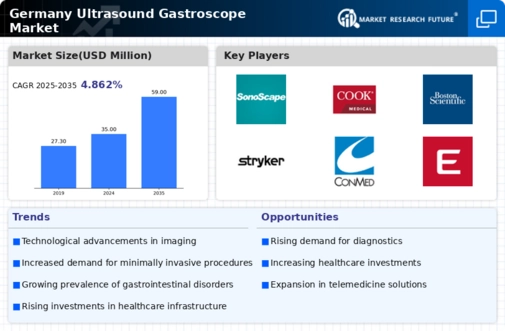
The projected market size is expected to reach 59.0 million USD by 2035.

What is the expected market value of the Germany Ultrasound Gastroscope Market in 2024?

The Germany Ultrasound Gastroscope Market is expected to be valued at 35.0 million USD in 2024.

What is the expected CAGR for the Germany Ultrasound Gastroscope Market from 2025 to 2035?

The market is expected to grow at a CAGR of 4.862% from 2025 to 2035.

Which product type is projected to have a higher market value in 2035 in the Germany Ultrasound Gastroscope Market?

Optic Ultrasound Gastroscopes are projected to reach a value of 34.0 million USD in 2035.

What is the estimated market size for Others product type in 2024?

The Others product type is estimated to be valued at 15.0 million USD in 2024.

Who are the key players in the Germany Ultrasound Gastroscope Market?

Major players include SonoScape, Cook Medical, Boston Scientific, and Hoya Corporation.

What are the anticipated challenges in the Germany Ultrasound Gastroscope Market?

Challenges may include market saturation and regulatory hurdles impacting growth.

What are the emerging trends in the Germany Ultrasound Gastroscope Market?

Innovations in technology and increased adoption of minimally invasive procedures are notable trends.

What are the applications of ultrasound gastroscopes in Germany?

Applications mainly include diagnostics and therapeutic procedures in gastroenterology.

How does the market growth rate vary across different segments in the Germany Ultrasound Gastroscope Market?

Each segment may experience varying growth rates, driven by factors like technological advancements and user demand.

Download Free Sample

Kindly complete the form below to receive a free sample of this Report

Compare Licence

×
Features License Type
Single User Multiuser License Enterprise User
Price $4,950 $5,950 $7,250
Maximum User Access Limit 1 User Upto 10 Users Unrestricted Access Throughout the Organization
Free Customization
Direct Access to Analyst
Deliverable Format
Platform Access
Discount on Next Purchase 10% 15% 15%
Printable Versions