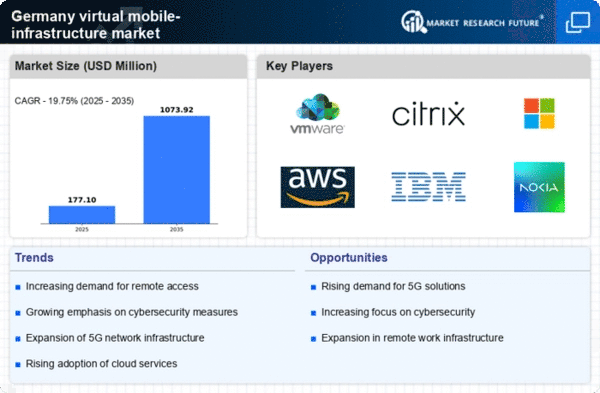
The virtual mobile-infrastructure market in Germany is characterized by a dynamic competitive landscape, driven by rapid technological advancements and increasing demand for mobile solutions. Key players such as VMware (US), Microsoft (US), and Amazon Web Services (US) are at the forefront, each adopting distinct strategies to enhance their market presence. VMware (US) focuses on innovation through its cloud-based solutions, aiming to streamline mobile operations for enterprises. Meanwhile, Microsoft (US) emphasizes digital transformation, leveraging its Azure platform to integrate mobile infrastructure with existing enterprise systems. Amazon Web Services (US) continues to expand its offerings, particularly in edge computing, which is becoming increasingly relevant in mobile applications. Collectively, these strategies contribute to a competitive environment that is both collaborative and competitive, as companies seek to differentiate themselves through technological advancements and customer-centric solutions.In terms of business tactics, companies are increasingly localizing their operations to better serve the German market, optimizing supply chains to enhance efficiency and responsiveness. The market structure appears moderately fragmented, with several key players holding substantial market shares while also facing competition from emerging firms. This fragmentation allows for a diverse range of solutions, catering to various customer needs and preferences, thereby fostering innovation and competition.
In October VMware (US) announced a strategic partnership with a leading telecommunications provider in Germany to enhance its mobile infrastructure solutions. This collaboration aims to integrate advanced network capabilities with VMware's cloud services, potentially improving service delivery and customer experience. Such partnerships are crucial as they enable companies to leverage each other's strengths, thereby enhancing their competitive positioning in the market.
In September Microsoft (US) launched a new initiative focused on AI-driven mobile solutions, aimed at optimizing enterprise mobility management. This initiative is significant as it aligns with the growing trend of integrating AI into mobile infrastructure, allowing businesses to automate processes and improve decision-making. By positioning itself at the intersection of AI and mobile technology, Microsoft (US) is likely to strengthen its market leadership and appeal to a broader customer base.
In November Amazon Web Services (US) unveiled a new edge computing service tailored for mobile applications, which is expected to enhance performance and reduce latency for users. This move is indicative of the increasing importance of edge computing in mobile infrastructure, as it allows for faster data processing closer to the end-user. By investing in this area, Amazon Web Services (US) is not only responding to market demands but also setting a precedent for future developments in mobile technology.
As of November current trends in the virtual mobile-infrastructure market are heavily influenced by digitalization, sustainability, and the integration of AI technologies. Strategic alliances are becoming increasingly vital, as companies recognize the need to collaborate to enhance their offerings and address complex customer requirements. Looking ahead, competitive differentiation is likely to evolve, shifting from traditional price-based competition to a focus on innovation, technological advancements, and supply chain reliability. This transition suggests that companies that prioritize these aspects will be better positioned to thrive in an increasingly competitive landscape.