×
Request Free Sample ×

Kindly complete the form below to receive a free sample of this Report

* Please use a valid business email

Leading companies partner with us for data-driven Insights

clients tt-cursor
Hero Background

South Korea Virtual Mobile Infrastructure Market

ID: MRFR/ICT/63195-HCR
200 Pages
Aarti Dhapte
October 2025

South Korea Virtual Mobile Infrastructure Market Research Report By Deployment Type (Cloud-Based, On-Premises, Hybrid), By Application (Enterprise Mobility Management, Remote Desktop Access, Mobile Application Development), By End User (Large Enterprises, Small and Medium Enterprises, Government) and By Service Type (Infrastructure as a Service, Platform as a Service, Software as a Service)- Forecast to 2035

Share:
Download PDF ×

We do not share your information with anyone. However, we may send you emails based on your report interest from time to time. You may contact us at any time to opt-out.

South Korea Virtual Mobile Infrastructure Market Infographic
Purchase Options

South Korea Virtual Mobile Infrastructure Market Summary

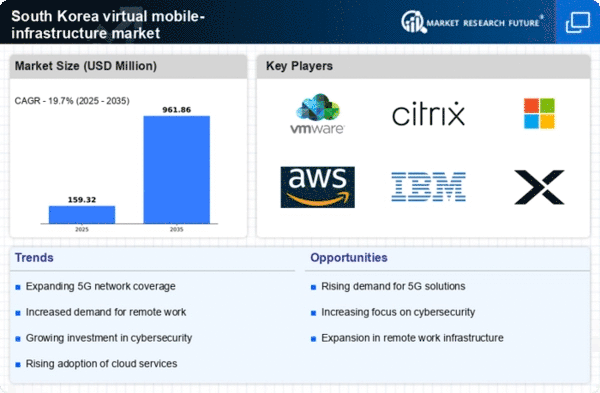
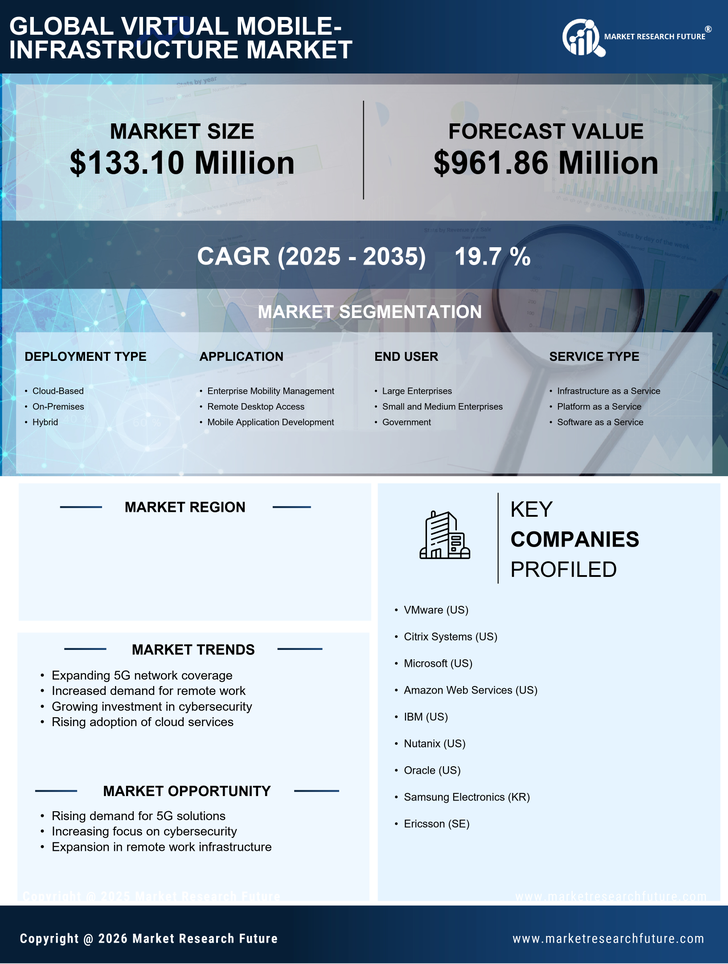
As per MRFR analysis, the South Korea virtual mobile-infrastructure market was estimated at 133.1 USD Million in 2024. The South Korea virtual mobile-infrastructure market is projected to grow from 159.32 USD Million in 2025 to 961.86 USD Million by 2035, exhibiting a compound annual growth rate (CAGR) of 19.7% during the forecast period 2025 - 2035.

Key Market Trends & Highlights

The South Korea virtual mobile-infrastructure market is experiencing robust growth driven by technological advancements and evolving user needs.

  • The largest segment in the South Korea virtual mobile-infrastructure market is cloud services, which continues to see increased adoption.
  • Security enhancements are becoming a focal point as organizations prioritize data protection in their mobile infrastructures.
  • AI and automation integration is emerging as a key trend, streamlining operations and improving user experiences.
  • Rising demand for remote work solutions and government initiatives supporting digital transformation are significant drivers of market growth.

Market Size & Forecast

2024 Market Size 133.1 (USD Million)
2035 Market Size 961.86 (USD Million)
CAGR (2025 - 2035) 19.7%

Major Players

VMware (US), Citrix Systems (US), Microsoft (US), Amazon Web Services (US), IBM (US), Nutanix (US), Oracle (US), Samsung Electronics (KR), Ericsson (SE)

South Korea Virtual Mobile Infrastructure Market Trends

The virtual mobile-infrastructure market in South Korea is currently experiencing a notable transformation, driven by advancements in technology and increasing demand for mobile solutions. The proliferation of mobile devices and the growing reliance on cloud-based services are reshaping how businesses operate. Organizations are increasingly adopting virtual mobile infrastructures to enhance operational efficiency, reduce costs, and improve flexibility. This shift is further supported by government initiatives aimed at fostering innovation and digital transformation within the country. As a result, the market is witnessing a surge in investments and the emergence of new players, which could lead to a more competitive landscape. In addition, the emphasis on security and data privacy is becoming paramount in the virtual mobile-infrastructure market. With the rise of cyber threats, companies are prioritizing secure mobile solutions to protect sensitive information. This trend is likely to drive the development of advanced security features and compliance measures, ensuring that businesses can operate safely in a digital environment. Furthermore, the integration of artificial intelligence and machine learning technologies into mobile infrastructures may enhance decision-making processes and optimize resource allocation, indicating a promising future for the market in South Korea.

Increased Adoption of Cloud Services

The virtual mobile-infrastructure market is witnessing a significant shift towards cloud-based solutions. Businesses are increasingly leveraging cloud technologies to enhance scalability and flexibility. This trend is driven by the need for efficient resource management and the ability to access data from anywhere, which aligns with the growing mobile workforce.

Focus on Security Enhancements

As cyber threats continue to evolve, there is a heightened focus on security within the virtual mobile-infrastructure market. Companies are investing in advanced security measures to protect sensitive data and ensure compliance with regulations. This trend reflects the necessity for robust security frameworks in mobile environments.

Integration of AI and Automation

The incorporation of artificial intelligence and automation technologies is becoming prevalent in the virtual mobile-infrastructure market. These innovations are expected to streamline operations, improve user experiences, and facilitate better decision-making processes. The potential for enhanced efficiency and productivity is driving this trend.

South Korea Virtual Mobile Infrastructure Market Drivers

Advancements in 5G Technology

The rollout of 5G technology in South Korea is poised to revolutionize the virtual mobile-infrastructure market. With download speeds potentially reaching 10 Gbps, 5G enables enhanced mobile connectivity and supports the increasing demand for data-intensive applications. This technological advancement is expected to drive a 40% increase in mobile data traffic over the next few years. As businesses leverage 5G capabilities, the need for sophisticated virtual mobile infrastructure solutions will likely grow. This trend suggests that the virtual mobile-infrastructure market will benefit from the enhanced performance and reliability offered by 5G, positioning it as a key enabler of digital transformation.

Rising Demand for Remote Work Solutions

The virtual mobile-infrastructure market in South Korea is experiencing a notable surge in demand for remote work solutions. As organizations increasingly adopt flexible work arrangements, the need for robust mobile infrastructure becomes paramount. This shift is evidenced by a reported 30% increase in remote work adoption among South Korean companies in the past year. Consequently, businesses are investing in virtual mobile infrastructure to ensure seamless connectivity and collaboration among employees. This trend is likely to continue, as companies recognize the benefits of enhanced productivity and employee satisfaction. The virtual mobile-infrastructure market is thus positioned to grow significantly, driven by the necessity for reliable and efficient remote work solutions.

Increased Focus on Data Privacy Regulations

In South Korea, the virtual mobile-infrastructure market is influenced by a heightened focus on data privacy regulations. Recent legislative changes have mandated stricter compliance measures for businesses handling sensitive information. As organizations strive to meet these regulatory requirements, there is a growing demand for secure virtual mobile infrastructure solutions. This trend is reflected in a 25% increase in investments in cybersecurity measures among South Korean firms over the past year. Consequently, the virtual mobile-infrastructure market is likely to expand as companies seek to implement robust security protocols to protect data and maintain compliance with evolving regulations.

Growing Interest in Mobile Application Development

The virtual mobile-infrastructure market in South Korea is witnessing a surge in interest surrounding mobile application development. As businesses recognize the importance of mobile apps in enhancing customer engagement and operational efficiency, there is a corresponding increase in demand for virtual mobile infrastructure to support these initiatives. Recent surveys indicate that 60% of South Korean companies plan to invest in mobile app development within the next year. This trend is likely to drive growth in the virtual mobile-infrastructure market, as organizations seek to create and deploy applications that require robust and scalable infrastructure to meet user expectations.

Government Initiatives Supporting Digital Transformation

The South Korean government is actively promoting digital transformation initiatives, which significantly impact the virtual mobile-infrastructure market. With investments exceeding $1 billion in digital infrastructure, the government aims to enhance connectivity and support technological advancements. These initiatives are designed to foster innovation and improve the overall digital ecosystem, encouraging businesses to adopt virtual mobile infrastructure solutions. As a result, the market is likely to witness accelerated growth, driven by government support and funding. This proactive approach not only enhances the competitiveness of South Korean enterprises but also positions the virtual mobile-infrastructure market as a critical component of the nation's digital economy.

Market Segment Insights

South Korea Virtual Mobile Infrastructure Market Segment Insights

South Korea Virtual Mobile Infrastructure Market Segment Insights

Virtual Mobile Infrastructure Market Deployment Type Insights

Virtual Mobile Infrastructure Market Deployment Type Insights

The South Korea Virtual Mobile Infrastructure Market exhibits a diverse range of deployment types, essential for meeting the varying needs of businesses and organizations across the region. The three primary types within this category include Cloud-Based, On-Premises, and Hybrid solutions, each offering distinct advantages and challenges, contributing to the dynamics of the market. Cloud-Based solutions are gaining popularity due to their flexibility, scalability, and cost-effectiveness, enabling organizations to dynamically allocate resources while minimizing IT overhead costs. 

Particularly in South Korea, where the adoption of cloud technologies has been accelerated by the government's push for digital transformation, this segment stands out in terms of market growth and acceptance. On-Premises solutions remain relevant for organizations with stringent data security requirements, providing enterprises with complete control over their virtual mobile infrastructure. Given South Korea's strong emphasis on cybersecurity and data protection regulations, many businesses prefer an On-Premises deployment to ensure compliance while safeguarding sensitive information. 

Moreover, the Hybrid deployment model is emerging as a significant choice for companies looking to maximize the benefits of both cloud and on-premises solutions, allowing for enhanced operational agility and efficiency. As the South Korea Virtual Mobile Infrastructure Market evolves, the interplay between these deployment types is critical in determining how organizations embrace technological advancements to improve productivity and user experience. The focus on virtualization, alongside the growing adoption of mobile technologies in work environments, has spurred innovations within these deployment frameworks. 

Emerging trends such as a rising emphasis on remote work capabilities, coupled with increasing mobile device usage, further amplify the significance of these deployment types. Overall, the market continues to adapt and transform, crafting opportunities for businesses to harness the potential of virtual mobile infrastructure tailored to their specific deployment needs.

Virtual Mobile Infrastructure Market Application Insights

Virtual Mobile Infrastructure Market Application Insights

The South Korea Virtual Mobile Infrastructure Market, particularly in the Application segment, exhibits significant growth potential as businesses increasingly prioritize mobile access and operational efficiency. Enterprise Mobility Management is critical in this landscape, enabling organizations to manage and secure mobile devices effectively, thus boosting productivity while minimizing security risks. Remote Desktop Access plays a pivotal role, allowing employees to access data and applications remotely, which enhances workflow, especially in a country where remote work is on the rise due to technological advancements and the need for flexibility.

Mobile Application Development is another essential aspect, fostering innovation and the creation of tailored applications that suit specific business needs, ultimately driving customer engagement and retention. Together, these components contribute to the robust South Korea Virtual Mobile Infrastructure Market, reflecting an evolving landscape shaped by rapid digitization and the demand for seamless connectivity across platforms. The market is poised for enhancement, backed by increasing smartphone penetration and growing demand for mobile computing in various sectors.

Virtual Mobile Infrastructure Market End User Insights

Virtual Mobile Infrastructure Market End User Insights

The South Korea Virtual Mobile Infrastructure Market is notably structured around various End Users, uniquely catering to their distinct needs and functionalities. Large Enterprises are increasingly adopting these solutions to enhance their operational efficiency and bolster data security, which remains crucial in the highly competitive South Korean landscape. Small and Medium Enterprises also play an essential role in the market, leveraging Virtual Mobile Infrastructure to streamline their processes and reduce IT costs, thereby facilitating growth and innovation.The Government segment demonstrates significant engagement as well, focusing on necessary digital transformation initiatives that improve service delivery and increase citizen engagement. 

The emphasis on mobile security and accessibility across these End User categories is a driving force in the market. Moreover, the quickening pace of digital transformation, coupled with a growing reliance on remote work solutions, presents substantial opportunities for market expansion. South Korea's robust technological infrastructure further supports the adoption of these solutions, making the Virtual Mobile Infrastructure Market vital for various sectors of the economy.

Virtual Mobile Infrastructure Market Service Type Insights

Virtual Mobile Infrastructure Market Service Type Insights

The South Korea Virtual Mobile Infrastructure Market has shown robust growth and segmentation, particularly within the Service Type category, which comprises Infrastructure as a Service, Platform as a Service, and Software as a Service. Infrastructure as a Service is becoming increasingly significant as organizations leverage cloud-based infrastructures to enhance scalability and reduce costs. Meanwhile, Platform as a Service plays a crucial role by enabling developers to build, deploy, and manage applications in the cloud efficiently, enhancing innovation while minimizing downtime.

Software as a Service dominates the market, providing users with on-demand software applications accessible via the internet, appealing to a wide array of industries from finance to healthcare. The South Korean government actively promotes digital transformation initiatives, further fueling investment in these service types. Key trends include the increasing demand for remote work solutions and data security, driving organizations to adopt more flexible and secure virtual mobile infrastructure services. The ongoing growth in mobile device usage in South Korea complements these trends, making the service type segment vital in supporting the dynamic needs of businesses and consumers alike.Overall, the Service Type segmentation reflects South Korea's commitment to technological advancement and competitive edge in the global market.

Get more detailed insights about South Korea Virtual Mobile Infrastructure Market

Key Players and Competitive Insights

The virtual mobile-infrastructure market in South Korea is characterized by a dynamic competitive landscape, driven by rapid technological advancements and increasing demand for mobile solutions. Key players such as VMware (US), Microsoft (US), and Samsung Electronics (KR) are strategically positioned to leverage innovation and partnerships to enhance their market presence. VMware (US) focuses on cloud infrastructure and digital workspace solutions, while Microsoft (US) emphasizes its Azure platform to integrate mobile infrastructure with cloud services. Samsung Electronics (KR), leveraging its hardware capabilities, aims to provide comprehensive mobile solutions that integrate seamlessly with its devices, thereby enhancing user experience. Collectively, these strategies foster a competitive environment that prioritizes technological integration and user-centric solutions.

In terms of business tactics, companies are increasingly localizing their operations to better serve the South Korean market. This includes optimizing supply chains and enhancing customer support services. The market structure appears moderately fragmented, with several key players vying for market share. However, the influence of major companies like Amazon Web Services (US) and IBM (US) is substantial, as they continue to innovate and expand their service offerings, thereby shaping the competitive dynamics.

In October 2025, VMware (US) announced a strategic partnership with a leading South Korean telecommunications provider to enhance its cloud services tailored for mobile infrastructure. This collaboration is expected to facilitate the deployment of advanced mobile applications, thereby improving service delivery and customer satisfaction. Such partnerships are crucial as they allow VMware (US) to tap into local expertise and infrastructure, potentially increasing its market penetration.

In September 2025, Microsoft (US) launched a new initiative aimed at integrating AI capabilities into its mobile infrastructure solutions. This move is significant as it positions Microsoft (US) at the forefront of technological innovation, enabling businesses to leverage AI for enhanced operational efficiency and decision-making. The integration of AI is likely to attract more enterprises seeking to modernize their mobile infrastructure, thereby expanding Microsoft's customer base.

In November 2025, Samsung Electronics (KR) unveiled a new line of mobile devices optimized for its virtual mobile infrastructure solutions. This launch is strategically important as it reinforces Samsung's commitment to providing end-to-end solutions that enhance user experience. By aligning its hardware offerings with its mobile infrastructure services, Samsung Electronics (KR) is likely to strengthen its competitive position in the market.

As of November 2025, current trends in the virtual mobile-infrastructure market include a strong emphasis on digitalization, sustainability, and AI integration. Strategic alliances among key players are increasingly shaping the competitive landscape, fostering innovation and collaboration. Looking ahead, competitive differentiation is expected to evolve, with a shift from price-based competition to a focus on technological innovation, reliability, and supply chain efficiency. This transition underscores the importance of adaptability and forward-thinking strategies in maintaining a competitive edge.

Key Companies in the South Korea Virtual Mobile Infrastructure Market market include

Industry Developments

In recent months, the South Korea Virtual Mobile Infrastructure Market has seen several noteworthy developments. Embracing the growing demand for cloud-based solutions, Oracle and VMware have been actively expanding their service offerings tailored to local enterprises. 

Notably, in October 2023, SK Telecom revealed its plan to enhance its Virtual Mobile Infrastructure by integrating advanced security features in partnership with Palo Alto Networks. Meanwhile, Samsung Electronics and LG Electronics continue to innovate by developing new mobile infrastructure solutions that prioritize user efficiency and security. Additionally, in September 2023, Naver Corporation and Kakao Corp strengthened their market position through a strategic partnership aimed at fostering collaborations in virtual mobile technologies. 

Regarding mergers and acquisitions, no major deals involving the specified companies have been publicly announced since August 2023. Over the past two years, the market has experienced steady growth, with an increase in mobile enterprise applications prompting a surge in infrastructure investments. These advancements are reinforcing South Korea's status as a hub for cutting-edge mobile technology solutions, with significant implications for the broader Asian market.

Future Outlook

South Korea Virtual Mobile Infrastructure Market Future Outlook

The Virtual Mobile Infrastructure Market is projected to grow at a 19.7% CAGR from 2024 to 2035, driven by technological advancements, increased mobile data consumption, and demand for remote work solutions.

New opportunities lie in:

  • Development of AI-driven mobile management platforms
  • Expansion of 5G infrastructure to enhance connectivity
  • Creation of tailored mobile security solutions for enterprises

By 2035, the market is expected to achieve substantial growth, positioning itself as a leader in mobile technology.

Market Segmentation

South Korea Virtual Mobile Infrastructure Market End User Outlook

  • Large Enterprises
  • Small and Medium Enterprises
  • Government

South Korea Virtual Mobile Infrastructure Market Application Outlook

  • Enterprise Mobility Management
  • Remote Desktop Access
  • Mobile Application Development

South Korea Virtual Mobile Infrastructure Market Service Type Outlook

  • Infrastructure as a Service
  • Platform as a Service
  • Software as a Service

South Korea Virtual Mobile Infrastructure Market Deployment Type Outlook

  • Cloud-Based
  • On-Premises
  • Hybrid

Report Scope

MARKET SIZE 2024 133.1(USD Million)
MARKET SIZE 2025 159.32(USD Million)
MARKET SIZE 2035 961.86(USD Million)
COMPOUND ANNUAL GROWTH RATE (CAGR) 19.7% (2024 - 2035)
REPORT COVERAGE Revenue Forecast, Competitive Landscape, Growth Factors, and Trends
BASE YEAR 2024
Market Forecast Period 2025 - 2035
Historical Data 2019 - 2024
Market Forecast Units USD Million
Key Companies Profiled VMware (US), Citrix Systems (US), Microsoft (US), Amazon Web Services (US), IBM (US), Nutanix (US), Oracle (US), Samsung Electronics (KR), Ericsson (SE)
Segments Covered Deployment Type, Application, End User, Service Type
Key Market Opportunities Integration of advanced cloud solutions enhances scalability in the virtual mobile-infrastructure market.
Key Market Dynamics Rising demand for secure mobile solutions drives innovation in virtual mobile-infrastructure technologies within South Korea.
Countries Covered South Korea

Leave a Comment

FAQs

What is the expected market size of the South Korea Virtual Mobile Infrastructure Market in 2024?

The South Korea Virtual Mobile Infrastructure Market is expected to be valued at 125.0 million USD in 2024.

What is the projected market size for the South Korea Virtual Mobile Infrastructure Market by 2035?

By 2035, the South Korea Virtual Mobile Infrastructure Market is anticipated to reach approximately 1506.0 million USD.

What is the expected CAGR for the South Korea Virtual Mobile Infrastructure Market from 2025 to 2035?

The market is expected to grow at a CAGR of 25.391% during the forecast period from 2025 to 2035.

Which deployment type is projected to have the highest market value by 2035?

The Cloud-Based deployment type is projected to reach approximately 634.0 million USD by 2035.

What is the estimated market value of the On-Premises segment in 2035?

The On-Premises segment is expected to be valued at around 420.0 million USD by 2035.

How much is the Hybrid deployment type expected to be valued in 2035?

The Hybrid deployment type is projected to be valued at approximately 452.0 million USD in 2035.

Who are the major players in the South Korea Virtual Mobile Infrastructure Market?

Some key players in this market include Oracle, Naver Corporation, VMware, and SK Telecom.

What is a significant trend influencing the growth of the South Korea Virtual Mobile Infrastructure Market?

A significant trend is the increasing adoption of cloud-based solutions, which are enhancing efficiency and flexibility.

What opportunities does the growing market present for companies?

The growing market presents opportunities for innovation in services and improvements in security and infrastructure.

How is the competitive landscape of the South Korea Virtual Mobile Infrastructure Market expected to evolve?

The competitive landscape is likely to evolve with increased focus on technological advancements and strategic partnerships among major players.

Download Free Sample

Kindly complete the form below to receive a free sample of this Report

Compare Licence

×
Features License Type
Single User Multiuser License Enterprise User
Price $4,950 $5,950 $7,250
Maximum User Access Limit 1 User Upto 10 Users Unrestricted Access Throughout the Organization
Free Customization
Direct Access to Analyst
Deliverable Format
Platform Access
Discount on Next Purchase 10% 15% 15%
Printable Versions