×
Request Free Sample ×

Kindly complete the form below to receive a free sample of this Report

* Please use a valid business email

Leading companies partner with us for data-driven Insights

clients tt-cursor
Hero Background

Glycerol Monostearate Powder Market

ID: MRFR/CnM/35964-HCR
100 Pages
Chitranshi Jaiswal
October 2025

Glycerol Monostearate GMS Powder Market Research Report By Application (Food Industry, Cosmetics, Pharmaceuticals, Personal Care), By Type (Non-GMO, GMO), By Functionality (Emulsifier, Stabilizer, Thickener), By End Use (Bakery Products, Dairy Products, Confectionery) and By Regional (North America, Europe, South America, Asia Pacific, Middle East and Africa) - Forecast to 2035

Share:
Download PDF ×

We do not share your information with anyone. However, we may send you emails based on your report interest from time to time. You may contact us at any time to opt-out.

Glycerol Monostearate Powder Market Infographic
Purchase Options

Glycerol Monostearate Powder Market Summary

As per MRFR analysis, the Glycerol Monostearate Powder Market Size was estimated at 1097.47 USD Million in 2024. The Glycerol Monostearate Powder industry is projected to grow from 1147.54 in 2025 to 1792.7 by 2035, exhibiting a compound annual growth rate (CAGR) of 4.56 during the forecast period 2025 - 2035.

Key Market Trends & Highlights

The Glycerol Monostearate Powder Market is experiencing robust growth driven by evolving consumer preferences and technological advancements.

  • The market is witnessing a rising demand for clean label products, particularly in North America, which remains the largest market.
  • Technological advancements in production processes are enhancing the efficiency and quality of Glycerol Monostearate Powder.
  • The food industry continues to dominate the market, while the cosmetics segment is emerging as the fastest-growing area.
  • Key market drivers include rising health consciousness and regulatory support for food additives, particularly benefiting the bakery sector.

Market Size & Forecast

2024 Market Size 1097.47 (USD Million)
2035 Market Size 1792.7 (USD Million)
CAGR (2025 - 2035) 4.56%

Major Players

Wilmar International Limited (SG), BASF SE (DE), Cargill, Incorporated (US), Kraton Corporation (US), P&G Chemicals (US), Kao Corporation (JP), Evonik Industries AG (DE), Mitsubishi Chemical Corporation (JP), SABIC (SA)

Glycerol Monostearate Powder Market Trends

The Glycerol Monostearate Powder Market is currently experiencing a notable evolution, driven by various factors that influence its demand and application across multiple industries. This compound, recognized for its emulsifying properties, finds extensive use in food, pharmaceuticals, and cosmetics. The increasing consumer preference for natural and clean-label products appears to be steering manufacturers towards incorporating glycerol monostearate as a safer alternative to synthetic emulsifiers. Furthermore, the growing trend of health consciousness among consumers may lead to a rise in demand for products containing this ingredient, as it is perceived to be less harmful compared to other additives. In addition to the health trends, the Glycerol Monostearate Powder Market is also witnessing advancements in production technologies. Innovations in processing methods could enhance the quality and efficiency of glycerol monostearate production, potentially lowering costs and increasing availability. Moreover, the expansion of the food and beverage sector, particularly in developing regions, suggests a promising outlook for this market. As industries continue to explore sustainable and effective solutions, glycerol monostearate may play a pivotal role in meeting these evolving demands, thereby solidifying its position in the market.

Rising Demand for Clean Label Products

The trend towards clean label products is gaining momentum, as consumers increasingly seek transparency in ingredient sourcing. Glycerol monostearate, being a natural emulsifier, aligns well with this demand, making it a preferred choice for manufacturers aiming to cater to health-conscious consumers.

Technological Advancements in Production

Innovations in production techniques are likely to enhance the efficiency and quality of glycerol monostearate powder. These advancements may lead to reduced production costs and improved product consistency, thereby attracting more industries to utilize this versatile ingredient.

Expansion in Food and Beverage Sector

The growth of the food and beverage industry, particularly in emerging markets, suggests a rising demand for glycerol monostearate. As manufacturers seek effective emulsifiers for various applications, this compound may see increased adoption, further driving market growth.

Glycerol Monostearate Powder Market Drivers

Market Growth Projections

The Global Glycerol Monostearate GMS Powder Market Industry is expected to witness substantial growth over the coming years. Projections indicate that the market will reach 1.1 USD Billion in 2024 and is anticipated to grow to 1.79 USD Billion by 2035. This growth trajectory suggests a compound annual growth rate (CAGR) of 4.52% from 2025 to 2035. Such figures reflect the increasing applications of GMS across various sectors, including food, personal care, and pharmaceuticals. The market's expansion is likely to be influenced by evolving consumer preferences and the ongoing development of innovative products.

Rising Demand in Food Industry

The Global Glycerol Monostearate GMS Powder Market Industry is experiencing increased demand driven by the food sector. GMS is widely utilized as an emulsifier and stabilizer in various food products, including baked goods, dairy items, and confectionery. As consumer preferences shift towards processed and convenience foods, the need for GMS is likely to grow. In 2024, the market is projected to reach 1.1 USD Billion, reflecting the food industry's pivotal role in this growth. The trend towards clean label products may further enhance the demand for GMS, as manufacturers seek natural emulsifiers to meet consumer expectations.

Emerging Markets and Global Trade

The Global Glycerol Monostearate GMS Powder Market Industry is poised for growth due to the expansion of emerging markets. Countries in Asia-Pacific and Latin America are experiencing economic development, leading to increased consumption of processed foods, personal care products, and pharmaceuticals. This trend is likely to drive demand for GMS as these regions adopt Western consumption patterns. Additionally, global trade dynamics may facilitate the distribution of GMS across borders, enhancing market accessibility. As the market evolves, it is projected to reach 1.79 USD Billion by 2035, indicating robust growth opportunities.

Expansion in Personal Care Products

The Global Glycerol Monostearate GMS Powder Market Industry is also benefiting from its application in personal care and cosmetic products. GMS serves as an emulsifier and thickening agent in creams, lotions, and other formulations. With the increasing consumer focus on skincare and beauty, the demand for GMS in this sector is anticipated to rise. The personal care industry is projected to expand significantly, contributing to the overall market growth. As consumers become more aware of ingredient transparency, the shift towards natural and safe formulations may further bolster the use of GMS in personal care products.

Growth in Pharmaceutical Applications

The Global Glycerol Monostearate GMS Powder Market Industry is witnessing growth due to its applications in the pharmaceutical sector. GMS is utilized as an excipient in drug formulations, enhancing the stability and bioavailability of active ingredients. The increasing prevalence of chronic diseases and the demand for effective drug delivery systems are likely to drive the market forward. As the pharmaceutical industry continues to innovate, the role of GMS as a crucial component in formulations may expand. This trend could contribute to the market's projected growth, with an anticipated CAGR of 4.52% from 2025 to 2035.

Technological Advancements in Production

The Global Glycerol Monostearate GMS Powder Market Industry is influenced by technological advancements in production processes. Innovations in manufacturing techniques can lead to improved efficiency and cost-effectiveness, thereby enhancing product availability. As manufacturers adopt modern technologies, the quality of GMS can also improve, meeting the rising standards of various industries. This shift may attract new entrants into the market, further stimulating competition and growth. The ongoing development of sustainable production methods may also resonate with environmentally conscious consumers, potentially increasing the market's appeal.
Market Segment Insights

By Application: Food Industry (Largest) vs. Cosmetics (Fastest-Growing)

In the Glycerol Monostearate Powder Market, the application segment exhibits a diverse distribution across various industries. The food industry holds the largest share, utilizing glycerol monostearate as a food additive to enhance texture and stability in various products. Alongside, the cosmetics sector is gaining significant traction as a vital ingredient in formulations for emulsifying and stabilizing products, indicating its robust potential. The growth dynamics within the application segment are influenced by factors such as increasing health consciousness and demand for natural products. The cosmetics sector is particularly positioned for rapid expansion due to the rise in consumer preferences for organic and clean beauty products, creating further opportunities for glycerol monostearate formulation in the market.

Food Industry (Dominant) vs. Pharmaceutical (Emerging)

The food industry serves as the dominant player in the Glycerol Monostearate Powder Market, leveraging its extensive use in food formulations, where it functions primarily as an emulsifier and stabilizer. Its ability to improve the texture and shelf-life of various food products makes it indispensable. In contrast, the pharmaceutical sector is emerging as a significant contender, utilizing glycerol monostearate in drug formulations and delivery systems. This sector is experiencing growth, driven by advances in pharmaceutical technology and the push for enhanced drug stability and bioavailability. Both segments reflect a robust demand trajectory, bolstering the overall market growth while highlighting their unique contributions to diverse applications.

By End Use: Emulsifier (Largest) vs. Stabilizer (Fastest-Growing)

In the Glycerol Monostearate Powder Market, the 'By End Use' segment showcases a diverse distribution of applications. The emulsifier segment commands the largest market share, primarily due to its extensive use in food and beverage products where it helps blend oil and water-based ingredients, enhancing the texture and stability of formulations. Following closely behind, the stabilizer segment is also significant, providing necessary support in maintaining the quality and appearance of products over time, particularly in cosmetics and personal care items.

Emulsifier (Dominant) vs. Stabilizer (Emerging)

The emulsifier segment currently stands out as the dominant force within the Glycerol Monostearate Powder Market. Responsible for facilitating the mixing of immiscible ingredients, emulsifiers are pivotal in food, cosmetics, and pharmaceuticals, where they enhance texture and extend shelf life. In contrast, the stabilizer segment is emerging rapidly, primarily driven by the increasing demand for clean-label products and natural ingredients. Stabilizers maintain the structural integrity of formulations, making them essential in sectors like cosmetics, where product consistency is key. As consumer awareness grows regarding product formulations, both emulsifiers and stabilizers are expected to evolve, responding to trends in health and sustainability.

By Formulation Type: Powder (Largest) vs. Liquid (Fastest-Growing)

The Glycerol Monostearate Powder Market exhibits a diverse formulation type landscape, with powder formulations holding the largest market share due to their versatility and extensive applications across various industries. Powder formulations are preferred for their ease of handling, stability, and compatibility with various formulations, making them a favored choice among manufacturers. Meanwhile, the liquid formulation segment is gaining traction as more companies look for innovative solutions in product development, catering to specific consumer preferences, which are beginning to carve a significant niche within the market.

Powder (Dominant) vs. Liquid (Emerging)

The powder formulation of glycerol monostearate is currently the dominant player in the market, praised for its stability and versatility in various applications like food, pharmaceuticals, and cosmetics. Its powdered form allows for easier mixing and processing, making it a preferred choice for manufacturers seeking high-quality emulsifiers and stabilizers. On the other hand, the liquid formulation represents an emerging segment that meets the demand for convenience and ease of use. As the industry trends towards ready-to-use solutions, liquid glycerol monostearate is gaining popularity for its application in formulations requiring smooth texture and immediate solubility, although it still lags behind powders in overall market presence.

By Source: Vegetable (Largest) vs. Synthetic (Fastest-Growing)

In the Glycerol Monostearate Powder Market, the source segment showcases a diverse distribution of market shares among the varieties of vegetable, animal, and synthetic origins. The vegetable-derived glycerol monostearate holds the largest market share, appealing to health-conscious consumers seeking plant-based ingredients. Animal-derived options are significant but are gradually losing ground to synthetic sources, which are increasingly preferred due to their consistent quality and cost-effectiveness. The emergence of synthetic options underscores a shift towards more flexible sourcing strategies in the industry, as consumers embrace a broader array of ingredient options for various applications.

Source: Vegetable (Dominant) vs. Synthetic (Emerging)

The vegetable-derived segment of glycerol monostearate is dominating the market, characterized by its alignment with consumer trends favoring natural and plant-based products. This segment appeals particularly to the food and beverage industry, where clean label products are gaining traction. Conversely, the synthetic segment is emerging rapidly, driven by advances in production technology and the ability to meet large-scale demands at competitive prices. Synthetic glycerol monostearate provides manufacturers with uniformity in product quality and performance, making it an attractive option for companies looking to optimize their ingredient sourcing. While vegetable sources focus on health and sustainability, synthetic options cater to efficiency and cost considerations, creating a dynamic interplay in this market.

By Purity Level: Food Grade (Largest) vs. Industrial Grade (Fastest-Growing)

In the Glycerol Monostearate Powder Market, the segment distribution reveals that Food Grade purity is the largest contributor, favored for its applications in the food industry, particularly in emulsification and as a stabilizer in food products. Pharmaceutical Grade and Industrial Grade follow, with the former utilized in medicinal formulations for its high safety standards, while Industrial Grade caters to non-food applications, including cosmetics and lubricants.

Food Grade (Dominant) vs. Pharmaceutical Grade (Emerging)

The Food Grade segment remains dominant in the Glycerol Monostearate Powder Market due to its extensive applications in various food products where emulsification and texture improvement are essential. This segment benefits from growing consumer demand for processed and functional foods, which drives the need for reliable emulsifying agents. On the other hand, the Pharmaceutical Grade segment is emerging, gaining traction due to increased usage in drug formulations and supplements where purity and quality are paramount. As health trends rise, this segment is expected to see significant growth, supporting the overall market demand.

Get more detailed insights about Glycerol Monostearate Powder Market

Regional Insights

North America : Market Leader in Glycerol Monostearate

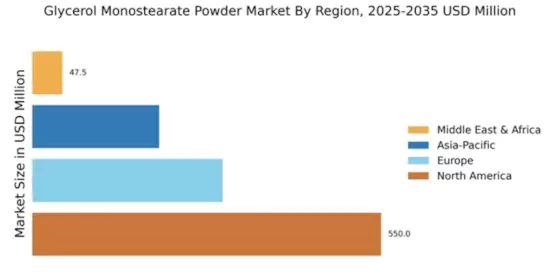
North America is poised to maintain its leadership in the Glycerol Monostearate Powder market, holding a significant market share of 550.0. The region's growth is driven by increasing demand in food and beverage applications, coupled with stringent food safety regulations that promote the use of safe emulsifiers. The rising trend of clean label products further fuels market expansion, as consumers seek transparency in ingredients. The United States stands as the largest market, supported by key players such as Cargill, Incorporated and P&G Chemicals. The competitive landscape is characterized by innovation and strategic partnerships among leading companies. With a focus on sustainability and product development, North American firms are well-positioned to capitalize on emerging trends, ensuring continued growth in this sector.

Europe : Regulatory-Driven Market Growth

Europe's Glycerol Monostearate Powder market is projected to grow significantly, with a market size of 300.0. The region benefits from robust regulatory frameworks that encourage the use of safe and effective emulsifiers in food products. The European Food Safety Authority (EFSA) plays a crucial role in ensuring compliance, which drives demand for high-quality ingredients. Additionally, the trend towards healthier food options is propelling the market forward, as consumers increasingly prefer natural emulsifiers. Leading countries such as Germany, France, and the UK are at the forefront of this market, with major players like BASF SE and Evonik Industries AG driving innovation. The competitive landscape is marked by a focus on sustainability and product differentiation, as companies strive to meet evolving consumer preferences. This dynamic environment positions Europe as a key player in The Glycerol Monostearate Powder.

Asia-Pacific : Emerging Market Potential

The Asia-Pacific region is witnessing a burgeoning Glycerol Monostearate Powder market, with a size of 200.0. This growth is primarily driven by increasing industrial applications in food, cosmetics, and pharmaceuticals. The rising disposable income and changing consumer preferences towards processed foods are significant factors contributing to market expansion. Additionally, favorable government policies aimed at boosting food safety standards are expected to further enhance demand for emulsifiers in the region. Countries like China, Japan, and India are leading the charge, with a growing presence of key players such as Kao Corporation and Mitsubishi Chemical Corporation. The competitive landscape is evolving, with local manufacturers emerging alongside established global firms. This dynamic environment presents ample opportunities for innovation and market penetration, positioning Asia-Pacific as a vital region in the Glycerol Monostearate market.

Middle East and Africa : Niche Market Development

The Middle East and Africa region represents a niche market for Glycerol Monostearate Powder, with a market size of 47.47. The growth in this region is driven by increasing demand in the food and personal care sectors, alongside a gradual shift towards modern retail formats. Regulatory frameworks are evolving, promoting the use of safe emulsifiers, which is expected to enhance market growth. The region's diverse consumer base is also contributing to the demand for varied applications of Glycerol Monostearate. Countries such as South Africa and the UAE are leading the market, with local and international players vying for a share. The competitive landscape is characterized by a mix of established companies and emerging startups, focusing on product innovation and sustainability. This dynamic environment offers significant potential for growth and development in the Glycerol Monostearate market.

Key Players and Competitive Insights

The Glycerol Monostearate Powder Market is currently characterized by a dynamic competitive landscape, driven by increasing demand across various sectors, including food, pharmaceuticals, and cosmetics. Key players such as Wilmar International Limited (SG), BASF SE (DE), and Cargill, Incorporated (US) are strategically positioning themselves through innovation and regional expansion. For instance, Wilmar International Limited (SG) has focused on enhancing its product portfolio to cater to the growing health-conscious consumer base, while BASF SE (DE) emphasizes sustainable production methods to align with global environmental standards. These strategies collectively shape a competitive environment that is increasingly focused on sustainability and product differentiation.

In terms of business tactics, companies are localizing manufacturing and optimizing supply chains to enhance efficiency and reduce costs. The market appears moderately fragmented, with several players vying for market share. However, the collective influence of major companies like Kraton Corporation (US) and P&G Chemicals (US) is notable, as they leverage their extensive distribution networks and technological advancements to maintain competitive advantages.

In November 2025, Cargill, Incorporated (US) announced a significant investment in a new production facility aimed at increasing its output of Glycerol Monostearate Powder. This strategic move is likely to enhance Cargill's market presence and meet the rising demand for high-quality emulsifiers in the food industry. The investment underscores the company's commitment to expanding its operational capabilities and responding to market needs effectively.

Similarly, in October 2025, BASF SE (DE) launched a new line of Glycerol Monostearate Powder that incorporates bio-based raw materials. This initiative not only aligns with the growing trend towards sustainability but also positions BASF as a leader in innovative product development. The introduction of bio-based products may attract environmentally conscious consumers and businesses, thereby enhancing BASF's competitive edge.

In September 2025, P&G Chemicals (US) entered into a strategic partnership with a leading biotechnology firm to develop advanced emulsifiers, including Glycerol Monostearate Powder. This collaboration is expected to accelerate product innovation and improve the sustainability profile of P&G's offerings. By integrating biotechnology into its production processes, P&G could potentially reduce its environmental footprint while enhancing product performance.

As of December 2025, the competitive trends in the Glycerol Monostearate Powder Market are increasingly defined by digitalization, sustainability, and the integration of AI technologies. Strategic alliances are becoming more prevalent, as companies recognize the need to collaborate for innovation and efficiency. The shift from price-based competition to a focus on technological advancements and supply chain reliability is evident. Moving forward, competitive differentiation will likely hinge on the ability to innovate and adapt to changing consumer preferences, with sustainability at the forefront of strategic initiatives.

Key Companies in the Glycerol Monostearate Powder Market market include

Industry Developments

Recent developments in the Global Glycerol Monostearate (GMS) Powder Market reflect a dynamic landscape, with key companies like Corbion, Drew Marine, and Kerry Group actively contributing to innovation and growth. Unilever and BASF are increasingly focusing on sustainability, adjusting their production methods to accommodate eco-friendly practices. Notably, Crown Chemical and Wilmar International have reported an upsurge in demand due to the rising utilization of GMS in food and cosmetics, which is pushing market valuations higher. The market is witnessing competitive advancements, highlighted by mergers and acquisitions among major players.

Recent acquisitions involving IOI Group and P and G have made headlines, illustrating a trend of consolidation aimed at enhancing market share and operational efficiencies. Nestlé's strategic initiatives to expand its product portfolio within this segment further emphasize the growing importance of GMS. Moreover, Kraton Corporation and Cargill are enhancing their research efforts to develop innovative GMS applications, driving market growth. This robust activity is indicative of a thriving market environment, where increased investments and strategic collaborations are shaping the future of Glycerol Monostearate across various industries.

Future Outlook

Glycerol Monostearate Powder Market Future Outlook

The Glycerol Monostearate Powder Market is projected to grow at a 4.56% CAGR from 2024 to 2035, driven by increasing demand in food and cosmetics industries.

New opportunities lie in:

  • Expansion into emerging markets with tailored product formulations.
  • Development of sustainable production methods to attract eco-conscious consumers.
  • Strategic partnerships with food manufacturers for innovative applications.

By 2035, the market is expected to solidify its position as a key ingredient across various industries.

Market Segmentation

Glycerol Monostearate Powder Market Source Outlook

  • Vegetable
  • Animal
  • Synthetic

Glycerol Monostearate Powder Market End Use Outlook

  • Emulsifier
  • Stabilizer
  • Thickening Agent
  • Surfactant
  • Texturizer

Glycerol Monostearate Powder Market Application Outlook

  • Food Industry
  • Cosmetics
  • Pharmaceuticals
  • Industrial
  • Personal Care

Glycerol Monostearate Powder Market Purity Level Outlook

  • Food Grade
  • Pharmaceutical Grade
  • Industrial Grade

Glycerol Monostearate Powder Market Formulation Type Outlook

  • Powder
  • Liquid
  • Granular
  • Paste

Report Scope

MARKET SIZE 20241097.47(USD Million)
MARKET SIZE 20251147.54(USD Million)
MARKET SIZE 20351792.7(USD Million)
COMPOUND ANNUAL GROWTH RATE (CAGR)4.56% (2024 - 2035)
REPORT COVERAGERevenue Forecast, Competitive Landscape, Growth Factors, and Trends
BASE YEAR2024
Market Forecast Period2025 - 2035
Historical Data2019 - 2024
Market Forecast UnitsUSD Million
Key Companies ProfiledWilmar International Limited (SG), BASF SE (DE), Cargill, Incorporated (US), Kraton Corporation (US), P&G Chemicals (US), Kao Corporation (JP), Evonik Industries AG (DE), Mitsubishi Chemical Corporation (JP), SABIC (SA)
Segments CoveredApplication, End Use, Formulation Type, Source, Purity Level
Key Market OpportunitiesRising demand for clean label products drives growth in the Glycerol Monostearate Powder Market.
Key Market DynamicsRising demand for clean label products drives growth in the Glycerol Monostearate Powder market.
Countries CoveredNorth America, Europe, APAC, South America, MEA

Leave a Comment

FAQs

What is the projected compound annual growth rate (CAGR) for the Glycerol Monostearate GMS Powder Market from 2025 to 2034?

Glycerol Monostearate Powder Market is projected to grow at a CAGR of 4.56% during the forecast period, 2025-2035

Which application segment will have the highest market value by 2035?

The Food Industry segment is expected to have the highest market value at 0.6 USD Billion by 2035.

What is the expected market size for the Cosmetics application in 2035?

The Cosmetics application is projected to reach a market size of 0.35 USD Billion in 2035.

How much is the Glycerol Monostearate GMS Powder Market valued in North America in 2024?

Glycerol Monostearate Powder Market was valued at USD 1.10 Billion in 2024

Which region is expected to show significant market growth from 2024 to 2035?

Glycerol Monostearate Powder Market size was valued at USD 1.10 Billion in 2024

Who are some of the major players in the Glycerol Monostearate GMS Powder Market?

Major players include Corbion, Drew Marine, Kerry Group, Unilever, BASF, and others.

What is the expected market value of the Pharmaceuticals application in 2035?

The Pharmaceuticals application is expected to have a market value of 0.25 USD Billion in 2035.

What market value is anticipated for South America in 2035?

The South American market is anticipated to reach a value of 0.2 USD Billion in 2035.

What is the expected growth rate in the Personal Care segment from 2024 to 2035?

The Personal Care segment is expected to grow from 0.2 USD Billion in 2024 to 0.3 USD Billion in 2035.

Download Free Sample

Kindly complete the form below to receive a free sample of this Report

Compare Licence

×
Features License Type
Single User Multiuser License Enterprise User
Price $4,950 $5,950 $7,250
Maximum User Access Limit 1 User Upto 10 Users Unrestricted Access Throughout the Organization
Free Customization
Direct Access to Analyst
Deliverable Format
Platform Access
Discount on Next Purchase 10% 15% 15%
Printable Versions