×
Request Free Sample ×

Kindly complete the form below to receive a free sample of this Report

* Please use a valid business email

Leading companies partner with us for data-driven Insights

clients tt-cursor
Hero Background

Gum Rosin Market

ID: MRFR/CnM/6957-CR
111 Pages
Chitranshi Jaiswal
December 2022

Gum Rosin Market Research Report Information by Type (WW, WG, K, X, and Others), By Product Type (Adhesive & Sealants, Rubber, Paint & Coatings, Printing Inks, Food & Beverage, and Others), And By Region (North America, Europe, Asia-Pacific, And Rest Of The World) –Market Forecast Till 2035

Share:
Download PDF ×

We do not share your information with anyone. However, we may send you emails based on your report interest from time to time. You may contact us at any time to opt-out.

Gum Rosin Market Infographic
Purchase Options

Gum Rosin Market Summary

As per Market Research Future analysis, the Gum Rosin Market Size was estimated at 1.51 USD Billion in 2024. The Gum Rosin industry is projected to grow from 1.564 USD Billion in 2025 to 2.226 USD Billion by 2035, exhibiting a compound annual growth rate (CAGR) of 3.59% during the forecast period 2025 - 2035

Key Market Trends & Highlights

The Gum Rosin Market is poised for growth driven by sustainability and technological advancements.

  • The market is increasingly influenced by a focus on sustainability, prompting innovations in production processes.
  • North America remains the largest market for gum rosin, while Asia-Pacific is recognized as the fastest-growing region.
  • In the adhesive and sealants segment, demand continues to dominate, whereas the printing inks segment is experiencing rapid growth.
  • Rising demand in adhesives and sealants, along with expansion in the paints and coatings sector, are key drivers of market growth.

Market Size & Forecast

2024 Market Size 1.51 (USD Billion)
2035 Market Size 2.226 (USD Billion)
CAGR (2025 - 2035) 3.59%

Major Players

Eastman Chemical Company (US), Forestar Group Inc. (US), Hercules Inc. (US), Kolon Industries Inc. (KR), Resin Tech Inc. (US), Wuzhou Pine Chemical Co. Ltd. (CN), Yongjia Chemical Co. Ltd. (CN), Dingxin Chemical Co. Ltd. (CN)

Our Impact
Enabled $4.3B Revenue Impact for Fortune 500 and Leading Multinationals
Partnering with 2000+ Global Organizations Each Year
30K+ Citations by Top-Tier Firms in the Industry

Gum Rosin Market Trends

The Gum Rosin Market is currently experiencing a dynamic phase characterized by evolving consumer preferences and increasing applications across various industries. This natural resin, derived from pine trees, is gaining traction due to its versatility in sectors such as adhesives, inks, and coatings. The growing demand for eco-friendly and sustainable products appears to be influencing market dynamics, as manufacturers seek to innovate and adapt their offerings to meet these changing requirements. Furthermore, the rise of bio-based materials is likely to drive interest in gum rosin, as it aligns with global sustainability goals and regulatory frameworks aimed at reducing reliance on synthetic alternatives. In addition, the Gum Rosin Market seems to be benefiting from advancements in processing technologies, which enhance product quality and expand its range of applications. As industries increasingly prioritize performance and efficiency, the ability to produce high-purity gum rosin could provide a competitive edge. Moreover, the market may witness a shift towards regional sourcing strategies, as companies aim to mitigate supply chain risks and ensure consistent quality. Overall, the Gum Rosin Market is poised for growth, driven by innovation, sustainability, and a focus on quality in production processes.


Sustainability Focus


The emphasis on sustainable practices is reshaping the Gum Rosin Market. As consumers and industries alike prioritize eco-friendly materials, the demand for natural resins is likely to increase. This trend encourages manufacturers to explore sustainable sourcing and production methods, aligning with global environmental initiatives.


Technological Advancements


Innovations in processing technologies are enhancing the quality and versatility of gum rosin. These advancements may lead to improved product characteristics, enabling broader applications in various sectors. As companies invest in research and development, the market could see a surge in high-performance gum rosin products.


Regional Sourcing Strategies


The Gum Rosin Market appears to be shifting towards regional sourcing to mitigate supply chain vulnerabilities. By focusing on local suppliers, companies may enhance product quality and reliability. This trend reflects a growing awareness of the importance of supply chain resilience in a rapidly changing market.

Gum Rosin Market Drivers

Growth in the Printing Inks Market

The Gum Rosin Market is benefiting from the growth in the printing inks market, where gum rosin is utilized as a key ingredient in various ink formulations. The demand for high-quality printing inks is on the rise, driven by the expansion of the packaging and publishing sectors. In 2025, the printing inks market is projected to reach USD 25 billion, with gum rosin being favored for its excellent solubility and compatibility with other components. This trend suggests a promising outlook for the Gum Rosin Market, as manufacturers increasingly incorporate natural resins to enhance the performance and sustainability of their ink products.

Emerging Applications in Bioplastics

The Gum Rosin Market is exploring emerging applications in the bioplastics sector, where gum rosin is being investigated as a renewable feedstock. With the increasing emphasis on sustainability and reducing plastic waste, bioplastics are gaining traction as an alternative to conventional plastics. The bioplastics market is projected to grow at a compound annual growth rate of over 20% through 2025, indicating a significant opportunity for the Gum Rosin Market. As manufacturers seek to develop biodegradable and eco-friendly products, the incorporation of gum rosin could play a pivotal role in enhancing the performance and sustainability of bioplastics.

Rising Demand in Adhesives and Sealants

The Gum Rosin Market is experiencing a notable increase in demand for adhesives and sealants, which are integral in various applications such as construction, automotive, and packaging. The adhesive segment is projected to account for a substantial share of the market, driven by the growing construction activities and the need for durable bonding solutions. In 2025, the adhesive market is expected to reach a valuation of approximately USD 50 billion, with gum rosin being a preferred choice due to its excellent tackifying properties. This trend indicates a robust growth trajectory for the Gum Rosin Market, as manufacturers seek sustainable and effective materials to meet the evolving needs of end-users.

Increasing Use in Personal Care Products

The Gum Rosin Market is witnessing an uptick in the use of gum rosin in personal care products, including cosmetics and toiletries. As consumers become more conscious of ingredient transparency and sustainability, manufacturers are turning to natural resins like gum rosin for their formulations. The personal care market is expected to grow significantly, with projections indicating a value of over USD 500 billion by 2025. This shift towards natural ingredients is likely to drive demand for gum rosin, as it offers beneficial properties such as emulsification and stabilization, thereby enhancing the overall quality of personal care products within the Gum Rosin Market.

Expansion in the Paints and Coatings Sector

The Gum Rosin Market is poised for growth due to the expansion of the paints and coatings sector. As environmental regulations become more stringent, there is a shift towards eco-friendly formulations, where gum rosin serves as a natural resin that enhances the performance of coatings. The Gum Rosin Market is anticipated to surpass USD 200 billion by 2025, with gum rosin playing a crucial role in improving adhesion, gloss, and durability. This increasing preference for sustainable materials in the coatings industry is likely to bolster the demand for gum rosin, thereby positively impacting the Gum Rosin Market.
Market Segment Insights

By Type: WW (Largest) vs. WG (Fastest-Growing)

The Gum Rosin Market exhibits a diverse range of types, each with distinct characteristics and market roles. The WW grade currently holds the largest market share, driven by its wide acceptance in various applications, including adhesives, varnishes, and coatings. This grade's purity and properties make it a preferred choice among manufacturers. On the other hand, WG is gaining traction as the fastest-growing segment, attributed to its increasing use in the production of specific specialty products that demand higher quality and performance.

WW (Dominant) vs. WG (Emerging)

The WW grade of gum rosin is characterized by its high purity and solid consistency, making it ideal for a variety of applications such as adhesives, inks, and paints. This dominance in the market stems from the versatility of WW rosin in different industries requiring reliable chemical performance. Conversely, the WG grade is emerging rapidly due to its enhanced properties that cater to niche markets, particularly in the food and pharmaceutical sectors, where high-quality rosin is essential. The increasing demand for higher performance and environmentally friendly products is driving WG's growth, positioning it as a strong contender to challenge established market players in the near future.

By Product Type: Adhesive & Sealants (Largest) vs. Printing Inks (Fastest-Growing)

In the Gum Rosin Market, the product type segment showcases varied applications, with 'Adhesive & Sealants' occupying the largest share. This segment benefits from the rising demand for eco-friendly adhesives and sealants across various industries, including construction and automotive. Following closely are 'Rubber' and 'Paint & Coatings', which also hold significant shares due to their essential roles in manufacturing processes. 'Food & Beverage' and 'Others' contribute to a smaller yet noteworthy portion of the market, indicating the versatility of gum rosin in different applications. Growth trends in the gum rosin segment reveal a strong inclination towards sustainability and innovation. 'Printing Inks' is recognized as the fastest-growing category, driven by the increasing use of water-based inks in the packaging and printing industries. The surge in eco-conscious choices among consumers is propelling the demand for more sustainable options, prompting manufacturers to invest in research and development efforts within this area. Similarly, 'Rubber' is expected to maintain steady growth, influenced by rising automotive production and a growing rubber industry.

Adhesive & Sealants (Dominant) vs. Printing Inks (Emerging)

The 'Adhesive & Sealants' segment, as the dominant player in the gum rosin market, leverages its widespread applicability in several industries, including construction, automotive, and general manufacturing. This category benefits from a continuous push towards eco-friendly products, making it appealing to businesses seeking sustainable solutions. Its adaptability to different formulations is a key strength, allowing for the development of products that cater to specific requirements across various sectors. Conversely, the 'Printing Inks' segment is emerging rapidly, driven by innovations aimed at compliance with environmental regulations and consumer preferences for sustainable packaging. Manufacturers are focusing on developing water-based and low-VOC inks to align with the current market dynamics. As these trends evolve, both segments will have a significant influence on the future landscape of the gum rosin market.

Get more detailed insights about Gum Rosin Market

Regional Insights

North America : Market Leader in Gum Rosin Market

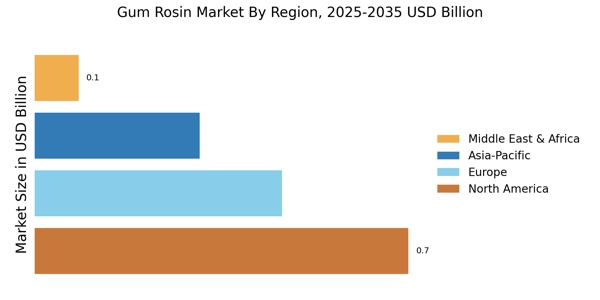
The Gum Rosin Market share is largely concentrated in the North America region accounting for approximately 45% of the global share. The region's growth is driven by increasing demand in the adhesives and coatings industries, alongside stringent regulations promoting the use of bio-based materials. The U.S. is the primary contributor, supported by a robust manufacturing base and innovation in product development. The regulatory environment is favorable, encouraging sustainable practices and investments in eco-friendly alternatives. The competitive landscape in North America features key players such as Eastman Chemical Company, Hercules Inc., and Resin Tech Inc. These companies leverage advanced technologies and extensive distribution networks to maintain their market positions. The presence of established firms fosters innovation and enhances product offerings, ensuring that North America remains at the forefront of the gum rosin market.

Europe : Emerging Regulatory Framework

Europe is witnessing significant growth in the gum rosin market, holding approximately 30% of the global share. The region's demand is primarily driven by the increasing adoption of eco-friendly products and stringent regulations aimed at reducing environmental impact. Countries like Germany and France are leading the market, supported by government initiatives promoting sustainable materials and innovation in the chemical sector. The regulatory landscape is evolving, with policies encouraging the use of renewable resources. Leading countries in Europe are Germany, France, and Italy, where major players like Kolon Industries and other local manufacturers are actively engaged. The competitive environment is characterized by a focus on sustainability and innovation, with companies investing in research and development to create high-performance gum rosin products. This commitment to sustainability is reshaping the market dynamics in Europe, making it a key player in the global landscape.

Asia-Pacific : Rapidly Growing Market Potential

Asia-Pacific is emerging as a significant player in the gum rosin market, accounting for around 20% of the global share. The region's growth is fueled by rising industrialization, particularly in countries like China and India, where demand for adhesives and coatings is surging. Government initiatives aimed at boosting manufacturing and exports further enhance market potential. The regulatory environment is gradually adapting to support sustainable practices, although challenges remain in enforcement and compliance. China is the largest market in the region, with companies like Wuzhou Pine Chemical Co. Ltd. and Yongjia Chemical Co. Ltd. leading the charge. The competitive landscape is marked by a mix of local and international players, with a focus on cost-effective production and innovation. As the region continues to industrialize, the demand for gum rosin is expected to grow, driven by both domestic consumption and export opportunities.

Middle East and Africa : Emerging Market Opportunities

The Middle East and Africa region is gradually developing its gum rosin market, currently holding about 5% of the global share. The growth is primarily driven by increasing industrial activities and a rising demand for natural resins in various applications. Countries like South Africa and the UAE are beginning to invest in the production of gum rosin, supported by government initiatives aimed at diversifying economies and promoting local manufacturing. However, the market is still in its nascent stages, with significant room for growth. In this region, the competitive landscape is characterized by a few emerging players and local manufacturers. The focus is on establishing a sustainable supply chain and enhancing production capabilities. As the market matures, there is potential for international companies to enter and collaborate with local firms, fostering innovation and expanding the market reach of gum rosin products.

Gum Rosin Market Regional Image

Key Players and Competitive Insights

The Gum Rosin Market is characterized by a dynamic competitive landscape, driven by increasing demand across various applications such as adhesives, inks, and coatings. Key players are actively engaging in strategies that emphasize innovation, sustainability, and regional expansion. Companies like Eastman Chemical Company (US) and Hercules Inc. (US) are focusing on enhancing their product portfolios through research and development, while Wuzhou Pine Chemical Co. Ltd. (CN) is leveraging its strong manufacturing capabilities to cater to the growing Asian market. This collective approach not only intensifies competition but also fosters a climate of continuous improvement and adaptation among market participants.In terms of business tactics, companies are increasingly localizing manufacturing to reduce lead times and optimize supply chains. The market structure appears moderately fragmented, with several players vying for market share. However, the influence of major companies is substantial, as they set benchmarks for quality and innovation. This competitive structure encourages smaller firms to innovate and differentiate their offerings, thereby enhancing overall market dynamism.
In August Eastman Chemical Company (US) announced a strategic partnership with a leading technology firm to develop bio-based gum rosin products. This initiative is significant as it aligns with the growing consumer preference for sustainable materials, potentially positioning Eastman as a leader in eco-friendly solutions within the gum rosin sector. The partnership may also enhance their R&D capabilities, allowing for faster product development cycles.
In September Hercules Inc. (US) expanded its production facility in the Midwest to increase output capacity for its gum rosin products. This expansion is indicative of Hercules' commitment to meeting rising demand in North America, particularly in the adhesives market. By enhancing production capabilities, Hercules is likely to strengthen its market position and improve supply chain efficiencies, which could lead to better customer satisfaction and loyalty.
In July Wuzhou Pine Chemical Co. Ltd. (CN) launched a new line of high-purity gum rosin aimed at the specialty chemicals market. This product introduction reflects Wuzhou's strategy to diversify its offerings and cater to niche markets, which may provide a competitive edge in an increasingly crowded marketplace. The focus on high-purity products could attract customers seeking quality and performance, thereby enhancing Wuzhou's reputation and market share.
As of October the Gum Rosin Market is witnessing trends that emphasize digitalization, sustainability, and the integration of advanced technologies such as AI in production processes. Strategic alliances are becoming increasingly prevalent, as companies recognize the value of collaboration in driving innovation and efficiency. Looking ahead, competitive differentiation is likely to evolve from traditional price-based strategies to a focus on innovation, technological advancements, and supply chain reliability, suggesting a transformative shift in how companies compete in this sector.

Key Companies in the Gum Rosin Market include

Industry Developments

  • Q2 2024: Henkel launches new bio-based hot melt adhesives incorporating gum rosin Henkel announced the launch of a new line of bio-based hot melt adhesives that utilize gum rosin as a key tackifier, targeting sustainable packaging and construction applications.

Future Outlook

Gum Rosin Market Future Outlook

The Gum Rosin Market size is projected to grow at a 3.59% CAGR from 2025 to 2035, driven by increasing demand in adhesives, inks, and coatings.
The global Gum Rosin Market is set for steady growth, fueled by rising demand for bio-based adhesives and sustainable packaging. Expanding construction, automotive, and printing ink industries will further drive long-term expansion.

New opportunities lie in:

  • Expansion into bio-based gum rosin products for sustainable applications. Development of specialized rosin derivatives for high-performance adhesives. Investment in automated production technologies to enhance efficiency and reduce costs.

By 2035, the Gum Rosin Market is expected to achieve robust growth, reflecting evolving industry demands.

Market Segmentation

Gum Rosin Market Type Outlook

  • WW

  • WG

  • K

  • X

  • Others

Gum Rosin Market Product Type Outlook

  • Adhesive & Sealants

  • Rubber

  • Paint & Coatings

  • Printing Inks

  • Food & Beverage

  • Others

Report Scope

MARKET SIZE 2024 1.51(USD Billion)
MARKET SIZE 2025 1.564(USD Billion)
MARKET SIZE 2035 2.226(USD Billion)
COMPOUND ANNUAL GROWTH RATE (CAGR) 3.59% (2025 - 2035)
REPORT COVERAGE Revenue Forecast, Competitive Landscape, Growth Factors, and Trends
BASE YEAR 2024
Market Forecast Period 2025 - 2035
Historical Data 2019 - 2024
Market Forecast Units USD Billion
Key Companies Profiled Eastman Chemical Company (US), Forestar Group Inc. (US), Hercules Inc. (US), Kolon Industries Inc. (KR), Resin Tech Inc. (US), Wuzhou Pine Chemical Co. Ltd. (CN), Yongjia Chemical Co. Ltd. (CN), Dingxin Chemical Co. Ltd. (CN)
Segments Covered Type, Product Type, Region
Key Market Opportunities Growing demand for bio-based adhesives and coatings drives innovation in the Gum Rosin Market.

Key Market Dynamics Rising demand for eco-friendly adhesives drives innovation and competition in the Gum Rosin Market.

Countries Covered North America, Europe, APAC, South America, MEA

Market Highlights

Author
Chitranshi Jaiswal
Research Analyst Level I

In her 3 years of experience in the market research field, she has handled critical cross-domain projects. She has an in-depth knowledge of market estimation & analysis, problem-solving, primary as well as secondary research, and team management.She holds an engineering degree and is an MBA professional from a well-known university, capable of evaluating the market and competitive conditions. An exceptional strategist with excellent communication skills and a passion for delivering cutting-edge & practical insights for the market. Proficient in multi-tasking, and can successfully deal with competing demands, while maintaining complete confidentiality. Generated business through active client and project development, networking, and high-quality responses. Her knowledge and skills have helped in making solid business decisions, securing funding from investors, and avoiding business failures.

Leave a Comment

FAQs

What is the current valuation of the Gum Rosin Market as of 2024?

The Gum Rosin Market was valued at 1.51 USD Billion in 2024.

What is the projected market valuation for the Gum Rosin Market in 2035?

The market is projected to reach 2.226 USD Billion by 2035.

What is the expected CAGR for the Gum Rosin Market during the forecast period 2025 - 2035?

The expected CAGR for the Gum Rosin Market during 2025 - 2035 is 3.59%.

Which companies are considered key players in the Gum Rosin Market?

Key players include Eastman Chemical Company, Forestar Group Inc., Hercules Inc., Kolon Industries Inc., Resin Tech Inc., Wuzhou Pine Chemical Co. Ltd., Yongjia Chemical Co. Ltd., and Dingxin Chemical Co. Ltd.

What are the main product types contributing to the Gum Rosin Market?

Main product types include Adhesive & Sealants, Rubber, Paint & Coatings, Printing Inks, and Food & Beverage.

How much revenue is generated from Adhesive & Sealants in the Gum Rosin Market?

Revenue from Adhesive & Sealants is projected to range from 0.45 to 0.65 USD Billion.

Research Approach

Secondary Research

The secondary research process involved comprehensive analysis of regulatory databases, forestry statistics, peer-reviewed chemical engineering journals, industry publications, and authoritative trade organizations. Key sources included the Food and Agriculture Organization of the United Nations (FAO) FAOSTAT-Forestry Database and Non-Wood Forest Products Statistics, US Department of Agriculture (USDA) Forest Service National Forest Products Database, US International Trade Commission (USITC) Trade DataWeb, International Trade Centre (ITC) Trade Map, Eurostat Forest Products Statistics, and UN Comtrade Database for international resin trade flows. Industry-specific sources included the Pine Chemicals Association International (PCA), Adhesive and Sealant Council (ASC), American Coatings Association, China Forestry Chemicals Association, Brazilian Association of Pine Resin Producers (ANPir), and Indian Gum Rosin Manufacturers Association. Regulatory data was sourced from the US Food and Drug Administration (FDA) 21 CFR 172.615 (chewing gum base), EPA Toxic Substances Control Act (TSCA), European Chemicals Agency (ECHA) REACH Registration Database, China National Forestry and Grassland Administration Resin Tapping Guidelines, Brazilian Institute of Environment and Renewable Natural Resources (IBAMA), and Indonesian Ministry of Environment and Forestry. Additional sources included the International Tropical Timber Organization (ITTO) Tropical Forest Products Statistical Database, UNECE/FAO Forest Products Annual Market Review, and national customs databases from China, Indonesia, Brazil, India, and Portugal for gum rosin export/import quantification by grade (WW, WG, K, X) and application.

Primary Research

As part of the initial research process, stakeholders from both the supply and demand sides were interviewed to get both qualitative and quantitative information about the whole value chain, from resin tapping to final use applications. On the supply side, there were CEOs, VPs of Operations, plantation managers, and harvesting directors from companies that made gum rosin (tapping operations), tall oil refiners (kraft pulping by-product processors), companies that made gum rosin derivatives (esterification and hydrogenation facilities), and OEM suppliers. Demand-side sources included R&D leaders and procurement heads from companies that make adhesives and sealants, printing ink, synthetic rubber, paints and coatings, food and drink companies (using food-grade rosin esters), and companies that make chemicals used to size paper. Primary research confirmed market segmentation across WW, WG, K, and X grades. It also confirmed product pipeline timelines for sustainable plantation systems and gathered information on how to manage price volatility, trends in replacing hydrocarbon resins, and regulatory compliance for food-contact applications.

Primary Respondent Breakdown:

By Designation: C-level Primaries (40%), Director Level (32%), Others (28%)

By Region: North America (32%), Europe (30%), Asia-Pacific (28%), Rest of World (10%)

Market Size Estimation

Global market valuation was derived through production volume mapping and revenue analysis across the pine chemicals value chain. The methodology included:

Identification of 45+ key manufacturers across China (Guangxi, Yunnan, Fujian pine belt), Indonesia (Sumatra), Brazil (Paraná, Minas Gerais), India (Northeastern states), Portugal, and North American tall oil rosin producers

Product mapping across WW (Water-White), WG (Water-Glass), K (K-Class), X (X-Class), and other technical grades, as well as downstream derivatives (rosin esters, hydrogenated rosin, disproportionated rosin)

Analysis of reported and modeled annual revenues specific to rosin resin portfolios, including direct gum rosin sales and captive consumption for derivative production

Coverage of manufacturers representing 70–75% of global market share in 2024, encompassing state-owned enterprises in China (e.g., Wuzhou Pine Chemical) and integrated pine chemical majors (e.g., Eastman Chemical, Kraton, Ingevity)

Extrapolation using bottom-up (harvested oleoresin volume × yield factors × ASP by country/grade) and top-down (manufacturer revenue validation and trade data triangulation) approaches to derive segment-specific valuations for adhesive and sealants, printing inks, rubber, paint and coatings, and food and beverage applications

Download Free Sample

Kindly complete the form below to receive a free sample of this Report

Compare Licence

×
Features License Type
Single User Multiuser License Enterprise User
Price $4,950 $5,950 $7,250
Maximum User Access Limit 1 User Upto 10 Users Unrestricted Access Throughout the Organization
Free Customization
Direct Access to Analyst
Deliverable Format
Platform Access
Discount on Next Purchase 10% 15% 15%
Printable Versions














