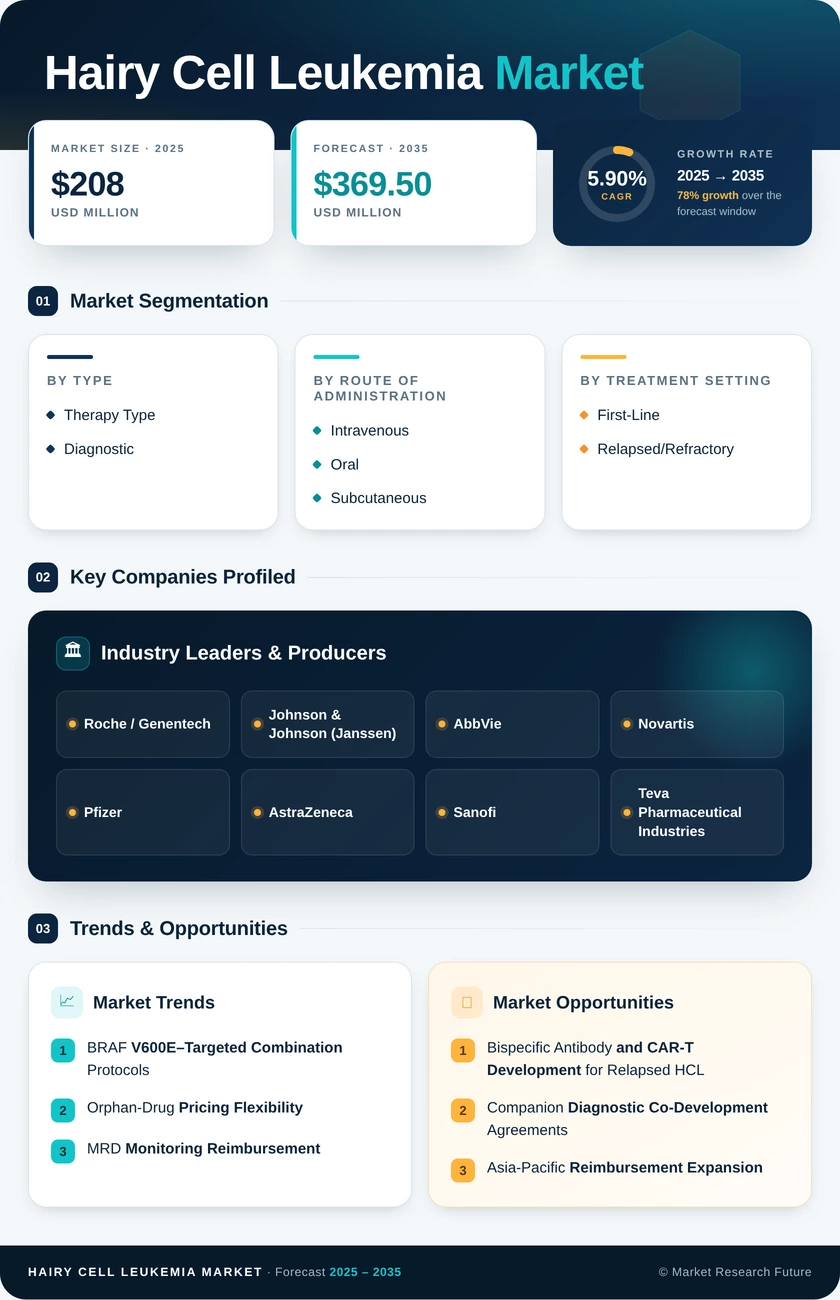
Segmentation Quick Reference
| Dimension | Sub-Segments | Dominant Segment | Fastest Growing Segment |
| Product Type | Therapy Type, Diagnostic | Therapy Type (65.8% share, 2025) | Diagnostic (8.40% CAGR) |
| Route of Administration | Intravenous, Oral, Subcutaneous | Intravenous (54.5% share, 2025) | Oral (8.60% CAGR) |
| Treatment Setting | First-Line, Relapsed/Refractory | First-Line (56.1% share, 2025) | Relapsed/Refractory (8.80% CAGR) |
| End User | Hospitals, Specialty Cancer Centers, Diagnostic Laboratories | Hospitals (59.2% share, 2025) | Diagnostic Laboratories (8.50% CAGR) |
| Geography | North America, Europe, Asia-Pacific, South America, Middle East & Africa | North America (42.1% share, 2025) | Asia-Pacific (7.55% CAGR) |
Market Segmentation Overview
By Product Type
| Sub-Segment | Key Trend |
| Therapy Type | BRAF-inhibitor combinations replacing purine-analog monotherapy; orphan-drug pricing sustains high per-patient revenue |
| Diagnostic | MRD flow-cytometry panels and BRAF V600E companion diagnostics transitioning from research to regulated IVDs |
Therapy-type products anchor the hairy cell leukemia market's revenue base, driven by orphan-drug exclusivity and premium pricing for targeted agents. Diagnostic modalities are growing faster as reimbursement expands for MRD monitoring and molecular companion diagnostics that guide treatment selection.
By Route of Administration
| Sub-Segment | Key Trend |
| Intravenous | Two-hour IV push cladribine protocol reduces chair time; rituximab infusions remain standard |
| Oral | BRAF inhibitors (vemurafenib, dabrafenib) and BTK inhibitors drive oral-segment acceleration |
| Subcutaneous | SC rituximab formulations reduce administration burden; adoption growing in maintenance settings |
Intravenous delivery retains dominance due to the entrenched role of IV cladribine and rituximab in first-line protocols. Oral administration is gaining share as targeted oral agents demonstrate equivalent efficacy with improved patient convenience in relapsed and refractory settings.
By Treatment Setting
| Sub-Segment | Key Trend |
| First-Line | Single-agent cladribine achieves durable remissions in 80–90% of treatment-naïve patients |
| Relapsed/Refractory | BRAF-inhibitor–rituximab combinations establish new salvage standard; MRD-guided retreatment emerging |
First-line therapy generates the majority of treatment-related revenue due to the high initial cost of purine-analog induction. The relapsed/refractory segment expands faster as longer patient survival increases the retreatment-eligible population over time.
By End User
| Sub-Segment | Key Trend |
| Hospitals | Integrated infusion-diagnostic services consolidate care; academic hospitals lead trial enrollment |
| Specialty Cancer Centers | NCI-designated centers drive investigator-initiated trial activity and guideline development |
| Diagnostic Laboratories | Reference laboratories build dedicated rare-leukemia MRD panels for send-out testing |
Hospitals serve as the primary site of care for HCL patients, offering consolidated access to infusion services, pathology, and hematology-oncology expertise. Diagnostic laboratories are expanding their role as decentralized MRD testing reaches community oncology practices.
By Geography
| Sub-Segment | Key Trend |
| North America | Academic trial ecosystems, CMS MRD reimbursement, and off-label payer flexibility |
| Europe | EMA orphan-drug incentives, joint HTA regulation, Italian cooperative-group registries |
| Asia-Pacific | NRDL expansion in China, South Korea hematology benefit rollout, and PMDA accelerated approvals |
| South America | SUS formulary additions in Brazil, private-sector oncology network growth in Argentina |
| Middle East & Africa | Saudi Vision 2030 healthcare investment, UAE medical-tourism hub development |
North America and Europe account for over 70% of the global hairy cell leukemia market revenue, reflecting mature diagnostic infrastructure and favorable orphan-drug reimbursement. Asia-Pacific leads growth as governments in China, South Korea, and Japan expand coverage for ultra-rare hematologic therapies.