Hematology Diagnostics Market Summary
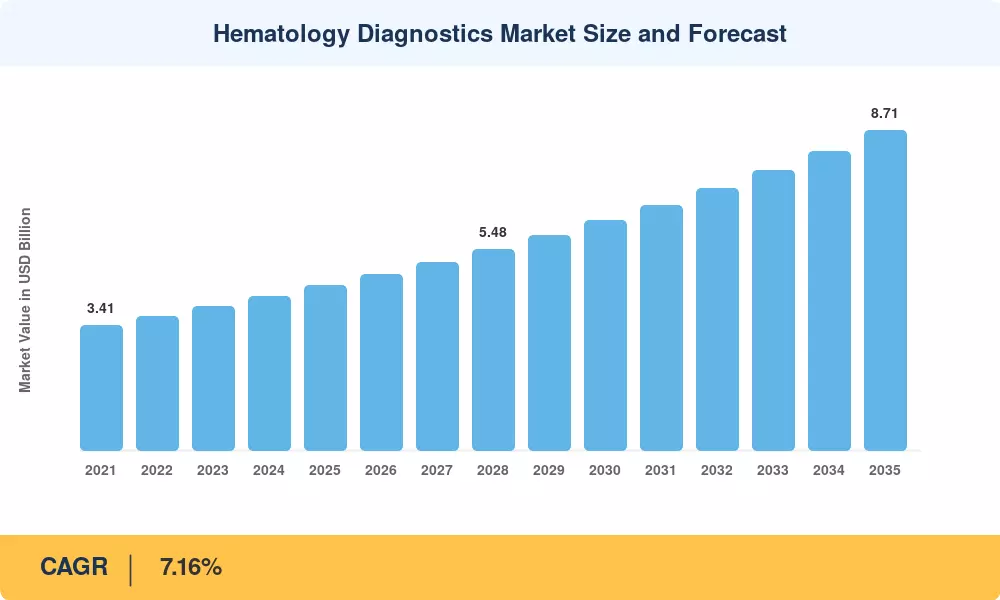
The Hematology Diagnostics Market reached USD 4.49 billion in 2025 and is positioned to grow from a 2026 starting base of USD 4.81 billion to roughly USD 8.71 billion by 2035, advancing at a 7.16% CAGR across the forecast window. Two catalysts anchor this trajectory: the steady expansion of public laboratory modernization budgets across developed health systems and a sustained push by clinical networks to consolidate testing under high-throughput platforms. Demand for reliable blood cell count analysis sits at the center of routine clinical workflows, and that durability makes the Hematology Diagnostics Market unusually resilient against macroeconomic swings.
Laboratories are retiring manual differential workflows and standalone 3-part counters in favor of integrated 5/6-part analyzers paired with digital morphology and laboratory information system connectivity. Capital spending on automated analyzer fleets has climbed notably, with several national health agencies committing over USD 200 million collectively toward diagnostic infrastructure upgrades since 2023. Improved CBC diagnostic testing throughput and shorter turnaround times underpin this shift, while AI-assisted slide review reduces dependency on scarce skilled technologists.
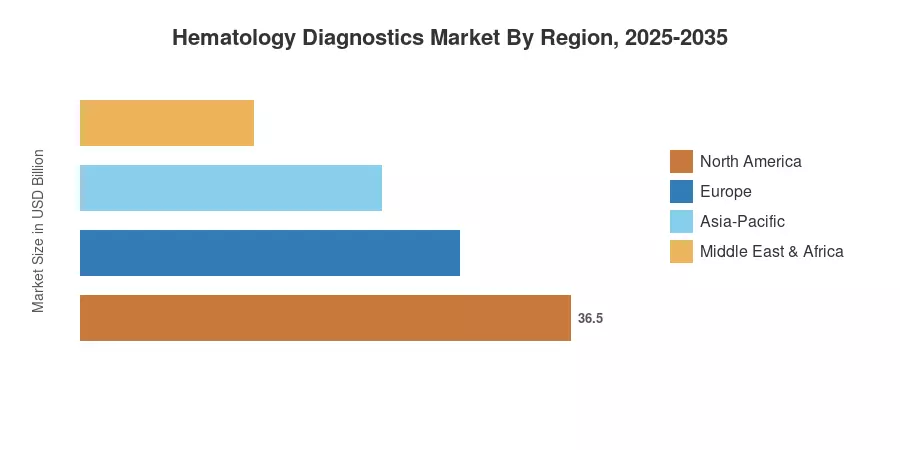
North America holds the dominant position with roughly 31% of global revenue, supported by mature reimbursement frameworks and dense hospital networks. Asia-Pacific is the fastest-growing region at an 8.18% CAGR, driven by hospital construction and rising diagnostic access. Europe ranks second, anchored by aging-population demand and centralized procurement. The decade ahead will reward vendors that combine instrument reliability with software-led service models.
Key Report Takeaways
• By Technology
- 5/6-part differential analyzers led the Hematology Diagnostics Market with 47.8% share in 2024
- Molecular and digital hematology technologies are advancing at a 10.10% CAGR through 2035
• By Sector
- Complete blood count generated the largest test-type revenue at USD 1.62 billion in 2024
- Hospital laboratories anchored end-user demand within the Hematology Diagnostics Market at 43.1% share
- Point-of-care settings are forecast to expand at an 11.65% CAGR through 2035
• By Region
- North America captured 31.2% of the Hematology Diagnostics Market revenue in 2024
- Asia-Pacific is the fastest-growing region at an 8.18% CAGR
Market Size and Forecast (2021–2035)
Market sizing draws on a blended methodology combining bottom-up instrument shipment data, consumables consumption modeling, and validation against published payer reimbursement volumes. Historical figures reflect installed-base analysis; forecast years apply a calibrated CAGR anchored to anemia and leukemia detection volumes and procedural growth.





















.webp?v=1783335236)
