Hernia Repair Market (2026 - 2035)

Hernia Repair Market Research Report By Hernia Type (Inguinal Hernia, Umbilical Hernia, Incisional Hernia, Hiatal Hernia), By Surgical Technique (Open Surgery, Laparoscopic Surgery, Robotic Surgery), By Material Type (Synthetic Mesh, Biologic Mesh, Absorbable Mesh), By End User (Hospitals, Ambulatory Surgical Centers, Specialty Clinics) and By Regional (North America, Europe, South America, Asia Pacific, Middle East and Africa) - Industry Forecast to 2035.
ID: MRFR/MED/1680-HCR
80 Pages
Vikita Thakur, Kinjoll Dey
Last Updated: July 17, 2026
Hernia Repair Market
Market Size
Forecast Period2026-2035
CAGR (2026-2035)4.6%
2025 Market SizeUSD 4.57 billion
2035 Market SizeUSD 7.17 billion
Key Players
Medtronic plc
BD (Becton
Dickinson)
Johnson & Johnson
W.L. Gore & Associates
B. Braun SE
Opportunities
  • Biosynthetic Hybrid Mesh Platforms
  • Robotic Platform Ecosystem Expansion
  • Emerging-Market Surgical Infrastructure

Hernia Repair Market Summary

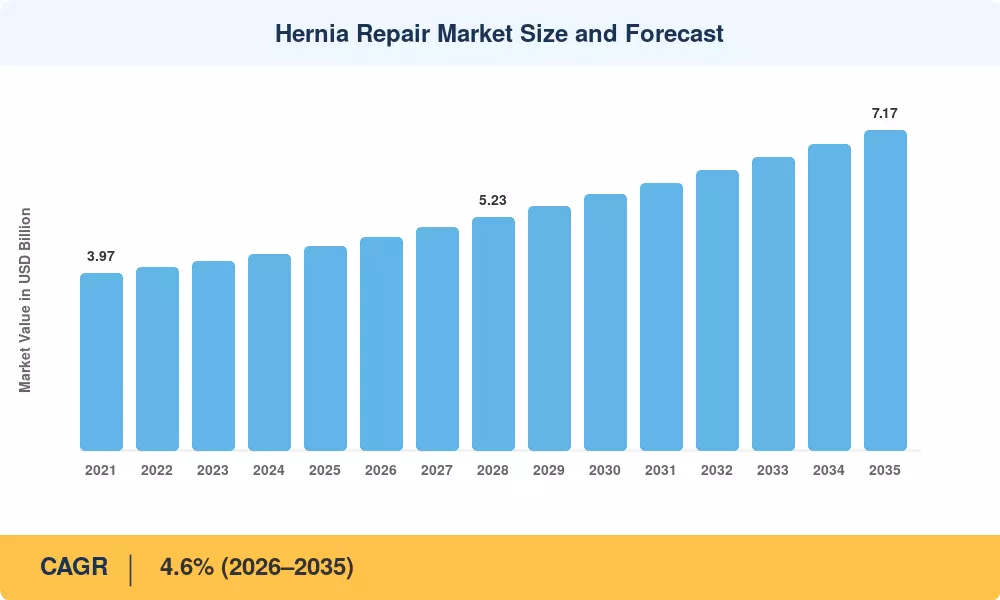
The Hernia Repair Market reached an estimated USD 4.57 billion in 2025 and is projected to grow from USD 4.78 billion in 2026 to USD 7.17 billion by 2035, registering a CAGR of 4.6% during the forecast period. Rising obesity prevalence across developed and emerging economies, combined with aging populations that are inherently predisposed to abdominal wall weakening, continues to fuel procedural volumes. Medicare and Medicaid expansion of outpatient surgical coverage in the United States has further accelerated the shift toward same-day hernia procedures, reinforcing the revenue trajectory of the Hernia Repair Market through the next decade [1].

A significant technology shift is altering the way surgeons do hernia repair. Minimally invasive and robotic-assisted procedures are slowly replacing traditional open techniques that have dominated hospitals for decades. Global hospital systems are projected to invest USD 2.8 billion in robotic surgical platforms from 2022 to 2024, with hernia repair among the top five operations targeted for robotic adoption [2]. Older heavyweight polypropylene products are being replaced with lightweight composite mesh configurations designed for trocar distribution and biologic scaffolds that decrease chronic pain concerns.


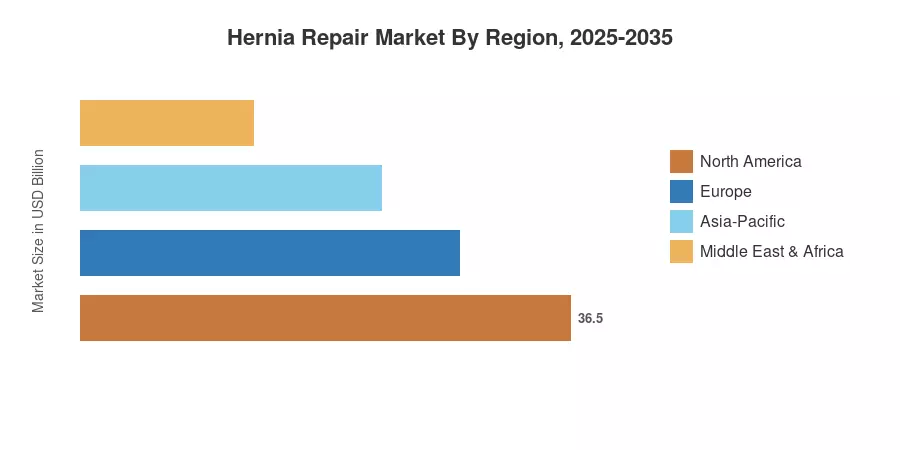
North America has the largest share of the global Hernia Repair Market revenue, at over 44.2%, driven by high procedural reimbursement rates and a large base of robotic platform installations. Asia-Pacific is the fastest-growing market with a predicted CAGR of 6.1% due to increasing insurance coverage in India and China. Europe accounts for around 28% of worldwide income, driven by national health care procurement regimes in Germany, France and the UK. The Hernia Repair Market is expected to witness steady growth with expanding surgical infrastructure in emerging regions and tipping points for robotic penetration in tier 2 cities.


Key Report Takeaways

• By Hernia Type

  • Inguinal repairs accounted for 59.2% of the Hernia Repair Market in 2025, reflecting the high global incidence of groin hernias across adult male populations.
  • Ventral and incisional repair procedures are forecast to expand at a 7.1% CAGR through 2035, driven by rising bariatric and revision surgery caseloads.

• By Mesh Type & Material

  • Synthetic mesh products represented approximately 90.5% of the Hernia Repair Market revenue in 2025, owing to cost-effectiveness and broad surgeon familiarity.
  • Biologic mesh alternatives are projected to grow at a 6.9% CAGR, supported by demand in contaminated-field procedures.

• By Surgical Technique & End User

  • Open procedures comprised 62.1% of all hernia surgeries in 2025, though robotic-assisted approaches are climbing at a 7.5% CAGR.
  • Ambulatory surgical centers are expected to post the fastest end-user growth at an 8.1% CAGR, propelled by expanded outpatient reimbursement.

• By Geography

  • North America led the Hernia Repair Market with a 44.2% share in 2025
  • Asia-Pacific is forecast to register the highest regional CAGR at 6.1% through 2035


Market Size and Forecast (2021–2035)

Market Research Future (MRFR) draws its estimations on extensive primary interviews with procurement directors at more than 120 hospital networks, revenue disclosures from device manufacturers, CMS procedure databases and proprietary price models cross-checked against regional tender data. Historical values reflect device revenue. Forecast values are derived from procedure volume forecasts, reimbursement trend analyses and product mix developments.
Hernia Repair Market Size and Forecast
Our Impact
Enabled $4.3B Revenue Impact for Fortune 500 and Leading Multinationals
Partnering with 2000+ Global Organizations Each Year
30K+ Citations by Top-Tier Firms in the Industry

Driver Impact Analysis

Driver ~% Impact on CAGR Geographic Relevance Impact Timeline
Rising global obesity prevalence +0.9% Global Long-term (≥4 yr)
Aging population demographics +0.7% North America, Europe Long-term (≥4 yr)
Robotic-assisted surgery adoption +0.8% North America, Asia-Pacific Medium-term (2–4 yr)
Outpatient reimbursement expansion +0.6% North America Short-term (≤2 yr)
Biologic and biosynthetic mesh innovation +0.5% Global Medium-term (2–4 yr)
Emerging-market insurance coverage expansion +0.7% Asia-Pacific, South America Medium-term (2–4 yr)
Recurrent hernia and revision procedure growth +0.4% Global Long-term (≥4 yr)


Rising Global Obesity Prevalence

The World Obesity Federation projects that 1.5 billion adults globally will carry a BMI above 30 by 2030, a 40% increase from 2020 levels [4]. Obesity directly elevates intra-abdominal pressure, increasing both the initial incidence of ventral and inguinal hernias and the risk of recurrence after primary repair. The Hernia Repair Market benefits disproportionately because obese patients often require larger mesh implants, reinforced fixation, and staged procedures that generate higher per-case device revenue.

Robotic-Assisted Surgery Adoption

Hospital systems added over 1,800 new robotic surgical consoles worldwide in 2024, with hernia repair representing roughly 12% of total robotic general surgery case volume [6]. Robotic platforms reduce conversion-to-open rates by an estimated 35% compared with conventional laparoscopy, allowing surgeons to tackle complex ventral and incisional cases with greater precision. For the Hernia Repair Market, robotic adoption drives a shift toward premium mesh products specifically designed for robotic trocar delivery, increasing average selling prices per procedure.

Outpatient Reimbursement Expansion

CMS finalized expanded ASC-eligible procedure codes for complex ventral hernia repair in its 2024 Outpatient Prospective Payment System rule, opening an estimated 180,000 additional procedures per year to the ambulatory setting [7]. The cost differential between hospital inpatient and ASC settings ranges from 40% to 60%, incentivizing payers and patients alike to shift volume. This policy tailwind strengthens the Hernia Repair Market by lowering access barriers and boosting total addressable procedure counts.

Emerging-Market Insurance Expansion

India's Ayushman Bharat Pradhan Mantri Jan Arogya Yojana added elective hernia repair to its coverage list in 2023, extending cashless surgical access to over 500 million beneficiaries [9]. Similar coverage expansions in Brazil's SUS system and China's urban employee insurance programs are projected to add a combined 600,000 incremental hernia procedures annually by 2030, directly expanding the addressable Hernia Repair Market in these regions.


Restraints Impact Analysis

Restraint ~% Impact on CAGR Geographic Relevance Impact Timeline
Mesh-related litigation and settlements –0.6% North America Short-term (≤2 yr)
Post-implant chronic pain and adverse events –0.4% Global Long-term (≥4 yr)
Pricing pressure from value-based procurement –0.3% Europe, Asia-Pacific Medium-term (2–4 yr)
Regulatory tightening on mesh safety data –0.3% Europe, Australia Medium-term (2–4 yr)
Surgeon preference for suture-only repair in select cases –0.2% Europe Long-term (≥4 yr)


Mesh-Related Litigation

Cumulative legal settlements tied to polypropylene mesh complications exceeded USD 1.1 billion in 2024, with multidistrict litigation in the United States remaining the primary venue [11]. While most cases target pelvic mesh rather than hernia-specific products, the reputational spillover constrains pricing power and compels manufacturers to invest heavily in post-market surveillance studies. The Hernia Repair Market faces continued headwinds as procurement committees demand long-term safety data and indemnity clauses before approving new mesh products.

Chronic Pain and Adverse Event Concerns

Between 10% and 15% of patients undergoing inguinal hernia repair with synthetic mesh report chronic groin pain lasting beyond three months, according to a 2023 meta-analysis published in the British Journal of Surgery [12]. These outcomes drive surgeon interest in mesh-free tissue repair for small primary hernias and in biologic or biosynthetic alternatives that promise reduced foreign-body reaction. The Hernia Repair Market growth rate is moderated in segments where suture repair is clinically viable.

Regulatory Tightening

The European Commission reclassified hernia mesh from Class IIb to Class III under the EU Medical Device Regulation in 2023, requiring full clinical investigation data for new product approvals [14]. Australia's TGA followed with enhanced post-market review requirements. These regulatory shifts lengthen time-to-market for innovative mesh designs and increase development costs, tempering the pace of product launches in the Hernia Repair Market.


Hernia Repair Market Opportunities

Biosynthetic Hybrid Mesh Platforms

Next-generation hybrid scaffolds that combine a permanent synthetic core with a resorbable biologic layer represent a rapidly emerging product category. These platforms aim to deliver the tensile strength of polypropylene with the tissue integration benefits of biologic materials, targeting the estimated 25% of ventral repair cases classified as contaminated or potentially contaminated fields. The Hernia Repair Market stands to gain as hybrid products command premium pricing over conventional synthetic mesh.

Robotic Platform Ecosystem Expansion

As multiple new robotic surgery platforms enter the market and erode the single-vendor pricing model, procedure costs are projected to decline by 15–20% between 2026 and 2030 [6]. Lower per-procedure costs will expand robotic hernia repair into community hospitals and ambulatory settings, significantly growing the addressable patient pool for the Hernia Repair Market.

Emerging-Market Surgical Infrastructure

Sub-Saharan Africa and Southeast Asia collectively perform fewer than 30% of the hernia procedures clinically indicated each year, according to the Lancet Commission on Global Surgery [16]. Government and multilateral investments in district hospital operating theaters and surgical workforce training represent a multi-decade growth vector for the Hernia Repair Market, with an addressable gap exceeding 20 million unmet procedures annually.

Data-Driven Outcomes Registries and Value-Based Contracting

Payers increasingly link mesh reimbursement to outcomes-registry data, creating opportunities for manufacturers who can demonstrate superior recurrence and complication rates. Companies that invest in real-world evidence platforms and digital health integrations can differentiate their Hernia Repair Market offerings through performance guarantees and risk-sharing contracts.

AI-Assisted Intraoperative Planning

Machine-learning algorithms capable of mapping abdominal wall defect geometry from preoperative CT scans and recommending optimal mesh size, placement, and fixation technique are in late-stage clinical validation. Early studies demonstrate a 22% reduction in mesh-related complications when AI guidance is employed [17]. Commercialization of these platforms will create a complementary revenue stream within the Hernia Repair Market.


Hernia Repair Market Future Outlook

Robotic Democratization and Platform Competition

The entry of three new robotic surgery platforms between 2025 and 2028 will break the single-vendor dominance that kept per-procedure costs elevated. Competition is expected to reduce robotic hernia procedure costs by up to 25%, enabling community hospitals with 100–200 beds to adopt the technology. The Hernia Repair Market will see a corresponding shift in product design toward mesh architectures optimized for multi-platform compatibility [6].

Personalized Mesh Selection Through Digital Twins

Digital twin technology applied to abdominal wall biomechanics is advancing from academic prototypes to clinical pilots. By 2030, surgeons may routinely upload CT data to cloud-based platforms that simulate mesh-tissue interaction and recommend optimal product specifications. This development will deepen the Hernia Repair Market's premium tier and create software-as-a-medical-device revenue streams [17].

Sustainability and Circular Supply Chains

Environmental scrutiny of single-use surgical products is intensifying, with the UK's NHS pledging net-zero procurement by 2035 [19]. Mesh manufacturers are responding with sterilizable delivery systems, reduced packaging waste, and polymer sourcing from bio-based feedstocks. The Hernia Repair Market will increasingly reward companies that embed lifecycle sustainability metrics into their product portfolios.

Value-Based Reimbursement and Bundled Payments

CMS and European payers are piloting bundled payment models for hernia repair that tie reimbursement to 90-day outcomes rather than per-item device fees [20]. This shift rewards manufacturers whose products demonstrate low recurrence and complication rates, fundamentally altering competitive dynamics in the Hernia Repair Market from volume-driven to outcomes-driven strategies.


Hernia Repair Market Segmentation

By Hernia Type

Segment Key Metric Primary Demand Driver
Inguinal 59.2% share (2025) High incidence in adult males
Incisional / Ventral 7.1% CAGR (2026–2035) Rising bariatric revision caseloads
Other (femoral, umbilical, hiatal) USD 0.41 billion (2025) Pediatric and specialty repair demand


Inguinal hernia repair dominates the Hernia Repair Market in procedure count and revenue, reflecting the condition's status as the most common abdominal wall defect worldwide. The segment benefits from standardized repair techniques and broad payer coverage across most geographies. Ventral and incisional repairs are growing faster due to increasing obesity-related abdominal surgeries and the corresponding rise in post-surgical herniation rates.

By Mesh Type

Segment Key Metric Primary Demand Driver
Synthetic 90.5% share (2025) Cost efficiency and surgeon familiarity
Biologic 6.9% CAGR (2026–2035) Contaminated-field clinical demand
Bio-Synthetic / Hybrid USD 0.12 billion (2025) Emerging category bridging performance gaps


Synthetic mesh products form the backbone of the Hernia Repair Market, driven by decades of clinical data supporting polypropylene and polyester constructs. Biologic scaffolds derived from human or porcine dermis command significantly higher price points and are gaining traction in clinical scenarios where synthetic materials carry elevated infection risk. The hybrid category remains nascent but is attracting substantial R&D investment from all major manufacturers.

By Surgical Repair Technique

Segment Key Metric Primary Demand Driver
Open 62.1% share (2025) Global standard of care for primary inguinal repair
Laparoscopic USD 0.98 billion (2025) Established a minimally invasive alternative
Robotic-Assisted 7.5% CAGR (2026–2035) Platform expansion and training program growth


Open repair retains the largest share of the Hernia Repair Market because it remains the preferred approach for straightforward primary inguinal cases in community settings. Robotic-assisted techniques, however, are growing rapidly as platform costs decline and fellowship-trained surgeons enter practice. The robotic segment's higher per-procedure device revenue makes it a disproportionately important growth driver for mesh manufacturers.

By End User

Segment Key Metric Primary Demand Driver
Hospitals 52.3% share (2025) Complex case concentration and robotic platform access
Ambulatory Surgical Centers 8.1% CAGR (2026–2035) CMS coverage expansion and cost advantages
Specialty Clinics USD 0.19 billion (2025) Dedicated hernia centers of excellence


Hospitals retain the majority of the Hernia Repair Market revenue because complex ventral, recurrent, and robotic cases require inpatient infrastructure. Ambulatory surgical centers represent the fastest-growing end-user segment, capturing routine inguinal repairs that benefit from same-day discharge protocols and significantly lower facility fees.


Regional Market Share Analysis

Region Key Metric Primary Investment Themes
North America 44.2% global share (2025) Robotic adoption, ASC migration, outcomes registries
Europe USD 1.28 billion (2025) MDR compliance, suture-vs-mesh clinical trials
Asia-Pacific 6.1% CAGR (2026–2035) Public insurance expansion, hospital capacity buildout
South America USD 0.24 billion (2025) SUS reimbursement reform, public-private partnerships
Middle East & Africa 5.3% CAGR (2026–2035) Medical tourism, WHO surgical capacity initiatives

The Hernia Repair Market exhibits a clear concentration in developed markets where surgical infrastructure and insurance coverage are mature. At the same time, emerging regions offer the highest growth rates driven by expanding healthcare access.


North America

Country Key Metric Key Driver
United States 82% of regional share Largest robotic install base globally
Canada 4.8% CAGR Provincial wait-time reduction mandates
Mexico USD 0.09 billion (2025) Growing medical tourism for elective surgery


The United States accounts for the majority of the North American Hernia Repair Market revenue, performing an estimated 1.1 million hernia repairs annually. CMS reimbursement updates and widespread robotic platform availability sustain premium mesh pricing. Canada's single-payer provinces are investing in surgical backlog clearance following pandemic-era delays, while Mexico's private hospital sector captures cross-border demand from cost-conscious U.S. patients [7].

Europe

Country Key Metric Key Driver
Germany 26% of regional share High per-capita hernia procedure rate
United Kingdom 5.0% CAGR NHS elective recovery program
France USD 0.16 billion (2025) National mesh registry mandate
Italy 4.3% CAGR Expanding day-surgery facilities
Spain USD 0.10 billion (2025) Public hospital modernization
Nordic Countries 4.7% CAGR Quality registries driving evidence-based adoption
Russia USD 0.07 billion (2025) Import substitution initiatives
Rest of Europe 4.2% CAGR Varied regulatory environments


Europe's Hernia Repair Market is shaped by the EU Medical Device Regulation transition that requires Class III clinical data for mesh products. Germany leads on procedure volume and surgeon specialization, while the United Kingdom's NHS elective recovery fund allocated GBP 8 billion to clear surgical backlogs through 2025, directly benefiting hernia procedure throughput [14].

Asia-Pacific

Country Key Metric Key Driver
China 35% of regional share Tier-2 and tier-3 hospital expansion
India 7.2% CAGR Ayushman Bharat coverage expansion
Japan USD 0.11 billion (2025) Aging population, robotic surgery investment
South Korea 5.8% CAGR National health insurance procedural add-ons
ASEAN USD 0.08 billion (2025) Medical tourism growth in Thailand and Malaysia
Rest of Asia-Pacific 5.5% CAGR Incremental infrastructure investments


Asia-Pacific represents the fastest-growing region for the Hernia Repair Market, fueled by India's public insurance expansion that brought over 500 million citizens into cashless surgical coverage and China's hospital construction program that added 12,000 operating rooms between 2021 and 2024 [9]. Japan's aging demographics and South Korea's favorable reimbursement environment support steady premium mesh adoption.

South America

Country Key Metric Key Driver
Brazil 62% of regional share SUS elective surgery expansion
Argentina 4.9% CAGR Private clinic network growth
Rest of South America USD 0.04 billion (2025) Multilateral health investment


Brazil dominates the South American Hernia Repair Market, with its unified health system (SUS) funding an increasing proportion of elective procedures. Argentina's private healthcare sector is expanding surgical capacity in Buenos Aires and Córdoba, while smaller economies rely on multilateral funding to build baseline surgical infrastructure [16].

Middle East & Africa

Country Key Metric Key Driver
Saudi Arabia 30% of regional share Vision 2030 healthcare investment
UAE 5.9% CAGR Medical tourism hub positioning
South Africa USD 0.03 billion (2025) Private-sector surgical capacity
Egypt 5.1% CAGR Population-driven procedural demand
Rest of MEA USD 0.04 billion (2025) WHO surgical capacity programs


Saudi Arabia's Vision 2030 healthcare spending targets a 65% increase in surgical beds by 2030, creating procurement demand across the Hernia Repair Market [18]. The UAE positions itself as a regional medical tourism destination, attracting patients from neighboring countries for elective procedures, including hernia repair.


Hernia Repair Market By Region, 2025-2035

Competitive Benchmarking

The Hernia Repair Market is moderately concentrated, and the top five players contribute to an estimated 55-62% of the market revenue worldwide. The Herfindahl-Hirschman Index is low to moderate, indicating a combination of diversified medtech conglomerates and dedicated surgical device experts. Competition is focused on mesh material innovation, robotic compatibility, clinical evidence portfolios and outcomes-based contracts.

Company Est. Revenue Share Range Key Offerings Strategic Positioning
Medtronic plc ~14–18% Parietex composite mesh, Hugo RAS platform integration Broad portfolio spanning open, laparoscopic, and robotic repair
BD (Becton, Dickinson) ~12–16% Ventralex, Bard Mesh, PerFix plug systems Legacy dominance in synthetic inguinal and ventral mesh
Johnson & Johnson (Ethicon) ~10–14% Proceed mesh, Physiomesh successor platforms Extensive clinical evidence database, global distribution
W.L. Gore & Associates ~7–10% Gore Bio-A, Gore Synecor biomaterial platforms Premium positioning in biologic and biosynthetic categories
B. Braun SE ~5–8% Optilene mesh, robotic-compatible delivery systems Strong European footprint with value-tier pricing
Getinge AB (Atrium) ~4–6% C-QUR mesh with hydrogel barrier coating Differentiated anti-adhesion technology
TELA Bio, Inc. ~2–4% OviTex reinforced tissue matrix Pure-play biologic mesh innovator
Integra LifeSciences ~2–3% SurgiMend collagen matrix Niche focuses on complex reconstructive cases
Cook Medical ~2–3% Biodesign biologic grafts Porcine-derived scaffold portfolio
Teleflex Incorporated ~1–3% Mini-invasive hernia fixation devices Complementary access and fixation tools


Recent News & Developments

  • Medtronic (September 2024): Received FDA 510(k) clearance for a next-generation lightweight composite mesh designed for robotic trocar delivery, targeting ventral hernia cases [21].


  • TELA Bio (January 2025): TELA Bio, Inc. announced the European launch of its OviTex Inguinal Reinforced Tissue Matrix, designed for laparoscopic and robotic-assisted inguinal hernia repair. This follows the successful U.S. launch in 2024, where it generated over USD 1 million in sales in its first year. The product offers a natural alternative to synthetic mesh for hernia surgeries.


Hernia Repair Market Report Scope

Parameter Details
Market Scope Hernia Repair Market — devices, mesh implants, fixation products, and biologic scaffolds
Study Period 2021–2035
CAGR 4.6% (2026–2035)
Base Year Market Size USD 4.57 billion (2025)
Forecast Endpoint USD 7.17 billion (2035)
Fastest Growing Segment Ambulatory Surgical Centers (by end user); Robotic-Assisted (by technique)
Companies Profiled 10
Valuation Currency USD billion


FAQs

How do mesh-related litigation trends affect purchasing decisions for hospital procurement teams?
Procurement committees now require manufacturers to provide indemnity clauses and long-term post-market surveillance data before approving new mesh products. Risk-management departments increasingly score vendors on litigation exposure as part of total-value assessments [11].
What clinical criteria determine whether a surgeon selects biologic mesh over synthetic mesh?
Contaminated surgical fields, concurrent bowel procedures, and patients with prior mesh infections are the primary clinical indicators for biologic mesh selection. Synthetic products remain preferred for clean elective cases due to lower cost and comparable recurrence rates [15].
How are bundled payment models changing manufacturer pricing strategies in hernia repair?
Bundled payments tie reimbursement to 90-day outcomes, pushing manufacturers to offer risk-sharing contracts and demonstrate superior recurrence data. Companies invest in registries that track real-world complication rates to support value-based pricing [20].
What training requirements exist for surgeons transitioning from laparoscopic to robotic hernia repair?
Most robotic platforms require 20–30 proctored cases before independent credentialing. Fellowship-trained surgeons complete the learning curve faster, and simulation-based curricula are reducing training timelines by approximately 35% [6].
How does the mesh fixation technique influence long-term patient outcomes in the Hernia Repair Market?
Absorbable tack fixation reduces chronic pain incidence compared with permanent metallic tacks, while fibrin sealant fixation shows promise for reducing postoperative discomfort in lightweight mesh applications [12].
What role do hernia-specific registries play in shaping the Hernia Repair Market competitive landscape?
National registries in Denmark, Sweden, and Germany publicly benchmark recurrence and complication rates by product brand. Manufacturers with consistently favorable registry data gain preferential formulary positioning in evidence-driven procurement systems [15].
How are single-port robotic platforms expected to affect hernia repair procedure economics?
Single-port systems reduce instrument costs per procedure by an estimated 20% compared with multi-arm platforms. Their smaller footprint also makes them viable for ambulatory surgical centers, expanding robotic repair access beyond large hospitals [6].    
Author
Author
Author Profile
Vikita Thakur LinkedIn
Senior Research Analyst
She holds an experience of about 5+ years in market research and business consulting projects for sectors such as life sciences, medical devices, and healthcare IT. She possesses a robust background in data analysis, market estimation, competitive intelligence, pipeline analysis market trend identification, and consumer behavior insights. Her expertise lies in technical Sales support, client interaction and project management, designing and implementing market research studies, conducting competitive analysis, and synthesizing complex data into actionable recommendations that drive business growth.
Co-Author
Co-Author Profile
Kinjoll Dey LinkedIn
Senior Research Analyst
He is an extremely curious individual currently working in Healthcare and Medical Devices Domain. Kinjoll is comfortably versed in data centric research backed by healthcare educational background. He leverages extensive data mining and analytics tools such as Primary and Secondary Research, Statistical Analysis, Machine Learning, Data Modelling. His key role also involves Technical Sales Support, Client Interaction and Project management within the Healthcare team. Lastly, he showcases extensive affinity towards learning new skills and remain fascinated in implementing them.

Research Approach


Secondary Research

The secondary research process involved comprehensive analysis of surgical registries, FDA 510(k) and PMA databases, peer-reviewed surgical journals, and authoritative health organizations. Key sources included the US Food & Drug Administration (FDA) Center for Devices and Radiological Health, European Medicines Agency (EMA), Therapeutic Goods Administration (TGA) Australia, American College of Surgeons National Surgical Quality Improvement Program (ACS NSQIP), Healthcare Cost and Utilization Project (HCUP) Statistical Briefs, Agency for Healthcare Research and Quality (AHRQ), Society of American Gastrointestinal and Endoscopic Surgeons (SAGES), European Association for Endoscopic Surgery (EAES), European Hernia Society (EHS), International Hernia Collaboration (IHC), National Institutes of Health (NIH), National Center for Biotechnology Information (NCBI/PubMed), Cochrane Library, CDC National Hospital Discharge Survey, World Health Organization (WHO) Global Health Observatory, OECD Health Statistics, and Eurostat Healthcare Database.

Surgical procedure volumes, mesh safety surveillance data, recurrence rates, regulatory clearance pathways for synthetic and biologic meshes, laparoscopic approach adoption metrics, and patient demographic trends across inguinal, ventral (incisional/umbilical), femoral, and hiatal hernia segments were collected using these sources.


Primary Research

Qualitative and quantitative insights were obtained by interviewing supply-side and demand-side stakeholders during the primary research process. Supply-side sources encompassed CEOs, VPs of Product Development, heads of Surgical Robotics divisions, regulatory affairs directors, and commercial leads from hernia mesh manufacturers (synthetic permanent, synthetic absorbable, and biologic categories), mesh fixation device companies (tackers, sutures, tissue adhesives), trocar/access device manufacturers, and surgical robotics platforms. Surgical oncologists (for complex abdominal wall reconstruction), board-certified general surgeons, minimally invasive surgery (MIS) specialists, hernia center medical directors, procurement officers from academic medical centers, community hospitals, and ambulatory surgical centers (ASCs), and OR managers comprised demand-side sources. Primary research has confirmed the product development pipelines for next-generation composite meshes, validated market segmentation across procedure types (open, laparoscopic TAPP/TEP, robotic-assisted), and gathered insights on the clinical adoption of biosynthetic scaffolds, fixation methods, and component separation techniques.

Primary Respondent Breakdown:

By Designation: C-level Primaries (31%), Director Level (34%), Others (35%)

By Region: North America (38%), Europe (30%), Asia-Pacific (25%), Rest of World (7%)


Market Size Estimation

The global market valuation was determined by analyzing procedure volume, device utilization rates, and revenue mapping across the hernia repair continuum. The methodology comprised the following:

The identification of over 50 significant manufacturers in North America, Europe, Asia-Pacific, and Latin America, who specialize in surgical instrumentation, mesh implants, and fixation devices.

The following is a product mapping of synthetic non-absorbable mesh (polypropylene, polyester), synthetic absorbable mesh, biologic mesh (porcine dermis, bovine pericardium, human allograft), biosynthetic composite mesh, fixation systems (permanent and absorbable tacks, sutures, tissue adhesives), and laparoscopic/robotic surgical equipment.

Examination of annual revenues that are specific to hernia repair product portfolios, as reported and modeled

Manufacturers that account for 75-80% of the global market share in 2024 are included in the coverage.

Procedure volume modeling by hernia type (inguinal 65-70%, ventral 20-25%, others 5-10%) and approach (open, laparoscopic, robotic) in key countries

Derive segment-specific valuations for mesh, fixation devices, and surgical equipment through extrapolation using bottom-up (procedure volume × ASP by country/setting, accounting for hospital inpatient, hospital outpatient, and ASC volumes) and top-down (manufacturer revenue validation, WHO/CDC surgical statistics triangulation) approaches.

Download Free Sample

Kindly complete the form below to receive a free sample of this Report

Download PDF ×

We do not share your information with anyone. However, we may send you emails based on your report interest from time to time. You may contact us at any time to opt-out.














