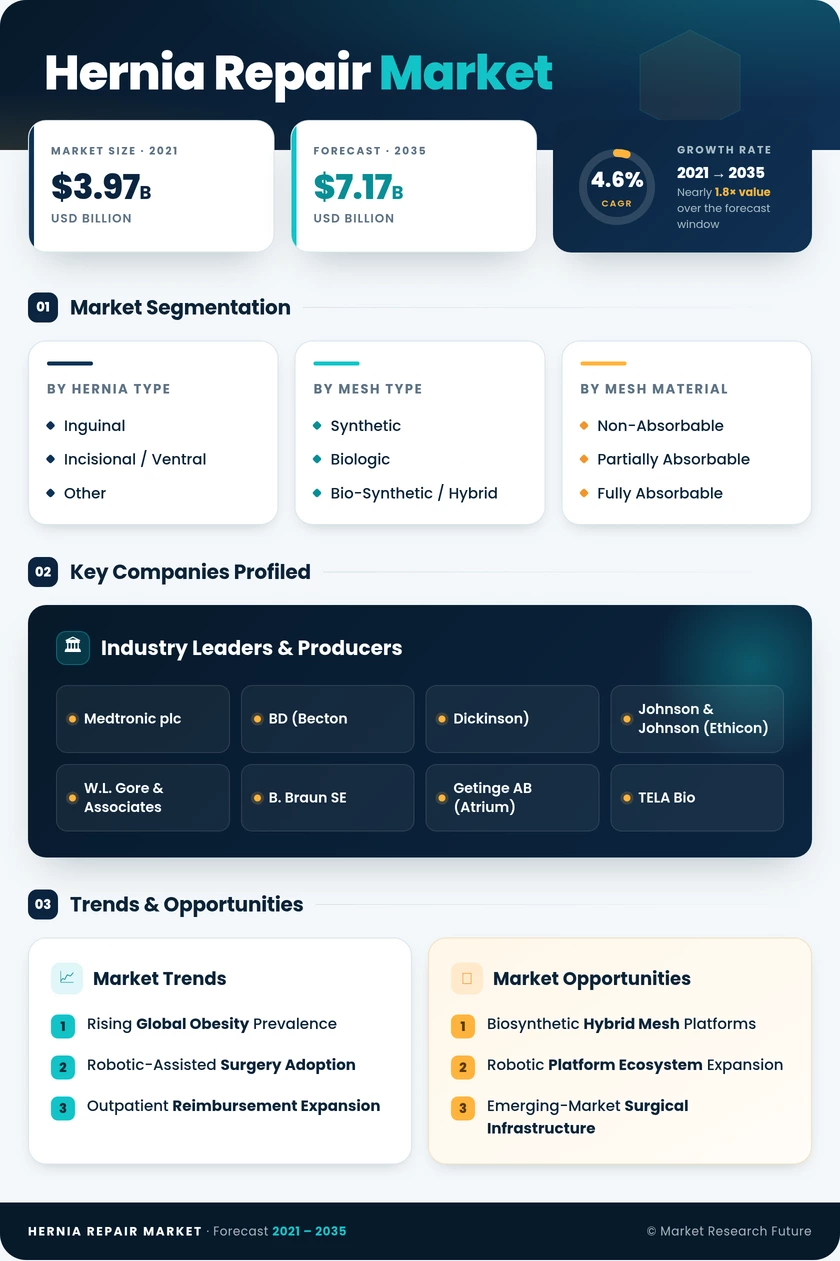
Hernia Repair Market (2026 - 2035)

ID: MRFR/MED/1680-HCR
80 Pages
Vikita Thakur
Last Updated: July 17, 2026
Hernia Repair Market Research Report By Hernia Type (Inguinal Hernia, Umbilical Hernia, Incisional Hernia, Hiatal Hernia), By Surgical Technique (Open Surgery, Laparoscopic Surgery, Robotic Surgery), By Material Type (Synthetic Mesh, Biologic Mesh, Absorbable Mesh), By End User (Hospitals, Ambulatory Surgical Centers, Specialty Clinics) and By Regional (North America, Europe, South America, Asia Pacific, Middle East and Africa) - Industry Forecast to 2035.
Hernia Repair Market
Market Size
Forecast Period2026-2035
CAGR (2026-2035)4.6%
2025 Market SizeUSD 4.57 billion
2035 Market SizeUSD 7.17 billion
Key Players
Medtronic plc
BD (Becton
Dickinson)
Johnson & Johnson
W.L. Gore & Associates
B. Braun SE
Opportunities
  • Biosynthetic Hybrid Mesh Platforms
  • Robotic Platform Ecosystem Expansion
  • Emerging-Market Surgical Infrastructure
  1. 1 Market Overview
  2. 1 Study Assumptions & Market Definition
  3. 2 Scope of the Study
  4. 3 Research Methodology
  5. 2 Market Summary & Key Takeaways
  6. 3 Market Dynamics
  7. 1 Market Drivers Analysis | |
  8. 3.1.1 Rising Global Obesity Prevalence | |
  9. 3.1.2 Robotic-Assisted Surgery Adoption | |
  10. 3.1.3 Outpatient Reimbursement Expansion | |
  11. 3.1.4 Emerging-Market Insurance Coverage Expansion | |
  12. 3.1.5 Aging Population Demographics | |
  13. 3.1.6 Biologic and Biosynthetic Mesh Innovation | |
  14. 3.1.7 Recurrent Hernia and Revision Procedure Growth
  15. 2 Market Restraints Analysis | |
  16. 3.2.1 Mesh-Related Litigation and Settlements | |
  17. 3.2.2 Post-Implant Chronic Pain and Adverse Events | |
  18. 3.2.3 Pricing Pressure from Value-Based Procurement | |
  19. 3.2.4 Regulatory Tightening on Mesh Safety Data | |
  20. 3.2.5 Surgeon Preference for Suture-Only Repair in Select Cases
  21. 3 Market Opportunity Analysis | |
  22. 3.3.1 Biosynthetic Hybrid Mesh Platforms | |
  23. 3.3.2 Robotic Platform Ecosystem Expansion | |
  24. 3.3.3 Emerging-Market Surgical Infrastructure | |
  25. 3.3.4 Data-Driven Outcomes Registries and Value-Based Contracting | |
  26. 3.3.5 AI-Assisted Intraoperative Planning
  27. 4 Industry Value Chain Analysis
  28. 5 Porter's Five Forces Analysis
  29. 4 Global Hernia Repair Market Size & Forecast (2021–2035)
  30. 1 Historical Market Size (2021–2025)
  31. 2 Current & Forecast Market Size (2026–2035)
  32. 3 Market Size by Revenue (USD billion)
  33. 4 Year-over-Year Growth Analysis
  34. 5 Segmentation Analysis
  35. 1 By Hernia Type | |
  36. 5.1.1 Inguinal | |
  37. 5.1.2 Incisional / Ventral | |
  38. 5.1.3 Other (Femoral, Umbilical, Hiatal)
  39. 2 By Mesh Type | |
  40. 5.2.1 Synthetic | |
  41. 5.2.2 Biologic | |
  42. 5.2.3 Bio-Synthetic / Hybrid
  43. 3 By Mesh Material | |
  44. 5.3.1 Non-Absorbable | |
  45. 5.3.2 Partially Absorbable | |
  46. 5.3.3 Fully Absorbable
  47. 4 By Surgical Repair Technique | |
  48. 5.4.1 Open | |
  49. 5.4.2 Laparoscopic | |
  50. 5.4.3 Robotic-Assisted
  51. 5 By End User | |
  52. 5.5.1 Hospitals | |
  53. 5.5.2 Ambulatory Surgical Centers | |
  54. 5.5.3 Specialty Clinics
  55. 6 Regional Analysis
  56. 1 North America | |
  57. 6.1.1 United States | |
  58. 6.1.2 Canada | |
  59. 6.1.3 Mexico
  60. 2 Europe | |
  61. 6.2.1 Germany | |
  62. 6.2.2 United Kingdom | |
  63. 6.2.3 France | |
  64. 6.2.4 Italy | |
  65. 6.2.5 Spain | |
  66. 6.2.6 Nordic Countries | |
  67. 6.2.7 Russia | |
  68. 6.2.8 Rest of Europe
  69. 3 Asia-Pacific | |
  70. 6.3.1 China | |
  71. 6.3.2 India | |
  72. 6.3.3 Japan | |
  73. 6.3.4 South Korea | |
  74. 6.3.5 ASEAN | |
  75. 6.3.6 Rest of Asia-Pacific
  76. 4 South America | |
  77. 6.4.1 Brazil | |
  78. 6.4.2 Argentina | |
  79. 6.4.3 Rest of South America
  80. 5 Middle East & Africa | |
  81. 6.5.1 Saudi Arabia | |
  82. 6.5.2 UAE | |
  83. 6.5.3 South Africa | |
  84. 6.5.4 Egypt | |
  85. 6.5.5 Rest of MEA
  86. 7 Competitive Landscape
  87. 1 Market Share Analysis (2025)
  88. 2 Competitive Benchmarking Matrix
  89. 3 Company Profiles | |
  90. 7.3.1 Medtronic plc | |
  91. 7.3.2 BD (Becton, Dickinson) | |
  92. 7.3.3 Johnson & Johnson (Ethicon) | |
  93. 7.3.4 W.L. Gore & Associates | |
  94. 7.3.5 B. Braun SE | |
  95. 7.3.6 Getinge AB (Atrium) | |
  96. 7.3.7 TELA Bio, Inc. | |
  97. 7.3.8 Integra LifeSciences | |
  98. 7.3.9 Cook Medical | |
  99. 7.3.10 Teleflex Incorporated
  100. 8 Future Outlook & Strategic Recommendations (2026–2035)
  101. 1 Robotic Democratization and Platform Competition
  102. 2 Personalized Mesh Selection Through Digital Twins
  103. 3 Sustainability and Circular Supply Chains
  104. 4 Value-Based Reimbursement and Bundled Payments
  105. 9 Recent Developments & News
  106. 10 Frequently Asked Questions (FAQs)
  107. 11 Report Scope & Methodology
  108. 1 Study Period & Base Year
  109. 2 Data Sources & Citations
  110. 3 Abbreviations
  111. 4 LIST OF TABLES |
  112. TABLE 1 Global Hernia Repair Market Size & Forecast, by Revenue (USD billion), 2021–2035 |
  113. TABLE 2 Global Hernia Repair Market – Year-over-Year Growth Analysis, 2021–2035 |
  114. TABLE 3 Global Hernia Repair Market – Driver Impact Analysis |
  115. TABLE 4 Global Hernia Repair Market – Restraint Impact Analysis |
  116. TABLE 5 Global Hernia Repair Market Size, by Hernia Type, 2021–2035 (USD billion) |
  117. TABLE 6 Global Hernia Repair Market Size, by Mesh Type, 2021–2035 (USD billion) |
  118. TABLE 7 Global Hernia Repair Market Size, by Mesh Material, 2021–2035 (USD billion) |
  119. TABLE 8 Global Hernia Repair Market Size, by Surgical Repair Technique, 2021–2035 (USD billion) |
  120. TABLE 9 Global Hernia Repair Market Size, by End User, 2021–2035 (USD billion) |
  121. TABLE 10 Global Hernia Repair Market Size, by Region, 2021–2035 (USD billion) |
  122. TABLE 11 North America Hernia Repair Market Size, by Country, 2021–2035 (USD billion) |
  123. TABLE 12 Europe Hernia Repair Market Size, by Country, 2021–2035 (USD billion) |
  124. TABLE 13 Asia-Pacific Hernia Repair Market Size, by Country, 2021–2035 (USD billion) |
  125. TABLE 14 South America Hernia Repair Market Size, by Country, 2021–2035 (USD billion) |
  126. TABLE 15 Middle East & Africa Hernia Repair Market Size, by Country, 2021–2035 (USD billion) |
  127. TABLE 16 Competitive Benchmarking Matrix – Global Hernia Repair Market, 2025 |
  128. TABLE 17 Company Profiles – Key Players, Global Hernia Repair Market |
  129. TABLE 18 Recent Developments & Strategic Announcements, 2023–2025 |
  130. TABLE 19 Report Scope & Methodology Summary |
  131. TABLE 20 Detailed Sources and Citations |
  132. TABLE 21 North America Hernia Repair Market Size, by Hernia Type, 2021–2035 (USD billion) |
  133. TABLE 22 North America Hernia Repair Market Size, by Mesh Type, 2021–2035 (USD billion) |
  134. TABLE 23 North America Hernia Repair Market Size, by Surgical Repair Technique, 2021–2035 (USD billion) |
  135. TABLE 24 North America Hernia Repair Market Size, by End User, 2021–2035 (USD billion) |
  136. TABLE 25 Europe Hernia Repair Market Size, by Hernia Type, 2021–2035 (USD billion) |
  137. TABLE 26 Europe Hernia Repair Market Size, by Mesh Type, 2021–2035 (USD billion) |
  138. TABLE 27 Europe Hernia Repair Market Size, by Surgical Repair Technique, 2021–2035 (USD billion) |
  139. TABLE 28 Europe Hernia Repair Market Size, by End User, 2021–2035 (USD billion) |
  140. TABLE 29 Asia-Pacific Hernia Repair Market Size, by Hernia Type, 2021–2035 (USD billion) |
  141. TABLE 30 Asia-Pacific Hernia Repair Market Size, by Mesh Type, 2021–2035 (USD billion) |
  142. TABLE 31 Asia-Pacific Hernia Repair Market Size, by Surgical Repair Technique, 2021–2035 (USD billion) |
  143. TABLE 32 Asia-Pacific Hernia Repair Market Size, by End User, 2021–2035 (USD billion) |
  144. TABLE 33 South America Hernia Repair Market Size, by Hernia Type, 2021–2035 (USD billion) |
  145. TABLE 34 South America Hernia Repair Market Size, by Mesh Type, 2021–2035 (USD billion) |
  146. TABLE 35 South America Hernia Repair Market Size, by Surgical Repair Technique, 2021–2035 (USD billion) |
  147. TABLE 36 South America Hernia Repair Market Size, by End User, 2021–2035 (USD billion) |
  148. TABLE 37 Middle East & Africa Hernia Repair Market Size, by Hernia Type, 2021–2035 (USD billion) |
  149. TABLE 38 Middle East & Africa Hernia Repair Market Size, by Mesh Type, 2021–2035 (USD billion) |
  150. TABLE 39 Middle East & Africa Hernia Repair Market Size, by Surgical Repair Technique, 2021–2035 (USD billion) |
  151. TABLE 40 Middle East & Africa Hernia Repair Market Size, by End User, 2021–2035 (USD billion)
  152. 5 LIST OF FIGURES |
  153. FIGURE 1 Global Hernia Repair Market Dynamics Overview |
  154. FIGURE 2 Value Chain Analysis – Hernia Repair Market |
  155. FIGURE 3 Porter's Five Forces Analysis – Hernia Repair Market |
  156. FIGURE 4 Global Hernia Repair Market Size Trend & Forecast (USD billion), 2021–2035 |
  157. FIGURE 5 Global Hernia Repair Market Share, by Hernia Type (%), 2025 |
  158. FIGURE 6 Global Hernia Repair Market Share, by Mesh Type (%), 2025 |
  159. FIGURE 7 Global Hernia Repair Market Share, by Mesh Material (%), 2025 |
  160. FIGURE 8 Global Hernia Repair Market Share, by Surgical Repair Technique (%), 2025 |
  161. FIGURE 9 Global Hernia Repair Market Share, by End User (%), 2025 |
  162. FIGURE 10 Global Hernia Repair Market Share, by Region (%), 2025 |
  163. FIGURE 11 North America Hernia Repair Market Size Trend (USD billion), 2021–2035 |
  164. FIGURE 12 Europe Hernia Repair Market Size Trend (USD billion), 2021–2035 |
  165. FIGURE 13 Asia-Pacific Hernia Repair Market Size Trend (USD billion), 2021–2035 |
  166. FIGURE 14 South America Hernia Repair Market Size Trend (USD billion), 2021–2035 |
  167. FIGURE 15 Middle East & Africa Hernia Repair Market Size Trend (USD billion), 2021–2035 |
  168. FIGURE 16 Competitive Landscape – Market Share Distribution (%), 2025 |
  169. FIGURE 17 Competitive Benchmarking Radar Chart – Top 10 Players

Segmentation Quick Reference

DimensionSub-SegmentsDominant SegmentFastest Growing Segment
By Hernia TypeInguinal; Incisional / Ventral; OtherInguinalIncisional / Ventral
By Mesh TypeSynthetic; Biologic; Bio-Synthetic / HybridSyntheticBiologic
By Mesh MaterialNon-Absorbable; Partially Absorbable; Fully AbsorbableNon-AbsorbableFully Absorbable
By Surgical Repair TechniqueOpen; Laparoscopic; Robotic-AssistedOpenRobotic-Assisted
By End UserHospitals; Ambulatory Surgical Centers; Specialty ClinicsHospitalsAmbulatory Surgical Centers


Market Segmentation Overview

By Hernia Type

Sub-SegmentKey Trend
InguinalStandardized repair protocols and a high global incidence sustain a dominant share.
Incisional / VentralRising obesity and post-bariatric revision cases accelerate growth.
Other (Femoral, Umbilical, Hiatal)Pediatric and specialty repair volumes grow modestly


Inguinal hernia remains the most frequently performed abdominal wall repair worldwide, accounting for the largest share of the market. Incisional and ventral cases represent the fastest-growing sub-segment as obesity-driven abdominal surgeries increase the pool of patients at risk for post-surgical herniation.

By Mesh Type

Sub-SegmentKey Trend
SyntheticPolypropylene and polyester constructs remain the clinical workhorse
BiologicPorcine and human dermis scaffolds gain share in contaminated-field cases.
Bio-Synthetic / HybridEmerging category combining permanent core with resorbable overlay


Synthetic meshes continue to dominate due to extensive clinical evidence and cost-effectiveness. Biologic and hybrid platforms are capturing incremental share as clinical guidelines increasingly recommend non-synthetic options for complex or contaminated procedures.

By Mesh Material

Sub-SegmentKey Trend
Non-AbsorbablePermanent polypropylene remains the standard for clean elective repairs.
Partially AbsorbableComposite designs with absorbable coatings reduce adhesion risk.
Fully AbsorbablePoly-4-hydroxybutyrate platforms offer complete resorption within 18 months.


Non-absorbable materials retain the largest market position, though fully absorbable polymers represent the fastest-growing material category as surgeons seek to eliminate permanent foreign-body implants in appropriate clinical settings.

By Surgical Repair Technique

Sub-SegmentKey Trend
OpenGlobal standard for primary inguinal repair in community settings
LaparoscopicEstablished a minimally invasive approach with a mature adoption curve
Robotic-AssistedRapid growth driven by platform cost reduction and surgeon training expansion


Open repair maintains the highest procedural volume globally, while robotic-assisted techniques are expanding rapidly as new platform entrants drive down per-procedure costs and training programs scale across academic and community hospitals.

By End User

Sub-SegmentKey Trend
HospitalsRetain complex case concentration and robotic infrastructure
Ambulatory Surgical CentersFastest-growing channel, fueled by outpatient reimbursement expansion
Specialty ClinicsDedicated hernia centers of excellence attract high-volume referrals.


Hospitals remain the primary revenue channel due to their capacity for complex ventral and robotic cases. Ambulatory surgical centers are growing fastest as expanded payer coverage and cost advantages make them the preferred setting for routine inguinal repair.


 

Download PDF ×

We do not share your information with anyone. However, we may send you emails based on your report interest from time to time. You may contact us at any time to opt-out.