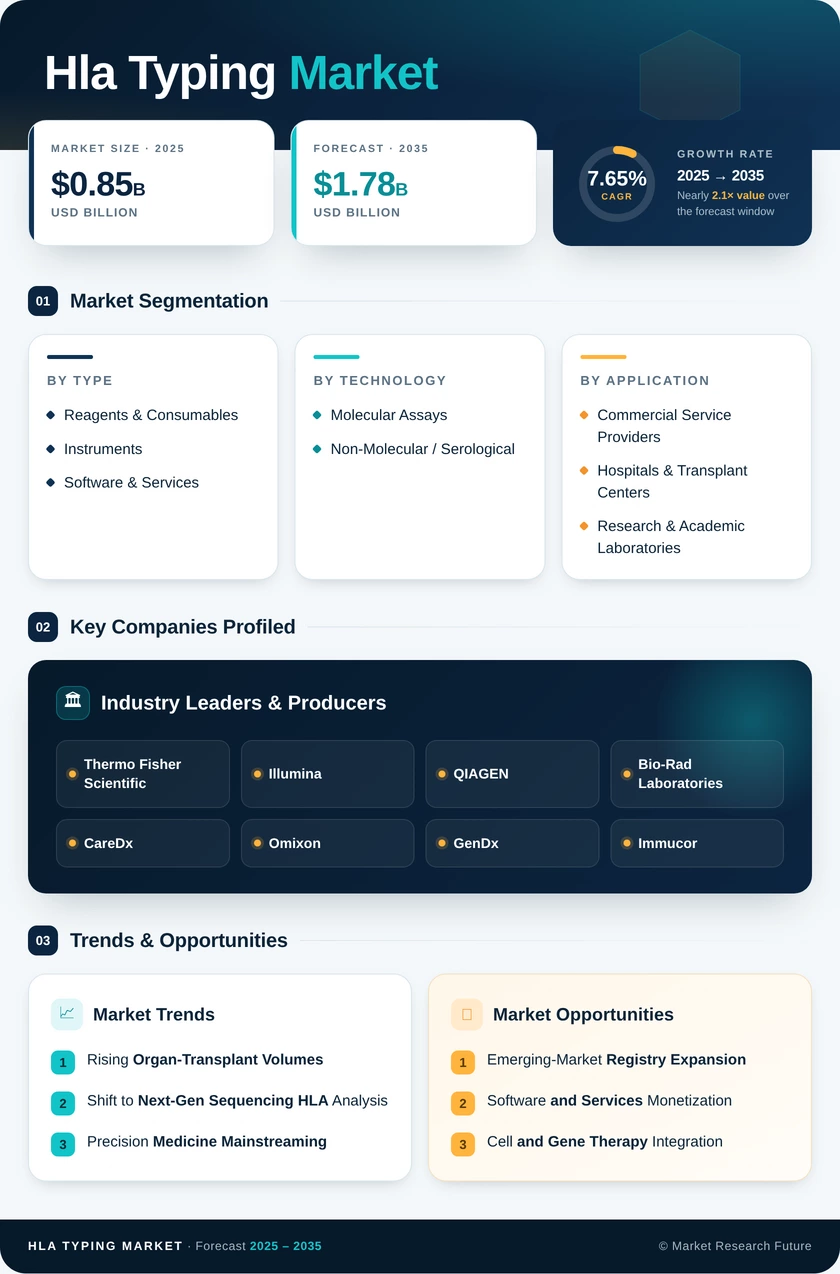
HLA Typing Market

ID: MRFR/LS/19929-HCR
128 Pages
Nidhi Mandole
Last Updated: June 05, 2026
HLA Typing Market Research Report: Size, Share, Trend Analysis By Technology (Molecular Assay Technologies, Non-molecular Assay Technologies), By Product & Service (Reagents & Consumables, Instruments, Software & Services), By Applications (Diagnostic Applications, Research Applications, Donor-recipient cross-matching, Infectious disease testing, Cancer diagnosis & prevention, Transfusion therapy, Other diagnostic applications), By End-user (Commercial service providers, Hospitals & surgical centers, Research laboratories & academic institutes), And By Region (North America, Europe, Asia-Pacific, And Rest Of The World) - Growth Outlook & Industry Forecast 2025 To 2035
Download PDF ×

We do not share your information with anyone. However, we may send you emails based on your report interest from time to time. You may contact us at any time to opt-out.

  1. 1 Market Summary
  2. 2 Key Report Takeaways
  3. 3 Market Size & Forecast (2021–2035) |
    1. 3.1 Historical Market Size (2021–2025) |
    2. 3.2 Current & Forecast Market Size (2026–2035) |
    3. 3.3 Year-over-Year Growth Analysis
  4. 4 Driver Impact Analysis |
    1. 4.1 Rising Organ-Transplant Volumes |
    2. 4.2 Shift to Next-Gen Sequencing HLA Analysis |
    3. 4.3 Precision Medicine Mainstreaming |
    4. 4.4 Performance-Based Reimbursement Policy
  5. 5 Restraints Impact Analysis |
    1. 5.1 High Cost of NGS Instrumentation |
    2. 5.2 Reimbursement Gaps for Advanced Typing |
    3. 5.3 Shortage of Skilled Immunogenetics Staff
  6. 6 Opportunities |
    1. 6.1 Emerging-Market Registry Expansion |
    2. 6.2 Software and Services Monetization |
    3. 6.3 Cell and Gene Therapy Integration |
    4. 6.4 Point-of-Care and Decentralized Testing |
    5. 6.5 AI-Assisted Interpretation
  7. 7 Regional Market Share & Country-Level Analysis |
    1. 7.1 North America | |
      1. 7.1.1 United States | |
      2. 7.1.2 Canada | |
      3. 7.1.3 Mexico |
    2. 7.2 Europe | |
      1. 7.2.1 Germany | |
      2. 7.2.2 United Kingdom | |
      3. 7.2.3 France | |
      4. 7.2.4 Italy | |
      5. 7.2.5 Spain | |
      6. 7.2.6 Nordic Countries | |
      7. 7.2.7 Russia | |
      8. 7.2.8 Rest of Europe |
    3. 7.3 Asia-Pacific | |
      1. 7.3.1 China | |
      2. 7.3.2 India | |
      3. 7.3.3 Japan | |
      4. 7.3.4 South Korea | |
      5. 7.3.5 ASEAN | |
      6. 7.3.6 Rest of Asia-Pacific |
    4. 7.4 South America | |
      1. 7.4.1 Brazil | |
      2. 7.4.2 Argentina | |
      3. 7.4.3 Rest of South America |
    5. 7.5 Middle East & Africa | |
      1. 7.5.1 Saudi Arabia | |
      2. 7.5.2 UAE | |
      3. 7.5.3 South Africa | |
      4. 7.5.4 Egypt | |
      5. 7.5.5 Rest of MEA
  8. 8 Future Outlook (2026–2035) |
    1. 8.1 AI-Driven Allele Interpretation |
    2. 8.2 Platform Economics and Recurring Revenue |
    3. 8.3 Convergence with Cell and Gene Therapy |
    4. 8.4 Decentralized and Equitable Access
  9. 9 Market Segmentation Analysis |
    1. 9.1 By Product & Service |
    2. 9.2 By Technology |
    3. 9.3 By Application |
    4. 9.4 By End User
  10. 10 Competitive Landscape
  11. 11 Recent News & Developments
  12. 12 Report Scope & Methodology
  13. 13 Detailed Sources & Citations
  14. 14 Frequently Asked Questions
  15. 15 LIST OF TABLES |
  16. TABLE 1 HLA Typing Market Header Summary |
  17. TABLE 2 Global HLA Typing Market Size & Forecast, by Revenue (USD Billion), 2021–2035 |
  18. TABLE 3 Driver Impact Analysis – HLA Typing Market |
  19. TABLE 4 Restraints Impact Analysis – HLA Typing Market |
  20. TABLE 5 Regional Market Summary, 2025 |
  21. TABLE 6 North America HLA Typing Market, by Country |
  22. TABLE 7 Europe HLA Typing Market, by Country |
  23. TABLE 8 Asia-Pacific HLA Typing Market, by Country |
  24. TABLE 9 South America HLA Typing Market, by Country |
  25. TABLE 10 Middle East & Africa HLA Typing Market, by Country |
  26. TABLE 11 Market Segmentation, by Product & Service |
  27. TABLE 12 Market Segmentation, by Technology |
  28. TABLE 13 Market Segmentation, by Application |
  29. TABLE 14 Market Segmentation, by End User |
  30. TABLE 15 Competitive Benchmarking Matrix – HLA Typing Market |
  31. TABLE 16 Report Scope & Methodology |
  32. TABLE 17 Detailed Sources & Citations
  33. 16 LIST OF FIGURES |
  34. FIGURE 1 HLA Typing Market Dynamics – Drivers, Restraints & Opportunities |
  35. FIGURE 2 Industry Value Chain Analysis – HLA Typing Market |
  36. FIGURE 3 Porter's Five Forces Analysis – HLA Typing Market |
  37. FIGURE 4 HLA Typing Market Size Trend, 2021–2035 (USD Billion) |
  38. FIGURE 5 Year-over-Year Growth Rate, 2021–2035 |
  39. FIGURE 6 Market Share by Product & Service, 2025 |
  40. FIGURE 7 Market Share by Technology, 2025 |
  41. FIGURE 8 Market Share by Application, 2025 |
  42. FIGURE 9 Market Share by End User, 2025 |
  43. FIGURE 10 Regional Revenue Share, 2025 |
  44. FIGURE 11 Asia-Pacific Country-Level Growth Outlook |
  45. FIGURE 12 Competitive Landscape – Estimated Revenue Share, 2025

Segmentation Quick Reference

DimensionSub-SegmentsDominant SegmentFastest Growing Segment
By Product & ServiceInstruments; Reagents & Consumables; Software & ServicesReagents & ConsumablesSoftware & Services
By TechnologyMolecular Assays; Non-Molecular / SerologicalMolecular AssaysNon-Molecular / Serological
By ApplicationDiagnostic; ResearchDiagnosticResearch
By End UserHospitals & Transplant Centers; Commercial Service Providers; Research & Academic LaboratoriesCommercial Service ProvidersResearch & Academic Laboratories


Market Segmentation Overview

By Product & Service

Sub-SegmentKey Trend
InstrumentsShift toward compact, automated NGS sequencing platforms
Reagents & ConsumablesSteady recurring demand tied to per-sample typing volume
Software & ServicesFastest-growing layer as cloud bioinformatics and interpretation services scale


Reagents and consumables remain the revenue backbone because every typing event consumes assay kits, but software and services capture the strategic upside as laboratories monetize allele-calling analytics and cloud HLA databases.

By Technology

Sub-SegmentKey Trend
Molecular AssaysAllele-level resolution displacing legacy serological methods
Non-Molecular / SerologicalRetained for rapid antibody screening and confirmatory crossmatch


Molecular assays dominate as transplant programs demand unambiguous typing, while serological methods persist as complementary rapid-screening tools rather than primary platforms.

By Application

Sub-SegmentKey Trend
DiagnosticTransplant compatibility and post-transplant monitoring drive bulk demand
ResearchPharmacogenomics and immunology studies fuel the fastest growth.


Diagnostic testing anchors application demand through transplant workflows, while research use expands rapidly as immune gene matching enters drug discovery and disease-association studies.

By End User

Sub-SegmentKey Trend
Hospitals & Transplant CentersOn-site compatibility testing for active transplant programs
Commercial Service ProvidersOutsourced high-throughput typing captures the largest share.
Research & Academic LaboratoriesGrant-funded immunogenetics research drives the fastest growth.


Commercial service providers lead as transplant centers outsource high-volume tissue matching diagnostics, while academic laboratories grow fastest on expanding immunogenetics research funding.