Hose Pipe Market
Hose Pipe Market Summary
As per Market Research Future analysis, the Hose Pipe Market Size was estimated at 12.85 USD Billion in 2024. The Hose Pipe industry is projected to grow from 13.35 USD Billion in 2025 to 19.46 USD Billion by 2035, exhibiting a compound annual growth rate (CAGR) of 3.84% during the forecast period 2025 - 2035
Key Market Trends & Highlights
The Hose Pipe Market is experiencing a dynamic shift towards sustainability and technological innovation.
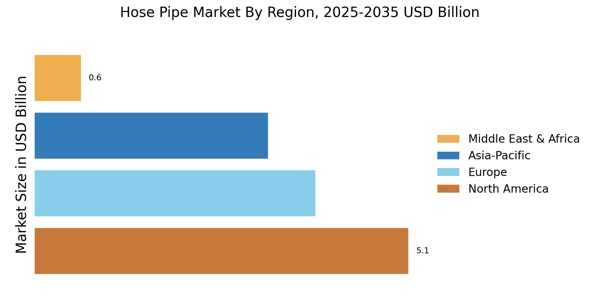
- North America remains the largest market for hose pipes, driven by robust agricultural and industrial sectors.
- Asia-Pacific is emerging as the fastest-growing region, fueled by rapid urbanization and infrastructure development.
- The rubber segment continues to dominate the market, while the PVC segment is witnessing the highest growth rates.
- Key market drivers include rising agricultural demand and growing landscaping trends, which are significantly influencing market dynamics.
Market Size & Forecast
| 2024 Market Size | 12.85 (USD Billion) |
| 2035 Market Size | 19.46 (USD Billion) |
| CAGR (2025 - 2035) | 3.84% |
Major Players
Continental AG (DE), Parker Hannifin Corporation (US), Gates Corporation (US), Trelleborg AB (SE), Hose Master LLC (US), RUBBEREX Corporation (MY), Eaton Corporation (IE), Aeroquip (US), Hose Solutions (AU)
Hose Pipe Market Trends
The Hose Pipe Market is currently experiencing a dynamic evolution, driven by various factors that influence demand and supply. The increasing need for efficient water management in agriculture, construction, and industrial applications appears to be a primary driver. Additionally, the growing awareness regarding environmental sustainability is prompting manufacturers to innovate and develop eco-friendly hose pipe solutions. This shift towards sustainable practices may lead to the introduction of biodegradable materials and recyclable options, which could reshape consumer preferences and market dynamics. Moreover, advancements in technology are likely to enhance the performance and durability of hose pipes. Innovations such as reinforced materials and smart hose systems that monitor water flow and pressure may become more prevalent. As industries seek to optimize their operations, the Hose Pipe Market could witness a surge in demand for high-performance products. Overall, the interplay of sustainability, technological advancements, and evolving consumer preferences suggests a promising outlook for the Hose Pipe Market in the near future.
Sustainability Initiatives
The Hose Pipe Market is increasingly influenced by sustainability initiatives. Manufacturers are focusing on creating products that minimize environmental impact, such as using recyclable materials and reducing waste during production. This trend reflects a broader commitment to eco-friendly practices, appealing to environmentally conscious consumers.
Technological Advancements
Technological advancements are reshaping the Hose Pipe Market. Innovations in materials and design are leading to the development of more durable and efficient hose pipes. Features such as enhanced flexibility and resistance to wear and tear are becoming standard, catering to the demands of various industries.
Customization and Personalization
Customization and personalization are emerging trends within the Hose Pipe Market. Consumers are increasingly seeking products tailored to their specific needs, whether for residential or industrial use. This demand for bespoke solutions is prompting manufacturers to offer a wider range of options, enhancing customer satisfaction.
Hose Pipe Market Drivers
Rising Agricultural Demand
The Hose Pipe Market is experiencing a notable surge in demand driven by the agricultural sector. As the need for efficient irrigation systems increases, farmers are increasingly adopting hose pipes for their versatility and ease of use. The market for agricultural hoses is projected to grow at a compound annual growth rate of approximately 5.2% over the next few years. This growth is attributed to the rising global population and the consequent need for enhanced food production. Hose pipes facilitate effective water management, which is crucial for crop yield. Furthermore, the trend towards sustainable farming practices is likely to bolster the adoption of hose pipes, as they enable targeted irrigation, reducing water wastage. Thus, the agricultural sector remains a pivotal driver for the Hose Pipe Market.
Environmental Regulations and Standards
The Hose Pipe Market is influenced by stringent environmental regulations aimed at promoting sustainable practices. Governments are increasingly implementing standards that require the use of eco-friendly materials in manufacturing hose pipes. This shift is likely to drive innovation within the industry, as manufacturers seek to comply with these regulations while maintaining product performance. The market is expected to grow by approximately 3.5% as companies adapt to these changes. Furthermore, the emphasis on reducing plastic waste and promoting recyclable materials aligns with the growing consumer preference for sustainable products. Consequently, the Hose Pipe Market is poised to benefit from these regulatory trends, fostering a more environmentally conscious approach to production.
Growing Landscaping and Gardening Trends
The Hose Pipe Market is benefiting from the rising popularity of landscaping and gardening activities. As more individuals engage in home improvement projects, the demand for high-quality hose pipes is increasing. The market is projected to grow by approximately 4.0%, driven by this trend. Homeowners are seeking efficient watering solutions for their gardens and lawns, leading to a surge in the sales of specialized hoses designed for residential use. Furthermore, the increasing awareness of environmental sustainability encourages consumers to invest in hoses that promote efficient water usage. This growing interest in landscaping and gardening not only supports the Hose Pipe Market but also fosters a culture of environmental stewardship among consumers.
Urbanization and Infrastructure Development
Urbanization is a significant driver for the Hose Pipe Market, as rapid population growth in urban areas necessitates improved infrastructure. The construction of residential and commercial buildings requires efficient water supply systems, where hose pipes play a crucial role. The market is projected to witness a growth rate of around 4.8%, fueled by ongoing infrastructure projects. Additionally, hose pipes are essential for firefighting systems, landscaping, and maintenance of public spaces. As cities expand, the demand for reliable water distribution systems increases, further propelling the Hose Pipe Market. The integration of hose pipes in urban planning and development projects indicates a robust future for this market segment.
Technological Innovations in Hose Manufacturing
Technological advancements are reshaping the Hose Pipe Market, leading to the development of high-performance hoses. Innovations such as the use of advanced polymers and composite materials enhance durability and flexibility, catering to diverse applications. The market is anticipated to expand at a rate of 4.2%, driven by these technological improvements. Manufacturers are increasingly investing in research and development to create hoses that can withstand extreme conditions, thereby broadening their applicability. Additionally, smart hose technologies that integrate sensors for monitoring water flow and pressure are emerging, appealing to both residential and commercial users. This trend towards innovation is likely to sustain the growth trajectory of the Hose Pipe Market.
Market Segment Insights
By Material: Rubber (Largest) vs. PVC (Fastest-Growing)
In the Hose Pipe Market, the material segment shows a diverse distribution with Rubber commanding the largest share. It has established itself as the go-to choice for various applications due to its durability and flexibility. PVC, while trailing behind, is recognized for its affordability and lightweight characteristics, making it a popular option for less demanding applications such as gardening and household use. As more industries look for versatile materials, the market is adapting accordingly, pushing other materials like Polyethylene and Nylon into emerging roles amongst niche applications.
Rubber (Dominant) vs. PVC (Emerging)
Rubber hose pipes are renowned for their resilience and are preferred in high-pressure and high-temperature environments, making them dominant in industrial applications. Their ability to withstand harsh conditions and longevity has solidified their reputation. On the other hand, PVC hoses are gaining traction as an emerging alternative due to their lightweight composition and cost-effectiveness. They are increasingly used in residential settings, but their performance under extreme conditions is limited. The growing interest in DIY projects and home gardening is positively impacting PVC's market presence, highlighting the distinct applications and advantages of each material.
By Application: Gardening (Largest) vs. Automotive (Fastest-Growing)
In the Hose Pipe Market, the application segment showcases a diverse distribution among its key segments: Gardening, Construction, Automotive, and Industrial. Gardening emerges as the largest application, commanding a significant share of the market due to its essential role in residential and commercial landscaping. Following closely is the Construction segment, which also holds a substantial presence owing to its demand for various industrial applications. Meanwhile, the Automotive sector, with its increasing need for high-performance hoses, is becoming a notable player in this landscape, alongside the resilient Industrial segment, which remains a staple in manufacturing processes and mechanical applications.
Gardening (Dominant) vs. Automotive (Emerging)
Gardening applications dominate the Hose Pipe Market, attributed to their widespread use in gardening and outdoor applications. Hose pipes used in this segment are typically designed for flexibility, durability, and resistance to various weather conditions, ensuring their longevity in outdoor environments. Alternatively, the Automotive sector is proving to be a rapidly emerging field, driven by innovations in vehicle design and performance requirements. Automakers are increasingly utilizing specialized hoses that meet enhanced regulations and performance metrics. This duality in applications highlights the Hose Pipe Market's adaptability to both established and emerging consumer demands.
By Hose Type: Flex Hoses (Largest) vs. Specialty Hoses (Fastest-Growing)
The hose pipe market showcases a diverse array of hose types, with flex hoses leading the market in terms of share due to their versatility and wide application across various industries. Non-flex hoses, while significant, have been overshadowed by the flexibility and adaptability provided by flex hoses, which cater to both residential and industrial needs. Specialty hoses are carving out a niche market, increasingly gaining attention for specific applications in sectors such as food and beverage, pharmaceuticals, and automotive, thus indicating a growing trend in customization and specialization in hose design.
Flex Hoses (Dominant) vs. Specialty Hoses (Emerging)
Flex hoses are characterized by their ability to stretch and bend without losing functionality, making them ideal for applications requiring movement and adaptability, such as in plumbing and irrigation systems. Their dominance in the market is attributed to their widespread use across various sectors, enabling efficient fluid transfer. In contrast, specialty hoses are emerging as critical components in specialized applications, designed to meet the rigorous demands of specific industries. With advancements in materials and technology, these hoses offer enhanced performance, chemical resistance, and specialized design features that cater to the unique challenges of industries like pharmaceuticals and food processing. This trend towards specialization signifies an evolving market that prioritizes performance and application-specific needs.
By Size: Medium Diameter (Largest) vs. Small Diameter (Fastest-Growing)
In the Hose Pipe Market, the market share distribution reveals that Medium Diameter hoses, ranging from ~1 to 2 inches, command the largest share due to their versatility in various industrial applications. They cater to a wide range of sectors including agriculture, construction, and manufacturing, making them a preferred choice among consumers. Small Diameter hoses, approximately ~1/2 inch, although smaller in market share, have been emerging rapidly due to their increasing use in residential gardening and light industrial applications. Their compactness and flexibility contribute to their growing popularity among consumers seeking efficient solutions for water delivery.
Medium Diameter (Dominant) vs. Small Diameter (Emerging)
Medium Diameter hoses, known for their substantial versatility, dominate the Hose Pipe Market as they cater to a broad spectrum of applications. They are ideal for high-pressure situations and are extensively used in agriculture, construction, and industrial settings. Their durability and ability to handle various fluids make them highly sought after. In contrast, Small Diameter hoses are emerging as a popular choice in niche markets such as gardening and small-scale irrigation systems. Their lightweight design and maneuverability ensure ease of use, attracting consumers who prioritize convenience and efficiency in areas like home gardening and small-scale workshops.
By End Use: Residential (Largest) vs. Industrial (Fastest-Growing)
The Hose Pipe Market demonstrates distinct market share distribution across its end use segmentation, primarily between Residential, Commercial, and Industrial sectors. The Residential segment captures the largest share, fueled by the consistent demand for garden hoses and household maintenance. Commercial applications follow closely, serving businesses with varying hose needs for landscaping, cleaning, and other operational purposes. Industrial applications possess a smaller share but play a crucial role in specific manufacturing and irrigation processes, illustrating a diverse usage profile within the segment.
Residential (Dominant) vs. Industrial (Emerging)
The Residential segment of the Hose Pipe Market remains dominant due to strong consumer preferences for product durability and usability in various household tasks, including gardening and washing. These hoses are designed for ease of use and storage, ensuring frequent usage among homeowners. On the other hand, the Industrial segment is emerging significantly, propelled by growing investments in infrastructure and agriculture. They require specialized hoses that can withstand high pressure and abrasive materials. Manufacturers are increasingly focusing on innovations to cater to the evolving demands of industrial applications, paving the way for growth in this segment.
Regional Insights
North America : Market Leader in Hose Pipes
North America is the largest market for hose pipes, accounting for approximately 40% of the global market share. The growth is driven by increasing demand in construction, agriculture, and automotive sectors, alongside stringent regulations promoting safety and quality standards. The U.S. and Canada are the primary contributors, with a robust infrastructure supporting manufacturing and distribution. The competitive landscape is characterized by major players such as Parker Hannifin Corporation and Gates Corporation, which dominate the market with innovative products and extensive distribution networks. The presence of these key players fosters a competitive environment, driving advancements in technology and product offerings. The region's focus on sustainability and efficiency further enhances market growth, positioning it as a hub for hose pipe innovation.
Europe : Emerging Market Dynamics
Europe is witnessing significant growth in the hose pipe market, holding approximately 30% of the global share. The region benefits from a strong manufacturing base and increasing investments in infrastructure projects. Regulatory frameworks aimed at environmental sustainability and safety are driving demand for high-quality hose pipes, particularly in the automotive and industrial sectors. Germany and the UK are the largest markets, contributing significantly to the overall growth. Leading countries in Europe are characterized by a mix of established players and innovative startups. Companies like Trelleborg AB and Eaton Corporation are at the forefront, leveraging advanced technologies to enhance product performance. The competitive landscape is dynamic, with a focus on research and development to meet evolving customer needs. The region's commitment to sustainability and innovation positions it as a key player in The Hose Pipe Market.

Asia-Pacific : Rapidly Expanding Market
Asia-Pacific is emerging as a powerhouse in the hose pipe market, accounting for approximately 25% of the global share. The rapid industrialization and urbanization in countries like China and India are significant growth drivers. Additionally, government initiatives aimed at improving infrastructure and manufacturing capabilities are catalyzing demand for hose pipes across various sectors, including agriculture and construction. China is the largest market in the region, followed by India, with a growing presence of both local and international players. Companies such as RUBBEREX Corporation and Hose Solutions are expanding their operations to meet the rising demand. The competitive landscape is marked by a focus on cost-effective solutions and innovation, as manufacturers strive to enhance product quality and performance to capture a larger market share.
Middle East and Africa : Emerging Opportunities Ahead
The Middle East and Africa region is witnessing gradual growth in the hose pipe market, holding about 5% of the global share. The growth is primarily driven by increasing investments in infrastructure and construction projects, particularly in the Gulf Cooperation Council (GCC) countries. Regulatory support for industrial development and a focus on improving water management systems are also contributing to market expansion. Leading countries in this region include the UAE and South Africa, where key players are establishing a foothold to capitalize on emerging opportunities. The competitive landscape is evolving, with both local and international companies vying for market share. The presence of firms like Hose Master LLC indicates a growing interest in enhancing product offerings to meet regional demands, particularly in the oil and gas sector.
Key Players and Competitive Insights
Key Companies in the Hose Pipe Market include
Industry Developments
This growth is attributed to increasing demand from various industries, including construction, agriculture, and manufacturing.Recent developments in the market include the growing adoption of lightweight and durable materials such as polyurethane and polyethylene, enabling the production of hoses with enhanced flexibility and resistance to harsh conditions. Furthermore, advancements in manufacturing technologies have led to increased production efficiency and reduced costs, making hoses more accessible to a wider range of consumers.
Future Outlook
Hose Pipe Market Future Outlook
The Hose Pipe Market is projected to grow at 3.84% CAGR from 2025 to 2035, driven by increasing industrial applications, agricultural demand, and advancements in material technology.
New opportunities lie in:
- Expansion into eco-friendly hose materials for sustainability-focused markets.
- Development of smart hose systems with integrated sensors for efficiency.
- Partnerships with agricultural tech firms to enhance irrigation solutions.
By 2035, the Hose Pipe Market is expected to achieve robust growth, driven by innovation and strategic partnerships.
Market Segmentation
Hose Pipe Market Size Outlook
- Small Diameter (~1/2 inch)
- Medium Diameter (~1-2 inches)
- Large Diameter (~2 inches or more)
Hose Pipe Market End Use Outlook
- Residential
- Commercial
- Industrial
Hose Pipe Market Material Outlook
- Rubber
- PVC
- Polyethylene
- Nylon
Hose Pipe Market Hose Type Outlook
- Flex Hoses
- Non-flex Hoses
- Specialty Hoses
Hose Pipe Market Application Outlook
- Gardening
- Construction
- Automotive
- Industrial
Report Scope
| MARKET SIZE 2024 | 12.85(USD Billion) |
| MARKET SIZE 2025 | 13.35(USD Billion) |
| MARKET SIZE 2035 | 19.46(USD Billion) |
| COMPOUND ANNUAL GROWTH RATE (CAGR) | 3.84% (2025 - 2035) |
| REPORT COVERAGE | Revenue Forecast, Competitive Landscape, Growth Factors, and Trends |
| BASE YEAR | 2024 |
| Market Forecast Period | 2025 - 2035 |
| Historical Data | 2019 - 2024 |
| Market Forecast Units | USD Billion |
| Key Companies Profiled | Continental AG (DE), Parker Hannifin Corporation (US), Gates Corporation (US), Trelleborg AB (SE), Hose Master LLC (US), RUBBEREX Corporation (MY), Eaton Corporation (IE), Aeroquip (US), Hose Solutions (AU) |
| Segments Covered | Material, Application, Hose Type, Size, End Use, Regional |
| Key Market Opportunities | Integration of smart technology in Hose Pipe Market enhances efficiency and consumer engagement. |
| Key Market Dynamics | Rising demand for durable and flexible hose pipes driven by industrial automation and agricultural advancements. |
| Countries Covered | North America, Europe, APAC, South America, MEA |
FAQs
What is the current valuation of the Hose Pipe Market in 2025?
The Hose Pipe Market is valued at approximately 12.85 USD Billion in 2024.
What is the projected market size for the Hose Pipe Market by 2035?
The Hose Pipe Market is expected to reach a valuation of 19.46 USD Billion by 2035.
What is the expected CAGR for the Hose Pipe Market during the forecast period 2025 - 2035?
The Hose Pipe Market is projected to grow at a CAGR of 3.84% from 2025 to 2035.
Which materials dominate the Hose Pipe Market segments?
In 2024, the Rubber segment was valued at 3.85 USD Billion, while PVC reached 4.0 USD Billion.
What are the key applications driving the Hose Pipe Market?
The Construction application segment was valued at 3.85 USD Billion in 2024, indicating strong demand.
How do hose types vary in market valuation?
In 2024, Non-flex Hoses were valued at 5.1 USD Billion, suggesting a preference for this type.
What size categories are prevalent in the Hose Pipe Market?
The Medium Diameter (~1-2 inches) segment was valued at 5.14 USD Billion in 2024, highlighting its significance.
What end-use segments are contributing to the Hose Pipe Market growth?
The Industrial end-use segment was valued at 6.15 USD Billion in 2024, indicating robust industrial demand.
Who are the key players in the Hose Pipe Market?
Prominent players include Continental AG, Parker Hannifin Corporation, and Gates Corporation.
What trends are expected in the Hose Pipe Market by 2035?
Kindly complete the form below to receive a free sample of this Report
Customer Stories
“This is really good guys. Excellent work on a tight deadline. I will continue to use you going forward and recommend you to others. Nice job”
“Thanks. It’s been a pleasure working with you, please use me as reference with any other Intel employees.”
“Thanks for sending the report it gives us a good global view of the Betaïne market.”
“Thank you, this will be very helpful for OQS.”
“We found the report very insightful! we found your research firm very helpful. I'm sending this email to secure our future business.”
“I am very pleased with how market segments have been defined in a relevant way for my purposes (such as "Portable Freezers & refrigerators" and "last-mile"). In general the report is well structured. Thanks very much for your efforts.”
“I have been reading the first document or the study, ,the Global HVAC and FP market report 2021 till 2026. Must say, good info! I have not gone in depth at all parts, but got a good indication of the data inside!”
“We got the report in time, we really thank you for your support in this process. I also thank to all of your team as they did a great job.”