×
Request Free Sample ×

Kindly complete the form below to receive a free sample of this Report

* Please use a valid business email

Leading companies partner with us for data-driven Insights

clients tt-cursor
Hero Background

LPG Hose Market

ID: MRFR/EnP/19990-HCR
128 Pages
Garvit Vyas
October 2025

LPG Hose Market Research Report Information By Source (Refinery, Associated Gas And Non-Associated Gas), By Application (Residential/Commercial, Chemical, Industrial, Autogas, Refinery And Others), And By Region (North America, Europe, Asia-Pacific, And Rest Of The World) –Market Forecast Till 2035

Share:
Download PDF ×

We do not share your information with anyone. However, we may send you emails based on your report interest from time to time. You may contact us at any time to opt-out.

LPG Hose Market Infographic
Purchase Options

LPG Hose Market Summary

As per MRFR analysis, the LPG Hose Market Size was estimated at 11.32 USD Billion in 2024. The LPG Hose industry is projected to grow from 12.89 USD Billion in 2025 to 47.46 USD Billion by 2035, exhibiting a compound annual growth rate (CAGR) of 13.92 during the forecast period 2025 - 2035.

Key Market Trends & Highlights

The LPG Hose Market is poised for growth driven by sustainability and technological advancements.

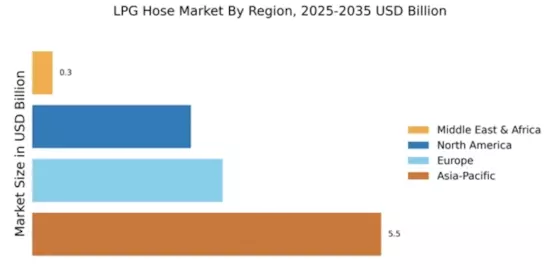
  • North America remains the largest market for LPG hoses, driven by robust infrastructure and demand.
  • Asia-Pacific is the fastest-growing region, reflecting increasing urbanization and energy needs.
  • The residential segment dominates the market, while the commercial segment is experiencing rapid growth.
  • Rising demand for LPG and regulatory compliance are key drivers propelling market expansion.

Market Size & Forecast

2024 Market Size 11.32 (USD Billion)
2035 Market Size 47.46 (USD Billion)
CAGR (2025 - 2035) 13.92%

Major Players

Parker Hannifin (US), Continental AG (DE), Gates Corporation (US), Trelleborg AB (SE), RUBBEREX (MY), Hose Master (US), Aeroquip (US), Suhner (CH)

LPG Hose Market Trends

The LPG Hose Market is currently experiencing a dynamic phase characterized by evolving consumer preferences and regulatory frameworks. As the demand for liquefied petroleum gas continues to rise, the market is adapting to meet the needs of various sectors, including residential, commercial, and industrial applications. Innovations in material technology and manufacturing processes are enhancing the durability and safety of hoses, which is crucial given the flammable nature of LPG. Furthermore, the increasing focus on environmental sustainability is prompting manufacturers to explore eco-friendly alternatives, potentially reshaping product offerings in the near future. In addition, the LPG Hose Market is witnessing a shift towards greater customization and flexibility in product design. This trend is driven by the diverse requirements of end-users, who seek hoses that can withstand specific conditions and applications. As competition intensifies, companies are likely to invest in research and development to create specialized solutions that cater to niche markets. Overall, the LPG Hose Market appears poised for growth, with opportunities emerging from technological advancements and changing consumer demands.

Sustainability Initiatives

The LPG Hose Market is increasingly influenced by sustainability initiatives, as manufacturers seek to reduce their environmental footprint. This trend involves the development of hoses made from recyclable materials and the implementation of eco-friendly production processes. Such efforts not only align with global environmental goals but also appeal to a growing segment of environmentally conscious consumers.

Technological Advancements

Technological advancements are playing a pivotal role in the LPG Hose Market, with innovations in materials and design enhancing product performance. The introduction of lightweight, flexible hoses that maintain high resistance to pressure and temperature fluctuations is becoming more prevalent. These advancements are likely to improve safety and efficiency in various applications.

Customization and Flexibility

Customization and flexibility are emerging as key trends within the LPG Hose Market. As end-users demand products tailored to specific applications, manufacturers are responding by offering a wider range of sizes, colors, and specifications. This trend reflects a broader shift towards personalized solutions that meet the unique needs of diverse industries.

LPG Hose Market Drivers

Regulatory Support for Safety Standards

The Global LPG Hose Market Industry benefits from stringent regulatory frameworks that promote safety in the handling and transportation of LPG. Governments worldwide are implementing and enforcing safety standards that require the use of high-quality hoses to prevent leaks and accidents. For example, regulations in the European Union mandate specific certifications for LPG hoses, which enhances market growth. As the industry evolves, compliance with these regulations is likely to drive innovation and improve product quality, ensuring that the market continues to expand towards the projected value of 5500 USD Million by 2035.

Expansion of LPG Distribution Infrastructure

The expansion of LPG distribution infrastructure plays a crucial role in the growth of the Global LPG Hose Market Industry. Investments in pipelines, storage facilities, and distribution networks are essential for ensuring the efficient delivery of LPG to end-users. Governments and private entities are collaborating to enhance infrastructure, particularly in regions with high growth potential. This development not only facilitates increased LPG consumption but also drives the demand for high-quality hoses that can withstand the rigors of transportation. As infrastructure improves, the market is poised for growth, aligning with the projected figures for 2024 and beyond.

Growing Demand for LPG in Emerging Economies

The Global LPG Hose Market Industry is experiencing a surge in demand driven by the increasing adoption of liquefied petroleum gas in emerging economies. Countries in Asia-Pacific and Africa are witnessing a rise in LPG consumption due to urbanization and the need for cleaner energy sources. For instance, the LPG market in India is projected to grow significantly, contributing to the overall market value expected to reach 3250 USD Million in 2024. This trend indicates a shift towards LPG as a preferred energy source, thereby bolstering the demand for LPG hoses that ensure safe and efficient transportation.

Rising Awareness of Environmental Sustainability

The Global LPG Hose Market Industry is influenced by the growing awareness of environmental sustainability among consumers and businesses. As LPG is considered a cleaner alternative to traditional fossil fuels, its adoption is increasing in various sectors, including residential, commercial, and industrial applications. This shift is prompting manufacturers to focus on producing eco-friendly hoses that meet sustainability criteria. The increasing preference for environmentally responsible products is likely to contribute to the market's expansion, as evidenced by the anticipated growth in market value to 5500 USD Million by 2035.

Technological Advancements in Hose Manufacturing

Technological innovations in the manufacturing processes of LPG hoses are significantly impacting the Global LPG Hose Market Industry. Advanced materials and production techniques are leading to the development of hoses that are more durable, flexible, and resistant to extreme temperatures and pressures. For instance, the introduction of thermoplastic elastomers has improved the performance of LPG hoses, making them safer and more reliable. This trend not only enhances product offerings but also aligns with the projected CAGR of 4.9% from 2025 to 2035, indicating a robust growth trajectory driven by technological enhancements.
Market Segment Insights

By Application: Residential (Largest) vs. Commercial (Fastest-Growing)

The LPG Hose Market shows a diverse application landscape with significant contributions from residential, commercial, industrial, and automotive segments. Among these, the residential segment holds the largest market share, owing to the growing demand for LPG in household cooking and heating applications. The commercial segment, however, is witnessing rapid growth due to the increasing adoption of LPG in restaurants, hotels, and food processing industries, driving innovation and diversification in product offerings.

Residential (Dominant) vs. Commercial (Emerging)

The residential sector remains a dominant force in the LPG Hose Market, primarily driven by steady demand for heating and cooking solutions. This segment benefits from an established infrastructure that supports regular LPG usage in homes. Conversely, the commercial sector is emerging robustly, fueled by a growing reliance on LPG for cooking and heating needs in public establishments. Innovations and a shift toward environmentally-friendly alternatives are propelling this segment forward. The growing trend of implementing LPG in more applications, especially in urban settings, exemplifies its increasing relevance and potential.

By End Use: Cooking (Largest) vs. Power Generation (Fastest-Growing)

In the LPG Hose Market, the end use segments exhibit varying market shares, with cooking applications holding the largest share. Cooking is a crucial aspect of residential and commercial sectors, driving the adoption of LPG hoses due to their reliability and efficiency. Heating applications also contribute significantly, reflecting a steady demand for heating solutions across various climates. Fuel applications show moderate presence, while power generation is emerging as a rapidly growing sector, presenting opportunities for increased market penetration.

Cooking: Dominant vs. Power Generation: Emerging

Cooking applications dominate the LPG Hose Market, utilized in households and commercial kitchens for their efficient gas delivery. The reliability and safety features of LPG hoses make them indispensable in culinary settings. Conversely, power generation is an emerging segment, driven by the increasing need for alternative energy sources. This growth is fueled by rising energy demands, coupled with initiatives to diversify energy portfolios. As companies innovate and focus on sustainability, the role of LPG within power systems is set to expand, presenting a significant opportunity for market players.

By Material Type: Rubber (Largest) vs. PVC (Fastest-Growing)

The LPG hose market is characterized by a diverse range of materials, among which Rubber is the dominant choice, accounting for a significant share of overall market demand. PVC, on the other hand, is witnessing a surge in popularity, particularly due to its cost-effectiveness and versatility in various applications. Thermoplastic and Composite materials also play an essential role, catering to specific requirements in terms of flexibility and durability, but they occupy a smaller portion of the market compared to Rubber and PVC. As the market evolves, the growth of the PVC segment can be attributed to a growing preference for lightweight and easy-to-manufacture hoses, which aligns with the need for improved efficiency in industrial settings. Additionally, innovation in material technology and enhanced properties of Thermoplastic and Composite materials are increasingly driving demand as manufacturers seek to optimize performance and functionality. Ultimately, sustainability trends are also influencing the shift towards more eco-friendly materials, thus impacting the overall material type dynamics in the LPG hose market.

Rubber (Dominant) vs. Composite (Emerging)

Rubber hoses possess attributes such as high flexibility, excellent resistance to aging, and durability, making them the preferred choice for various LPG applications. They are known for their reliability under high-pressure conditions and adverse environmental factors. The dominant position of Rubber in the market is bolstered by its established manufacturing processes and widespread acceptance across different sectors. Conversely, Composite materials are emerging as attractive alternatives, particularly for their lightweight properties and improved chemical resistance, which enhance their usability in specialized applications. As manufacturers pursue lightweight solutions to maximize efficiency while minimizing operational costs, Composite hoses are gaining traction, particularly in sectors focused on innovation and performance optimization.

By Diameter Size: Small Diameter (Largest) vs. Large Diameter (Fastest-Growing)

In the LPG Hose Market, the diameter size segments reflect distinct preferences and applications. The Small Diameter segment holds the largest market share, catering to a wide range of residential and industrial uses. This segment is favored for its versatility and ease of installation, making it a preferred choice for many consumers. Conversely, the Large Diameter segment, while smaller in market share, is emerging rapidly, specifically due to increasing demand in industrial applications and large-scale operations. This contrasting dynamic between the segments highlights the diverse needs within the LPG hose applications. Market trends indicate a robust growth trajectory for the Large Diameter segment, driven by the expanding industrial sector seeking efficient and durable solutions. Factors such as the growth of LPG consumption across industries and regulatory support for safer handling standards have propelled this segment. Meanwhile, the Small Diameter segment continues to thrive due to its adaptability in both new installations and replacement markets, indicating a stable yet competitive landscape in the LPG Hose Market.

Small Diameter (Dominant) vs. Large Diameter (Emerging)

The Small Diameter segment is characterized by its dominance in both residential and commercial markets, addressing the need for flexible and efficient solutions. Its strong market presence is underpinned by widespread adoption and consumer preference for hoses that offer ease of handling and installation. On the other hand, the Large Diameter segment is positioned as an emerging player, catering primarily to heavy-duty applications in the logistics and industrial sectors. This segment is increasingly recognized for its capability to handle higher flow rates and withstand the demanding conditions of industrial operations. As industries expand and seek upgraded infrastructure, the Large Diameter segment is expected to carve a substantial niche, driven by advancements in materials and manufacturing technologies.

By Pressure Rating: High Pressure (Largest) vs. Low Pressure (Fastest-Growing)

The LPG hose market is segmented into three distinct pressure rating categories: Low Pressure, Medium Pressure, and High Pressure. Among these, High Pressure hoses command the largest market share, primarily due to their extensive use in industrial applications and in sectors that require high-performance gas transfer solutions. Conversely, while Low Pressure hoses currently show the least market penetration, they are becoming increasingly popular, especially in domestic applications and lighter industrial uses where safety and flexibility are paramount. Growth trends in the LPG hose market reflect strong demand for High Pressure systems, driven by advancements in industrial processes and the growing energy sector. Meanwhile, Low Pressure options are witnessing a notable increase in demand, fueled by rising safety standards and the need for more efficient gas transfer in residential and commercial settings. As industries adapt to evolving regulations and preferences for clean energy, both segments are expected to experience dynamic growth in the coming years.

Pressure Ratings: High Pressure (Dominant) vs. Low Pressure (Emerging)

High Pressure hoses are integral to heavy industrial applications, characterized by their robust construction and ability to handle high flow rates. These hoses typically incorporate advanced materials that withstand extreme conditions, making them ideal for use in petrochemical plants, refineries, and large-scale gas distribution systems. On the other hand, Low Pressure hoses are emerging in the market as they cater to a growing demand for lightweight and flexible gas transfer solutions. They are particularly well-suited for residential and commercial applications where space constraints and ease of installation are essential. With evolving technology and an increasing focus on safety standards, both High Pressure and Low Pressure segments are poised to play crucial roles in shaping the LPG hose market's future.

Get more detailed insights about LPG Hose Market

Regional Insights

North America : Stable Market with Growth Potential

The North American LPG hose market is projected to grow steadily, driven by increasing demand for LPG in residential and commercial applications. With a market size of $2.5 million, the region benefits from stringent safety regulations that promote the use of high-quality hoses. The growing trend towards cleaner energy sources further fuels demand, as LPG is seen as a more environmentally friendly option compared to other fossil fuels. Key players such as Parker Hannifin and Gates Corporation dominate the market, leveraging advanced technologies to enhance product performance. The U.S. remains the leading country, supported by a robust infrastructure for LPG distribution. Competitive dynamics are characterized by innovation and strategic partnerships, ensuring a steady supply of high-quality LPG hoses to meet rising consumer needs.

Key Players and Competitive Insights

The LPG Hose Market is currently characterized by a competitive landscape that is both dynamic and multifaceted. Key growth drivers include the increasing demand for liquefied petroleum gas in various applications, such as residential heating and industrial processes. Major players like Parker Hannifin (US), Continental AG (DE), and Gates Corporation (US) are strategically positioned to leverage innovation and regional expansion. For instance, Parker Hannifin (US) focuses on enhancing its product offerings through advanced materials and technology, while Continental AG (DE) emphasizes sustainability in its manufacturing processes. These strategies collectively shape a competitive environment that is increasingly focused on technological advancement and environmental responsibility.

In terms of business tactics, companies are localizing manufacturing to reduce lead times and optimize supply chains. The LPG Hose Market appears moderately fragmented, with several key players exerting influence over their respective segments. This fragmentation allows for a diverse range of products and services, catering to various customer needs. The collective influence of these key players fosters a competitive structure that encourages innovation and responsiveness to market demands.

In November 2025, Gates Corporation (US) announced the launch of a new line of high-pressure LPG hoses designed for industrial applications. This strategic move is significant as it not only expands their product portfolio but also positions them to capture a larger share of the industrial market, which is experiencing robust growth. The introduction of these hoses is likely to enhance their competitive edge by meeting the specific needs of industrial clients, thereby driving revenue growth.

Similarly, in October 2025, Trelleborg AB (SE) unveiled a partnership with a leading energy company to develop sustainable LPG hose solutions. This collaboration underscores Trelleborg's commitment to sustainability and innovation, aligning with current market trends that favor environmentally friendly products. The partnership is expected to enhance Trelleborg's market presence and reinforce its reputation as a leader in sustainable solutions within the LPG sector.

In December 2025, RUBBEREX (MY) reported a significant investment in digital transformation initiatives aimed at streamlining production processes and enhancing customer engagement. This investment reflects a broader trend within the industry towards digitalization, which is becoming increasingly critical for operational efficiency and customer satisfaction. By adopting advanced technologies, RUBBEREX is likely to improve its competitive positioning and responsiveness to market changes.

As of December 2025, current competitive trends in the LPG Hose Market are heavily influenced by digitalization, sustainability, and the integration of AI technologies. Strategic alliances are playing a pivotal role in shaping the landscape, enabling companies to pool resources and expertise to drive innovation. Looking ahead, competitive differentiation is expected to evolve, with a pronounced shift from price-based competition to a focus on innovation, technology, and supply chain reliability. This evolution suggests that companies that prioritize these aspects will likely emerge as leaders in the LPG Hose Market.

Key Companies in the LPG Hose Market market include

Industry Developments

In March 2021, Total Oil India Private Ltd. developed its most recent LPG-cutting gas product, which is specifically designed for the metal-cutting business. This item is manufactured at a large LPG factory in Bangalore, Namakkal, and Madurantacam. The release of this product expands the company's product offering.

In May 2020, Royal Dutch Shell plc established a sophisticated LNG processing facility in Nigeria. Once operational, the facility will add approximately 8 million tonnes to the Bonny Island complex's present yearly output of 30 million tonnes. The Nigerian National Petroleum Corporation (NNPC) controls 49% of this joint venture, along with Royal Dutch Shell plc, Total (15%), and ENI (10.4%).

Future Outlook

LPG Hose Market Future Outlook

The LPG Hose Market is projected to grow at a 13.92% CAGR from 2024 to 2035, driven by increasing demand for safe and efficient gas transfer solutions.

New opportunities lie in:

  • Expansion into renewable energy sectors with specialized hoses
  • Development of smart LPG hoses with integrated monitoring systems
  • Partnerships with major gas suppliers for exclusive distribution agreements

By 2035, the LPG Hose Market is expected to achieve robust growth and enhanced market positioning.

Market Segmentation

LPG Hose Market End Use Outlook

  • Cooking
  • Heating
  • Fuel
  • Power Generation

LPG Hose Market Application Outlook

  • Residential
  • Commercial
  • Industrial
  • Automotive

LPG Hose Market Diameter Size Outlook

  • Small Diameter
  • Medium Diameter
  • Large Diameter

LPG Hose Market Material Type Outlook

  • Rubber
  • PVC
  • Thermoplastic
  • Composite

LPG Hose Market Pressure Rating Outlook

  • Low Pressure
  • Medium Pressure
  • High Pressure

Report Scope

MARKET SIZE 202411.32(USD Billion)
MARKET SIZE 202512.89(USD Billion)
MARKET SIZE 203547.46(USD Billion)
COMPOUND ANNUAL GROWTH RATE (CAGR)13.92% (2024 - 2035)
REPORT COVERAGERevenue Forecast, Competitive Landscape, Growth Factors, and Trends
BASE YEAR2024
Market Forecast Period2025 - 2035
Historical Data2019 - 2024
Market Forecast UnitsUSD Billion
Key Companies ProfiledParker Hannifin (US), Continental AG (DE), Gates Corporation (US), Trelleborg AB (SE), RUBBEREX (MY), Hose Master (US), Aeroquip (US), Suhner (CH)
Segments CoveredApplication, End Use, Material Type, Diameter Size, Pressure Rating
Key Market OpportunitiesAdoption of advanced materials enhances safety and durability in the LPG Hose Market.
Key Market DynamicsRising safety regulations and technological advancements drive innovation in the LPG hose market, enhancing product reliability.
Countries CoveredNorth America, Europe, APAC, South America, MEA

Leave a Comment

FAQs

How much is the LPG Hose market?

The LPG Hose Market size was valued at USD XX Billion in 2025.

What is the growth rate of the LPG Hose market?

The global market is projected to grow at a CAGR of 6.00% during the forecast period, 2025-2032.

Which region held the largest market share in the LPG Hose market?

North America had the largest share in the global market

Who are the key players in the LPG Hose market?

The key players in the market are Repsol, China Gas Holdings Ltd., Saudi Arabian Oil Co., FLAGA GmbH, Kleenheat, Bharat Petroleum Corporation Limited, JGC HOLDINGS CORPORATION.

Which Source led the LPG Hose market?

The non-associated gas category dominated the market in 2023.

Which Application had the largest market share in the LPG Hose market?

The residential/commercial category had the largest share in the global market.

Download Free Sample

Kindly complete the form below to receive a free sample of this Report

Compare Licence

×
Features License Type
Single User Multiuser License Enterprise User
Price $4,950 $5,950 $7,250
Maximum User Access Limit 1 User Upto 10 Users Unrestricted Access Throughout the Organization
Free Customization
Direct Access to Analyst
Deliverable Format
Platform Access
Discount on Next Purchase 10% 15% 15%
Printable Versions