×
Request Free Sample ×

Kindly complete the form below to receive a free sample of this Report

* Please use a valid business email

Leading companies partner with us for data-driven Insights

clients tt-cursor
Hero Background

Lpg Tanker Market

ID: MRFR/EnP/23698-HCR
100 Pages
Priya Nagrale
October 2025

Lpg Tanker Market Research Report - By Tank Size (Small Tanks (10,000 gallons), Medium Tanks (10,000-30,000 gallons), Large Tanks (>30,000 gallons)), By Material (Carbon Steel, Stainless Steel, Aluminum, Composite Materials), By Application (Residential, Commercial, Industrial, Agriculture), By End User (Distributors, End Users, OEMs, Utilities), By Product Type (Fixed Storage Tanks, Mobile Storage Tanks, Transport Trailers, Swap Tanks) and By Regional (North America, Europe, South America, Asia Pacific, Middle East and Africa) - Forecast... read more

Share:
Download PDF ×

We do not share your information with anyone. However, we may send you emails based on your report interest from time to time. You may contact us at any time to opt-out.

Lpg Tanker Market Infographic
Purchase Options

Lpg Tanker Market Summary

As per MRFR analysis, the LPG Tanker Market Size was estimated at 4.868 USD Billion in 2024. The Lpg Tanker industry is projected to grow from 5.073 USD Billion in 2025 to 7.672 USD Billion by 2035, exhibiting a compound annual growth rate (CAGR) of 4.22 during the forecast period 2025 - 2035.

Key Market Trends & Highlights

The LPG tanker market is poised for growth driven by cleaner energy initiatives and technological advancements.

  • The market is experiencing a notable shift towards cleaner energy sources, particularly in North America.
  • Technological advancements in tanker design are enhancing efficiency and safety, especially in the Asia-Pacific region.
  • Geopolitical influences are reshaping trade dynamics, impacting LPG distribution channels across major markets.
  • The increasing demand for LPG and regulatory support for cleaner fuels are key drivers propelling market expansion.

Market Size & Forecast

2024 Market Size 4.868 (USD Billion)
2035 Market Size 7.672 (USD Billion)
CAGR (2025 - 2035) 4.22%

Major Players

Teekay Corporation (CA), BW Group Limited (SG), MOL Chemical Tankers (JP), Golar LNG Limited (BM), Exmar NV (BE), Dynagas LNG Partners LP (US), AET Tankers (MY), Knock Nevis (NO)

Lpg Tanker Market Trends

The Lpg Tanker Market is currently experiencing a dynamic phase characterized by evolving demand patterns and regulatory frameworks. The increasing global focus on cleaner energy sources appears to be driving a shift towards liquefied petroleum gas as a preferred fuel option. This transition is likely influenced by the growing awareness of environmental concerns and the need for sustainable energy solutions. Furthermore, advancements in tanker technology and design may enhance operational efficiency, thereby attracting more stakeholders to this sector. As the market adapts to these changes, it seems poised for growth, with potential opportunities emerging in various regions. In addition, the geopolitical landscape and trade dynamics are likely to play a crucial role in shaping the Lpg Tanker Market. Fluctuations in energy prices and supply chain disruptions could impact shipping routes and operational costs. Moreover, the increasing investment in infrastructure and logistics may facilitate smoother operations within the market. Overall, the Lpg Tanker Market appears to be on a trajectory of transformation, driven by both external pressures and internal innovations, suggesting a complex yet promising future for industry participants.

Shift Towards Cleaner Energy

The Lpg Tanker Market is witnessing a notable shift towards cleaner energy sources. This trend is driven by heightened environmental awareness and the global push for sustainable fuel alternatives. As countries implement stricter regulations on emissions, liquefied petroleum gas is increasingly viewed as a viable option, potentially leading to greater adoption in various sectors.

Technological Advancements in Tanker Design

Innovations in tanker design and technology are reshaping the Lpg Tanker Market. Enhanced safety features, improved fuel efficiency, and advanced navigation systems are becoming more prevalent. These developments may not only optimize operational performance but also attract new investments, thereby fostering market growth.

Geopolitical Influences on Trade Dynamics

The geopolitical landscape significantly impacts the Lpg Tanker Market. Trade agreements, tariffs, and international relations can alter shipping routes and influence supply chains. As nations navigate these complexities, the market may experience fluctuations in demand and operational costs, necessitating adaptive strategies from industry players.

Lpg Tanker Market Drivers

Increasing Demand for LPG

The rising demand for liquefied petroleum gas (LPG) across various sectors is a primary driver for the LPG Tanker Market. As countries strive to transition towards cleaner energy sources, LPG is increasingly favored for its lower emissions compared to traditional fuels. The residential, commercial, and industrial sectors are witnessing a surge in LPG consumption, with the market projected to grow at a compound annual growth rate (CAGR) of approximately 4.5% over the next few years. This heightened demand necessitates a robust logistics framework, thereby propelling the need for LPG tankers to facilitate efficient transportation. The LPG Tanker Market is thus positioned to benefit from this trend, as the need for reliable and safe transportation solutions becomes paramount.

Rising International Trade of LPG

The increasing international trade of LPG is a significant driver for the LPG Tanker Market. As countries diversify their energy sources and seek to enhance energy security, the cross-border trade of LPG is expanding. This trend is particularly evident in regions where domestic production is insufficient to meet local demand. The LPG Tanker Market is poised to benefit from this surge in international trade, as the need for efficient and reliable transportation solutions becomes more pronounced. The growth in trade volumes is likely to stimulate investments in tanker fleets and logistics, further solidifying the role of LPG tankers in the global energy landscape.

Regulatory Support for Cleaner Fuels

Government policies and regulations promoting the use of cleaner fuels are significantly influencing the LPG Tanker Market. Many nations are implementing stringent regulations aimed at reducing carbon emissions, which in turn encourages the adoption of LPG as a cleaner alternative. For instance, various countries have introduced incentives for industries to switch to LPG, thereby increasing its market penetration. This regulatory support not only boosts the demand for LPG but also necessitates the expansion of the LPG Tanker Market to meet the growing transportation needs. The alignment of regulatory frameworks with environmental goals is likely to create a favorable environment for LPG tankers, enhancing their operational viability and market presence.

Technological Innovations in Transportation

Technological advancements in transportation are reshaping the LPG Tanker Market. Innovations such as improved hull designs, enhanced safety features, and advanced monitoring systems are being integrated into LPG tankers, leading to increased efficiency and safety in transportation. These technologies not only optimize fuel consumption but also minimize the risk of leaks and accidents, which are critical concerns in the LPG sector. The adoption of such technologies is expected to drive operational efficiencies, thereby attracting more stakeholders to the LPG Tanker Market. As the industry evolves, the emphasis on technological integration will likely play a pivotal role in shaping the future landscape of LPG transportation.

Expansion of Infrastructure for LPG Distribution

The expansion of infrastructure dedicated to LPG distribution is a crucial driver for the LPG Tanker Market. Investments in storage facilities, pipelines, and distribution networks are on the rise, facilitating the efficient movement of LPG from production sites to end-users. This infrastructure development is essential for meeting the increasing demand for LPG, particularly in emerging markets where access to energy is expanding. The LPG Tanker Market stands to gain from these developments, as enhanced infrastructure reduces logistical challenges and improves supply chain efficiency. Furthermore, the establishment of new terminals and distribution hubs is likely to create additional opportunities for LPG tankers, thereby fostering growth in the industry.
Market Segment Insights

By Tank Size: Large Tanks (Largest) vs. Small Tanks (Fastest-Growing)

In the LPG tanker market, the distribution of tank sizes shows distinct preferences among carriers. Large tanks, those exceeding 30,000 gallons, have emerged as the dominant choice due to their ability to maintain economies of scale while meeting the vast logistical demands of the industry. Accordingly, they capture the largest share of the market, significantly influencing transportation dynamics. Conversely, small tanks, which cater to niche applications and smaller-scale operations, are gaining traction quickly among businesses looking for flexibility and reduced logistical costs, positioning themselves as a fast-growing segment. The growth trends within the tank size segment are driven by varying operational requirements across the LPG market. Increased demand for flexibility in distribution and the expansion of smaller urban markets are propelling the adoption of small tanks. These tanks provide a more agile approach to meeting local demand, while the large tanks benefit from sustained demand in large industrial applications. Overall, advancements in manufacturing technologies and regulatory support for efficient transport solutions are anticipated to fuel the growth of both small and large tank segments in the coming years.

Large Tanks (Dominant) vs. Small Tanks (Emerging)

The large tanks segment, characterized by capacities exceeding 30,000 gallons, is strategically positioned within the LPG tanker market due to its scale advantages and operational efficiency. These tanks are predominantly utilized in large-scale transportation ventures where efficiency and cost-effectiveness are paramount. Their ability to serve extensive supply chains makes them indispensable for major LPG distributors. Conversely, small tanks, with capacities less than 10,000 gallons, are adapting to meet the needs of emerging markets and changing consumer demands. Their compact size allows for easier transport in congested areas and is ideal for customers requiring smaller volumes. As the market shifts towards decentralized distribution models, the small tanks' agility and adaptability position them as an emerging preference among a growing clientele.

By Material: Carbon Steel (Largest) vs. Composite Materials (Fastest-Growing)

In the LPG tanker market, the material segment showcases a competitive landscape dominated by Carbon Steel, which holds the largest share due to its cost-effectiveness and strength. Stainless Steel also holds a significant position owing to its resistance to corrosion and durability, making it a popular choice. Meanwhile, Aluminum and Composite Materials are gaining traction, particularly for their lightweight properties and increased efficiency in transportation and fuel savings.

Carbon Steel (Dominant) vs. Composite Materials (Emerging)

Carbon Steel remains the dominant material in the LPG tanker market, appreciated for its robust durability and affordability, making it a preferred choice for many manufacturers. Stainless Steel, known for its resistance to harsh conditions, is also significant but often comes at a premium. In contrast, Composite Materials are emerging rapidly, capturing attention with their lightweight characteristics and superior resistance to corrosion and environmental damage. This transition towards composites is driven by the need for efficiency and performance improvements in LPG transportation, positioning them as a key factor in the evolving landscape of the market.

By Application: Residential (Largest) vs. Industrial (Fastest-Growing)

The LPG tanker market exhibits a diverse application landscape, segmented primarily into Residential, Commercial, Industrial, and Agriculture. The Residential segment commands the largest share, driven by the growing demand for clean energy solutions and the shift towards LPG for heating and cooking purposes. In contrast, the Industrial segment is experiencing rapid growth, fueled by increased LPG utilization in manufacturing processes, particularly in industries such as petrochemicals and metals.

Residential (Dominant) vs. Industrial (Emerging)

The Residential segment remains dominant in the LPG tanker market, characterized by widespread adoption for household energy needs and a reliable preference among consumers for LPG over traditional fuels. This segment is marked by a stable demand pattern, with increasing awareness about clean energy driving adoption. Conversely, the Industrial segment is emerging rapidly, driven by advancements in technology and production methods that utilize LPG efficiently. Its growth is propelled by industry expansions and the pursuit of environmentally friendly energy sources, indicating a shift towards LPG as a critical component in various industrial applications.

By End User: Distributors (Largest) vs. Utilities (Fastest-Growing)

In the LPG tanker market, the distribution of end users showcases a significant dominance of distributors. They play a pivotal role in facilitating the supply chain, ensuring robust logistics and distribution networks which contribute to their substantial market share. In contrast, utilities are emerging as a crucial component, particularly as the demand for sustainable energy sources increases. Their role in the energy market is expanding, presenting them with challenges and opportunities for growth in the LPG sector.

Distributors (Dominant) vs. Utilities (Emerging)

Distributors are the backbone of the LPG tanker market, characterized by their extensive logistical networks and strong relationships with LPG producers. Their established presence allows them to control significant market share, utilizing advanced strategies to enhance distribution efficiency. On the other hand, utilities represent an emerging segment, driven by the growing need for clean energy and the transition away from fossil fuels. Their increasing investment in LPG as a cleaner alternative positions them as a vital player in the market, focusing on infrastructure development and innovative solutions to meet the rising energy demands. The synergy between distributors and utilities is essential for a sustainable and efficient LPG supply chain.

By Product Type: Fixed Storage Tanks (Largest) vs. Mobile Storage Tanks (Fastest-Growing)

In the LPG Tanker Market, Fixed Storage Tanks hold the largest market share due to their ability to store large volumes of LPG safely and economically. They are often favored by industrial applications where stable storage is essential. Mobile Storage Tanks, while not leading in market share, are gaining momentum due to an increase in demand for flexibility and efficiency in transport logistics. Their portability makes them especially appealing in regions with varying supply needs. The growth trends in the LPG Tanker Market reveal a significant uptick for Mobile Storage Tanks, which are increasingly viewed as a solution for just-in-time deliveries and reduced transportation costs. As industries seek adaptable storage solutions to meet fluctuating demands, Mobile Storage Tanks are positioned for rapid growth. Furthermore, advancements in technology and stringent safety regulations are driving the innovation within this segment, facilitating its expansion in various markets.

Fixed Storage Tanks (Dominant) vs. Mobile Storage Tanks (Emerging)

Fixed Storage Tanks are recognized for their robustness and reliability, making them a dominant player in the LPG Tanker Market. They provide consistent storage solutions, often integrated into fixed infrastructure at large industrial sites. Their design prioritizes safety and compliance with regulatory standards, ensuring minimal risk during storage. Meanwhile, Mobile Storage Tanks are becoming an emerging market force, appealing to businesses needing adaptable and versatile storage options. These tanks allow for quick transport, catering to businesses requiring temporary storage solutions. Their innovative designs are becoming increasingly safe and efficient, thus attracting a broader customer base. Together, these segments illustrate the diverse needs within the market, balancing between traditional storage methods and modern, flexible solutions.

Get more detailed insights about Lpg Tanker Market

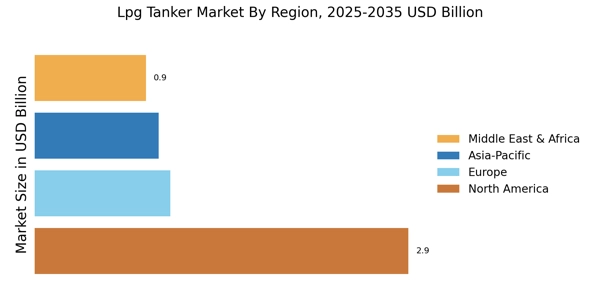
Regional Insights

North America : Energy Transition Leader

North America is witnessing robust growth in the LPG tanker market, driven by increasing domestic production and export capabilities. The U.S. is the largest market, holding approximately 60% of the regional share, followed by Canada at around 25%. Regulatory support for cleaner energy sources and infrastructure investments are key catalysts for this growth. The demand for LPG is expected to rise as industries shift towards more sustainable energy solutions. The competitive landscape is dominated by major players such as Teekay Corporation and Dynagas LNG Partners LP, which are leveraging advanced technologies to enhance operational efficiency. The U.S. Gulf Coast serves as a critical hub for LPG exports, with significant investments in port facilities and shipping capabilities. This region's strategic position and regulatory framework further bolster its attractiveness for LPG tanker operations.

Europe : Regulatory Framework Enhancer

Europe's LPG tanker market is expanding, driven by increasing demand for cleaner fuels and regulatory support for energy transition initiatives. The region is characterized by a diverse market, with Germany and the Netherlands being the largest players, holding approximately 35% and 20% of the market share, respectively. The European Union's commitment to reducing carbon emissions is a significant driver, encouraging investments in LPG infrastructure and shipping capabilities. Leading countries in this market include the UK, France, and Italy, with key players like Exmar NV and BW Group Limited actively participating. The competitive landscape is shaped by stringent regulations and a focus on sustainability, pushing companies to innovate and adopt greener technologies. The presence of established shipping routes and ports enhances the region's logistical capabilities, making it a vital player in The Lpg Tanker Market.

Asia-Pacific : Emerging Market Potential

The Asia-Pacific region is emerging as a significant player in the LPG tanker market, driven by rapid industrialization and urbanization. Countries like China and India are the largest markets, collectively accounting for over 70% of the regional share. The increasing demand for LPG in residential and commercial sectors, coupled with government initiatives to promote cleaner energy, is propelling market growth. Regulatory frameworks are evolving to support LPG infrastructure development, enhancing supply chain efficiency. China leads the market, with substantial investments in LPG import terminals and transportation networks. Key players such as MOL Chemical Tankers and Golar LNG Limited are expanding their fleets to meet rising demand. The competitive landscape is characterized by a mix of local and international companies, all vying for market share in this rapidly growing sector. The region's strategic location and growing economies further enhance its attractiveness for LPG tanker operations.

Middle East and Africa : Resource-Rich Market Dynamics

The Middle East and Africa region is a critical player in the LPG tanker market, primarily due to its abundant natural gas resources. Countries like Saudi Arabia and the UAE dominate the market, holding approximately 65% of the regional share. The region's strategic location as a key exporter of LPG to global markets is a significant growth driver. Regulatory frameworks are increasingly supportive of LPG production and export, facilitating infrastructure development and enhancing market dynamics. Saudi Arabia is the leading country, with major players like AET Tankers and Knock Nevis actively involved in the LPG shipping sector. The competitive landscape is shaped by a focus on efficiency and sustainability, with companies investing in modern fleets and technologies. The region's established shipping routes and port facilities further bolster its position as a leading exporter of LPG, making it a vital component of The Lpg Tanker Market.

Lpg Tanker Market Regional Image

Key Players and Competitive Insights

The LPG tanker market is currently characterized by a dynamic competitive landscape, driven by increasing global demand for liquefied petroleum gas (LPG) and the need for efficient transportation solutions. Key players such as Teekay Corporation (Canada), BW Group Limited (Singapore), and Golar LNG Limited (Bermuda) are strategically positioning themselves to capitalize on these growth opportunities. Teekay Corporation (Canada) has focused on enhancing its fleet capabilities through technological advancements and operational efficiencies, while BW Group Limited (Singapore) emphasizes sustainability and environmental compliance in its operations. Golar LNG Limited (Bermuda) appears to be leveraging its expertise in LNG to expand its LPG services, indicating a trend towards diversification among major players. Collectively, these strategies contribute to a competitive environment that is increasingly focused on innovation and sustainability.

In terms of business tactics, companies are adopting localized manufacturing and optimizing their supply chains to enhance operational efficiency. The LPG tanker market is moderately fragmented, with several key players exerting influence over pricing and service offerings. This fragmentation allows for a variety of operational strategies, as companies seek to differentiate themselves through specialized services and technological advancements.

In August 2025, Teekay Corporation (Canada) announced a partnership with a leading technology firm to develop a new digital platform aimed at optimizing fleet management and reducing operational costs. This strategic move is likely to enhance Teekay's competitive edge by improving efficiency and responsiveness to market demands. The integration of advanced analytics and real-time data could significantly streamline operations, positioning Teekay favorably in a competitive market.

In September 2025, BW Group Limited (Singapore) launched a new initiative focused on retrofitting its existing fleet with eco-friendly technologies. This initiative underscores BW Group's commitment to sustainability and aligns with global regulatory trends aimed at reducing carbon emissions. By investing in greener technologies, BW Group not only enhances its operational efficiency but also strengthens its market position as a leader in environmentally responsible shipping practices.

In October 2025, Golar LNG Limited (Bermuda) expanded its LPG transportation services by acquiring a fleet of modern LPG carriers. This acquisition is indicative of Golar's strategy to diversify its service offerings and enhance its market share in the LPG sector. The addition of these vessels is expected to improve Golar's operational capacity and flexibility, allowing it to better meet the growing demand for LPG transportation.

As of October 2025, the LPG tanker market is witnessing trends that emphasize digitalization, sustainability, and the integration of artificial intelligence in operations. Strategic alliances among key players are shaping the competitive landscape, fostering innovation and collaboration. The shift from price-based competition to a focus on technological advancements and supply chain reliability is becoming increasingly evident. Moving forward, companies that prioritize innovation and sustainability are likely to differentiate themselves in a market that is evolving rapidly.

Key Companies in the Lpg Tanker Market market include

Industry Developments

The LPG tanker market is projected to grow from USD 4.48 billion in 2023 to USD 6.5 billion by 2032, at a CAGR of 4.22% during the forecast period. Rising demand for LPG as a clean and efficient fuel for cooking, heating, and transportation, coupled with increasing trade of LPG, are driving the market growth. The market is also witnessing technological advancements, such as the development of more efficient and environmentally friendly LPG tankers, which are further contributing to the market expansion.

Recent news and developments in the market include the launch of new LPG tanker projects, strategic partnerships between key players, and investments in research and development of new technologies.

Future Outlook

Lpg Tanker Market Future Outlook

The LPG tanker market is projected to grow at a 4.22% CAGR from 2024 to 2035, driven by increasing energy demand, regulatory support, and technological advancements.

New opportunities lie in:

  • Expansion of LNG bunkering services for dual-fuel vessels.
  • Investment in advanced safety systems to enhance operational efficiency.
  • Development of eco-friendly LPG transport solutions to meet sustainability goals.

By 2035, the LPG tanker market is expected to achieve robust growth, positioning itself as a key player in global energy logistics.

Market Segmentation

Lpg Tanker Market End User Outlook

  • Distributors
  • End Users
  • OEMs
  • Utilities

Lpg Tanker Market Material Outlook

  • Carbon Steel
  • Stainless Steel
  • Aluminum
  • Composite Materials

Lpg Tanker Market Tank Size Outlook

  • Small Tanks (<10,000 gallons)
  • Medium Tanks (10,000-30,000 gallons)
  • Large Tanks (>30,000 gallons)

Lpg Tanker Market Application Outlook

  • Residential
  • Commercial
  • Industrial
  • Agriculture

Lpg Tanker Market Product Type Outlook

  • Fixed Storage Tanks
  • Mobile Storage Tanks
  • Transport Trailers
  • Swap Tanks

Report Scope

MARKET SIZE 20244.868(USD Billion)
MARKET SIZE 20255.073(USD Billion)
MARKET SIZE 20357.672(USD Billion)
COMPOUND ANNUAL GROWTH RATE (CAGR)4.22% (2024 - 2035)
REPORT COVERAGERevenue Forecast, Competitive Landscape, Growth Factors, and Trends
BASE YEAR2024
Market Forecast Period2025 - 2035
Historical Data2019 - 2024
Market Forecast UnitsUSD Billion
Key Companies ProfiledMarket analysis in progress
Segments CoveredMarket segmentation analysis in progress
Key Market OpportunitiesAdoption of advanced safety technologies enhances operational efficiency in the Lpg Tanker Market.
Key Market DynamicsRising demand for liquefied petroleum gas drives competition and innovation in the LPG tanker market.
Countries CoveredNorth America, Europe, APAC, South America, MEA

Leave a Comment

FAQs

What is the projected market valuation of the LPG tanker market by 2035?

The LPG tanker market is projected to reach a valuation of 7.672 USD Billion by 2035.

What was the market valuation of the LPG tanker market in 2024?

In 2024, the LPG tanker market was valued at 4.868 USD Billion.

What is the expected CAGR for the LPG tanker market during the forecast period 2025 - 2035?

The expected CAGR for the LPG tanker market during the forecast period 2025 - 2035 is 4.22%.

Which companies are considered key players in the LPG tanker market?

Key players in the LPG tanker market include Teekay Corporation, BW Group Limited, MOL Chemical Tankers, and Golar LNG Limited.

What are the different tank sizes in the LPG tanker market and their valuations?

The market segments for tank sizes include Small Tanks (<10,000 gallons) valued at 1.5168 USD Billion, Medium Tanks (10,000-30,000 gallons) at 2.2676 USD Billion, and Large Tanks (>30,000 gallons) at 3.8876 USD Billion.

How does the material type affect the LPG tanker market valuation?

Material types in the LPG tanker market include Carbon Steel valued at 2.4 USD Billion, Stainless Steel at 1.9 USD Billion, Aluminum at 1.3 USD Billion, and Composite Materials at 2.072 USD Billion.

What applications are driving the LPG tanker market growth?

The applications driving growth include Residential at 1.9 USD Billion, Commercial at 1.5 USD Billion, Industrial at 2.4 USD Billion, and Agriculture at 1.872 USD Billion.

What are the end-user segments in the LPG tanker market?

End-user segments include Distributors valued at 1.9 USD Billion, End Users at 2.4 USD Billion, OEMs at 1.6 USD Billion, and Utilities at 1.872 USD Billion.

What product types are available in the LPG tanker market and their valuations?

Product types include Fixed Storage Tanks valued at 2.4 USD Billion, Mobile Storage Tanks at 1.9 USD Billion, Transport Trailers at 1.5 USD Billion, and Swap Tanks at 1.872 USD Billion.

How does the LPG tanker market's growth compare to other sectors?

The LPG tanker market's growth appears robust, with a projected increase from 4.868 USD Billion in 2024 to 7.672 USD Billion by 2035, indicating strong demand.

Download Free Sample

Kindly complete the form below to receive a free sample of this Report

Compare Licence

×
Features License Type
Single User Multiuser License Enterprise User
Price $4,950 $5,950 $7,250
Maximum User Access Limit 1 User Upto 10 Users Unrestricted Access Throughout the Organization
Free Customization
Direct Access to Analyst
Deliverable Format
Platform Access
Discount on Next Purchase 10% 15% 15%
Printable Versions