Author

Rahul Gotadki

Huntington's Disease Treatment Market Research Report: Size, Share, Trend Analysis By Drug Type (Antipsychotics, Antidepressants, Mood Stabilizers, Neurologics, Genetic Therapies), By Administration Route (Oral, Intravenous, Subcutaneous, Topical), By End Users (Hospitals, Clinics, Homecare Settings, Research Centers), By Therapeutic Area (Psychiatric Disorders, Neurological Disorders, Genetic Disorders) and By Regional (North America, Europe, South America, Asia Pacific, Middle East and Africa) - Growth Outlook & Industry Forecast 2025 To 2035
As per Market Research Future analysis, the Huntington's Disease Treatment Market was estimated at 4.12 USD Billion in 2024. The Huntington's Disease Treatment industry is projected to grow from 4.298 USD Billion in 2025 to 6.554 USD Billion by 2035, exhibiting a compound annual growth rate (CAGR) of 4.31% during the forecast period 2025 - 2035
The Huntington's Disease Treatment Market is experiencing dynamic growth driven by innovative therapies and increasing patient needs.
| 2024 Market Size | 4.12 (USD Billion) |
| 2035 Market Size | 6.554 (USD Billion) |
| CAGR (2025 - 2035) | 4.31% |
Roche (CH), Novartis (CH), Teva Pharmaceuticals (IL), Pfizer (US), Bristol-Myers Squibb (US), Eli Lilly and Company (US), Biogen (US), Amgen (US), Sarepta Therapeutics(US)
Our Impact
Enabled $4.3B Revenue Impact for Fortune 500 and Leading Multinationals
Partnering with 2000+ Global Organizations Each Year
30K+ Citations by Top-Tier Firms in the Industry
The Huntington's Disease Treatment Market is currently experiencing a dynamic evolution, driven by advancements in therapeutic approaches and a growing understanding of the disease's underlying mechanisms. Recent developments in gene therapy and neuroprotective agents appear to be at the forefront of this transformation, potentially offering new avenues for treatment. Furthermore, the increasing prevalence of Huntington's disease is prompting heightened research efforts, which may lead to innovative solutions that address the unmet needs of patients. As the market progresses, collaboration among pharmaceutical companies, research institutions, and patient advocacy groups seems essential to foster the development of effective therapies. In addition, the Huntington's Disease Treatment Market is witnessing a shift towards personalized medicine, where treatments are tailored to individual genetic profiles. This trend suggests a more targeted approach, which could enhance treatment efficacy and minimize adverse effects. Moreover, the integration of digital health technologies, such as telemedicine and mobile health applications, is likely to improve patient engagement and monitoring. Overall, the market appears poised for significant growth, driven by scientific advancements and a commitment to improving the quality of life for those affected by Huntington's disease.
Recent innovations in gene therapy are emerging as a promising frontier in the Huntington's Disease Treatment Market. These therapies aim to address the root causes of the disease by targeting specific genetic mutations, potentially altering the disease's progression. As research continues, the efficacy and safety of these treatments may lead to a paradigm shift in how Huntington's disease is managed.
The trend towards personalized medicine is gaining traction within the Huntington's Disease Treatment Market. This approach focuses on customizing treatment plans based on individual genetic and phenotypic characteristics. By tailoring therapies to the unique needs of patients, there is potential for improved outcomes and reduced side effects, enhancing overall treatment effectiveness.
The incorporation of digital health technologies is transforming patient care in the Huntington's Disease Treatment Market. Tools such as telemedicine and mobile health applications are facilitating better communication between patients and healthcare providers. This trend may lead to improved patient monitoring, adherence to treatment regimens, and enhanced overall management of the disease.
The increasing awareness and advocacy efforts surrounding Huntington's Disease are significantly impacting the Huntington's Disease Treatment Market. Organizations dedicated to raising awareness about the disease are playing a vital role in educating the public and healthcare professionals. This heightened awareness is leading to earlier diagnosis and intervention, which can improve patient outcomes. Furthermore, advocacy groups are pushing for increased funding for research and better access to treatments, thereby influencing policy changes. As more individuals become informed about Huntington's Disease, the demand for effective treatments is likely to grow, driving the market forward. The Huntington's Disease Treatment Market must capitalize on this momentum to enhance its offerings and meet the evolving needs of patients.
Ongoing advancements in research and development are significantly influencing the Huntington's Disease Treatment Market. Innovative approaches, such as gene editing and novel pharmacological agents, are being explored to address the underlying genetic causes of the disease. Recent studies have indicated that targeted therapies may slow disease progression, which could transform treatment paradigms. The investment in R&D has surged, with funding from both public and private sectors aimed at discovering new therapeutic avenues. This influx of research not only enhances the understanding of Huntington's but also fosters the development of more effective treatment options. As a result, the Huntington's Disease Treatment Market is poised for substantial growth driven by these scientific breakthroughs.
The increasing recognition of the need for comprehensive care in managing Huntington's Disease is driving the Huntington's Disease Treatment Market. Supportive care services, including physical therapy, occupational therapy, and psychological support, are becoming integral components of treatment plans. As the disease progresses, patients often require multidisciplinary care to address various symptoms and improve their quality of life. The demand for these services is expected to rise, leading to an expansion of the market. Additionally, healthcare providers are increasingly focusing on holistic approaches that encompass both medical and supportive care, which may enhance patient outcomes. This trend indicates a shift towards more comprehensive treatment strategies within the Huntington's Disease Treatment Market.
Regulatory bodies are increasingly supportive of innovative therapies for Huntington's Disease, which is a crucial driver for the Huntington's Disease Treatment Market. Initiatives aimed at expediting the approval process for breakthrough therapies are being implemented, allowing for faster access to potentially life-altering treatments. The designation of orphan drug status for certain therapies has also encouraged pharmaceutical companies to invest in Huntington's research. This regulatory environment fosters innovation and encourages the development of new treatment modalities. As a result, the Huntington's Disease Treatment Market is likely to witness a surge in new product launches and therapeutic options, ultimately benefiting patients and healthcare providers alike.
The rising incidence of Huntington's Disease is a pivotal driver for the Huntington's Disease Treatment Market. As the population ages, the prevalence of neurodegenerative disorders, including Huntington's, is expected to increase. Current estimates suggest that approximately 3 to 7 per 100,000 individuals are affected by this condition, with a higher incidence in certain populations. This growing patient base necessitates the development and availability of effective treatment options, thereby propelling market growth. Furthermore, as awareness about the disease improves, more individuals are likely to seek diagnosis and treatment, further expanding the market. The Huntington's Disease Treatment Market must adapt to these demographic changes to meet the increasing demand for therapies.
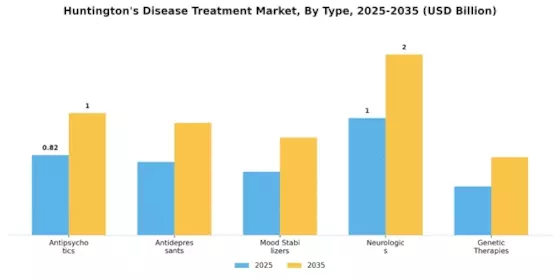
In the Huntington's Disease Treatment Market, the distribution of market share among the various treatment types is indicative of the diverse needs of patients. Neurologics dominate the market due to their established efficacy in managing symptoms associated with Huntington's Disease. They are often the first line of treatment, leading to a significant share when compared to other categories such as antipsychotics and antidepressants. Genetic therapies, while still emerging, are gaining traction as a promising avenue for targeting the root causes of the disease, contributing to their rapid growth in the current market landscape. Growth trends within this segment show a marked shift toward personalized medicine and innovative treatment options. The rise of genetic therapies is particularly noteworthy, fueled by advancements in genetic research and increased investment in biotechnology. On the other hand, neurologics remain a steadfast choice for treatment, as they provide immediate symptom relief. The ongoing development of new anti-Huntington compounds is expected to enhance the effectiveness and appeal of these therapies, solidifying their market position while paving the way for genetic therapies to expand their influence in the coming years.
Neurologics: Dominant vs. Genetic Therapies: Emerging
Neurologics represent the dominant force in the Huntington's Disease Treatment Market, owing to their long-standing reputation for managing both cognitive and motor symptoms. This category has established a strong foothold among healthcare providers and patients alike due to its familiarity and proven effectiveness. Commonly prescribed options include antipsychotic medications that combat behavioral symptoms and other neurologic agents that help with movement disorders. In contrast, genetic therapies are emerging as a revolutionary approach, leveraging cutting-edge science to target the genetic basis of huntington's disease. This innovative branch of treatment is still in its infancy but is rapidly gaining attention and funding, showing great potential for long-term efficacy and disease modification. As research progresses, genetic therapies are expected to redefine treatment paradigms, providing hope for greater therapeutic outcomes.
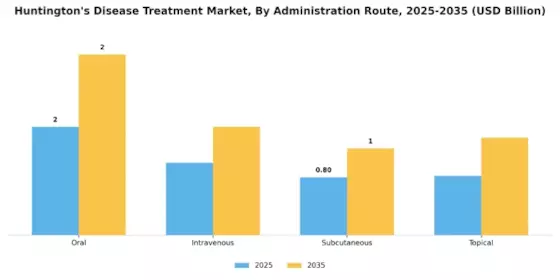
In the Huntington's Disease Treatment Market, the administration route segment is crucial, emphasizing various methods such as Oral, Intravenous, Subcutaneous, and Topical. Currently, the Oral administration route holds a significant market share, being preferred for its ease of use and convenience among patients. Intravenous administration, while smaller in comparison, is recognized for its efficacy in delivering medication directly into the bloodstream, thus gaining traction among healthcare providers.
Administration: Oral (Dominant) vs. Intravenous (Emerging)
Oral administration is the dominant route in the Huntington's Disease Treatment Market, appreciated for its patient-friendly approach, allowing individuals to manage their treatment regimens with minimal supervision. This method promotes adherence and allows for better quality of life as it aligns with the daily routines of patients. In contrast, Intravenous administration is emerging due to its rapid action and higher bioavailability, making it suitable for patients requiring immediate therapeutic effects. The trend towards personalization in treatment is also propelling the growth of Intravenous methods, as they can be tailored to meet specific patient needs, enhancing overall treatment outcomes.
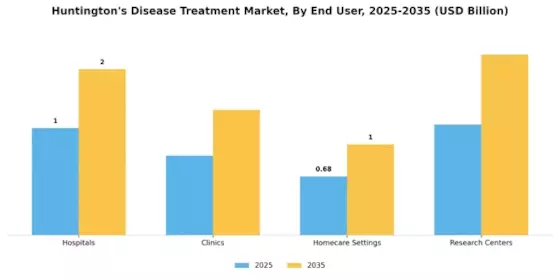
In the Huntington's Disease treatment market, hospitals currently dominate the end-user segment, accounting for a significant portion of the market share. They provide a comprehensive range of services and specialized care for patients, thus ensuring that they address both the medical and psychological needs of individuals suffering from Huntington's Disease. Clinics follow closely, catering to outpatient services and offering consultations specifically tailored to manage the disease, which makes them increasingly relevant in today's healthcare landscape. As awareness of Huntington's Disease increases among healthcare providers and patients, the clinic segment is poised for rapid growth. Emerging treatments and innovations are being adopted more quickly in clinical settings, while hospitals continue to expand their capabilities by incorporating multidisciplinary approaches to care. This trend is driven by the increasing prevalence of the disease and the demand for specialized treatment facilities, propelling clinics into the spotlight as a vital component of the healthcare system.
Hospitals (Dominant) vs. Clinics (Emerging)
Hospitals are recognized as the dominant end-users in the Huntington's Disease treatment market due to their ability to provide extensive inpatient care and support from a range of specialists. They have established infrastructure and resources, offering comprehensive diagnostic and therapeutic services. Clinics, on the other hand, are emerging as pivotal players by facilitating early intervention and ongoing management of the disease with a focus on outpatient care. The growth of telemedicine and personalized treatment plans in clinics enhances accessibility and patient adherence to treatment protocols. As research continues to unfold, clinics are becoming essential for cost-effective and efficient management of Huntington's Disease, thereby complementing the traditional hospital model and responding to the evolving needs of patients.
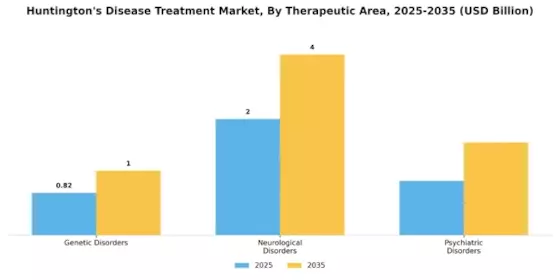
In the Huntington's Disease Treatment Market, the segment distribution reveals that Neurological Disorders account for the largest share, dominating treatment protocols and emphasizing the significance of neurological interventions. This segment's substantial market presence reflects the critical nature of addressing the symptomatic and progression-related aspects of Huntington's Disease. On the other hand, Genetic Disorders, while smaller in immediate market share, are emerging as a rapidly advancing segment due to increasing research and targeted therapies that focus on the genetic underpinnings of the disease.
Neurological Disorders: Dominant vs. Genetic Disorders: Emerging
Neurological Disorders occupy a central role in the Huntington's Disease Treatment Market, characterized by a robust portfolio of treatment options that include symptomatic management and innovative therapies targeting motor and cognitive impairments. This segment is fortified by advancing research into neuroprotective agents and disease-modifying treatments, driven by the urgent need for effective interventions. In contrast, Genetic Disorders are gaining traction as the fastest-growing segment, propelled by heightened interest in gene therapy approaches and precision medicine. Companies are increasingly investing in genetic research, reflecting a pivot towards tailored treatments that tackle the root causes of Huntington's Disease, positioning Genetic Disorders as a key area for future development.
Get more detailed insights about Huntington’s Disease Treatment Market Request Free Sample
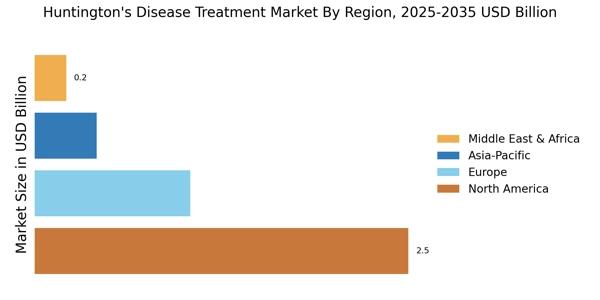
The Huntington's Disease Treatment Market shows a significant regional diversity in terms of revenue generation and growth potential. In 2023, North America leads the market with a valuation of 1.556 USD Billion, highlighting its majority holding in the industry. The prevalence of Huntington's Disease, traumatic brain injury, and advanced healthcare infrastructure contribute to this dominance. Europe follows with a revenue of 0.958 USD Billion, reflecting a significant focus on research and development in this region. The APAC market, valued at 0.638 USD Billion, is witnessing growth due to increasing awareness and healthcare improvements.
South America and MEA both hold a valuation of 0.399 USD Billion in 2023, which indicates emerging opportunities but also suggests a need for more robust healthcare initiatives. The Huntington's Disease Treatment Market data showcases the strong potential for growth across all regions, with North America sustaining its leading position due to a higher prevalence of the disease and innovative treatment options available. Each region presents unique challenges and opportunities, shaping the overall market statistics and influencing future market trends.
The Huntington's Disease Treatment Market has witnessed significant developments owing to the rising incidence of the disorder and the growing awareness regarding its treatment options among healthcare professionals and patients. Competitively, this market is characterized by the presence of a mix of pharmaceutical giants and smaller biotechnology firms. The landscape is marked by innovation, as companies are focused on developing novel therapies and precision medicine approaches to improve patient outcomes. Moreover, strategic collaborations, mergers, and acquisitions are increasingly common as companies aim to expand their product offerings and market reach. The competitive insights reveal that players in this market are leveraging their research capabilities and advanced technologies to formulate effective treatments that can significantly alter the disease's progression.BristolMyers Squibb has established a pronounced presence in the Huntington's Disease Treatment Market through its robust pipeline and commitment to research and development. The company is recognized for its strength in immunological and neuroscience therapeutic areas, contributing to a diversified portfolio that includes therapies focused on neurological disorders. BristolMyers Squibb differentiates itself through its strategic partnerships with academic institutions and research organizations, enhancing its capabilities in clinical trials and accelerating the development of new treatments. The company’s focus on innovative therapies, combined with a strong reputation in healthcare, positions it well to capture a significant share of the Huntington's Disease Treatment Market, thereby reinforcing its competitive edge.Sanofi is another key player in the Huntington's Disease Treatment Market, known for its dedication to advancing therapies that address unmet medical needs. With a footprint and a strong emphasis on research, Sanofi’s strengths lie in its established relationships with healthcare providers and deep understanding of patient needs. The company has made substantial investments in developing targeted therapies aimed at the root causes of Huntington's disease, showcasing its commitment to enhancing patient quality of life. Sanofi's integrated approach, which includes patient engagement and support programs, allows the company to effectively connect with patients and healthcare practitioners, thus bolstering its position in the competitive landscape of Huntington's Disease treatment. Its ongoing efforts to innovate and address the complexities of the disease will further enhance its relevance in this specialized market.




Recent developments in the Huntington's Disease Treatment Market indicate a surge in research and investment aimed at innovative therapies. Companies such as Bristol-Myers Squibb and Roche are advancing their clinical trials for potential therapeutic solutions, focusing on gene therapies and neuroprotective agents. Eli Lilly and Company and UniQure are exploring promising avenues for treatment, with ongoing studies aimed at gene silencing technologies. The Huntington's Disease Society of America continues to advocate for awareness and research funding, amplifying the conversation surrounding the disease.
Additionally, mergers and acquisitions have seen activity, particularly in the engagements involving companies like Teva Pharmaceutical Industries and Novartis, which are enhancing their portfolios in rare disease management. The overall market valuation for the Huntington's Disease treatment sector is projected to grow significantly due to increased governmental support and private sector initiatives. This growth is fostering competition among key players, such as Amgen and Pfizer, as they strive to develop effective interventions for this challenging condition, ultimately aiming to address unmet medical needs and improve patient outcomes.
The Huntington's Disease Treatment Market is projected to grow at a 4.31% CAGR from 2025 to 2035, driven by advancements in gene therapy, increased awareness, and improved diagnostic tools.
New opportunities lie in:
By 2035, the market is expected to achieve substantial growth, reflecting advancements in treatment and patient care.
| MARKET SIZE 2024 | 4.12(USD Billion) |
| MARKET SIZE 2025 | 4.298(USD Billion) |
| MARKET SIZE 2035 | 6.554(USD Billion) |
| COMPOUND ANNUAL GROWTH RATE (CAGR) | 4.31% (2025 - 2035) |
| REPORT COVERAGE | Revenue Forecast, Competitive Landscape, Growth Factors, and Trends |
| BASE YEAR | 2024 |
| Market Forecast Period | 2025 - 2035 |
| Historical Data | 2019 - 2024 |
| Market Forecast Units | USD Billion |
| Key Companies Profiled | Roche (CH), Novartis (CH), Teva Pharmaceuticals (IL), Pfizer (US), Bristol-Myers Squibb (US), Eli Lilly and Company (US), Biogen (US), Amgen (US), Sarepta Therapeutics (US) |
| Segments Covered | Drug Type, Administration Route, End Users, Therapeutic Area, Regional |
| Key Market Opportunities | Advancements in gene therapy and personalized medicine present new avenues in the Huntington's Disease Treatment Market. |
| Key Market Dynamics | Rising demand for innovative therapies drives competition and investment in Huntington's Disease treatment development. |
| Countries Covered | North America, Europe, APAC, South America, MEA |
The projected market valuation for the Huntington's Disease Treatment Market in 2035 is 6.554 USD Billion.
The overall market valuation for the Huntington's Disease Treatment Market was 4.12 USD Billion in 2024.
The expected CAGR for the Huntington's Disease Treatment Market during the forecast period 2025 - 2035 is 4.31%.
Key players in the Huntington's Disease Treatment Market include Roche, Novartis, Teva Pharmaceuticals, Pfizer, Bristol-Myers Squibb, Eli Lilly and Company, Biogen, Amgen, and Sarepta Therapeutics.
The projected revenue for antipsychotics in the Huntington's Disease Treatment Market is expected to reach 1.25 USD Billion by 2035.
The market for genetic therapies is projected to grow to 0.8 USD Billion by 2035.
The anticipated revenue for hospitals as end users in the Huntington's Disease Treatment Market is expected to be 1.92 USD Billion by 2035.
The expected revenue for neurological disorders in the Huntington's Disease Treatment Market is projected to reach 3.5 USD Billion by 2035.
The projected revenue for intravenous administration routes in the Huntington's Disease Treatment Market is expected to be 1.5 USD Billion by 2035.
The expected revenue for homecare settings in the Huntington's Disease Treatment Market is projected to reach 1.05 USD Billion by 2035.


The secondary research process involved comprehensive analysis of regulatory databases, peer-reviewed medical journals, clinical publications, and authoritative health organizations. Key sources included the US Food & Drug Administration (FDA), European Medicines Agency (EMA), European Commission's Health and Food Safety Directorate-General, National Institutes of Health (NIH), National Center for Biotechnology Information (NCBI/PubMed), Centers for Disease Control and Prevention (CDC), World Health Organization (WHO) Global Health Observatory, Huntington's Disease Society of America (HDSA), European Huntington's Disease Network (EHDN), Hereditary Disease Foundation (HDF), National Institute of Neurological Disorders and Stroke (NINDS), ClinicalTrials.gov registry, EU Clinical Trials Register, Orphanet database, and national health ministry reports from key markets. These sources were used to collect epidemiological data, regulatory approval data, clinical safety studies, pipeline analysis, demographic trends, and market landscape analysis for antipsychotics, antidepressants, mood stabilizers, neurologics, and genetic therapies.
Qualitative and quantitative insights were obtained by interviewing supply-side and demand-side stakeholders during the primary research process. Pharmaceutical manufacturers, biotechnology firms, and CMOs/CROs that specialize in rare disease and neurodegenerative therapies were considered supply-side sources. These sources included CEOs, VPs of Product Development, regulatory affairs managers, and commercial directors. Board-certified neurologists, movement disorder specialists, genetic counselors, hospital pharmacy directors, and procurement leaders from academic medical centers, specialty neurology clinics, and research centers comprised demand-side sources. Market segmentation was validated, product pipeline timelines were confirmed, and insights regarding clinical adoption patterns, pricing strategies, reimbursement dynamics, and patient access programs were obtained through primary research.
Primary Respondent Breakdown:
By Designation: C-level Primaries (32%), Director Level (31%), Others (37%)
By Region: North America (38%), Europe (25%), Asia-Pacific (28%), Rest of World (9%)
Global market valuation was derived through revenue mapping and patient volume analysis. The methodology included:
Identification of 35+ key manufacturers across North America, Europe, Asia-Pacific, and Latin America
Product mapping across antipsychotics, antidepressants, mood stabilizers, neurologics, and genetic therapy categories
Analysis of reported and modeled annual revenues specific to Huntington's disease and broader neurology portfolios
Coverage of manufacturers representing 70-75% of global market share in 2024
Extrapolation using bottom-up (patient volume × treatment cost by country) and top-down (manufacturer revenue validation) approaches to derive segment-specific valuations
Kindly complete the form below to receive a free sample of this Report

“This is really good guys. Excellent work on a tight deadline. I will continue to use you going forward and recommend you to others. Nice job”


“Thanks. It’s been a pleasure working with you, please use me as reference with any other Intel employees.”


“Thanks for sending the report it gives us a good global view of the Betaïne market.”


“Thank you, this will be very helpful for OQS.”


“We found the report very insightful! we found your research firm very helpful. I'm sending this email to secure our future business.”


“I am very pleased with how market segments have been defined in a relevant way for my purposes (such as "Portable Freezers & refrigerators" and "last-mile"). In general the report is well structured. Thanks very much for your efforts.”


“I have been reading the first document or the study, ,the Global HVAC and FP market report 2021 till 2026. Must say, good info! I have not gone in depth at all parts, but got a good indication of the data inside!”


“We got the report in time, we really thank you for your support in this process. I also thank to all of your team as they did a great job.”


“The Automotive 48V ECU Components Procurement Intelligence Study” was a complex project, but the Market Research Future (MRFR) team handled it with quality, agility, and customer-centricity. They delivered all requested data on time and within the agreed scope. The team, including Shubhendra Anand and Rahul Gotadki, was always readily available to clarify questions and swiftly implement necessary adjustments, driving the project to a successful conclusion within a very demanding timeframe.
I would also like to specifically commend Akshay Agarwal for his responsiveness and support at every stage—from our initial inquiry on May 6th through to final delivery on June 18th. His dedication made the entire process seamless.”



