Hybrid Cloud Market (2026 - 2035)

Hybrid Cloud Market Size, Share and Research Report: By Component (Solution, Services), By Service Type (Hybrid Hosting, Cloud Management, Orchestration, Disaster Recovery), By Service Model (Infrastructure-as-a-Service, Software-as-a-Service, Platform-as-a-Service), By Organization Size (SMEs And Large Enterprises), By Vertical (BFSI, IT & Telecom, Retail, Manufacturing, Media & Entertainment, Healthcare, Transportation, and Others), And By Region (North America, Europe, Asia-Pacific, And Rest Of The World) –Market Forecast Till 2035.
ID: MRFR/ICT/0512-CR
205 Pages
Ankit Gupta
Last Updated: July 20, 2026
Hybrid Cloud Market
Market Size
Forecast Period2026-2035
CAGR (2026-2035)13.28%
2025 Market SizeUSD 181.37 Billion
2035 Market SizeUSD 592.48 Billion
Key Players
Microsoft
Amazon Web Services
IBM
Google Cloud
VMware
Cisco Systems
Opportunities
  • AI-Optimized Hybrid Orchestration Platforms
  • Sovereign-Cloud Partnerships in Emerging Markets
  • Hybrid FinOps and Cost-Optimization Services

Hybrid Cloud Market Summary

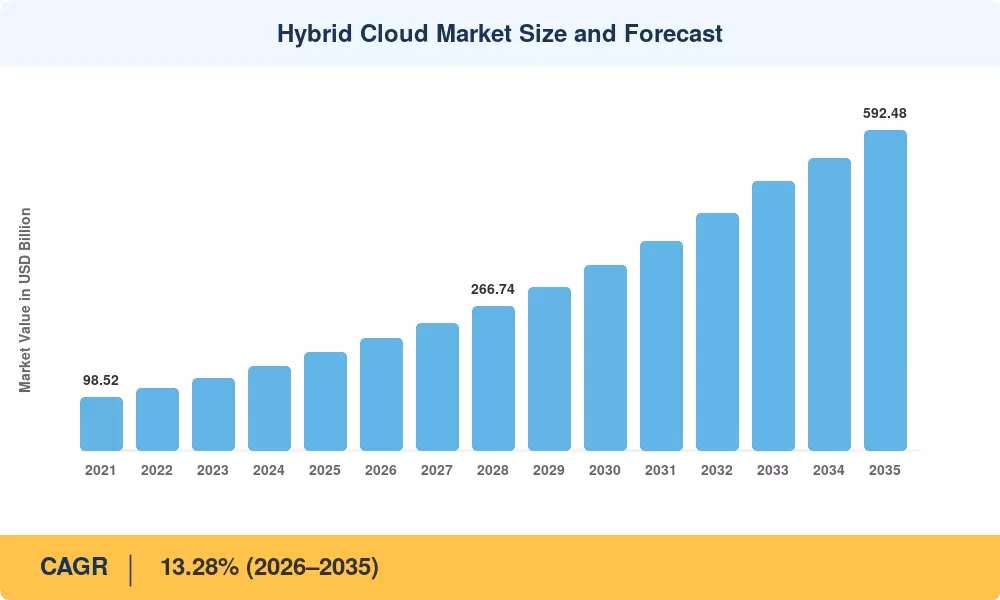
The Hybrid Cloud Market reached an estimated USD 181.37 Billion in 2025 and is projected to grow from USD 207.85 Billion in 2026 to USD 592.48 Billion by 2035, registering a CAGR of 13.28% during the forecast period. Data-sovereignty mandates such as the EU Data Act and sector-specific residency requirements in financial services are pushing enterprises to maintain on-premise cloud connectivity for sensitive workloads while leveraging public-cloud elasticity for burst computing. Corporate IT budgets earmarked for hybrid IT infrastructure surpassed USD 95 Billion globally in 2024, signaling that hybrid strategies have moved from pilot to production at scale.

A sweeping technology transformation is rewriting enterprise architecture. Legacy monolithic data centers that once anchored corporate IT are giving way to containerized, Kubernetes-orchestrated environments that span private racks and multiple hyperscaler regions. Cloud workload management platforms now abstract away provider-specific APIs, enabling security teams to enforce unified encryption, identity, and logging policies from a single control plane. Gartner estimates that over 75% of large enterprises will operate some form of multi-cloud integration strategy by 2027, up from roughly 55% in 2024.

North America commands the largest share of the Hybrid Cloud Market at approximately 43.8% of 2025 revenue, driven by early cloud adoption across financial services and federal modernization programs. Asia-Pacific is the fastest-growing region, advancing at a 14.72% CAGR through 2035 as digital-transformation spending accelerates across India, China, and Southeast Asian economies. Europe holds the second-largest position, underpinned by GDPR-driven hybrid IT infrastructure deployments and growing sovereign-cloud mandates. As generative-AI workloads proliferate and edge-computing requirements tighten, the Hybrid Cloud Market is positioned for sustained double-digit expansion well into the next decade


Key Report Takeaways

• By Component

  • Solutions accounted for 55.7% of the Hybrid Cloud Market in 2025, reflecting demand for orchestration platforms, security stacks, and cloud workload management suites
  • Services are expanding at a 14.18% CAGR through 2035, propelled by managed-services contracts and migration consulting

• By Service Model

  • Software as a Service generated the largest revenue share of the Hybrid Cloud Market in 2025, anchored by collaboration and CRM applications hosted across private-public cloud blend architectures
  • Platform as a Service is advancing at a 15.12% CAGR, as DevOps teams adopt multi-cloud integration toolchains for rapid application deployment

• By Region

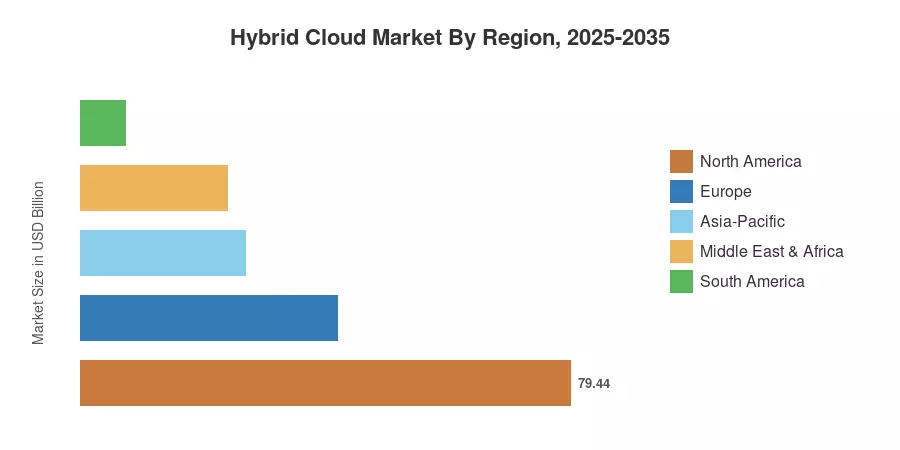
  • North America led all regions, contributing USD 79.44 Billion to the Hybrid Cloud Market in 2025
  • Asia-Pacific is the fastest-expanding region at 14.72% CAGR, driven by government digitization programs and 5G-linked edge infrastructure


Market Size and Forecast (2021–2035)

The historical and projected values below are derived from MRFR's proprietary demand-side modeling, triangulated with vendor revenue disclosures, enterprise IT spending surveys, and regional policy tracking. All figures represent end-user spending on hybrid IT infrastructure solutions and services.
Hybrid Cloud Market Size and Forecast
Our Impact
Enabled $4.3B Revenue Impact for Fortune 500 and Leading Multinationals
Partnering with 2000+ Global Organizations Each Year
30K+ Citations by Top-Tier Firms in the Industry

Driver Impact Analysis

Driver ~% Impact on CAGR Geographic Relevance Impact Timeline
Data-sovereignty and compliance mandates 18–22% Global Short-term (≤2 yr)
Generative-AI inference workload distribution 15–20% North America, Asia-Pacific Medium-term (2–4 yr)
5G edge-computing rollouts 12–16% Asia-Pacific, Europe Medium-term (2–4 yr)
Kubernetes and container orchestration maturity 10–14% Global Short-term (≤2 yr)
Disaster-recovery and business-continuity modernization 8–12% North America, Europe Long-term (≥4 yr)
Sustainability and carbon-aware workload placement 6–9% Europe, North America Long-term (≥4 yr)
SME digital-transformation funding programs 5–8% Asia-Pacific, South America Medium-term (2–4 yr)


Data-Sovereignty and Compliance Mandates

The EU Data Act, effective September 2025, requires that certain categories of industrial and personal data remain within jurisdictional boundaries, forcing enterprises to retain on-premise cloud connectivity for regulated workloads while still tapping hyperscaler AI services. Financial regulators in 27 countries now mandate that core banking transaction records reside on private infrastructure, according to the Financial Stability Board's 2024 cloud-risk review [7]. This regulatory pressure has driven a 34% year-over-year increase in spending on hybrid IT infrastructure configurations that pair private data planes with public compute layers.

Generative-AI Inference Workload Distribution

Large language model inference at scale demands a private public cloud blend strategy — training runs execute on GPU-dense public clouds, while inference endpoints handling sensitive customer data sit closer to enterprise perimeters. NVIDIA reported that 62% of its enterprise AI-platform customers deployed inference workloads in hybrid configurations during 2024 [8]. The Hybrid Cloud Market is absorbing this demand through orchestration layers that dynamically route AI queries based on latency, cost, and data-classification policies.

5G Edge-Computing Rollouts

Telecom operators deploying standalone 5G networks across Asia-Pacific and Europe are creating micro-data-center footprints that require cloud workload management integration with centralized private clouds. Ericsson estimates that 5G-connected enterprise edge nodes will exceed 12 million globally by 2028, each requiring real-time synchronization with core hybrid IT infrastructure [6]. Sub-50-millisecond response-time targets for industrial IoT and autonomous-vehicle telemetry are making location-aware control planes indispensable.

Kubernetes and Container Orchestration Maturity

The CNCF's 2024 survey found that 78% of organizations now run Kubernetes in production, up from 58% two years prior [9]. Container orchestration has become the de facto abstraction layer enabling multi-cloud integration — workloads packaged as containers move seamlessly between private racks and public clouds without rewriting application logic. This maturity directly feeds the Hybrid Cloud Market by lowering the friction of adopting distributed architectures.


Restraints Impact Analysis

The restraint impacts below represent estimated drag on adoption velocity and are directional rather than precisely additive.

Restraint ~% Impact on CAGR Geographic Relevance Impact Timeline
Integration complexity and skills shortage –12–16% Global Short-term (≤2 yr)
Data-egress and inter-cloud transfer costs –10–14% North America, Europe Medium-term (2–4 yr)
Security perimeter fragmentation –8–12% Global Long-term (≥4 yr)
Vendor lock-in and API incompatibility –6–10% Global Medium-term (2–4 yr)
Latency unpredictability in distributed architectures –4–7% Asia-Pacific, South America Short-term (≤2 yr)


Integration Complexity and Skills Shortage

Building and maintaining a hybrid IT infrastructure demands expertise across private-cloud platforms, multiple hyperscaler environments, networking, and security — a skill set that fewer than 18% of enterprise IT teams possess in-house, according to a 2024 Flexera survey [13]. The talent gap widens the implementation timeline for cloud workload management projects, often adding 6–12 months to migration schedules. Training and certification costs for hybrid architects averaged USD 14,500 per employee in 2024, creating budget pressure for mid-market organizations attempting multi-cloud integration.

Data-Egress and Inter-Cloud Transfer Costs

Hyperscaler egress pricing remains one of the most cited barriers to fully realizing the Hybrid Cloud Market's potential. AWS, Azure, and GCP collectively generated an estimated USD 6.2 Billion in egress fees during 2024 [14]. Enterprises running analytics pipelines that shuttle large datasets between on-premise cloud connectivity endpoints and public storage frequently discover that transfer costs erode 15–25% of projected savings from workload portability.

Security Perimeter Fragmentation

Distributing workloads across a private-public cloud blend inherently expands the attack surface. A Ponemon Institute study reported that organizations with hybrid environments experienced 23% more security incidents than those operating solely on-premises or in a single public cloud [15]. Unified policy engines mitigate this risk but require continuous configuration management, adding operational overhead to hybrid IT infrastructure.


Hybrid Cloud Market Opportunities

AI-Optimized Hybrid Orchestration Platforms

Platforms that intelligently route training, fine-tuning, and inference tasks across heterogeneous IT infrastructure depending on cost, latency, and governance limitations have an opportunity as generative-AI workloads rise at an exponential rate. A rapidly expanding portion of the Hybrid Cloud Market is available to vendors who provide GPU-aware cloud workload management with integrated model-registry integration


Sovereign-Cloud Partnerships in Emerging Markets

In India, Brazil, Indonesia and Saudi Arabia, governments are mandating local cloud infrastructure for the digitization of the public sector. Global hyperscalers partnering with regional telecom providers to establish sovereign on-premise cloud connectivity zones is a multi-billion-dollar potential until 2035


Hybrid FinOps and Cost-Optimization Services

The complexity of multi-cloud integration is increasing and organizations are finding it difficult to monitor and optimize spend across providers. SaaS subscriptions and managed services can monetise this pain point using FinOps solutions that aggregate billing telemetry from private racks, colocation facilities, and public-cloud accounts


Sustainability-Driven Workload Placement

Carbon-aware scheduling – sending batch jobs to cloud regions fueled by renewable energy – is evolving from proof-of-concept to corporate need. The EU Corporate Sustainability Reporting Directive (CSRD) will require disclosures of Scope 3 emissions including cloud computing by 2026, making hybrid IT infrastructure a crucial lever for ESG compliance [11]


Edge-to-Core Hybrid Continuum for Industrial IoT

Manufacturing, energy, and logistics companies deploying thousands of edge nodes need private public cloud blend architectures that synchronize operational-technology data with cloud analytics. This industrial segment of the Hybrid Cloud Market is expected to grow faster than enterprise IT segments, driven by Industry 4.0 investments


Hybrid Cloud Market Future Outlook

AI-Native Hybrid Architectures

By 2030, the Hybrid Cloud Market will be inseparable from AI infrastructure planning. Enterprises will deploy inference endpoints on private hardware for data-sensitive applications while leveraging public-cloud GPU clusters for model training. Autonomous cloud workload management systems will use reinforcement learning to optimize placement decisions in real time, reducing manual intervention by an estimated 70%, according to IDC projections [8].

Platform Economics and Marketplace Models

Hybrid-cloud platforms are evolving from infrastructure plumbing into marketplace ecosystems where ISVs distribute applications, data products, and AI models. This shift toward platform economics will reshape competitive dynamics in the Hybrid Cloud Market, rewarding vendors that build sticky developer communities around their multi-cloud integration toolchains. Snowflake, Databricks, and similar data-platform players are already embedding hybrid deployment options as default configurations [20].

Edge-Cloud Continuum and 6G Readiness

The boundary between edge and cloud will blur throughout the forecast period as on-premise cloud connectivity extends to millions of micro-data-center nodes. By 2032, early 6G trials will demand sub-10-millisecond hybrid control planes, pushing the Hybrid Cloud Market toward software-defined networking architectures that dynamically allocate compute across a mesh of private, public, and edge resources [6].

Sustainability Reporting and Carbon-Aware Scheduling

The CSRD, SEC climate-disclosure rules, and ISSB standards will make Scope 3 cloud-computing emissions a boardroom concern by 2028. Hybrid IT infrastructure operators that offer granular carbon-accounting APIs and renewable-energy-matched scheduling will capture premium pricing. The Hybrid Cloud Market stands to benefit as organizations shift batch workloads from carbon-intensive regions to facilities powered by renewable energy, reinforcing demand for location-aware private-public cloud blend control planes [11].


Hybrid Cloud Market Segmentation

By Component

Segment Key Metric Primary Demand Driver
Solutions 55.7% share (2025) Orchestration, security, and cloud workload management platforms
Services 14.18% CAGR (2026–2035) Migration consulting, managed hybrid IT infrastructure


Solutions dominate the Hybrid Cloud Market because enterprises prioritize platform investments that unify management across private and public environments. Orchestration suites from vendors like Red Hat, VMware, and Nutanix provide the abstraction layers necessary for seamless multi-cloud integration. Security solutions — including zero-trust network access and encrypted key management — represent the fastest-growing sub-segment within the solutions category.

Services are gaining momentum as skills-constrained organizations outsource hybrid-architecture design and day-to-day operations. Managed-services contracts for on-premise cloud connectivity monitoring and optimization grew 38% in bookings during 2024, reflecting the complexity of maintaining private public cloud blend environments at scale [13].

By Service Model

Segment Key Metric Primary Demand Driver
Software as a Service (SaaS) 47.9% share (2025) CRM, collaboration, and ERP delivered across hybrid IT infrastructure
Platform as a Service (PaaS) 15.12% CAGR (2026–2035) DevOps, CI/CD, and container-native development
Infrastructure as a Service (IaaS) USD 42.15 Billion (2025) Compute and storage provisioning for cloud workload management


SaaS maintains its position as the largest service-model segment in the Hybrid Cloud Market because enterprise applications like Salesforce, Microsoft 365, and SAP S/4HANA increasingly run in private public cloud blend configurations to satisfy data-residency requirements. PaaS is the fastest-growing model as development teams adopt multi-cloud integration platforms such as Azure Arc, Google Anthos, and AWS Outposts to build and deploy applications without locking into a single provider.

By Organization Size

Segment Key Metric Primary Demand Driver
Large Enterprises 65.5% share (2025) Complex regulatory environments, global operations
Small and Medium-Sized Enterprises (SMEs) 13.48% CAGR (2026–2035) Cloud-first digital transformation, managed-service availability


Large enterprises account for the majority of the Hybrid Cloud Market because they operate regulated, globally distributed workloads that demand on-premise cloud connectivity alongside public-cloud elasticity. SMEs represent the higher-growth segment as turnkey hybrid IT infrastructure offerings lower the barrier to adoption — cloud workload management platforms that previously required dedicated teams can now be consumed as fully managed services.

By End-User Industry

Segment Key Metric Primary Demand Driver
Banking, Financial Services, and Insurance (BFSI) 38.2% share (2025) Regulatory compliance, real-time transaction processing
Information and Communication Technology & Telecom 15.28% CAGR (2026–2035) 5G edge, network-function virtualization
Healthcare and Life Sciences USD 19.42 Billion (2025) HIPAA, clinical-trial data management
Government and Public Sector 13.84% CAGR (2026–2035) Sovereign-cloud mandates, citizen-services modernization


BFSI leads the Hybrid Cloud Market in revenue contribution because banks, insurers, and capital-markets firms must balance real-time transaction processing on private infrastructure with the analytical power of public-cloud AI services. Multi-cloud integration enables these institutions to run risk models on elastic compute while keeping core ledger data within on-premise cloud connectivity perimeters mandated by regulators such as the OCC and PRA [7].


Regional Market Share Analysis

Region Key Metric Primary Investment Themes
North America 43.8% revenue share (2025) Federal cloud modernization, GenAI inference, FinOps
Europe USD 41.71 Billion (2025) GDPR compliance, sovereign cloud, sustainability
Asia-Pacific 14.72% CAGR (2026–2035) 5G edge, government digitization, SME adoption
South America USD 7.25 Billion (2025) Banking digitization, open-finance mandates
Middle East & Africa 13.15% CAGR (2026–2035) Smart-city programs, oil-and-gas digital twins
Total USD 181.37 Billion (2025)

The Hybrid Cloud Market exhibits pronounced geographic variation in adoption maturity, regulatory drivers, and growth velocity.


North America

Country Key Metric Key Driver
US 78.4% of regional share FedRAMP modernization, hyperscaler HQ investments
Canada 12.68% CAGR Multi-cloud integration in banking and energy
Mexico USD 2.46 Billion (2025) Nearshoring-driven data-center expansion


North America's dominance in the Hybrid Cloud Market stems from the concentration of hyperscaler headquarters, deep venture-capital funding for cloud-native startups, and aggressive federal IT modernization. The U.S. Federal Cloud Smart Strategy has driven over USD 12 Billion in hybrid IT infrastructure procurement since 2022, while Canada's financial regulator (OSFI) requires banks to maintain on-premise cloud connectivity for critical transaction processing [7].

Europe

Country Key Metric Key Driver
Germany USD 8.92 Billion (2025) Industrie 4.0, automotive cloud workload management
UK 13.45% CAGR Financial-services hybrid mandates
France USD 5.18 Billion (2025) Sovereign-cloud programs (SecNumCloud)
Italy 12.87% CAGR Public-sector digitization
Spain USD 2.74 Billion (2025) SME cloud-adoption grants
Nordic Countries 13.62% CAGR Green-energy-powered data centers
Russia USD 1.85 Billion (2025) Domestic cloud-platform development
Rest of Europe 12.52% CAGR EU Data Act compliance


European adoption of the Hybrid Cloud Market is shaped by the world's most stringent data-protection regime. The EU's Gaia-X initiative and France's SecNumCloud certification are creating a parallel ecosystem of sovereign multi-cloud integration platforms. Germany's manufacturing sector is a particularly active buyer of private public cloud blend solutions that connect factory-floor OT systems with cloud-based analytics.

Asia-Pacific

Country Key Metric Key Driver
China 38.2% of regional share State-backed cloud infrastructure mandates
India 16.14% CAGR Digital India, UPI-linked fintech cloud
Japan USD 6.43 Billion (2025) Enterprise legacy modernization
South Korea 15.28% CAGR 5G edge and semiconductor cloud labs
ASEAN USD 4.87 Billion (2025) Cross-border data frameworks
Rest of Asia-Pacific 14.36% CAGR Telecom-led hybrid IT infrastructure


Asia-Pacific is the fastest-growing region in the Hybrid Cloud Market, driven by massive government digitization programs. India's MeitY Cloud initiative has allocated over USD 3.5 Billion to build national hybrid IT infrastructure, while China's "East Data, West Computing" program channels cloud workload management capacity to western provinces with lower energy costs [12].

South America

Country Key Metric Key Driver
Brazil 62.5% of regional share Open-banking mandates, fintech growth
Argentina 12.18% CAGR Government digitization
Rest of South America USD 1.34 Billion (2025) Telecom modernization


Brazil anchors the South American Hybrid Cloud Market, where central-bank-mandated open-finance APIs require banks to maintain on-premise cloud connectivity for transaction data while using public clouds for customer-facing applications. Multi-cloud integration adoption among Brazilian fintechs grew 41% year-over-year in 2024 [18].

Middle East & Africa

Country Key Metric Key Driver
Saudi Arabia 35.7% of regional share Vision 2030 digital transformation
UAE 14.52% CAGR Smart-city and logistics hubs
South Africa USD 1.12 Billion (2025) Financial-services cloud modernization
Egypt 13.87% CAGR Government cloud-first policy
Rest of MEA USD 0.94 Billion (2025) Telecom-led infrastructure


Saudi Arabia's Vision 2030 program has catalyzed a wave of hybrid IT infrastructure investment across the Middle East, with NEOM and other megaprojects specifying private public cloud blend architectures for building-management and logistics systems. The UAE's AI Strategy 2031 is accelerating cloud workload management adoption across government agencies [19].


Hybrid Cloud Market By Region, 2025-2035

Competitive Benchmarking

The Hybrid Cloud Market exhibits medium concentration, with the top five vendors collectively holding an estimated 42–48% revenue share. The Herfindahl-Hirschman Index (HHI) falls in the 800–1,200 range, indicating a moderately competitive structure where hyperscalers compete with specialized multi-cloud integration and on-premise cloud connectivity vendors.

Company Est. Revenue Share Range Key Offerings for Hybrid Cloud Market Strategic Positioning
Microsoft (Azure) ~12–15% Azure Arc, Azure Stack HCI, hybrid AI services Broadest private public cloud blend portfolio
Amazon Web Services ~10–13% AWS Outposts, EKS Anywhere, hybrid storage Scale-driven cloud workload management
IBM ~6–9% IBM Cloud Satellite, Red Hat OpenShift Open-source multi-cloud integration leader
Google Cloud ~5–8% Google Anthos, Distributed Cloud, GKE Enterprise Kubernetes-native hybrid IT infrastructure
VMware (Broadcom) ~5–7% VMware Cloud Foundation, Tanzu Legacy-modernization bridge
Cisco Systems ~3–5% Cisco Intersight, hybrid networking Network-centric on-premise cloud connectivity
Hewlett Packard Enterprise ~3–5% HPE GreenLake, Ezmeral Consumption-model hybrid IT infrastructure
Dell Technologies ~2–4% Dell APEX, PowerFlex Integrated hardware-software hybrid stack
Oracle ~2–4% OCI Dedicated Region, Exadata Cloud@Customer Database-centric private public cloud blend
Nutanix ~2–3% Nutanix Cloud Platform, NC2 Hyperconverged multi-cloud integration


Recent News & Developments

  • Microsoft (March 2025): Launched Azure Arc-enabled AI Services, extending Azure OpenAI capabilities to on-premises and edge locations, reinforcing hybrid IT infrastructure for GenAI inference [20].
  • AWS (January 2025): Expanded Outposts rack configurations with NVIDIA H100 GPU support, targeting enterprises running AI cloud workload management across private public cloud blend environments [8].
  • IBM (November 2024): Acquired Apptio for USD 4.6 Billion, integrating FinOps capabilities into its hybrid-cloud management platform to improve multi-cloud integration cost visibility [21].
  • Google Cloud (September 2024): Released Anthos 2.0 with sovereign-controls modules, enabling enterprises in regulated industries to maintain on-premise cloud connectivity while accessing Google AI services [22].
  • European Commission (June 2024): Finalized the EU Cloud Rulebook, establishing interoperability standards that directly accelerate the Hybrid Cloud Market in Europe by reducing vendor lock-in [7].
  • Cisco Systems (April 2024): Launched Intersight Hybrid Cloud Manager with AIOps-driven anomaly detection, strengthening network-level hybrid IT infrastructure monitoring [23].
  • Nutanix (February 2024): Partnered with Red Hat to certify OpenShift on the Nutanix Cloud Platform, expanding multi-cloud integration options for enterprise Kubernetes deployments [24].
  • Oracle (December 2023): Announced OCI Dedicated Region at customer-managed sites for USD 6.5 Million minimum commitment, targeting BFSI firms requiring full on-premise cloud connectivity with public-cloud feature parity [25].


Hybrid Cloud Market Report Scope

Parameter Detail
Market Scope Global Hybrid Cloud Market covering solutions, services, and deployment models
Study Period 2021–2035
CAGR 13.28% (2026–2035)
Base Year Market Size USD 181.37 Billion (2025)
Forecast Endpoint Market Size USD 592.48 Billion (2035)
Fastest Growing Segments Services (by component); PaaS (by service model); Asia-Pacific (by region)
Companies Profiled 10 (Microsoft, AWS, IBM, Google Cloud, VMware, Cisco, HPE, Dell, Oracle, Nutanix)
Valuation Currency USD Billion


FAQs

How does hybrid cloud differ from multi-cloud in practice?
Hybrid cloud combines private and public infrastructure under unified management, while multi-cloud uses multiple public providers without necessarily integrating them. The distinction matters for governance because hybrid architectures enforce consistent security policies across environments [16].
What is the typical ROI timeline for a hybrid cloud migration?
Most enterprises achieve positive ROI within 18–24 months of completing migration, primarily through reduced provisioning cycles and optimized cloud workload management. Early gains come from retiring legacy hardware maintenance contracts [2].
Which compliance frameworks most heavily drive hybrid cloud adoption?
GDPR, HIPAA, PCI-DSS, and the EU Data Act are the primary mandates requiring data to remain on private infrastructure while applications consume public-cloud services. Financial regulators in the US and UK add sector-specific residency rules [7].
How do enterprises manage security across a hybrid environment?
Organizations deploy unified policy engines that enforce encryption, identity, and logging standards across all nodes. Zero-trust architectures and microsegmentation reduce lateral-movement risk in distributed hybrid IT infrastructure [15].
What role does Kubernetes play in hybrid cloud adoption?
Kubernetes provides the container-orchestration layer that abstracts workloads from underlying infrastructure, enabling portable deployment across private racks and public clouds. It has become the standard for multi-cloud integration [9].
How should mid-market companies evaluate hybrid cloud vendors?
Prioritize vendors offering managed services with transparent egress pricing and pre-built compliance templates. Evaluate total cost of ownership including staff training, not just compute pricing [13].
What emerging technologies will reshape hybrid cloud by 2030?
Confidential computing, serverless edge functions, and AI-driven autonomous operations will redefine how workloads are placed and secured across on-premise cloud connectivity and public clouds [8].    
Author
Author
Author Profile
Ankit Gupta LinkedIn
Team Lead - Research
Ankit Gupta is a seasoned market intelligence and strategic research professional with over six plus years of experience in the ICT and Semiconductor industries. With academic roots in Telecom, Marketing, and Electronics, he blends technical insight with business strategy. Ankit has led 200+ projects, including work for Fortune 500 clients like Microsoft and Rio Tinto, covering market sizing, tech forecasting, and go-to-market strategies. Known for bridging engineering and enterprise decision-making, his insights support growth, innovation, and investment planning across diverse technology markets.

Research Approach


Secondary Research

The secondary research process involved comprehensive analysis of technology regulatory frameworks, cloud computing standards, peer-reviewed IT infrastructure journals, and authoritative ICT industry publications. Key sources included the National Institute of Standards and Technology (NIST) Cloud Computing Program, European Union Agency for Cybersecurity (ENISA) Cloud Security Publications, Federal Risk and Authorization Management Program (FedRAMP), Cloud Security Alliance (CSA) Guidance Documents, International Organization for Standardization (ISO/IEC 27017/27018 for cloud security), Gartner Research & Advisory Services, International Data Corporation (IDC) Worldwide Semiannual Public Cloud Services Tracker, Synergy Research Group Cloud Market Data, Forrester Research Cloud Computing Reports, Uptime Institute Annual Data Center Survey, OpenStack Foundation Market Analysis, Linux Foundation Cloud Native Computing Foundation (CNCF) Surveys, U.S. Securities and Exchange Commission (SEC) 10-K filings for hyperscale providers, Bloomberg Technology Intelligence, and Eurostat ICT Enterprise Statistics. These sources were utilized to collect market sizing data, cloud adoption metrics, security compliance frameworks, pricing benchmarks, and competitive landscape intelligence for Infrastructure-as-a-Service (IaaS), Platform-as-a-Service (PaaS), and hybrid cloud management platforms across BFSI, healthcare, retail, manufacturing, and government verticals.


Primary Research

Interviews with supply-side and demand-side stakeholders were conducted as part of the primary research process in order to gather qualitative and quantitative information about enterprise procurement practices, multi-cloud orchestration difficulties, and hybrid cloud migration patterns. Chief Technology Officers, Vice Presidents of Cloud Infrastructure, Heads of Partner Ecosystems, and Solutions Architects from managed service providers (MSPs), hybrid cloud platform manufacturers, and hyperscale cloud providers were among the supply-side sources. Chief information officers, chief digital officers, enterprise architects, directors of cloud infrastructure, and IT procurement managers from Fortune 1000 companies, mid-market businesses, and government agencies in North America, Europe, and Asia-Pacific were among the demand-side sources. Primary research collected information on vendor lock-in mitigation techniques, total cost of ownership (TCO) models, and compliance-driven deployment designs, validated service segmentations, and verified product roadmap dates.

Primary Respondent Breakdown:

By Designation: C-level Primaries (30%), Director Level (32%), Others (38%)

By Region: North America (40%), Europe (25%), Asia-Pacific (28%), Rest of World (7%)


Market Size Estimation

Global market valuation was derived through revenue triangulation and deployment volume analysis. The methodology included:

Identification of 60+ key technology providers across hyperscale cloud operators, infrastructure hardware vendors, cloud management platform providers, and systems integrators

Service mapping across public cloud integration, private cloud infrastructure, hybrid cloud orchestration software, and professional/managed services

Analysis of reported quarterly cloud revenue segments and modeled annual recurring revenues (ARR) specific to hybrid cloud deployments

Coverage of providers representing 75-80% of global hybrid cloud market share in 2024

Extrapolation using bottom-up (enterprise workload volume × average spend per deployment by vertical) and top-down (vendor revenue reconciliation and IT budget allocation analysis) approaches to derive segment-specific valuations across financial services, healthcare, retail, government, and telecommunications sectors

Download Free Sample

Kindly complete the form below to receive a free sample of this Report

Download PDF ×

We do not share your information with anyone. However, we may send you emails based on your report interest from time to time. You may contact us at any time to opt-out.
















