Hybrid Cloud Market (2026 - 2035)

ID: MRFR/ICT/0512-CR
205 Pages
Ankit Gupta
Last Updated: July 20, 2026
Hybrid Cloud Market Size, Share and Research Report: By Component (Solution, Services), By Service Type (Hybrid Hosting, Cloud Management, Orchestration, Disaster Recovery), By Service Model (Infrastructure-as-a-Service, Software-as-a-Service, Platform-as-a-Service), By Organization Size (SMEs And Large Enterprises), By Vertical (BFSI, IT & Telecom, Retail, Manufacturing, Media & Entertainment, Healthcare, Transportation, and Others), And By Region (North America, Europe, Asia-Pacific, And Rest Of The World) –Market Forecast Till 2035.
Hybrid Cloud Market
Market Size
Forecast Period2026-2035
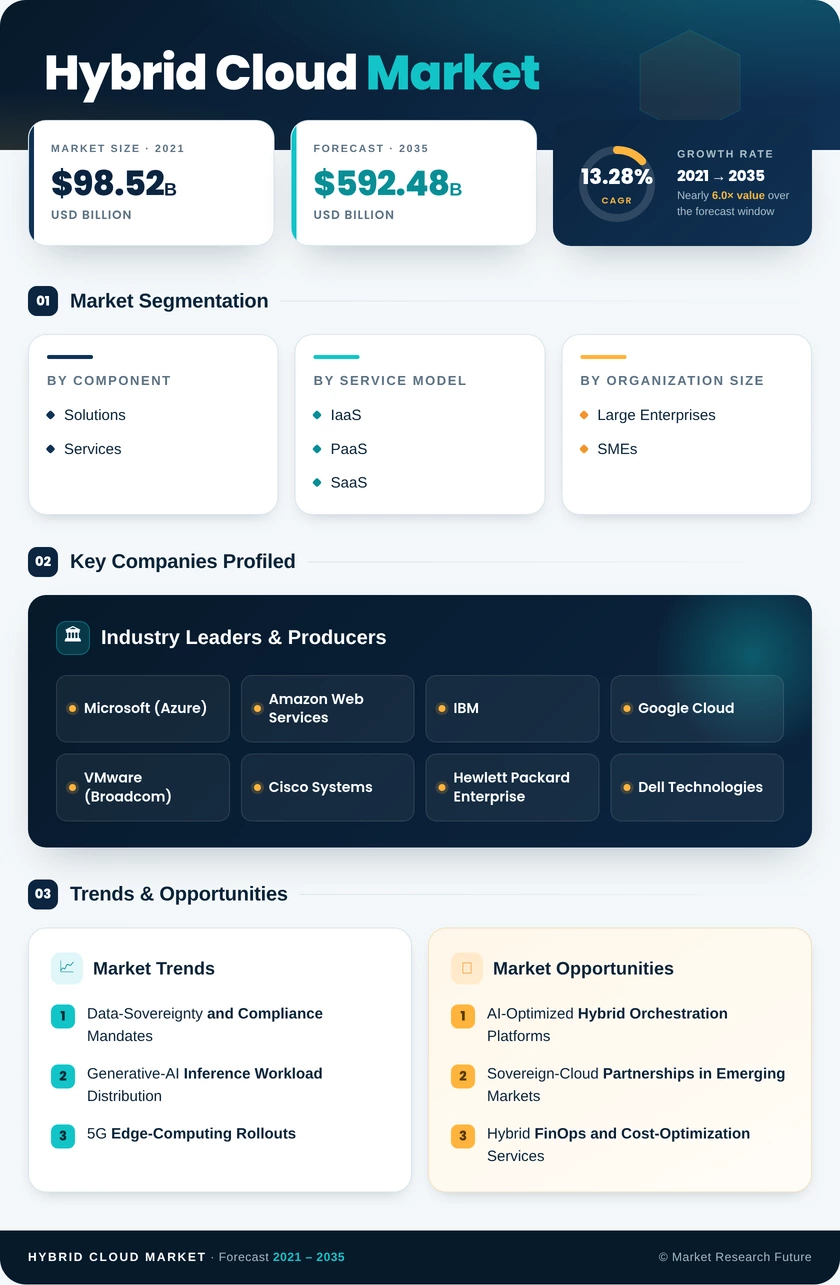
CAGR (2026-2035)13.28%
2025 Market SizeUSD 181.37 Billion
2035 Market SizeUSD 592.48 Billion
Key Players
Microsoft
Amazon Web Services
IBM
Google Cloud
VMware
Cisco Systems
Opportunities
  • AI-Optimized Hybrid Orchestration Platforms
  • Sovereign-Cloud Partnerships in Emerging Markets
  • Hybrid FinOps and Cost-Optimization Services
  1. 1 Market Overview |
    1. 1.1 Study Assumptions & Market Definition |
    2. 1.2 Scope of the Study |
    3. 1.3 Research Methodology
  2. 2 Market Summary & Key Takeaways
  3. 3 Market Dynamics |
    1. 3.1 Market Drivers Analysis | |
      1. 3.1.1 Data-Sovereignty and Compliance Mandates | |
      2. 3.1.2 Generative-AI Inference Workload Distribution | |
      3. 3.1.3 5G Edge-Computing Rollouts | |
      4. 3.1.4 Kubernetes and Container Orchestration Maturity | |
      5. 3.1.5 Disaster-Recovery and Business-Continuity Modernization | |
      6. 3.1.6 Sustainability and Carbon-Aware Workload Placement | |
      7. 3.1.7 SME Digital-Transformation Funding Programs |
    2. 3.2 Market Restraints Analysis | |
      1. 3.2.1 Integration Complexity and Skills Shortage | |
      2. 3.2.2 Data-Egress and Inter-Cloud Transfer Costs | |
      3. 3.2.3 Security Perimeter Fragmentation | |
      4. 3.2.4 Vendor Lock-In and API Incompatibility | |
      5. 3.2.5 Latency Unpredictability in Distributed Architectures |
    3. 3.3 Market Opportunity Analysis | |
      1. 3.3.1 AI-Optimized Hybrid Orchestration Platforms | |
      2. 3.3.2 Sovereign-Cloud Partnerships in Emerging Markets | |
      3. 3.3.3 Hybrid FinOps and Cost-Optimization Services | |
      4. 3.3.4 Sustainability-Driven Workload Placement | |
      5. 3.3.5 Edge-to-Core Hybrid Continuum for Industrial IoT |
    4. 3.4 Industry Value Chain Analysis |
    5. 3.5 Porter's Five Forces Analysis
  4. 4 Global Hybrid Cloud Market Size & Forecast (2021–2035) |
    1. 4.1 Historical Market Size (2021–2025) |
    2. 4.2 Current & Forecast Market Size (2026–2035) |
    3. 4.3 Market Size by Revenue (USD Billion) |
    4. 4.4 Year-over-Year Growth Analysis
  5. 5 Segmentation Analysis |
    1. 5.1 By Component | |
      1. 5.1.1 Solutions | |
      2. 5.1.2 Services |
    2. 5.2 By Service Model | |
      1. 5.2.1 Infrastructure as a Service (IaaS) | |
      2. 5.2.2 Platform as a Service (PaaS) | |
      3. 5.2.3 Software as a Service (SaaS) |
    3. 5.3 By Organization Size | |
      1. 5.3.1 Large Enterprises | |
      2. 5.3.2 Small and Medium-Sized Enterprises (SMEs) |
    4. 5.4 By End-User Industry | |
      1. 5.4.1 Banking, Financial Services, and Insurance (BFSI) | |
      2. 5.4.2 Information and Communication Technology & Telecom | |
      3. 5.4.3 Healthcare and Life Sciences | |
      4. 5.4.4 Government and Public Sector | |
      5. 5.4.5 Retail and E-Commerce | |
      6. 5.4.6 Manufacturing | |
      7. 5.4.7 Others
  6. 6 Regional Analysis |
    1. 6.1 North America | |
      1. 6.1.1 United States | |
      2. 6.1.2 Canada | |
      3. 6.1.3 Mexico |
    2. 6.2 Europe | |
      1. 6.2.1 Germany | |
      2. 6.2.2 United Kingdom | |
      3. 6.2.3 France | |
      4. 6.2.4 Italy | |
      5. 6.2.5 Spain | |
      6. 6.2.6 Nordic Countries | |
      7. 6.2.7 Russia | |
      8. 6.2.8 Rest of Europe |
    3. 6.3 Asia-Pacific | |
      1. 6.3.1 China | |
      2. 6.3.2 India | |
      3. 6.3.3 Japan | |
      4. 6.3.4 South Korea | |
      5. 6.3.5 ASEAN | |
      6. 6.3.6 Rest of Asia-Pacific |
    4. 6.4 South America | |
      1. 6.4.1 Brazil | |
      2. 6.4.2 Argentina | |
      3. 6.4.3 Rest of South America |
    5. 6.5 Middle East & Africa | |
      1. 6.5.1 Saudi Arabia | |
      2. 6.5.2 UAE | |
      3. 6.5.3 South Africa | |
      4. 6.5.4 Egypt | |
      5. 6.5.5 Rest of MEA
  7. 7 Competitive Landscape |
    1. 7.1 Market Share Analysis (2025) |
    2. 7.2 Competitive Benchmarking Matrix |
    3. 7.3 Company Profiles | |
      1. 7.3.1 Microsoft (Azure) | |
      2. 7.3.2 Amazon Web Services | |
      3. 7.3.3 IBM | |
      4. 7.3.4 Google Cloud | |
      5. 7.3.5 VMware (Broadcom) | |
      6. 7.3.6 Cisco Systems | |
      7. 7.3.7 Hewlett Packard Enterprise | |
      8. 7.3.8 Dell Technologies | |
      9. 7.3.9 Oracle | |
      10. 7.3.10 Nutanix
  8. 8 Future Outlook & Strategic Recommendations (2026–2035) |
    1. 8.1 AI-Native Hybrid Architectures |
    2. 8.2 Platform Economics and Marketplace Models |
    3. 8.3 Edge-Cloud Continuum and 6G Readiness |
    4. 8.4 Sustainability Reporting and Carbon-Aware Scheduling
  9. 9 Recent Developments & News
  10. 10 Frequently Asked Questions (FAQs)
  11. 11 Report Scope & Methodology |
    1. 11.1 Study Period & Base Year |
    2. 11.2 Data Sources & Citations |
    3. 11.3 Abbreviations
  12. 12 LIST OF TABLES |
  13. TABLE 1 Global Hybrid Cloud Market Size & Forecast, by Revenue (USD Billion), 2021–2035 |
  14. TABLE 2 Global Hybrid Cloud Market – Year-over-Year Growth Analysis, 2021–2035 |
  15. TABLE 3 Global Hybrid Cloud Market – Driver Impact Analysis, 2026–2035 |
  16. TABLE 4 Global Hybrid Cloud Market – Restraint Impact Analysis, 2026–2035 |
  17. TABLE 5 Global Hybrid Cloud Market Size, by Component, 2021–2035 (USD Billion) |
  18. TABLE 6 Global Hybrid Cloud Market Size, by Service Model, 2021–2035 (USD Billion) |
  19. TABLE 7 Global Hybrid Cloud Market Size, by Organization Size, 2021–2035 (USD Billion) |
  20. TABLE 8 Global Hybrid Cloud Market Size, by End-User Industry, 2021–2035 (USD Billion) |
  21. TABLE 9 Global Hybrid Cloud Market Size, by Region, 2021–2035 (USD Billion) |
  22. TABLE 10 North America Hybrid Cloud Market Size, by Country, 2021–2035 (USD Billion) |
  23. TABLE 11 Europe Hybrid Cloud Market Size, by Country, 2021–2035 (USD Billion) |
  24. TABLE 12 Asia-Pacific Hybrid Cloud Market Size, by Country, 2021–2035 (USD Billion) |
  25. TABLE 13 South America Hybrid Cloud Market Size, by Country, 2021–2035 (USD Billion) |
  26. TABLE 14 Middle East & Africa Hybrid Cloud Market Size, by Country, 2021–2035 (USD Billion) |
  27. TABLE 15 Competitive Benchmarking Matrix – Global Hybrid Cloud Market, 2025 |
  28. TABLE 16 Company Profiles – Key Players, Global Hybrid Cloud Market |
  29. TABLE 17 Recent Developments & Strategic Announcements, 2023–2025 |
  30. TABLE 18 North America Hybrid Cloud Market Size, by Component, 2021–2035 (USD Billion) |
  31. TABLE 19 North America Hybrid Cloud Market Size, by Service Model, 2021–2035 (USD Billion) |
  32. TABLE 20 North America Hybrid Cloud Market Size, by Organization Size, 2021–2035 (USD Billion) |
  33. TABLE 21 North America Hybrid Cloud Market Size, by End-User Industry, 2021–2035 (USD Billion) |
  34. TABLE 22 Europe Hybrid Cloud Market Size, by Component, 2021–2035 (USD Billion) |
  35. TABLE 23 Europe Hybrid Cloud Market Size, by Service Model, 2021–2035 (USD Billion) |
  36. TABLE 24 Europe Hybrid Cloud Market Size, by Organization Size, 2021–2035 (USD Billion) |
  37. TABLE 25 Europe Hybrid Cloud Market Size, by End-User Industry, 2021–2035 (USD Billion) |
  38. TABLE 26 Asia-Pacific Hybrid Cloud Market Size, by Component, 2021–2035 (USD Billion) |
  39. TABLE 27 Asia-Pacific Hybrid Cloud Market Size, by Service Model, 2021–2035 (USD Billion) |
  40. TABLE 28 Asia-Pacific Hybrid Cloud Market Size, by Organization Size, 2021–2035 (USD Billion) |
  41. TABLE 29 Asia-Pacific Hybrid Cloud Market Size, by End-User Industry, 2021–2035 (USD Billion) |
  42. TABLE 30 South America Hybrid Cloud Market Size, by Component, 2021–2035 (USD Billion) |
  43. TABLE 31 South America Hybrid Cloud Market Size, by Service Model, 2021–2035 (USD Billion) |
  44. TABLE 32 South America Hybrid Cloud Market Size, by Organization Size, 2021–2035 (USD Billion) |
  45. TABLE 33 South America Hybrid Cloud Market Size, by End-User Industry, 2021–2035 (USD Billion) |
  46. TABLE 34 Middle East & Africa Hybrid Cloud Market Size, by Component, 2021–2035 (USD Billion) |
  47. TABLE 35 Middle East & Africa Hybrid Cloud Market Size, by Service Model, 2021–2035 (USD Billion) |
  48. TABLE 36 Middle East & Africa Hybrid Cloud Market Size, by Organization Size, 2021–2035 (USD Billion) |
  49. TABLE 37 Middle East & Africa Hybrid Cloud Market Size, by End-User Industry, 2021–2035 (USD Billion) |
  50. TABLE 38 Report Scope & Methodology Summary |
  51. TABLE 39 Detailed Sources and Citations
  52. 13 LIST OF FIGURES |
  53. FIGURE 1 Global Hybrid Cloud Market Dynamics (Drivers, Restraints, Opportunities) |
  54. FIGURE 2 Industry Value Chain Analysis – Hybrid Cloud Market |
  55. FIGURE 3 Porter's Five Forces Analysis – Hybrid Cloud Market |
  56. FIGURE 4 Global Hybrid Cloud Market Size Trend & Forecast (USD Billion), 2021–2035 |
  57. FIGURE 5 Global Hybrid Cloud Market Share, by Component, 2025 (%) |
  58. FIGURE 6 Global Hybrid Cloud Market Share, by Service Model, 2025 (%) |
  59. FIGURE 7 Global Hybrid Cloud Market Share, by Organization Size, 2025 (%) |
  60. FIGURE 8 Global Hybrid Cloud Market Share, by End-User Industry, 2025 (%) |
  61. FIGURE 9 Global Hybrid Cloud Market Share, by Region, 2025 (%) |
  62. FIGURE 10 North America Hybrid Cloud Market Size Trend & Forecast (USD Billion), 2021–2035 |
  63. FIGURE 11 Europe Hybrid Cloud Market Size Trend & Forecast (USD Billion), 2021–2035 |
  64. FIGURE 12 Asia-Pacific Hybrid Cloud Market Size Trend & Forecast (USD Billion), 2021–2035 |
  65. FIGURE 13 South America Hybrid Cloud Market Size Trend & Forecast (USD Billion), 2021–2035 |
  66. FIGURE 14 Middle East & Africa Hybrid Cloud Market Size Trend & Forecast (USD Billion), 2021–2035 |
  67. FIGURE 15 Competitive Landscape – Market Share Analysis, Hybrid Cloud Market, 2025

Segmentation Quick Reference

DimensionSub-SegmentsDominant SegmentFastest Growing Segment
ComponentSolutions, ServicesSolutionsServices
Service ModelIaaS, PaaS, SaaSSaaSPaaS
Organization SizeLarge Enterprises, SMEsLarge EnterprisesSMEs
End-User IndustryBFSI, ICT & Telecom, Healthcare & Life Sciences, Government & Public Sector, Retail & E-Commerce, Manufacturing, OthersBFSIICT & Telecom
GeographyNorth America, Europe, Asia-Pacific, South America, Middle East & AfricaNorth AmericaAsia-Pacific


Market Segmentation Overview

By Component

Sub-SegmentKey Trend
SolutionsUnified orchestration platforms integrating security, observability, and cost management across hybrid environments
ServicesManaged-service contracts growing as enterprises outsource complex hybrid operations to specialized providers


Solutions remain the revenue backbone of the Hybrid Cloud Market, encompassing orchestration suites, security stacks, and workload-management platforms. Services are gaining share rapidly as managed hybrid offerings reduce the internal skills burden on IT teams.

By Service Model

Sub-SegmentKey Trend
Infrastructure as a Service (IaaS)Compute and storage provisioning with hybrid portability across private and public environments
Platform as a Service (PaaS)Container-native development platforms enabling consistent CI/CD pipelines across clouds
Software as a Service (SaaS)Enterprise applications increasingly deployed in hybrid configurations to meet data-residency mandates


SaaS dominates by revenue, reflecting the large installed base of enterprise applications. PaaS is the fastest-growing model as developer-centric toolchains standardize around Kubernetes and serverless frameworks.

By Organization Size

Sub-SegmentKey Trend
Large EnterprisesComplex regulatory environments and global operations drive multi-environment architectures
Small and Medium-Sized Enterprises (SMEs)Turnkey managed hybrid services lower adoption barriers for resource-constrained organizations


Large enterprises account for the majority of spending, but SMEs are closing the gap as cloud providers introduce consumption-based hybrid offerings with minimal upfront investment.

By End-User Industry

Sub-SegmentKey Trend
Banking, Financial Services, and Insurance (BFSI)Regulatory compliance and real-time transaction processing demand private-public integration
Information and Communication Technology & Telecom5G edge deployments and network-function virtualization drive hybrid adoption
Healthcare and Life SciencesHIPAA and clinical-data requirements necessitate sovereign hybrid configurations
Government and Public SectorNational cloud-sovereignty mandates accelerate hybrid infrastructure procurement
Retail and E-CommerceOmnichannel personalization engines span private data warehouses and public AI services
ManufacturingIndustry 4.0 and digital-twin workloads require edge-to-core hybrid architectures
OthersEnergy, education, media, and transportation sectors adopting hybrid for specialized workloads


BFSI leads by revenue share, while ICT & Telecom is the fastest-growing industry vertical, driven by 5G-related infrastructure investments and network-function virtualization programs.


 

Download PDF ×

We do not share your information with anyone. However, we may send you emails based on your report interest from time to time. You may contact us at any time to opt-out.