×
Request Free Sample ×

Kindly complete the form below to receive a free sample of this Report

* Please use a valid business email

Leading companies partner with us for data-driven Insights

clients tt-cursor
Hero Background

Hydrate Inhibitors Market

ID: MRFR/CnM/7322-CR
111 Pages
Anshula Mandaokar
October 2022

Hydrate Inhibitors Market Research Research Report Information By Type (Thermodynamic Inhibitors (THIs), Low-Dosage Hydrate Inhibitors (LDHIs)) Application (Onshore Operations, Offshore Operations) Forecast 2030

Share:
Download PDF ×

We do not share your information with anyone. However, we may send you emails based on your report interest from time to time. You may contact us at any time to opt-out.

Hydrate Inhibitors Market Infographic
Purchase Options

Hydrate Inhibitors Market Summary

As per MRFR analysis, the Hydrate Inhibitors Market Size was estimated at 15.71 USD Million in 2024. The Hydrate Inhibitors industry is projected to grow from 17.91 in 2025 to 66.26 by 2035, exhibiting a compound annual growth rate (CAGR) of 13.98 during the forecast period 2025 - 2035.

Key Market Trends & Highlights

The Hydrate Inhibitors Market is poised for growth driven by technological advancements and increasing demand for energy resources.

  • North America remains the largest market for hydrate inhibitors, primarily due to its extensive oil and gas production activities.
  • Asia-Pacific is emerging as the fastest-growing region, fueled by rapid industrialization and energy demands.
  • The oil and gas production segment dominates the market, while the water treatment segment is witnessing the highest growth rates.
  • Key market drivers include the increasing demand for energy resources and the expansion of offshore oil and gas activities.

Market Size & Forecast

2024 Market Size 15.71 (USD Million)
2035 Market Size 66.26 (USD Million)
CAGR (2025 - 2035) 13.98%

Major Players

BASF SE (DE), Clariant AG (CH), Halliburton Company (US), Schlumberger Limited (US), Baker Hughes Company (US), BASF Corporation (US), Ecolab Inc. (US), Nalco Champion (US)

Hydrate Inhibitors Market Trends

The Hydrate Inhibitors Market is currently experiencing a notable evolution, driven by the increasing demand for energy resources and the need for efficient extraction methods. As industries seek to optimize production processes, the role of hydrate inhibitors becomes increasingly critical. These substances are essential in preventing the formation of gas hydrates, which can obstruct pipelines and disrupt operations. The market appears to be influenced by advancements in chemical formulations and the growing emphasis on sustainable practices. Companies are likely focusing on developing innovative solutions that not only enhance performance but also minimize environmental impact. In addition, the Hydrate Inhibitors Market seems to be shaped by the rising exploration activities in deepwater and ultra-deepwater regions. As energy companies venture into more challenging environments, the necessity for effective hydrate management solutions becomes paramount. This trend indicates a shift towards specialized products tailored for specific operational conditions. Furthermore, collaboration between manufacturers and end-users is likely to foster the development of customized inhibitors, enhancing overall efficiency and safety in hydrocarbon production. Overall, the market is poised for growth, with a clear trajectory towards innovation and sustainability.

Sustainable Solutions

The Hydrate Inhibitors Market is witnessing a shift towards environmentally friendly products. Manufacturers are increasingly focusing on developing inhibitors that reduce ecological footprints while maintaining effectiveness. This trend reflects a broader industry commitment to sustainability.

Technological Advancements

Innovations in chemical formulations are transforming the Hydrate Inhibitors Market. New technologies are enhancing the performance of inhibitors, allowing for better prevention of hydrate formation. This evolution is crucial for optimizing production in challenging environments.

Customized Products

There is a growing demand for tailored hydrate inhibitors designed for specific operational needs. As companies explore diverse extraction environments, the need for specialized solutions is becoming more pronounced, driving collaboration between manufacturers and end-users.

Hydrate Inhibitors Market Drivers

Rising Demand for Energy

The Global Hydrate Inhibitors Market Industry is experiencing a surge in demand driven by the increasing need for energy resources. As global energy consumption rises, particularly in developing nations, the oil and gas sector is under pressure to enhance production efficiency. Hydrate inhibitors play a crucial role in preventing the formation of gas hydrates in pipelines, thereby ensuring uninterrupted flow. This demand is reflected in the market's projected growth, with an estimated value of 14.3 USD Billion in 2024 and a forecasted increase to 29.2 USD Billion by 2035. Such growth suggests a compound annual growth rate of 6.68% from 2025 to 2035.

Market Segment Insights

By Application: Oil and Gas Production (Largest) vs. Water Treatment (Fastest-Growing)

In the Hydrate Inhibitors Market, the application segment displays a significant distribution with Oil and Gas Production leading the market share. This segment encompasses a substantial portion of the overall demand for hydrate inhibitors, driven by its integral role in maintaining the operational efficiency of oil extraction processes. Following closely are Natural Gas Processing and Chemical Processing, which also contribute to the market, although at relatively lower shares compared to the dominant Oil and Gas Production segment. Water Treatment is emerging as a notable contender, reflecting a shift in focus towards sustainability and environmental considerations in industrial processes. The growth trends for the application segment indicate a robust trajectory, notably for Water Treatment, which is recognized as the fastest-growing segment. This growth can be attributed to increased stringent regulations regarding water quality and the rising need for safe water disposal and reuse in various industrial applications. Additionally, ongoing advancements in technology and enhanced effectiveness of hydrate inhibitors are key drivers, enabling the oil and gas sector to optimize production while minimizing environmental impact. As companies adapt to changing regulations and sustainability goals, the demand for hydrate inhibitors in sectors like water treatment will likely continue to escalate, further diversifying the market landscape.

Oil and Gas Production (Dominant) vs. Water Treatment (Emerging)

The Oil and Gas Production segment signifies the core of the hydrate inhibitors market, characterized by its critical role in preventing hydrate formation during the extraction processes. Hydrate inhibitors in this application are essential for minimizing operational disruptions, ensuring efficient flow of hydrocarbons, and maintaining productivity levels. This segment is dominated by established players leveraging advanced formulations that enhance performance in challenging environmental conditions. Conversely, the Water Treatment segment is regarded as an emerging area, driven by increasing awareness and regulatory requirements regarding water quality. Hydrate inhibitors used in this sector focus on enhancing the efficiency of water purification processes and mitigating issues tied to hydrate formation. As industries prioritize sustainable practices, the adoption of hydrate inhibitors in water treatment applications is gaining momentum, potentially reshaping market dynamics.

By Type: Thermodynamic Hydrate Inhibitors (Largest) vs. Kinetic Hydrate Inhibitors (Fastest-Growing)

The hydrate inhibitors market is primarily dominated by thermodynamic hydrate inhibitors, which play a crucial role in prevention strategies for hydrate formation. They hold the largest market share due to their effective performance and widespread application in various oil and gas operations. Kinetic hydrate inhibitors are gaining traction, albeit with a smaller slice of the market pie, as industries seek innovative solutions to enhance operational efficiency. Other categories such as anti-agglomerants contribute but are overshadowed by the performance capabilities of thermodynamic and kinetic inhibitors.

Thermodynamic Hydrate Inhibitors (Dominant) vs. Kinetic Hydrate Inhibitors (Emerging)

Thermodynamic hydrate inhibitors are established as the dominant players in the hydrate inhibitors market, recognized for their effectiveness in increasing the stability of hydrate formation under varying pressure and temperature conditions. Their resilience and reliability make them the preferred choice for operators dealing with high-risk environments. Kinetic hydrate inhibitors, while emerging, are known for their ability to delay hydrate formation and are witnessing significant investments in R&D. This category is primarily gaining momentum due to advancements that enable better performance under fluctuating operational conditions, which, coupled with the growing focus on safe and cost-effective solutions, is driving their adoption.

By End Use: Offshore (Largest) vs. Subsea (Fastest-Growing)

In the Hydrate Inhibitors Market, the distribution among end-use segments shows that the offshore segment holds the largest share, necessitating advanced technologies for hydrate prevention in deep-water drilling operations. The onshore segment also contributes significantly, but subsea applications are gaining momentum due to their pivotal role in the exploration of untapped resources and innovations in underwater extraction methods.

End Use: Offshore (Dominant) vs. Subsea (Emerging)

The offshore segment is characterized by its high demand for hydrate inhibitors, driven by extensive drilling activities in deep-water fields. This area requires sophisticated solutions to manage hydrate formation risks effectively. In contrast, the subsea sector is emerging rapidly, fueled by technological advancements and an increasing focus on sustainable extraction practices. As underwater exploration gains traction, the demand for efficient hydrate management solutions in subsea operations is expected to surge, presenting significant growth potential for players in this space.

By Formulation: Liquid (Largest) vs. Solid (Fastest-Growing)

In the Hydrate Inhibitors Market, the formulation segment exhibits distinct market share distribution, with liquid formulations dominating the landscape. This formulation type is preferred, due to its ease of application and effectiveness in preventing hydrates in various environments. Solid formulations, while holding a smaller part of the market, are rapidly gaining traction among users looking for innovative solutions to hydrate issues in specific applications. The growth trend in this segment is influenced by a rising demand for more effective hydrate management solutions across various industries, such as oil and gas. The transition towards solid formulations is driven by their potential advantages, including longer shelf life and specific operational benefits, making them an appealing option for companies seeking to reduce hydrate-related challenges.

Liquid (Dominant) vs. Solid (Emerging)

Liquid hydrate inhibitors are known for their versatility and immediate effectiveness, making them a staple in the Hydrate Inhibitors Market. These formulations are often favored for their ease of use and rapid action in preventing hydrate formation in pipelines and production systems. On the other hand, solid inhibitors are emerging as an innovative solution, offering advantages such as lower transportation costs and longer shelf life. The solid formulations' compact nature allows for easier handling and application in remote locations. As industries continue to seek reliable methods to mitigate hydrate risks, both liquid and solid formulations will play crucial roles, with solid formulations likely expanding their presence in the market as technology and applications evolve.

By Distribution Channel: Direct Sales (Largest) vs. Online Sales (Fastest-Growing)

The Hydrate Inhibitors Market is predominantly driven by direct sales, which currently commands the largest share among distribution channels. The preference for direct interaction with manufacturers ensures customers receive tailored solutions that cater to their specific needs. Distributors also play a significant role, acting as intermediaries that facilitate wider reach and availability of hydrate inhibitors in various markets.

Direct Sales (Dominant) vs. Online Sales (Emerging)

Direct sales in the Hydrate Inhibitors Market are characterized by personal engagement between manufacturers and customers, allowing for detailed discussions and customized solutions. This channel remains dominant due to its ability to establish strong relationships and foster trust over time. In contrast, online sales are emerging as a critical channel, influenced by the increasing shift toward digital platforms. Consumers appreciate the convenience of browsing and purchasing products online, leading to faster decision-making processes. As digital presence strengthens, online sales are expected to grow rapidly, supported by technological advancements and changing customer behavior.

Get more detailed insights about Hydrate Inhibitors Market

Regional Insights

North America : Market Leader in Hydrate Inhibitors

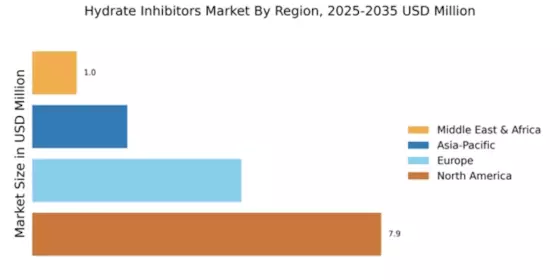
North America is poised to maintain its leadership in the hydrate inhibitors market, holding a significant share of 7.85 in 2024. The region's growth is driven by increasing offshore oil and gas exploration activities, stringent regulations on hydrate formation, and advancements in chemical technologies. The demand for effective hydrate management solutions is further fueled by the rising need for energy security and sustainable practices in the industry. The United States and Canada are the leading countries in this market, with major players like Halliburton Company, Schlumberger Limited, and Baker Hughes Company actively contributing to innovation and market expansion. The competitive landscape is characterized by strategic partnerships and investments in R&D, ensuring a robust supply of advanced hydrate inhibitors to meet the growing demand.

Europe : Emerging Market with Growth Potential

Europe's hydrate inhibitors market is gaining traction, with a market size of 4.71 in 2024. The region's growth is driven by increasing investments in renewable energy and stringent environmental regulations aimed at reducing greenhouse gas emissions. The demand for hydrate inhibitors is expected to rise as European countries focus on enhancing energy efficiency and sustainability in their operations. Leading countries such as the UK, Germany, and Norway are at the forefront of this market, supported by key players like BASF SE and Clariant AG. The competitive landscape is marked by innovation and collaboration among industry stakeholders, ensuring the development of effective solutions tailored to the unique challenges of the region. The European Commission emphasizes the importance of sustainable practices in energy production, stating that "the transition to a low-carbon economy is essential for the future of Europe."

Asia-Pacific : Rapidly Growing Market Segment

The Asia-Pacific region is witnessing significant growth in the hydrate inhibitors market, with a market size of 2.85 in 2024. This growth is driven by increasing offshore drilling activities, rising energy demands, and the need for effective hydrate management solutions. Countries like China and Australia are investing heavily in their oil and gas sectors, leading to a surge in demand for hydrate inhibitors. Regulatory frameworks promoting energy efficiency are also contributing to market expansion. China and Australia are the leading players in this market, with a competitive landscape featuring both local and international companies. Key players such as Ecolab Inc. and Nalco Champion are actively involved in providing innovative solutions to address hydrate formation challenges. The region's focus on technological advancements and sustainable practices is expected to further enhance market growth.

Middle East and Africa : Emerging Frontier for Hydrate Solutions

The Middle East and Africa region is an emerging frontier in the hydrate inhibitors market, with a market size of 0.3 in 2024. The growth in this region is primarily driven by increasing oil and gas exploration activities, coupled with the need for effective hydrate management solutions in challenging environments. The region's vast hydrocarbon reserves present significant opportunities for market expansion, particularly in offshore drilling operations. Countries like Saudi Arabia and South Africa are leading the charge, with key players such as Halliburton Company and Schlumberger Limited establishing a strong presence. The competitive landscape is evolving, with a focus on innovation and collaboration to develop tailored solutions for local challenges. The region's commitment to enhancing energy production efficiency is evident in various government initiatives aimed at promoting sustainable practices.

Key Players and Competitive Insights

The Hydrate Inhibitors Market is currently characterized by a dynamic competitive landscape, driven by the increasing demand for efficient solutions in oil and gas extraction processes. Key players are actively engaging in strategic initiatives to enhance their market positioning. For instance, BASF SE (DE) has been focusing on innovation and sustainability, developing advanced hydrate inhibitors that align with environmental regulations. Similarly, Halliburton Company (US) is emphasizing digital transformation, integrating AI technologies to optimize hydrate management solutions. These strategies collectively contribute to a competitive environment that is increasingly centered around technological advancement and sustainability.

In terms of business tactics, companies are localizing manufacturing and optimizing supply chains to enhance operational efficiency. The market structure appears moderately fragmented, with several key players exerting influence over specific regions. This fragmentation allows for a diverse range of products and services, catering to various customer needs while fostering competition among established and emerging players.

In November 2025, Clariant AG (CH) announced a strategic partnership with a leading oil and gas company to co-develop next-generation hydrate inhibitors. This collaboration is expected to leverage Clariant's expertise in specialty chemicals and the partner's extensive industry experience, potentially leading to innovative solutions that address the challenges of hydrate formation in deepwater drilling. The strategic importance of this partnership lies in its potential to enhance Clariant's product portfolio and market reach.

In October 2025, Baker Hughes Company (US) launched a new line of hydrate inhibitors designed specifically for offshore applications. This product introduction is significant as it addresses the unique challenges faced in offshore environments, where hydrate formation can severely impact production efficiency. By focusing on this niche, Baker Hughes aims to strengthen its competitive edge and cater to the growing demand for specialized solutions in the offshore sector.

In September 2025, Ecolab Inc. (US) expanded its hydrate management services through the acquisition of a technology firm specializing in real-time monitoring solutions. This acquisition is likely to enhance Ecolab's capabilities in providing comprehensive hydrate management solutions, integrating advanced monitoring technologies with chemical treatments. The strategic move underscores Ecolab's commitment to innovation and its focus on delivering value-added services to its clients.

As of December 2025, current competitive trends in the Hydrate Inhibitors Market are increasingly defined by digitalization, sustainability, and the integration of AI technologies. Strategic alliances are playing a crucial role in shaping the landscape, enabling companies to pool resources and expertise for enhanced innovation. Looking ahead, competitive differentiation is expected to evolve, with a notable shift from price-based competition towards a focus on technological innovation, supply chain reliability, and sustainable practices. This evolution suggests that companies that prioritize these aspects will likely gain a competitive advantage in the market.

Key Companies in the Hydrate Inhibitors Market market include

Future Outlook

Hydrate Inhibitors Market Future Outlook

The Hydrate Inhibitors Market is projected to grow at a 13.98% CAGR from 2024 to 2035, driven by increasing offshore oil and gas exploration and technological advancements in inhibitor formulations.

New opportunities lie in:

  • Development of biodegradable hydrate inhibitors for eco-friendly applications.
  • Integration of AI-driven predictive maintenance systems for hydrate management.
  • Expansion into emerging markets with tailored hydrate inhibition solutions.

By 2035, the Hydrate Inhibitors Market is expected to achieve substantial growth, driven by innovation and strategic market expansion.

Market Segmentation

Hydrate Inhibitors Market Type Outlook

  • Thermodynamic Hydrate Inhibitors
  • Kinetic Hydrate Inhibitors
  • Anti-Agglomerants

Hydrate Inhibitors Market End Use Outlook

  • Offshore
  • Onshore
  • Subsea

Hydrate Inhibitors Market Application Outlook

  • Oil and Gas Production
  • Natural Gas Processing
  • Chemical Processing
  • Water Treatment

Hydrate Inhibitors Market Formulation Outlook

  • Liquid
  • Solid
  • Powder

Hydrate Inhibitors Market Distribution Channel Outlook

  • Direct Sales
  • Distributors
  • Online Sales

Report Scope

MARKET SIZE 202415.71(USD Million)
MARKET SIZE 202517.91(USD Million)
MARKET SIZE 203566.26(USD Million)
COMPOUND ANNUAL GROWTH RATE (CAGR)13.98% (2024 - 2035)
REPORT COVERAGERevenue Forecast, Competitive Landscape, Growth Factors, and Trends
BASE YEAR2024
Market Forecast Period2025 - 2035
Historical Data2019 - 2024
Market Forecast UnitsUSD Million
Key Companies ProfiledBASF SE (DE), Clariant AG (CH), Halliburton Company (US), Schlumberger Limited (US), Baker Hughes Company (US), BASF Corporation (US), Ecolab Inc. (US), Nalco Champion (US)
Segments CoveredApplication, Type, End Use, Formulation, Distribution Channel
Key Market OpportunitiesAdvancements in biodegradable hydrate inhibitors present new opportunities in the Hydrate Inhibitors Market.
Key Market DynamicsRising demand for hydrate inhibitors driven by stringent regulations and technological advancements in oil and gas extraction.
Countries CoveredNorth America, Europe, APAC, South America, MEA

Market Highlights

Author
Anshula Mandaokar
Team Lead - Research

Anshula Mandaokar holds an academic degree in Chemical Engineering and has been contributing to the field for more than 5 years. She has expertise in Market Research and Business Consulting and serves as a Team Lead for a reputed Market Research firm under the Chemicals and Materials domain spectrum. She has worked on multiple projects, generating explicit results in a quick turnaround time. Her understanding of data interpretation justifies her role as a leader.

Leave a Comment

FAQs

What growth rate Global Hydrate inhibitors Market would register in the future?

The global hydrate inhibitors market would register a growth of 6.27%.

Which industry will play a crucial role in taking the Hydrate inhibitors market ahead?

Oil & Gas Industry will play a crucial role in taking the Hydrate inhibitors market ahead.

What is the key restraining factor for the global Hydrate inhibitors market?

Environmental issues associated with the use of Anti-agglomerate (AA) LDHI, is the key restraining factor for the global hydrate inhibitors market.

Download Free Sample

Kindly complete the form below to receive a free sample of this Report

Compare Licence

×
Features License Type
Single User Multiuser License Enterprise User
Price $4,950 $5,950 $7,250
Maximum User Access Limit 1 User Upto 10 Users Unrestricted Access Throughout the Organization
Free Customization
Direct Access to Analyst
Deliverable Format
Platform Access
Discount on Next Purchase 10% 15% 15%
Printable Versions