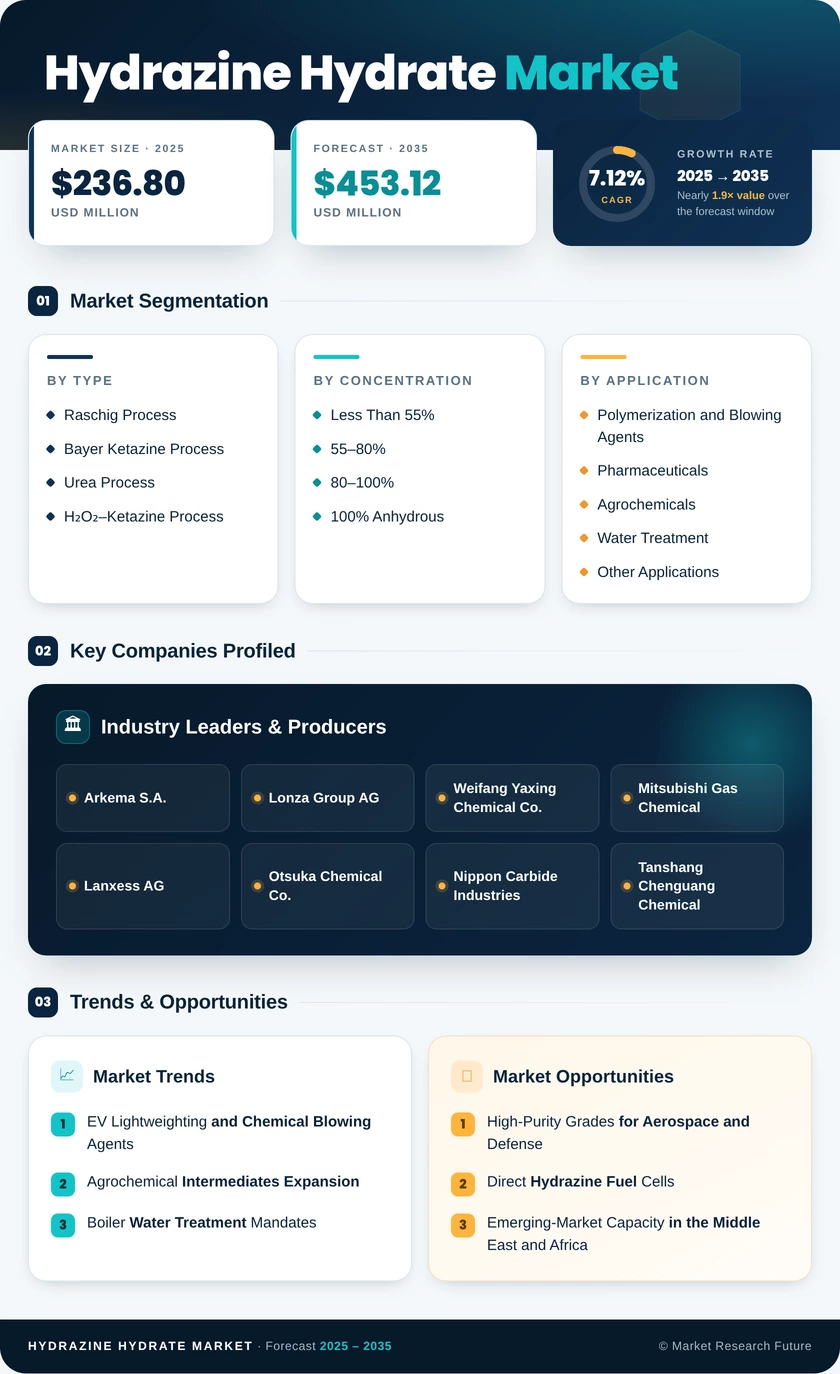
Hydrazine Hydrate Market

ID: MRFR/CnM/5123-HCR
140 Pages
Chitranshi Jaiswal
Last Updated: June 09, 2026
Hydrazine Hydrate Market Research Report Information By Concentration Level (100%, 40-55%, 60-85%, 24-35%), By Application (Polymerization & Blowing Agents, Pharmaceuticals, Water Treatment, Agrochemicals, Others), And By Region (North America, Europe, Asia-Pacific, And Rest Of The World) – Market Forecast Till 2035
Download PDF ×

We do not share your information with anyone. However, we may send you emails based on your report interest from time to time. You may contact us at any time to opt-out.

  1. 1 Market Overview |
    1. 1.1 Study Assumptions & Market Definition |
    2. 1.2 Scope of the Study |
    3. 1.3 Research Methodology
  2. 2 Market Summary & Key Takeaways
  3. 3 Market Dynamics |
    1. 3.1 Market Drivers Analysis | |
      1. 3.1.1 EV Lightweighting and Chemical Blowing Agents Demand | |
      2. 3.1.2 Agrochemical Intermediates Capacity Expansion in Asia | |
      3. 3.1.3 Boiler Water Treatment Regulatory Mandates | |
      4. 3.1.4 Pharmaceutical API Manufacturing Growth | |
      5. 3.1.5 Defense and Aerospace Propellant Procurement | |
      6. 3.1.6 Direct Hydrazine Fuel-Cell Development | |
      7. 3.1.7 Process Innovation in H₂O₂–Ketazine Synthesis |
    2. 3.2 Market Restraints Analysis | |
      1. 3.2.1 REACH and TSCA Toxicity Re-Evaluation | |
      2. 3.2.2 Substitute Oxygen-Scavenging Technologies | |
      3. 3.2.3 Feedstock Price Volatility (Ammonia, H₂O₂) | |
      4. 3.2.4 Carcinogenicity Classification Pressures | |
      5. 3.2.5 Wastewater Discharge Restrictions at Production Sites |
    3. 3.3 Market Opportunity Analysis | |
      1. 3.3.1 High-Purity Grades for Aerospace and Defense | |
      2. 3.3.2 Direct Hydrazine Fuel Cells | |
      3. 3.3.3 Emerging-Market Capacity in the Middle East and Africa | |
      4. 3.3.4 Green-Chemistry Process Licensing | |
      5. 3.3.5 Digital Supply-Chain Monetization |
    4. 3.4 Industry Value Chain Analysis |
    5. 3.5 Porter's Five Forces Analysis
  4. 4 Global Hydrazine Hydrate Market Size & Forecast (2021–2035) |
    1. 4.1 Historical Market Size (2021–2025) |
    2. 4.2 Current & Forecast Market Size (2026–2035) |
    3. 4.3 Market Size by Volume (Kilotons) |
    4. 4.4 Year-over-Year Growth Analysis
  5. 5 Segmentation Analysis |
    1. 5.1 By Production Process | |
      1. 5.1.1 Raschig Process | |
      2. 5.1.2 Bayer Ketazine Process | |
      3. 5.1.3 Urea Process | |
      4. 5.1.4 H₂O₂–Ketazine Process |
    2. 5.2 By Concentration | |
      1. 5.2.1 Less Than 55% | |
      2. 5.2.2 55–80% | |
      3. 5.2.3 80–100% | |
      4. 5.2.4 100% Anhydrous |
    3. 5.3 By Application | |
      1. 5.3.1 Polymerization and Blowing Agents | |
      2. 5.3.2 Pharmaceuticals | |
      3. 5.3.3 Agrochemicals | |
      4. 5.3.4 Water Treatment | |
      5. 5.3.5 Other Applications
  6. 6 Regional Analysis |
    1. 6.1 North America | |
      1. 6.1.1 United States | |
      2. 6.1.2 Canada | |
      3. 6.1.3 Mexico |
    2. 6.2 Europe | |
      1. 6.2.1 Germany | |
      2. 6.2.2 United Kingdom | |
      3. 6.2.3 France | |
      4. 6.2.4 Italy | |
      5. 6.2.5 Spain | |
      6. 6.2.6 Nordic Countries | |
      7. 6.2.7 Russia | |
      8. 6.2.8 Rest of Europe |
    3. 6.3 Asia-Pacific | |
      1. 6.3.1 China | |
      2. 6.3.2 India | |
      3. 6.3.3 Japan | |
      4. 6.3.4 South Korea | |
      5. 6.3.5 ASEAN | |
      6. 6.3.6 Rest of Asia-Pacific |
    4. 6.4 South America | |
      1. 6.4.1 Brazil | |
      2. 6.4.2 Argentina | |
      3. 6.4.3 Rest of South America |
    5. 6.5 Middle East & Africa | |
      1. 6.5.1 Saudi Arabia | |
      2. 6.5.2 UAE | |
      3. 6.5.3 South Africa | |
      4. 6.5.4 Egypt | |
      5. 6.5.5 Rest of MEA
  7. 7 Competitive Landscape |
    1. 7.1 Market Share Analysis (2025) |
    2. 7.2 Competitive Benchmarking Matrix |
    3. 7.3 Company Profiles | |
      1. 7.3.1 Arkema S.A. | |
      2. 7.3.2 Lonza Group AG | |
      3. 7.3.3 Weifang Yaxing Chemical Co. | |
      4. 7.3.4 Mitsubishi Gas Chemical | |
      5. 7.3.5 Lanxess AG | |
      6. 7.3.6 Otsuka Chemical Co. | |
      7. 7.3.7 Nippon Carbide Industries | |
      8. 7.3.8 Tanshang Chenguang Chemical | |
      9. 7.3.9 Arch Chemicals (Lonza subsidiary) | |
      10. 7.3.10 HPL Additives Ltd.
  8. 8 Future Outlook & Strategic Recommendations (2026–2035) |
    1. 8.1 Process Decarbonization and Green Chemistry |
    2. 8.2 Advanced Polymer and Composite Applications |
    3. 8.3 Fuel-Cell Commercialization Trajectory |
    4. 8.4 Supply-Chain Regionalization and Strategic Stockpiling
  9. 9 Recent Developments & News
  10. 10 Frequently Asked Questions (FAQs)
  11. 11 Report Scope & Methodology |
    1. 11.1 Study Period & Base Year |
    2. 11.2 Data Sources & Citations |
    3. 11.3 Abbreviations
  12. 12 LIST OF TABLES |
  13. TABLE 1 Global Hydrazine Hydrate Market Size & Forecast, by Volume (Kilotons), 2021–2035 |
  14. TABLE 2 Global Hydrazine Hydrate Market – Year-over-Year Growth Analysis, 2021–2035 |
  15. TABLE 3 Global Hydrazine Hydrate Market – Driver Impact Analysis |
  16. TABLE 4 Global Hydrazine Hydrate Market – Restraint Impact Analysis |
  17. TABLE 5 Global Hydrazine Hydrate Market Size, by Production Process, 2021–2035 (Kilotons) |
  18. TABLE 6 Global Hydrazine Hydrate Market Size, by Concentration, 2021–2035 (Kilotons) |
  19. TABLE 7 Global Hydrazine Hydrate Market Size, by Application, 2021–2035 (Kilotons) |
  20. TABLE 8 Global Hydrazine Hydrate Market Size, by Region, 2021–2035 (Kilotons) |
  21. TABLE 9 North America Hydrazine Hydrate Market Size, by Country, 2021–2035 (Kilotons) |
  22. TABLE 10 Europe Hydrazine Hydrate Market Size, by Country, 2021–2035 (Kilotons) |
  23. TABLE 11 Asia-Pacific Hydrazine Hydrate Market Size, by Country, 2021–2035 (Kilotons) |
  24. TABLE 12 South America Hydrazine Hydrate Market Size, by Country, 2021–2035 (Kilotons) |
  25. TABLE 13 Middle East & Africa Hydrazine Hydrate Market Size, by Country, 2021–2035 (Kilotons) |
  26. TABLE 14 Competitive Benchmarking Matrix – Global Hydrazine Hydrate Market, 2025 |
  27. TABLE 15 Company Profiles – Key Players, Global Hydrazine Hydrate Market |
  28. TABLE 16 Recent Developments & Strategic Announcements, 2023–2025 |
  29. TABLE 17 North America Hydrazine Hydrate Market Size, by Production Process, 2021–2035 (Kilotons) |
  30. TABLE 18 North America Hydrazine Hydrate Market Size, by Concentration, 2021–2035 (Kilotons) |
  31. TABLE 19 North America Hydrazine Hydrate Market Size, by Application, 2021–2035 (Kilotons) |
  32. TABLE 20 Europe Hydrazine Hydrate Market Size, by Production Process, 2021–2035 (Kilotons) |
  33. TABLE 21 Europe Hydrazine Hydrate Market Size, by Concentration, 2021–2035 (Kilotons) |
  34. TABLE 22 Europe Hydrazine Hydrate Market Size, by Application, 2021–2035 (Kilotons) |
  35. TABLE 23 Asia-Pacific Hydrazine Hydrate Market Size, by Production Process, 2021–2035 (Kilotons) |
  36. TABLE 24 Asia-Pacific Hydrazine Hydrate Market Size, by Concentration, 2021–2035 (Kilotons) |
  37. TABLE 25 Asia-Pacific Hydrazine Hydrate Market Size, by Application, 2021–2035 (Kilotons) |
  38. TABLE 26 South America Hydrazine Hydrate Market Size, by Production Process, 2021–2035 (Kilotons) |
  39. TABLE 27 South America Hydrazine Hydrate Market Size, by Concentration, 2021–2035 (Kilotons) |
  40. TABLE 28 South America Hydrazine Hydrate Market Size, by Application, 2021–2035 (Kilotons) |
  41. TABLE 29 Middle East & Africa Hydrazine Hydrate Market Size, by Production Process, 2021–2035 (Kilotons) |
  42. TABLE 30 Middle East & Africa Hydrazine Hydrate Market Size, by Concentration, 2021–2035 (Kilotons) |
  43. TABLE 31 Middle East & Africa Hydrazine Hydrate Market Size, by Application, 2021–2035 (Kilotons) |
  44. TABLE 32 Report Scope & Methodology Summary |
  45. TABLE 33 Detailed Sources and Citations
  46. 13 LIST OF FIGURES |
  47. FIGURE 1 Global Hydrazine Hydrate Market Dynamics — Drivers, Restraints & Opportunities |
  48. FIGURE 2 Industry Value Chain Analysis — Hydrazine Hydrate Market |
  49. FIGURE 3 Porter's Five Forces Analysis — Hydrazine Hydrate Market |
  50. FIGURE 4 Global Hydrazine Hydrate Market Size Trend (Kilotons), 2021–2035 |
  51. FIGURE 5 Global Hydrazine Hydrate Market Share, by Production Process (2025) |
  52. FIGURE 6 Global Hydrazine Hydrate Market Share, by Concentration (2025) |
  53. FIGURE 7 Global Hydrazine Hydrate Market Share, by Application (2025) |
  54. FIGURE 8 Global Hydrazine Hydrate Market Share, by Region (2025) |
  55. FIGURE 9 North America Hydrazine Hydrate Market Size Trend (Kilotons), 2021–2035 |
  56. FIGURE 10 Europe Hydrazine Hydrate Market Size Trend (Kilotons), 2021–2035 |
  57. FIGURE 11 Asia-Pacific Hydrazine Hydrate Market Size Trend (Kilotons), 2021–2035 |
  58. FIGURE 12 South America Hydrazine Hydrate Market Size Trend (Kilotons), 2021–2035 |
  59. FIGURE 13 Middle East & Africa Hydrazine Hydrate Market Size Trend (Kilotons), 2021–2035 |
  60. FIGURE 14 Competitive Landscape — Market Share Distribution, 2025 |
  61. FIGURE 15 Competitive Positioning Matrix — Key Players, 2025

Segmentation Quick Reference

DimensionSub-SegmentsDominant SegmentFastest Growing Segment
Production ProcessRaschig Process, Bayer Ketazine Process, Urea Process, H₂O₂–Ketazine ProcessBayer Ketazine Process (47.90% share, 2025)H₂O₂–Ketazine Process (7.85% CAGR)
ConcentrationLess Than 55%, 55–80%, 80–100%, 100% Anhydrous80–100% (55.20% share, 2025)100% Anhydrous (7.92% CAGR)
ApplicationPolymerization and Blowing Agents, Pharmaceuticals, Agrochemicals, Water Treatment, Other ApplicationsPolymerization and Blowing Agents (44.80% share, 2025)Other Applications (8.25% CAGR)
GeographyAsia-Pacific, North America, Europe, South America, the Middle East & AfricaAsia-Pacific (56.10% share, 2025)Asia-Pacific (7.72% CAGR)


Market Segmentation Overview

By Production Process

Sub-SegmentKey Trend
Raschig ProcessDeclining share as chlorinated-waste regulations tighten globally
Bayer Ketazine ProcessStable workhorse technology with the largest installed base
Urea ProcessNiche adoption for small-scale fine chemical synthesis applications
H₂O₂–Ketazine ProcessFastest-growing route driven by green-chemistry mandates and lower energy intensity


The production-process landscape is undergoing a generational transition. While the Bayer Ketazine Process retains its dominant installed base, every major capacity announcement since 2023 has specified the H₂O₂–Ketazine route, reflecting tightening environmental regulations and buyer preference for chloride-free product.

By Concentration

Sub-SegmentKey Trend
Less Than 55%Primarily consumed in water treatment and dilute industrial applications
55–80%Growing demand from agrochemical and polymer intermediate producers
80–100%Commercial workhorse grade serving pharmaceutical and blowing-agent sectors
100% AnhydrousPremium-priced segment driven by aerospace, defense, and fuel-cell applications


Concentration segmentation reflects end-use purity requirements. The 80–100% grade dominates volume, but the 100% Anhydrous category commands the highest margins and the fastest growth trajectory as defense and aerospace applications expand.

By Application

Sub-SegmentKey Trend
Polymerization and Blowing AgentsDriven by EV lightweighting and construction insulation foam demand
PharmaceuticalsIsoniazid and pyrazole-class API production sustains steady procurement.
AgrochemicalsHerbicide and fungicide synthesis drives bulk-volume consumption in Asia.
Water TreatmentBoiler oxygen scavengers remain essential in high-pressure thermal power systems.
Other ApplicationsRocket propellants and fuel-cell R&D create high-margin, fast-growing niches.


Application diversity is a defining characteristic of the hydrazine hydrate value chain. Polymerization and blowing agents anchor volume, while the "Other Applications" category—spanning defense propellants and emerging energy systems—offers the strongest growth and margin profile through 2035.

By Geography

Sub-SegmentKey Trend
Asia-PacificProduction and consumption hub led by China and India
EuropeHigh-value specialty demand in aerospace and power generation
North AmericaDefense-driven procurement and stringent water treatment standards
South AmericaAgricultural-sector growth supports the demand for agrochemical intermediates.
Middle East & AfricaImport substitution and new capacity development under Vision 2030


Asia-Pacific's dominance reflects both supply-side concentration (China's production clusters) and demand-side pull from the world's largest agrochemical and pharmaceutical manufacturing bases. Europe and North America are characterized by higher unit values driven by specialty and defense-grade applications.