×
Request Free Sample ×

Kindly complete the form below to receive a free sample of this Report

* Please use a valid business email

Leading companies partner with us for data-driven Insights

clients tt-cursor
Hero Background

Hydrogen Ic Engine Market

ID: MRFR/EnP/30164-HCR
128 Pages
Priya Nagrale
October 2025

Hydrogen IC Engine Market Research Report By Engine Type (Hydrogen Internal Combustion Engines, Hydrogen Fuel Cell Engines, Hybrid Hydrogen Engines), By Vehicle Category (Passenger Vehicles, Commercial Vehicles, Heavy-Duty Vehicles), By Application (Automotive, Marine, Aerospace), By Fuel Storage Technology (Compressed Hydrogen Storage, Liquid Hydrogen Storage, Metal Hydride Storage), By Regulatory Compliance (EU Emission Standards, US Environmental Protection Agency (EPA) Regulations, Global Harmonized Light Vehicle Test Procedure (WLTP)) a... read more

Share:
Download PDF ×

We do not share your information with anyone. However, we may send you emails based on your report interest from time to time. You may contact us at any time to opt-out.

Hydrogen Ic Engine Market Infographic
Purchase Options

Hydrogen Ic Engine Market Summary

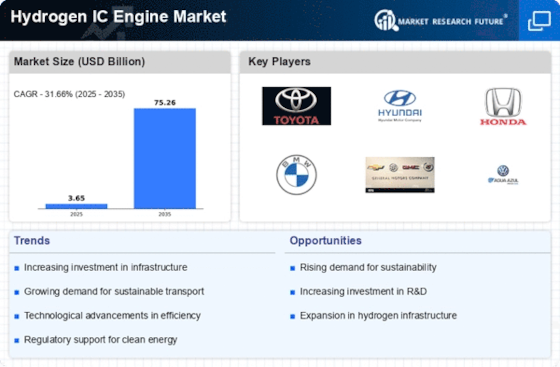
As per MRFR analysis, the Hydrogen IC Engine Market Size was estimated at 3.652 USD Billion in 2024. The Hydrogen IC Engine industry is projected to grow from 4.808 USD Billion in 2025 to 75.26 USD Billion by 2035, exhibiting a compound annual growth rate (CAGR) of 31.66 during the forecast period 2025 - 2035.

Key Market Trends & Highlights

The Hydrogen IC Engine Market is poised for substantial growth driven by technological advancements and regulatory support.

  • North America remains the largest market for hydrogen internal combustion engines, reflecting a strong demand for cleaner transportation solutions.
  • Asia-Pacific is emerging as the fastest-growing region, with increasing investments in hydrogen infrastructure and technology.
  • Hydrogen internal combustion engines dominate the market, while hydrogen fuel cell engines are rapidly gaining traction in the passenger vehicle segment.
  • Key market drivers include environmental sustainability and technological innovations, which are fostering a favorable regulatory framework.

Market Size & Forecast

2024 Market Size 3.652 (USD Billion)
2035 Market Size 75.26 (USD Billion)
CAGR (2025 - 2035) 31.66%

Major Players

Toyota Motor Corporation (JP), Hyundai Motor Company (KR), Honda Motor Co., Ltd. (JP), BMW AG (DE), General Motors Company (US), Volkswagen AG (DE), Daimler AG (DE), Ford Motor Company (US), Mazda Motor Corporation (JP)

Hydrogen Ic Engine Market Trends

The Hydrogen IC Engine Market is currently experiencing a transformative phase, driven by the increasing emphasis on sustainable energy solutions and the urgent need to reduce greenhouse gas emissions. This market appears to be gaining traction as various stakeholders, including automotive manufacturers and energy providers, explore hydrogen as a viable alternative to traditional fossil fuels. The potential for hydrogen to serve as a clean energy source is becoming more apparent, with advancements in technology and infrastructure supporting its adoption. Furthermore, the growing awareness of climate change and the push for regulatory frameworks that favor low-emission vehicles are likely to bolster the market's growth in the coming years. In addition, the Hydrogen IC Engine Market seems to be influenced by ongoing research and development efforts aimed at enhancing engine efficiency and performance. Collaborations between public and private sectors are fostering innovation, which may lead to breakthroughs in hydrogen production, storage, and utilization. As the global community increasingly prioritizes energy security and environmental sustainability, the Hydrogen IC Engine Market is poised to play a crucial role in the transition towards a cleaner transportation ecosystem. The interplay of technological advancements, regulatory support, and market demand suggests a promising future for hydrogen-powered internal combustion engines, potentially reshaping the automotive landscape.

Technological Advancements

Recent innovations in hydrogen fuel technology are enhancing the efficiency and performance of internal combustion engines. These advancements may lead to improved engine designs that optimize hydrogen combustion, thereby increasing power output and reducing emissions.

Regulatory Support

Governments worldwide are implementing policies that promote the use of hydrogen as a clean energy source. This regulatory support could create a favorable environment for the Hydrogen IC Engine Market, encouraging manufacturers to invest in hydrogen technologies.

Growing Infrastructure

The expansion of hydrogen refueling infrastructure is crucial for the market's growth. As more refueling stations become available, consumer confidence in hydrogen vehicles is likely to increase, facilitating wider adoption of hydrogen-powered engines.

Hydrogen Ic Engine Market Drivers

Regulatory Frameworks

The Hydrogen IC Engine Market is significantly influenced by supportive regulatory frameworks. Governments worldwide are implementing policies that promote the adoption of hydrogen technologies. Incentives such as tax breaks, subsidies, and grants for research and development are becoming commonplace. For example, the European Union has set ambitious targets for hydrogen adoption, aiming for 10 million tons of renewable hydrogen production by 2030. Such regulatory support not only encourages manufacturers to invest in hydrogen engine technologies but also fosters consumer acceptance. As regulations become more favorable, the Hydrogen IC Engine Market is poised for substantial growth, with projections indicating a compound annual growth rate of over 20% in the coming years.

Technological Innovations

Technological advancements play a pivotal role in the Hydrogen IC Engine Market. Innovations in hydrogen production, storage, and fuel cell technology are enhancing the efficiency and performance of hydrogen engines. For instance, improvements in electrolysis methods are making hydrogen production more cost-effective and sustainable. Additionally, advancements in materials science are leading to lighter and more durable engine components, which can significantly improve vehicle performance. According to recent studies, the efficiency of hydrogen engines is expected to increase by 30% over the next decade, making them more competitive with traditional internal combustion engines. This technological evolution is likely to attract investments and stimulate growth within the Hydrogen IC Engine Market.

Infrastructure Development

Infrastructure development is a crucial driver for the Hydrogen IC Engine Market. The establishment of hydrogen refueling stations and production facilities is essential for the widespread adoption of hydrogen vehicles. Recent initiatives have seen an increase in the number of hydrogen refueling stations, with estimates suggesting that the number could reach 10,000 by 2030. This expansion is vital for alleviating range anxiety among consumers and promoting the use of hydrogen-powered vehicles. Moreover, partnerships between governments and private sectors are facilitating the construction of necessary infrastructure. As the network of hydrogen refueling stations grows, the Hydrogen IC Engine Market is likely to experience accelerated growth, as consumers gain confidence in the availability of hydrogen fuel.

Environmental Sustainability

The Hydrogen IC Engine Market is increasingly driven by the global emphasis on environmental sustainability. As nations strive to reduce greenhouse gas emissions, hydrogen engines present a viable alternative to traditional fossil fuel engines. The combustion of hydrogen produces only water vapor, thus eliminating harmful emissions. This aligns with international climate agreements and national policies aimed at achieving net-zero emissions by 2050. Furthermore, the hydrogen economy is gaining traction, with projections indicating that the hydrogen market could reach USD 2.5 trillion by 2050. This shift towards cleaner technologies is likely to bolster the Hydrogen IC Engine Market, as manufacturers seek to innovate and meet the rising demand for eco-friendly transportation solutions.

Consumer Awareness and Demand

Consumer awareness and demand are emerging as significant drivers in the Hydrogen IC Engine Market. As environmental concerns become more pronounced, consumers are increasingly seeking sustainable transportation options. Surveys indicate that a substantial percentage of consumers are willing to consider hydrogen vehicles, provided that they are competitively priced and readily available. This shift in consumer preferences is prompting manufacturers to invest in hydrogen engine technologies and marketing strategies that highlight the benefits of hydrogen as a clean fuel. Additionally, educational campaigns aimed at informing the public about the advantages of hydrogen vehicles are gaining traction. As awareness grows, the demand for hydrogen-powered vehicles is expected to rise, further propelling the Hydrogen IC Engine Market.


Market Segment Insights

By Engine Type: Hydrogen Internal Combustion Engines (Largest) vs. Hydrogen Fuel Cell Engines (Fastest-Growing)

The Hydrogen IC Engine Market's engine type segment reveals a competitive landscape, with Hydrogen Internal Combustion Engines (H2 ICEs) currently holding the largest market share. These engines leverage existing infrastructure and technology, making them a preferred option for several applications, especially in transportation. Hydrogen Fuel Cell Engines, though smaller in market share, are gaining traction rapidly due to advancements in fuel cell technology and increasing investments in renewable energy sources, marking a notable shift in preferences among manufacturers and consumers alike. In terms of growth trends, Hydrogen Fuel Cell Engines are anticipated to be the fastest-growing segment driven by robust government incentives, increasing awareness of environmental issues, and a decline in costs associated with fuel cell production. The transition towards greener technologies and the urgent need for sustainable mobility is pushing both segments to innovate and adapt, but fuel cell technology is likely to witness exponential growth as global markets prioritize zero-emission solutions.

Hydrogen Internal Combustion Engines (Dominant) vs. Hydrogen Fuel Cell Engines (Emerging)

Hydrogen Internal Combustion Engines represent a dominant force in the Hydrogen IC Engine Market, primarily due to their compatibility with traditional combustion infrastructure and the familiarity of existing technologies to manufacturers. They benefit from a broader array of applications and have established a durable presence in commercial vehicles and industrial segments. In contrast, Hydrogen Fuel Cell Engines signify an emerging technology poised for disruptive growth. While still in the developmental stages for many applications, they are preferred for their high efficiency and low emissions. As environmental regulations tighten and companies strategize towards achieving sustainability goals, fuel cell technology is increasingly viewed as a viable alternative, prompting continued investment and research efforts to enhance performance and scalability.

By Vehicle Category: Passenger Vehicles (Largest) vs. Commercial Vehicles (Fastest-Growing)

The Hydrogen Internal Combustion Engine (IC) market is witnessing a diverse distribution across different vehicle categories. Passenger vehicles hold the largest market share, driven by rising consumer interest in sustainable mobility solutions. The segment is characterized by an increasing range of hydrogen-powered options, appealing to eco-conscious buyers. Conversely, commercial vehicles are emerging as the fastest-growing segment, benefiting from investments in hydrogen infrastructure and regulatory support for cleaner freight solutions.

Passenger Vehicles (Dominant) vs. Commercial Vehicles (Emerging)

Passenger vehicles dominate the hydrogen IC engine landscape, largely due to the growing consumer preference for eco-friendly transportation solutions. Automakers are increasingly focusing on this segment, introducing innovative hydrogen models that blend performance with sustainability. On the other hand, commercial vehicles are proving to be an emerging force in the market. These vehicles are gaining traction thanks to their potential for reducing emissions in high-mileage operations. The shift towards hydrogen technology in logistics and transportation is propelled by government incentives and the need to meet stringent environmental regulations.

By Application: Automotive (Largest) vs. Marine (Fastest-Growing)

In the Hydrogen IC Engine Market, the Automotive segment holds the largest share due to the increasing demand for environmentally friendly transportation solutions. This sector is witnessing significant investments and innovations aimed at integrating hydrogen fuel into vehicles, making it the leading application for hydrogen engines. Conversely, the Marine application is rapidly gaining traction, characterized by a growing focus on reducing emissions in shipping, which has historically relied on heavier fossil fuels. As governments implement stringent regulations regarding marine emissions, the adoption of hydrogen as a cleaner alternative is accelerating.

Automotive: Dominant vs. Marine: Emerging

The Automotive segment is dominant in the Hydrogen IC Engine Market, driven by consumer demand for sustainable transportation options. Automakers are increasingly investing in hydrogen vehicles, which offer longer ranges and quick refueling compared to battery-electric counterparts. Furthermore, the sector benefits from substantial research and development efforts aimed at enhancing engine efficiency and overall performance. On the other hand, the Marine segment is emerging rapidly, focusing on innovations in hydrogen propulsion systems for ships. This segment is spurred by international regulatory pressures to reduce maritime emissions, making hydrogen a viable solution for cleaner shipping solutions. As technologies evolve, the Marine market is expected to see significant advancements and adoption.

By Fuel Storage Technology: Compressed Hydrogen Storage (Largest) vs. Liquid Hydrogen Storage (Fastest-Growing)

The Hydrogen IC Engine Market exhibits a diversified fuel storage technology landscape, prominently featuring compressed hydrogen storage, which holds the largest share in the market. This technology is favored due to its proven efficiency, ease of use, and rapid refueling capabilities. On the other hand, liquid hydrogen storage is rapidly gaining traction, emerging as a significant player in the market, primarily due to its energy density and compatibility with a broader range of applications in the automotive sector. Together, these storage methods contribute to a competitive segment that drives innovation and investment. Looking at growth trends, the market for hydrogen storage technologies is predicted to expand significantly. Compressed hydrogen storage technology remains a mature solution, benefiting from ongoing enhancements in tank technology and safety protocols. In contrast, liquid hydrogen storage is leveraging advancements in cryogenic technology, making it an attractive option for applications demanding high energy density. The increasing emphasis on green hydrogen and sustainable transportation solutions further accelerates the growth of both segment values, presenting opportunities for new entrants and innovations within the Hydrogen IC Engine Market.
Compressed Hydrogen Storage (Dominant) vs. Liquid Hydrogen Storage (Emerging)

Compressed hydrogen storage is established as the dominant technology in the Hydrogen IC Engine Market, characterized by its simplicity and reliability. This method utilizes high-pressure tanks that allow for efficient storage and dispensing of hydrogen, making it suitable for various applications, including light-duty and heavy-duty vehicles. Its widespread adoption is driven by the growing infrastructure for refueling stations and continuous enhancement in safety measures. On the other hand, liquid hydrogen storage is emerging as a noteworthy alternative due to its superior energy density, enabling the storage of larger quantities of hydrogen in a compact form. This technology is particularly appealing for long-range applications and heavy-duty transport, although it requires stringent cryogenic conditions for storage. The competition between these two technologies signifies a dynamic shift towards optimizing storage solutions for hydrogen, aligning with the market's broader goals for sustainability and efficiency.

By Regulatory Compliance: EU Emission Standards (Largest) vs. US EPA Regulations (Fastest-Growing)

The regulatory landscape for Hydrogen IC Engines is largely shaped by EU emission standards, which currently hold the largest share due to stringent environmental policies in Europe. In contrast, the US EPA regulations, while historically more lenient, are now witnessing rapid adoption and updates, positioning them as the fastest-growing segment in the regulatory compliance category. The global push for cleaner emissions aligns with these standards, raising their importance in the market.

EU Emission Standards (Dominant) vs. US EPA Regulations (Emerging)

EU Emission Standards play a dominant role in shaping the regulatory framework for Hydrogen IC Engines, primarily due to their stringent requirements aimed at reducing overall carbon emissions. These standards incentivize manufacturers to invest in greener technologies, driving innovation and adoption in the market. Conversely, US EPA Regulations are emerging rapidly, adapting to the international trends toward sustainability. This evolution reflects a broader commitment within the United States to enhance environmental protections and combat climate change, thus influencing manufacturers to comply more closely with these standards. As both segments evolve, the interplay between European and American regulations will significantly impact the future development of Hydrogen IC Engines.

Get more detailed insights about Hydrogen Ic Engine Market

Regional Insights

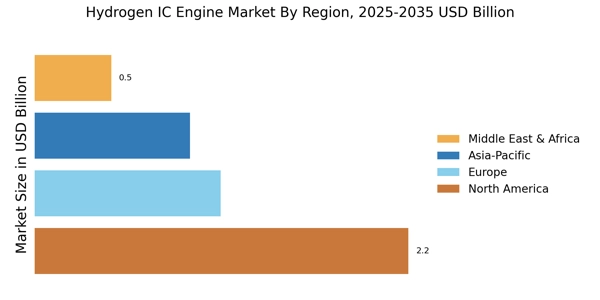
The Hydrogen IC Engine Market is witnessing substantial growth across various regions, driven by increasing environmental regulations and advancements in hydrogen technology. In 2023, North America held a significant portion of the market, valued at 0.8 USD Billion, showing a strong potential for expansion, particularly due to governmental support and investment in clean energy. Europe follows closely, with a valuation of 0.7 USD Billion, as it pursues aggressive climate goals and enhances hydrogen infrastructure. Asia-Pacific is emerging as a substantial player with a valuation of 0.4 USD Billion in 2023, bolstered by rapid industrialization and growing energy demands.

Meanwhile, the Middle East and Africa remain in the early stages, valued at 0.1 USD Billion, focusing on development projects and strategic partnerships to enhance their market presence. South America, valued at 0.2 USD Billion in 2023, is gradually adopting hydrogen technologies, supported by various initiatives aimed at sustainability. The trends reflect a major shift towards low-emission transportation solutions, with North America and Europe dominating in market growth and investment potential, while the emerging players in Asia-Pacific and South America highlight opportunities for future growth within the Hydrogen IC Engine Market segmentation.

Hydrogen Ic Engine Market Regional Image

Key Players and Competitive Insights

The Hydrogen IC Engine Market is rapidly evolving, characterized by increasing investments in research and development, driven by the urgent need for sustainable energy solutions. The shift towards hydrogen as a clean fuel alternative is reshaping the automotive landscape, with a myriad of companies vying for a competitive edge. The market is fragmented, with various players focusing on innovative technologies, strategic collaborations, and expanded production capabilities. As stakeholders recognize the potential of hydrogen fuel for reducing carbon emissions and improving energy efficiency, competition is intensifying.

Emerging technologies focused on hydrogen production, storage, and utilization are becoming key differentiators, positioning companies uniquely within the market.

BMW AG has established a notable presence in the Hydrogen IC Engine Market by leveraging its robust engineering expertise and significant investment in hydrogen fuel technology. The company boasts a strong commitment to sustainability and innovation, positioning itself as a pioneer in developing hydrogen-powered internal combustion engines. With a focus on performance and efficiency, BMW AG is integrating hydrogen fuel solutions into its broader sustainability strategy, allowing it to cater to the growing demand for eco-friendly mobility solutions.

Honda Motor Co Ltd is actively participating in the Hydrogen IC Engine Market by focusing on advanced research and development initiatives aimed at harnessing hydrogen as a viable fuel source. The company's commitment to sustainable mobility aligns with the growing global emphasis on reducing greenhouse gas emissions and promoting greener technologies. Honda Motor Co Ltd has made strides in creating innovative hydrogen fuel systems, showcasing a balanced combination of performance, reliability, and environmental responsibility

Through these initiatives, Honda seeks to create a strong foothold in the burgeoning hydrogen market, highlighting its dedication to the evolution of clean energy solutions.

Key Companies in the Hydrogen Ic Engine Market market include

Industry Developments

  • Q2 2025: PHINIA and KGM forge strategic partnership for hydrogen-powered LCV development PHINIA Inc. and KG Mobility (KGM) announced a strategic partnership to design, develop, and supply a 2.2-litre hydrogen internal combustion engine (H2ICE) for light commercial vehicles, integrating PHINIA’s hydrogen-specific fuel injection technology with KGM’s diesel engine expertise to offer a zero-carbon alternative to diesel engines.
  • Q1 2025: Landmark start to 2025 as JCB's Hydrogen engine approved for use JCB secured approvals from 11 European licensing authorities to commercially use its hydrogen combustion engine in construction machinery, marking the first such approval for a hydrogen-fueled engine in the sector, with further certifications expected in 2025.
  • Q1 2025: Hydrogen Combustion Engines: A Bridge to Sustainable Energy in 2025 In January 2024, Bosch announced plans to launch a hydrogen combustion engine specifically designed for trucks and construction vehicles, targeting commercial deployment as part of its clean energy initiatives.
  • Q1 2025: UCR and U of Michigan launch hydrogen-engine alliance The University of California, Riverside and the University of Michigan, along with industry partners, launched the Hydrogen Engine Alliance of North America (H2EA-NA) to promote hydrogen as a viable alternative fuel for internal combustion engines, aiming to accelerate adoption and support the transition to zero-emission technologies.

This growing interest is reflected in an optimistic market outlook, with substantial anticipated growth from 2024 to 2032, aligned with expanding initiatives for climate change mitigation and energy transition strategies. As technological advancements continue, the hydrogen ICE market is poised for transformation, attracting investment and fostering global partnerships that will shape the future of mobility.

Future Outlook

Hydrogen Ic Engine Market Future Outlook

The Hydrogen IC Engine Market is projected to grow at a 31.66% CAGR from 2024 to 2035, driven by technological advancements, regulatory support, and increasing demand for sustainable transportation solutions.

New opportunities lie in:

  • Development of hydrogen refueling infrastructure in urban areas.
  • Partnerships with automotive manufacturers for hydrogen engine integration.
  • Investment in R&D for high-efficiency hydrogen combustion technologies.

By 2035, the Hydrogen IC Engine Market is expected to be a pivotal segment in the global automotive industry.

Market Segmentation

Hydrogen Ic Engine Market Application Outlook

  • Automotive
  • Marine
  • Aerospace

Hydrogen Ic Engine Market Engine Type Outlook

  • Hydrogen Internal Combustion Engines
  • Hydrogen Fuel Cell Engines
  • Hybrid Hydrogen Engines

Hydrogen Ic Engine Market Vehicle Category Outlook

  • Passenger Vehicles
  • Commercial Vehicles
  • Heavy-Duty Vehicles

Hydrogen Ic Engine Market Regulatory Compliance Outlook

  • EU Emission Standards
  • US Environmental Protection Agency (EPA) Regulations
  • Global Harmonized Light Vehicle Test Procedure (WLTP)

Hydrogen Ic Engine Market Fuel Storage Technology Outlook

  • Compressed Hydrogen Storage
  • Liquid Hydrogen Storage
  • Metal Hydride Storage

Report Scope

MARKET SIZE 20243.652(USD Billion)
MARKET SIZE 20254.808(USD Billion)
MARKET SIZE 203575.26(USD Billion)
COMPOUND ANNUAL GROWTH RATE (CAGR)31.66% (2024 - 2035)
REPORT COVERAGERevenue Forecast, Competitive Landscape, Growth Factors, and Trends
BASE YEAR2024
Market Forecast Period2025 - 2035
Historical Data2019 - 2024
Market Forecast UnitsUSD Billion
Key Companies ProfiledMarket analysis in progress
Segments CoveredMarket segmentation analysis in progress
Key Market OpportunitiesGrowing demand for sustainable transportation fuels drives innovation in the Hydrogen IC Engine Market.
Key Market DynamicsRising regulatory support and technological advancements drive the adoption of hydrogen internal combustion engines in transportation.
Countries CoveredNorth America, Europe, APAC, South America, MEA

Leave a Comment

FAQs

What is the projected market valuation of the Hydrogen IC Engine Market by 2035?

The Hydrogen IC Engine Market is projected to reach a valuation of 75.26 USD Billion by 2035.

What was the market valuation of the Hydrogen IC Engine Market in 2024?

In 2024, the overall market valuation was 3.652 USD Billion.

What is the expected CAGR for the Hydrogen IC Engine Market during the forecast period 2025 - 2035?

The expected CAGR for the Hydrogen IC Engine Market during the forecast period 2025 - 2035 is 31.66%.

Which companies are considered key players in the Hydrogen IC Engine Market?

Key players in the Hydrogen IC Engine Market include Toyota Motor Corporation, Hyundai Motor Company, Honda Motor Co., Ltd., and others.

What are the main segments of the Hydrogen IC Engine Market?

The main segments of the Hydrogen IC Engine Market include Engine Type, Vehicle Category, Application, Fuel Storage Technology, and Regulatory Compliance.

How much is the Hydrogen Internal Combustion Engine segment valued at in 2025?

The Hydrogen Internal Combustion Engine segment is valued at 30.0 USD Billion in 2025.

What is the projected valuation for the Commercial Vehicles segment by 2035?

The projected valuation for the Commercial Vehicles segment is 20.0 USD Billion by 2035.

What is the valuation of the Hydrogen Fuel Cell Engines segment in 2024?

In 2024, the Hydrogen Fuel Cell Engines segment was valued at 1.8 USD Billion.

What is the expected valuation for Liquid Hydrogen Storage by 2035?

The expected valuation for Liquid Hydrogen Storage is 20.0 USD Billion by 2035.

What regulatory standards impact the Hydrogen IC Engine Market?

Regulatory standards impacting the market include EU Emission Standards and US Environmental Protection Agency (EPA) Regulations.

Download Free Sample

Kindly complete the form below to receive a free sample of this Report

Compare Licence

×
Features License Type
Single User Multiuser License Enterprise User
Price $4,950 $5,950 $7,250
Maximum User Access Limit 1 User Upto 10 Users Unrestricted Access Throughout the Organization
Free Customization
Direct Access to Analyst
Deliverable Format
Platform Access
Discount on Next Purchase 10% 15% 15%
Printable Versions