×
Request Free Sample ×

Kindly complete the form below to receive a free sample of this Report

* Please use a valid business email

Leading companies partner with us for data-driven Insights

clients tt-cursor
Hero Background

India Carbon Black Market

ID: MRFR/CnM/20172-HCR
128 Pages
Priya Nagrale
October 2025

India Carbon Black Market Research Report Information by Type (Furnace Black, Acetylene Black, Channel Black, and Others), by Application (Rubber Black (Tire Treads (Inner Liner and Tubes, Conveyor Belts, Hoses, Others) and Specialty Black (Plastics, Ink and Toners, Paint and Coatings, Wires and Cables, Others)) – India Market Forecast Till 2035

Share:
Download PDF ×

We do not share your information with anyone. However, we may send you emails based on your report interest from time to time. You may contact us at any time to opt-out.

India Carbon Black Market Infographic
Purchase Options

India Carbon Black Market Summary

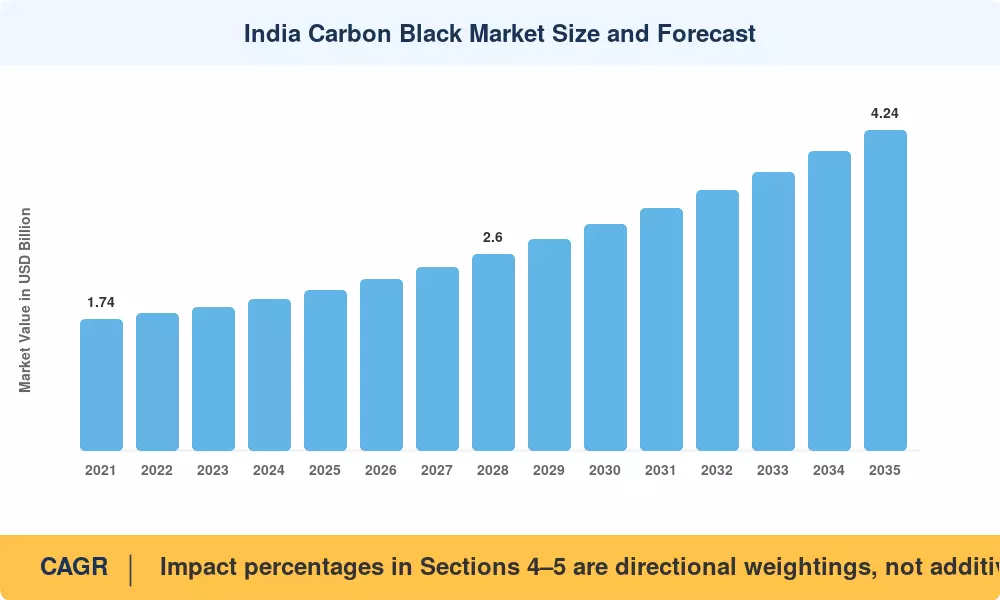
As per analysis, the India carbon black market is projected to grow from USD 1.26 Billion in 2025 to USD 1.96 Billion by 2035, exhibiting a compound annual growth rate (CAGR) of 4.5% during the forecast period (2025 - 2035).

Key Market Trends & Highlights

The India carbon black market is poised for growth driven by sustainable practices and rising demand across key sectors.

  • The automotive sector remains the largest consumer of carbon black, primarily due to its extensive use in tire manufacturing.
  • The tire segment is the largest market for carbon black, while the plastics segment is experiencing the fastest growth.
  • Technological advancements in manufacturing processes are enhancing production efficiency and sustainability in the carbon black industry.
  • Key market drivers include the growing demand for tires and infrastructure development initiatives that support increased carbon black consumption.

Market Size & Forecast

2024 Market Size 1.21 (USD Billion)
2035 Market Size 1.96 (USD Billion)
CAGR (2025 - 2035) 4.5%

Major Players

Continental Carbon India Limited (IN), Aditya Birla Carbon (IN), Orion Engineered Carbons S.A. (IN), Cabot Carbon Limited (IN), Phillips Carbon Black Limited (IN), Tianjin Black Cat Carbon Black Co., Ltd. (IN), Saarthi Carbon (IN), Maharashtra Rubber Products (IN)

India Carbon Black Market Trends

The India carbon black market is currently experiencing a dynamic phase characterized by evolving demand and production capabilities. The market is primarily driven by the automotive and tire industries, which are significant consumers of carbon black due to its essential role in enhancing the durability and performance of rubber products. Additionally, the increasing focus on sustainable practices and the adoption of eco-friendly materials are influencing manufacturers to innovate and adapt their processes. This shift towards sustainability may lead to the development of bio-based carbon black alternatives, which could reshape the competitive landscape in the coming years. Moreover, the regulatory environment in India is becoming increasingly stringent, with the government emphasizing environmental compliance and pollution control. This regulatory pressure may compel manufacturers to invest in cleaner technologies and more efficient production methods. As a result, the India carbon black market appears poised for growth, driven by both domestic demand and the need for compliance with environmental standards. The interplay between traditional manufacturing practices and emerging sustainable technologies will likely define the future trajectory of this market.

Sustainable Production Practices

The India carbon black market is witnessing a notable shift towards sustainable production methods. Manufacturers are increasingly adopting eco-friendly technologies to reduce emissions and waste. This trend is driven by regulatory pressures and consumer demand for greener products, prompting companies to explore alternative raw materials and processes.

Rising Demand from Automotive Sector

The automotive industry remains a primary driver of growth in the India carbon black market. As vehicle production increases, the need for high-performance tires and rubber components continues to rise. This demand is likely to stimulate innovation in carbon black formulations, enhancing product performance and longevity.

Technological Advancements in Manufacturing

Technological advancements are playing a crucial role in shaping the India carbon black market. Innovations in production techniques are enabling manufacturers to improve efficiency and reduce costs. These advancements may also facilitate the development of specialized carbon black grades tailored to specific applications, further expanding market opportunities.

India Carbon Black Market Drivers

Expansion of the Plastics Industry

The India Carbon Black Market is significantly influenced by the expansion of the plastics sector. Carbon black is widely used as a reinforcing agent in various plastic products, enhancing their strength and durability. With the plastics industry projected to grow at a compound annual growth rate of approximately 8% over the next few years, the demand for carbon black is expected to follow suit. This growth is driven by increasing applications in packaging, consumer goods, and construction materials. As manufacturers seek to improve the performance characteristics of their plastic products, the reliance on carbon black is likely to intensify, thereby bolstering the India Carbon Black Market.

Increasing Environmental Regulations

The India Carbon Black Market is being shaped by the increasing environmental regulations aimed at reducing emissions and promoting sustainable practices. As industries face stricter compliance requirements, there is a growing emphasis on producing carbon black through cleaner technologies. This shift is likely to drive innovation within the industry, as manufacturers invest in research and development to create eco-friendly carbon black alternatives. Furthermore, the demand for sustainable products is rising among consumers, prompting companies to adopt greener practices. This evolving landscape indicates that the India Carbon Black Market may experience a transformation, aligning with global sustainability trends while meeting regulatory standards.

Rising Demand from Tire Manufacturing

The India Carbon Black Market is experiencing a notable surge in demand, primarily driven by the tire manufacturing sector. Tires account for a substantial portion of carbon black consumption, with estimates suggesting that around 70% of carbon black produced is utilized in tire production. As the automotive industry expands, particularly with the increasing production of passenger and commercial vehicles, the demand for high-performance tires is likely to rise. This trend is further supported by the growing emphasis on safety and durability in tire design, which necessitates the use of high-quality carbon black. Consequently, the India Carbon Black Market is poised for growth, as manufacturers strive to meet the evolving needs of the tire sector.

Growth in the Coatings and Inks Sector

The India Carbon Black Market is also witnessing growth due to the rising demand from the coatings and inks sector. Carbon black serves as a vital pigment and reinforcing agent in various coatings, providing color and enhancing durability. The coatings industry is projected to grow at a steady pace, driven by increasing applications in automotive, industrial, and decorative coatings. As manufacturers seek to improve the performance and aesthetic qualities of their products, the incorporation of carbon black is likely to become more prevalent. This trend suggests a promising future for the India Carbon Black Market, as it adapts to the evolving needs of the coatings and inks market.

Infrastructure Development Initiatives

The India Carbon Black Market is benefiting from the ongoing infrastructure development initiatives across the country. The government's focus on enhancing transportation networks, urban development, and housing projects is driving demand for construction materials that incorporate carbon black. For instance, carbon black is utilized in the production of asphalt and concrete, which are essential for road construction and maintenance. With the Indian government allocating substantial budgets for infrastructure projects, the demand for carbon black is anticipated to increase. This trend indicates a positive outlook for the India Carbon Black Market, as it aligns with national development goals and the need for sustainable construction practices.

Market Segment Insights

By Application: Tires (Largest) vs. Plastics (Fastest-Growing)

In the India carbon black market, the application segment is primarily dominated by tires, which constitute a significant portion of the total demand. This is driven by the growing automotive industry in India, where the need for high-quality tires is on the rise due to increasing vehicle ownership and road infrastructure development. Following tires, the plastics segment is also noteworthy, but it holds a smaller share as compared to tires, showing steady growth driven by a surge in consumer goods production.

Tires (Dominant) vs. Plastics (Emerging)

The tires segment is the backbone of the carbon black market in India, characterized by high demand owing to the automobile industry's expansion. This segment not only supplies black carbon needed for tire production but also impacts quality and performance standards. In contrast, the plastics segment is emerging as a rapid growth area, fueled by increasing applications in packaging, consumer goods, and industrial products. The growing emphasis on lightweight and durable materials in the plastics sector has led to a higher use of carbon black, encouraging innovations that cater to sustainability without compromising performance.

By End Use Industry: Automotive (Largest) vs. Construction (Fastest-Growing)

The India carbon black market is significantly influenced by various end use industries, with the automotive sector dominating its share. The automotive segment heavily relies on carbon black for tire production, which remains crucial due to the increasing demand for vehicles. In contrast, the construction sector, while smaller in current market share, shows remarkable growth prospects, driven by rising infrastructure investments and urbanization trends throughout India. As the demand for electric vehicles and the push for improved fuel efficiency rise, the automotive sector is adapting by employing advanced materials, thereby maintaining its dominant position. The construction industry, on the other hand, is experiencing rapid growth as government initiatives and private investments fuel new projects, making it one of the fastest-growing segments in the carbon black market, catering to advanced materials in construction applications.

Automotive: Trusted (Dominant) vs. Construction: Innovative (Emerging)

In the India carbon black market, the automotive sector stands as a trusted and dominant player, utilizing carbon black primarily in tire manufacturing and rubber products. This reliance continues as vehicle production ramps up, and technologies evolve to support sustainability and efficiency. On the other hand, the construction sector is viewed as an innovative and emerging frontier, with increasing applications for carbon black in the production of lightweight composites and advanced concrete formulations. The construction industry's growth is catalyzed by government initiatives aimed at enhancing infrastructure, alongside a rising emphasis on sustainable building practices. This shift marks a transformative phase where both sectors are adapting but at distinctly different paces and with varying end-use applications.

By Production Process: Furnace Black (Largest) vs. Acetylene Black (Fastest-Growing)

In the India carbon black market, the production process is characterized by various segments including Thermal Black, Acetylene Black, Furnace Black, Lamp Black, and Channel Black. Furnace Black holds the largest market share, primarily due to its extensive application in tire manufacturing and rubber products. Acetylene Black, while holding a smaller share, is witnessing rapid growth driven by its unique properties which cater to specialized applications such as conductive materials and electronics, thus indicating a shift towards performance-oriented products.

Furnace Black (Dominant) vs. Acetylene Black (Emerging)

Furnace Black remains the dominant player in the India carbon black production process, recognized for its high performance and cost-effectiveness in a variety of industrial applications. Its robustness makes it integral to tire production, contributing significantly to the overall market dynamics. In contrast, Acetylene Black is emerging as a significant player, valued for its superior purity and conductivity, making it suitable for high-end applications including electronics and coatings. As industries evolve, the demand for Acetylene Black is anticipated to rise, with manufacturers increasingly recognizing its potential in specialized sectors.

By Grade: Standard Grade (Largest) vs. Specialty Grade (Fastest-Growing)

The carbon black market in India is significantly influenced by various grades, with Standard Grade dominating the landscape. This segment captures a substantial share of the total market, primarily due to its widespread applications in tires, coatings, and plastics. Following Standard Grade, the Specialty Grade is gaining traction as the demand for advanced materials in industries such as electronics and automotive progresses. Specialty Grade's unique properties cater to niche markets, enhancing its importance in the carbon black segment. Growth trends in the Indian carbon black market indicate a steady rise in demand for both Standard and Specialty Grades. The increasing production of automotive tires, coupled with advancements in manufacturing processes, is propelling the consumption of Standard Grade. In contrast, the Specialty Grade is driven by innovation and development in high-performance applications. The push for sustainable and efficient materials is also propelling the market as industries shift towards newer, advanced carbon black grades.

Standard Grade (Dominant) vs. Specialty Grade (Emerging)

Standard Grade carbon black remains the dominant force in the India carbon black market. Its widespread use in the production of tires, plastics, and coatings marks its essential role in various industries. This grade is characterized by its excellent reinforcement properties, which enhance the durability and performance of products. On the other hand, Specialty Grade carbon black is emerging as a significant segment thanks to its tailored characteristics that suit specific industrial applications like electronics, coatings, and adhesives. It offers unique functionalities, including superior conductivity and strength, which attract growth in high-tech sectors. This emerging segment is likely to capture more market share as industries continue to demand specialized carbon black solutions to meet evolving performance standards.

Get more detailed insights about India Carbon Black Market

Regional Insights

North America : Innovation and Sustainability Focus

The North American carbon black market is driven by increasing demand from the automotive and tire industries, which account for a significant portion of consumption. Regulatory initiatives aimed at reducing carbon emissions are also propelling the market forward. The U.S. holds the largest market share at approximately 70%, followed by Canada at 20%. This growth is supported by advancements in production technologies and a shift towards sustainable practices. Leading players in this region include Continental Carbon and Orion Engineered Carbons, which are investing in innovative production methods to enhance efficiency and reduce environmental impact. The competitive landscape is characterized by a mix of established companies and emerging players, all striving to meet the growing demand for high-performance carbon black products. The focus on sustainability is reshaping market dynamics, encouraging companies to adopt greener practices.

Europe : Regulatory Compliance and Innovation

The European carbon black market is experiencing growth due to stringent environmental regulations and a shift towards sustainable manufacturing practices. The region's largest market, Germany, holds approximately 40% of the market share, followed by France at 25%. Regulatory frameworks, such as the EU's Green Deal, are catalyzing investments in cleaner technologies and promoting the use of recycled materials in production. Key players like Cabot Carbon and Aditya Birla Carbon are leading the charge in innovation, focusing on developing eco-friendly products. The competitive landscape is robust, with companies investing heavily in R&D to comply with regulations and meet consumer demand for sustainable solutions. The presence of a well-established automotive sector further drives demand for high-quality carbon black, making Europe a pivotal market in the global landscape.

Asia-Pacific : Emerging Markets and Demand Surge

The Asia-Pacific region is witnessing a surge in carbon black demand, primarily driven by the booming automotive and construction sectors. India and China are the largest markets, with India holding approximately 30% and China at 50% of the regional market share. The rapid industrialization and urbanization in these countries are significant growth drivers, alongside supportive government policies promoting infrastructure development. The competitive landscape is dominated by local players such as Phillips Carbon Black and Saarthi Carbon, alongside international firms like Tianjin Black Cat. These companies are expanding their production capacities to meet the increasing demand. The region's focus on enhancing manufacturing capabilities and adopting advanced technologies is expected to further boost market growth, making it a key player in The India Carbon Black Market.

Middle East and Africa : Resource-Rich and Growing Demand

The Middle East and Africa region is emerging as a potential market for carbon black, driven by increasing industrial activities and infrastructure development. The largest market in this region is South Africa, holding approximately 35% of the market share, followed by the UAE at 25%. The growth is supported by government initiatives aimed at diversifying economies and enhancing manufacturing capabilities, particularly in the automotive and construction sectors. Key players in this region include local firms and international companies looking to establish a foothold. The competitive landscape is evolving, with investments in production facilities and technology upgrades to meet the growing demand. As the region continues to develop, the carbon black market is expected to expand, driven by both local consumption and export opportunities.

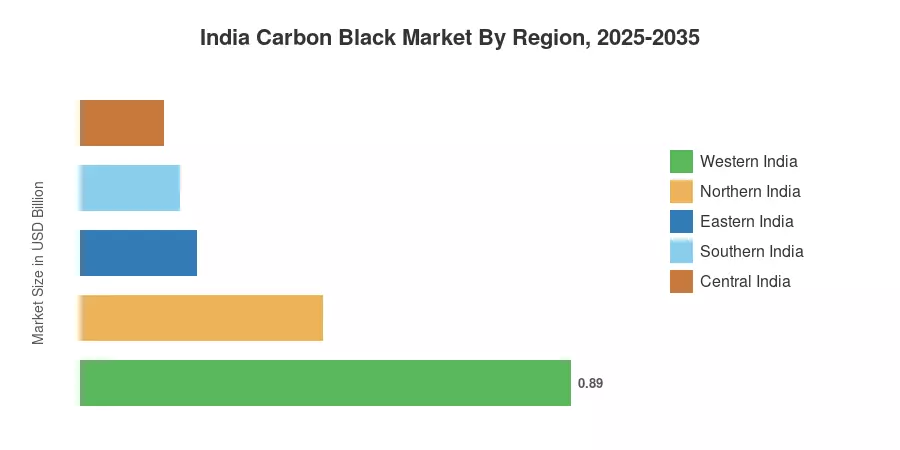
India Carbon Black Market Regional Image

Key Players and Competitive Insights

The carbon black market in India is characterized by a competitive landscape that is increasingly shaped by innovation, sustainability, and strategic partnerships. Key players such as Aditya Birla Carbon (India), Phillips Carbon Black Limited (India), and Continental Carbon India Limited (India) are actively pursuing strategies that enhance their market positioning. Aditya Birla Carbon (India) focuses on expanding its product portfolio to include sustainable carbon black solutions, which aligns with global trends towards eco-friendly materials. Meanwhile, Phillips Carbon Black Limited (India) emphasizes technological advancements in production processes to improve efficiency and reduce environmental impact. Continental Carbon India Limited (India) is also investing in research and development to innovate its offerings, thereby contributing to a competitive environment that prioritizes quality and sustainability.

The business tactics employed by these companies reflect a concerted effort to localize manufacturing and optimize supply chains. The market structure appears moderately fragmented, with several players vying for market share. However, the collective influence of major companies is significant, as they leverage their resources to enhance operational efficiencies and respond to evolving customer demands. This competitive dynamic fosters an environment where innovation and sustainability are paramount, potentially reshaping market strategies across the board.

In November 2025, Aditya Birla Carbon (India) announced a partnership with a leading technology firm to develop advanced carbon black production techniques that minimize waste and energy consumption. This strategic move underscores the company's commitment to sustainability and positions it favorably in a market increasingly driven by environmental considerations. The collaboration is expected to enhance production efficiency and reduce costs, thereby strengthening Aditya Birla's competitive edge.

In October 2025, Phillips Carbon Black Limited (India) launched a new line of high-performance carbon blacks tailored for the automotive sector. This initiative not only diversifies their product offerings but also aligns with the growing demand for specialized materials in the automotive industry. The introduction of these products is likely to bolster Phillips Carbon's market presence and cater to the evolving needs of manufacturers seeking high-quality materials.

In September 2025, Continental Carbon India Limited (India) completed the expansion of its manufacturing facility, which is anticipated to increase production capacity by 30%. This expansion is a strategic response to the rising demand for carbon black in various applications, including tires and coatings. By enhancing its production capabilities, Continental Carbon aims to solidify its market position and meet the growing needs of its customers.

As of December 2025, the competitive trends in the carbon black market are increasingly defined by digitalization, sustainability, and the integration of advanced technologies such as AI. Strategic alliances are becoming more prevalent, as companies recognize the importance of collaboration in driving innovation and efficiency. The shift from price-based competition to a focus on technological advancement and supply chain reliability is evident, suggesting that future competitive differentiation will hinge on the ability to innovate and adapt to changing market dynamics.

Key Companies in the India Carbon Black Market market include

Future Outlook

India Carbon Black Market Future Outlook

The India carbon black market is projected to grow at a 4.5% CAGR from 2024 to 2035, driven by increasing automotive production, demand for tires, and advancements in manufacturing technologies.

New opportunities lie in:

  • Expansion of specialty carbon black production for high-performance applications.
  • Investment in sustainable production methods to meet regulatory standards.
  • Development of strategic partnerships with automotive manufacturers for tailored solutions.

By 2035, the carbon black market in India is expected to achieve robust growth and enhanced market positioning.

Market Segmentation

India Carbon Black Market Grade Outlook

  • Standard Grade
  • High-Performance Grade
  • Specialty Grade
  • Reinforcement Grade
  • Conductive Grade

India Carbon Black Market Application Outlook

  • Tires
  • Plastics
  • Coatings
  • Inks
  • Adhesives

India Carbon Black Market End Use Industry Outlook

  • Automotive
  • Construction
  • Electronics
  • Consumer Goods
  • Industrial

India Carbon Black Market Production Process Outlook

  • Thermal Black
  • Acetylene Black
  • Furnace Black
  • Lamp Black
  • Channel Black

Report Scope

MARKET SIZE 20241.21(USD Billion)
MARKET SIZE 20251.26(USD Billion)
MARKET SIZE 20351.96(USD Billion)
COMPOUND ANNUAL GROWTH RATE (CAGR)4.5% (2024 - 2035)
REPORT COVERAGERevenue Forecast, Competitive Landscape, Growth Factors, and Trends
BASE YEAR2024
Market Forecast Period2025 - 2035
Historical Data2019 - 2024
Market Forecast UnitsUSD Billion
Key Companies ProfiledContinental Carbon India Limited (IN), Aditya Birla Carbon (IN), Orion Engineered Carbons S.A. (IN), Cabot Carbon Limited (IN), Phillips Carbon Black Limited (IN), Tianjin Black Cat Carbon Black Co., Ltd. (IN), Saarthi Carbon (IN), Maharashtra Rubber Products (IN)
Segments CoveredApplication, End Use Industry, Production Process, Grade
Key Market OpportunitiesGrowing demand for sustainable carbon black alternatives in the India carbon black market presents significant opportunities.
Key Market DynamicsRising demand for sustainable materials drives innovation and competition in India's carbon black market.
Countries CoveredIndia

Market Highlights

Author
Priya Nagrale
Senior Research Analyst

With an experience of over five years in market research industry (Chemicals & Materials domain), I gather and analyze market data from diverse sources to produce results, which are then presented back to a client. Also, provide recommendations based on the findings. As a Senior Research Analyst, I perform quality checks (QC) for market estimations, QC for reports, and handle queries and work extensively on client customizations. Also, handle the responsibilities of client proposals, report planning, report finalization, and execution

Leave a Comment

FAQs

What is the current valuation of the India Carbon Black Market?

The overall market valuation reached 106.14 USD Billion in 2024.

What is the projected market size for the India Carbon Black Market by 2035?

The market is expected to grow to 288.62 USD Billion by 2035.

What is the expected CAGR for the India Carbon Black Market during the forecast period?

The anticipated CAGR for the market from 2025 to 2035 is 9.52%.

Which segments are included in the India Carbon Black Market?

The market segments include Furnace Black, Acetylene Black, Channel Black, Rubber Black, and Specialty Black.

What are the estimated values for Furnace Black in the India Carbon Black Market?

Furnace Black is valued between 60.0 and 160.0 USD Billion.

Download Free Sample

Kindly complete the form below to receive a free sample of this Report

Compare Licence

×
Features License Type
Single User Multiuser License Enterprise User
Price $4,950 $5,950 $7,250
Maximum User Access Limit 1 User Upto 10 Users Unrestricted Access Throughout the Organization
Free Customization
Direct Access to Analyst
Deliverable Format
Platform Access
Discount on Next Purchase 10% 15% 15%
Printable Versions