×
Request Free Sample ×

Kindly complete the form below to receive a free sample of this Report

* Please use a valid business email

Leading companies partner with us for data-driven Insights

clients tt-cursor
Hero Background

India Glass Market

ID: MRFR/CnM/46514-HCR
111 Pages
Chitranshi Jaiswal
October 2025

India Glass Market Research Report By Product (Container Glass, Flat Glass, Fiber Glass, Others) and By Application (Packaging, Construction, Transportation, Electrical & Electronics, Telecommunication, Others)- Forecast to 2035.

Share:
Download PDF ×

We do not share your information with anyone. However, we may send you emails based on your report interest from time to time. You may contact us at any time to opt-out.

India Glass Market Infographic
Purchase Options

India Glass Market Summary

As per analysis, the India glass market is projected to grow from USD 18.68 Billion in 2025 to USD 30.72 Billion by 2035, exhibiting a compound annual growth rate (CAGR) of 5.1% during the forecast period (2025 - 2035).

Key Market Trends & Highlights

The India glass market is poised for substantial growth driven by sustainability and technological advancements.

  • The automotive segment remains the largest contributor to the India glass market, reflecting a robust demand for glass in vehicle manufacturing.
  • The construction segment is currently the fastest-growing, propelled by increasing infrastructure projects and urbanization.
  • Sustainable glass solutions are gaining traction, as consumers and industries alike prioritize eco-friendly products.
  • Key market drivers include the rising demand for eco-friendly glass products and the expansion of the construction sector, which is likely to bolster overall market growth.

Market Size & Forecast

2024 Market Size 17.77 (USD Billion)
2035 Market Size 30.72 (USD Billion)
CAGR (2025 - 2035) 5.1%

Major Players

Saint-Gobain (IN), Asahi India Glass Limited (IN), Tata Glass (IN), Hindustan National Glass & Industries Limited (IN), JSW Glass (IN), Borosil Glass Works Limited (IN), Schott Glass India (IN), Triveni Glass Limited (IN)

India Glass Market Trends

The India glass market is currently experiencing a dynamic transformation, driven by various factors including urbanization, increasing demand for sustainable materials, and advancements in technology. The construction sector, in particular, plays a pivotal role in shaping the market landscape, as glass is increasingly utilized in modern architecture for its aesthetic appeal and energy efficiency. Furthermore, the automotive industry is witnessing a shift towards the use of glass components, enhancing vehicle design and functionality. This evolving landscape suggests a robust growth trajectory for the India glass market, as stakeholders adapt to changing consumer preferences and regulatory frameworks. In addition to construction and automotive applications, the India glass market is also influenced by the rising popularity of glass packaging in the food and beverage sector. Consumers are becoming more environmentally conscious, leading to a preference for recyclable materials. This trend is likely to encourage manufacturers to innovate and develop new glass products that meet sustainability standards. Overall, the India glass market appears poised for continued expansion, with opportunities emerging across various sectors as the nation progresses towards a more sustainable future.

Sustainable Glass Solutions

The demand for eco-friendly glass products is on the rise in the India glass market. Manufacturers are increasingly focusing on developing sustainable glass solutions that minimize environmental impact. This trend is driven by consumer awareness and regulatory pressures, prompting companies to adopt greener production methods and materials.

Technological Advancements in Glass Manufacturing

Innovations in glass manufacturing processes are reshaping the India glass market. Advanced technologies, such as automated production lines and smart glass applications, are enhancing efficiency and product quality. These advancements not only improve operational performance but also cater to the evolving needs of consumers.

Growth in Architectural Glass Applications

The architectural sector is witnessing a surge in the use of glass for both functional and aesthetic purposes. The India glass market is seeing increased adoption of glass facades, windows, and partitions in commercial and residential buildings. This trend reflects a broader shift towards modern design and energy-efficient construction practices.

Market Segment Insights

By Application: Automotive (Largest) vs. Construction (Fastest-Growing)

In the India glass market, the automotive sector represents the largest application segment, significantly outpacing others in market share. The demand for automotive glass is driven by the growing vehicle production, which continues to show a resilient trend despite economic fluctuations. On the other hand, the construction segment is witnessing rapid growth, fueled by increased investments in urban infrastructure and housing developments across the country.

Construction (Dominant) vs. Solar Energy (Emerging)

The construction segment in the India glass market holds a dominant position, largely attributed to the booming real estate sector that necessitates superior glass products for both aesthetic appeal and functional efficiency. Simultaneously, solar energy is emerging as a noteworthy sector, as India's commitment to renewable energy sources gains momentum. Solar glass, a specialized type designed for photovoltaic cells, is expected to gain traction as investments in solar energy projects rise, presenting a unique opportunity for growth in this innovative market.

By End Use: Residential (Largest) vs. Commercial (Fastest-Growing)

In the India glass market, the end-use segments exhibit a diverse distribution, with the residential segment leading in market share. The demand for glass in residential applications stems from an increasing trend towards modern architecture and energy-efficient solutions. Conversely, the commercial segment is rapidly gaining traction, primarily due to the surge in infrastructure development and urbanization, making it the fastest-growing segment. This growth is further augmented by innovations in glass technology and design, catering to the evolving needs of commercial establishments.

Residential (Dominant) vs. Healthcare (Emerging)

The residential segment of the India glass market is characterized by its strong demand for energy-efficient, aesthetically pleasing solutions, such as double-glazed windows and tinted glass. This segment dominates due to rising disposable incomes and changing consumer preferences towards home improvement and sustainable living. On the other hand, the healthcare segment is emerging with significant potential, driven by the need for sterile, safe, and durable glass in medical applications. Both segments are crucial to the market, with the residential segment leading in consumption while the healthcare segment is witnessing rapid innovations in glass for medical and pharmaceutical uses.

By Product Type: Container Glass (Largest) vs. Flat Glass (Fastest-Growing)

The India glass market is characterized by a diverse range of product types, with container glass holding the largest share, thanks to its extensive use in the beverage and food packaging sectors. Flat glass is gaining traction rapidly, driven by the construction industry's demand for energy-efficient and aesthetically appealing materials. Specialty glass, fiberglass, and glass wool occupy niche segments but play crucial roles in specific applications such as automotive, construction, and insulation, respectively. In recent years, the market for flat glass has shown impressive growth, fueled by the booming real estate and infrastructure projects across India. Container glass continues to be a strong performer, benefiting from the trend towards sustainable packaging solutions. The growing importance of eco-friendly products is spurring innovations in specialty glass, while the rise in energy efficiency standards is promoting the use of fiberglass and glass wool in construction and insulation applications. Overall, the segment shows promising potential for expansion as consumer preferences shift towards sustainable and high-performance materials.

Container Glass (Dominant) vs. Specialty Glass (Emerging)

Container glass is recognized as the dominant segment in the India glass market, owing to its widespread utility in the packaging of beverages, pharmaceuticals, and food items. This segment benefits from reliable demand driven by changing consumer habits favoring glass packaging due to its recyclability and health safety. On the other hand, specialty glass is emerging as a significant player in the market. Comprising products such as optical glass, laboratory glassware, and advanced glass technologies like glass ceramics, this segment caters to high-end applications in the medical, electronics, and automotive sectors. As industries increasingly focus on innovation and quality, specialty glass is gradually proliferating, distinguished by its unique properties and tailored solutions. With advancements in technology, this segment is expected to see heightened growth as manufacturers adapt to sophisticated consumer and industrial requirements.

By Material Type: Soda-Lime Glass (Largest) vs. Borosilicate Glass (Fastest-Growing)

The India glass market is predominantly characterized by the presence of Soda-Lime Glass, which holds the largest market share among material types due to its versatility in various applications including construction, packaging, and household items. Following closely is Borosilicate Glass, known for its thermal resistant properties, which accounts for a significant portion of the market, particularly in laboratory equipment and kitchenware. Other material types such as Lead Glass, Aluminosilicate Glass, and Tempered Glass share a smaller proportion of the market but each serves essential niche applications. The growth trends within the 'Material Type' segment are largely driven by advancements in manufacturing technologies and increasing demand from the pharmaceutical, food and beverage, and automotive industries. Borosilicate Glass is rapidly gaining traction due to its application in scientific sectors and the growing trend towards high-quality kitchen products. As sustainability becomes a focus, other materials are also witnessing evolving preferences that aim to meet safety and environmental standards, further enhancing their market presence.

Soda-Lime Glass (Dominant) vs. Lead Glass (Emerging)

Soda-Lime Glass stands out as the dominant material type in the India glass market, recognized for its cost-effectiveness, high availability, and extensive range of applications across industries such as construction and packaging. This type of glass is favored for its practical qualities, making it ideal for everyday use in bottles, containers, and windows. On the other hand, Lead Glass has emerged into a niche market driven by its higher refractive index and aesthetic appeal, primarily in decorative items and crystal ware. While Soda-Lime Glass maintains a robust overall market presence, Lead Glass is carving out its position among consumers seeking luxury and high-quality glass products, thus showing promise for growth in premium segments.

By Manufacturing Process: Blow Molding (Largest) vs. Glass Fiber Production (Fastest-Growing)

In the India glass market, the manufacturing process segment is diverse, comprising various methods including Blow Molding, Press Molding, Sheet Glass Production, Glass Fiber Production, and Casting. Among these, Blow Molding holds the largest share owing to its wide applicability in producing containers and bottles. Press Molding and Sheet Glass Production follow closely behind, catered largely towards industrial uses and architectural applications, respectively. Meanwhile, Glass Fiber Production is gaining traction and is expected to see increased market interest as the demand for lightweight and high-strength materials rises across different industries.

Blow Molding (Dominant) vs. Glass Fiber Production (Emerging)

Blow Molding is a dominant manufacturing process in India, well-established for producing a wide range of glass products, especially in the packaging sector. Its efficiency in mass production and versatility in shaping make it a go-to method for manufacturers. Conversely, Glass Fiber Production is emerging as a key process; it harnesses the growing demand from sectors such as construction, automotive, and aerospace. With its ability to produce lightweight yet durable materials, Glass Fiber is poised for rapid growth, driven by increasing investments in sustainable construction and innovative designs in various applications.

Get more detailed insights about India Glass Market

Key Players and Competitive Insights

The glass market in India is characterized by a dynamic competitive landscape, driven by increasing demand across various sectors such as construction, automotive, and consumer goods. Key players are actively pursuing strategies that emphasize innovation, sustainability, and regional expansion. For instance, Saint-Gobain (France) has been focusing on enhancing its product portfolio with energy-efficient glass solutions, which aligns with the growing emphasis on sustainability in construction. Similarly, Asahi India Glass Limited (India) is leveraging its strong distribution network to penetrate deeper into tier-2 and tier-3 cities, thereby broadening its market reach. These strategic initiatives collectively contribute to a competitive environment that is increasingly shaped by technological advancements and consumer preferences.

In terms of business tactics, companies are localizing manufacturing to reduce costs and improve supply chain efficiency. The market structure appears moderately fragmented, with several players vying for market share. However, the collective influence of major companies like Hindustan National Glass & Industries Limited (India) and Tata Glass (India) is notable, as they continue to innovate and optimize their operations to maintain competitive advantages.

In November 2025, Hindustan National Glass & Industries Limited (India) announced a strategic partnership with a leading technology firm to develop smart glass solutions aimed at enhancing energy efficiency in buildings. This move is significant as it not only positions the company at the forefront of technological innovation but also aligns with the increasing regulatory focus on energy conservation in the construction sector.

In October 2025, Tata Glass (India) launched a new line of eco-friendly glass products made from recycled materials. This initiative reflects a growing trend towards sustainability and positions Tata Glass as a responsible player in the market, appealing to environmentally conscious consumers. The strategic importance of this launch lies in its potential to capture a segment of the market that prioritizes sustainable practices.

In September 2025, Borosil Glass Works Limited (India) expanded its manufacturing capabilities by investing in advanced automation technologies. This investment is crucial as it enhances production efficiency and reduces operational costs, allowing Borosil to remain competitive in a price-sensitive market. The integration of automation also suggests a shift towards more technologically advanced manufacturing processes, which could redefine operational standards in the industry.

As of December 2025, current competitive trends indicate a strong focus on digitalization, sustainability, and the integration of AI technologies within the glass market. Strategic alliances are increasingly shaping the landscape, enabling companies to pool resources and expertise to drive innovation. The competitive differentiation is likely to evolve from traditional price-based competition to a more nuanced approach that emphasizes technological innovation, supply chain reliability, and sustainable practices. This shift suggests that companies that can effectively leverage these trends will be better positioned to thrive in the future.


Key Companies in the India Glass Market market include

Industry Developments

The India Glass Market has recently witnessed pivotal developments, particularly with companies like JSW Glass and Asahi India Glass Market expanding their production facilities to meet surging demand, driven by sectors such as construction and automotive. In June 2023, Saint-Gobain India reported a substantial increase in revenue, bolstered by innovations in energy-efficient glass products. Additionally, in August 2023, Hindustan Aeronautics Limited announced a collaboration with Central Glass and Ceramic Research Institute aimed at advancing research in aerospace glass materials, a move expected to significantly bolster the aerospace segment.

The market has seen a steady growth trajectory, with an estimated valuation increase of about 15% over the past year, largely due to urbanization and government initiatives promoting sustainable building materials. Merger and acquisition activities have been relatively quiet, with no significant transactions announced concerning the listed companies as of now. However, previous collaborations, such as Triveni Glass's partnership with BSG Glass for decorative glass products in late 2022, have enhanced product offerings in the luxury market segment. Overall, the India Glass Market is poised for continued growth amid increasing industrial innovation and evolving consumer preferences.

Future Outlook

India Glass Market Future Outlook

The India glass market is projected to grow at a 5.1% CAGR from 2024 to 2035, driven by urbanization, infrastructure development, and increasing demand for sustainable packaging.

New opportunities lie in:

  • Expansion of smart glass technologies in commercial buildings.
  • Development of eco-friendly glass recycling initiatives.
  • Investment in automated glass manufacturing processes to enhance efficiency.

By 2035, the India glass market is expected to achieve robust growth, positioning itself as a leader in innovation and sustainability.

Market Segmentation

India Glass Market End Use Outlook

  • Residential
  • Commercial
  • Industrial
  • Automotive
  • Healthcare

India Glass Market Application Outlook

  • Automotive
  • Construction
  • Electronics
  • Packaging
  • Solar Energy

India Glass Market Product Type Outlook

  • Flat Glass
  • Container Glass
  • Specialty Glass
  • Fiberglass
  • Glass Wool

India Glass Market Material Type Outlook

  • Soda-Lime Glass
  • Borosilicate Glass
  • Lead Glass
  • Aluminosilicate Glass
  • Tempered Glass

India Glass Market Manufacturing Process Outlook

  • Blow Molding
  • Press Molding
  • Sheet Glass Production
  • Glass Fiber Production
  • Casting

Report Scope

MARKET SIZE 202417.77(USD Billion)
MARKET SIZE 202518.68(USD Billion)
MARKET SIZE 203530.72(USD Billion)
COMPOUND ANNUAL GROWTH RATE (CAGR)5.1% (2024 - 2035)
REPORT COVERAGERevenue Forecast, Competitive Landscape, Growth Factors, and Trends
BASE YEAR2024
Market Forecast Period2025 - 2035
Historical Data2019 - 2024
Market Forecast UnitsUSD Billion
Key Companies ProfiledSaint-Gobain (IN), Asahi India Glass Limited (IN), Tata Glass (IN), Hindustan National Glass & Industries Limited (IN), JSW Glass (IN), Borosil Glass Works Limited (IN), Schott Glass India (IN), Triveni Glass Limited (IN)
Segments CoveredApplication, End Use, Product Type, Material Type, Manufacturing Process
Key Market OpportunitiesGrowing demand for sustainable packaging solutions drives innovation in the India glass market.
Key Market DynamicsRising demand for eco-friendly glass products drives innovation and competition in India's glass manufacturing sector.
Countries CoveredIndia

Leave a Comment

FAQs

What is the projected market size of the India Glass Market in 2024?

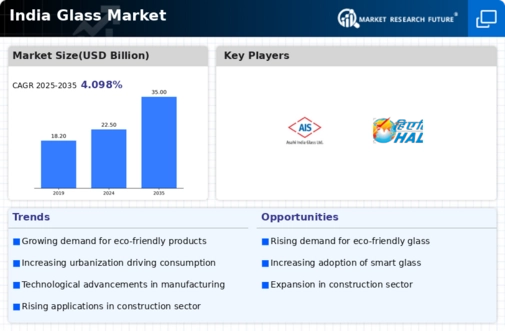
The India Glass Market is expected to be valued at 22.5 USD Billion in 2024.

What is the expected value of the India Glass Market in 2035?

By 2035, the market is projected to be valued at 35.0 USD Billion.

What is the expected compound annual growth rate (CAGR) for the India Glass Market from 2025 to 2035?

The expected CAGR for the India Glass Market is 4.098% from 2025 to 2035.

Which product segment holds the largest market share in the India Glass Market in 2024?

Container Glass holds the largest market share, valued at 8.5 USD Billion in 2024.

What is the market size for Flat Glass in 2024 within the India Glass Market?

The market size for Flat Glass in 2024 is valued at 7.0 USD Billion.

Who are some of the key players in the India Glass Market?

Key players include JSW Glass, Schott Glass, Uttam Glass, and SaintGobain India.

What is the market value of Fiber Glass in the India Glass Market in 2024?

Fiber Glass is valued at 4.0 USD Billion in 2024 within the market.

What are the anticipated growth drivers for the India Glass Market?

The growth drivers include increased demand in construction and automotive applications.

How much is the Others segment projected to be valued in the India Glass Market in 2035?

The Others segment is projected to be valued at 4.5 USD Billion in 2035.

What challenges does the India Glass Market currently face?

Challenges include rising raw material costs and regulatory compliance.

Download Free Sample

Kindly complete the form below to receive a free sample of this Report

Compare Licence

×
Features License Type
Single User Multiuser License Enterprise User
Price $4,950 $5,950 $7,250
Maximum User Access Limit 1 User Upto 10 Users Unrestricted Access Throughout the Organization
Free Customization
Direct Access to Analyst
Deliverable Format
Platform Access
Discount on Next Purchase 10% 15% 15%
Printable Versions