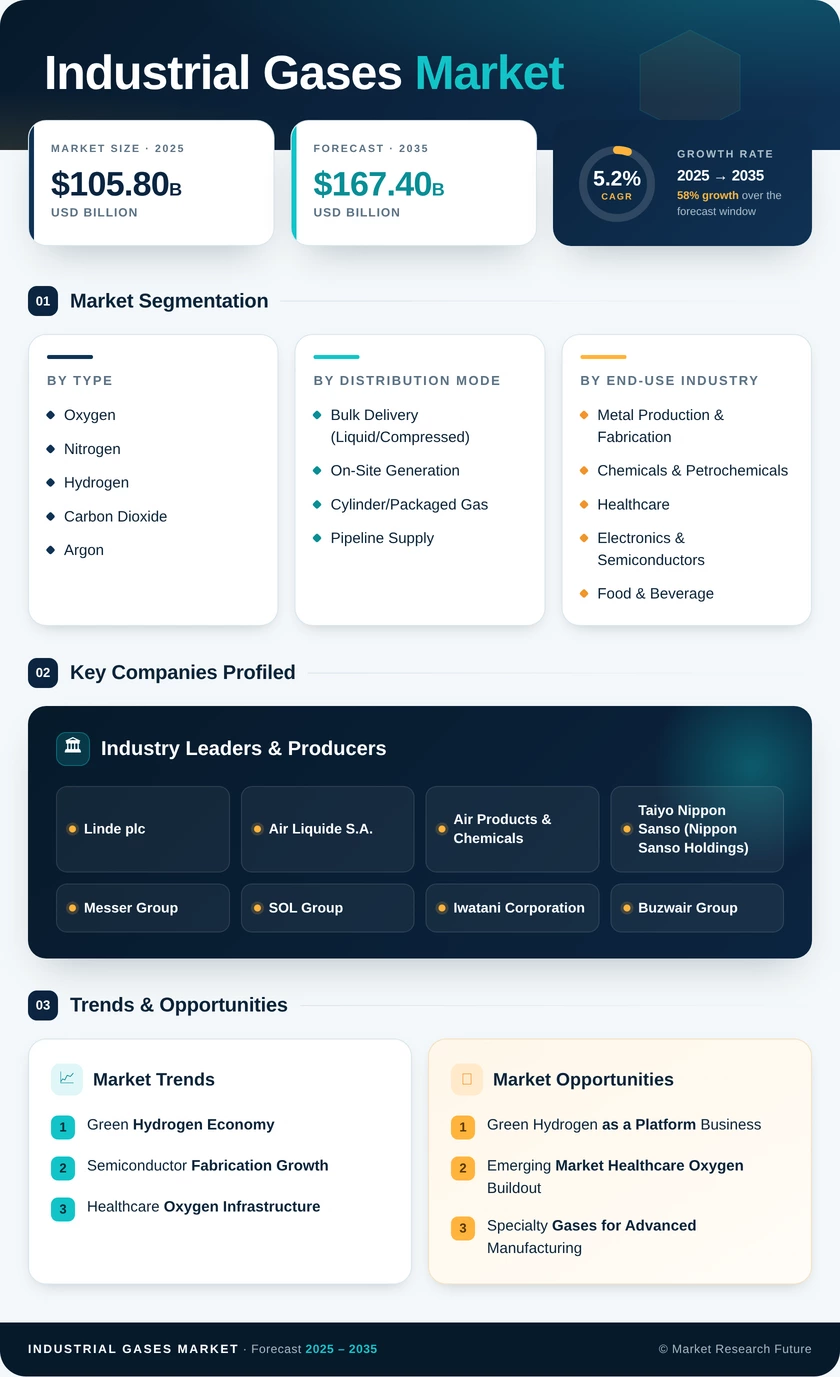
Industrial Gases Market

ID: MRFR/EnP/5046-CR
100 Pages
Chitranshi Jaiswal
Last Updated: June 16, 2026
Industrial Gases Market Size, Share & Growth Analysis Report By Gas Type (Oxygen, Nitrogen, Hydrogen, Carbon Dioxide, Argon, Acetylene, Others (Helium, Neon, Krypton, Xenon)), By Distribution Mode (Bulk Delivery (Liquid/Compressed), On-Site Generation, Cylinder/Packaged Gas, Pipeline Supply), By End-Use Industry (Metal Production & Fabrication, Chemicals & Petrochemicals, Healthcare, Electronics & Semiconductors, Food & Beverage, Energy & Utilities, Others (Aerospace, Glass, Pulp & Paper)), and By Country - Trends & Industry Forecast to 2035
Download PDF ×

We do not share your information with anyone. However, we may send you emails based on your report interest from time to time. You may contact us at any time to opt-out.

  1. 1 Market Overview |
    1. 1.1 Study Assumptions & Market Definition |
    2. 1.2 Scope of the Study |
    3. 1.3 Research Methodology
  2. 2 Market Summary & Key Takeaways
  3. 3 Market Dynamics |
    1. 3.1 Market Drivers Analysis | |
      1. 3.1.1 Green Hydrogen Economy Scale-Up | |
      2. 3.1.2 Semiconductor & Electronics Fab Expansion | |
      3. 3.1.3 Healthcare Oxygen Infrastructure Buildout | |
      4. 3.1.4 Carbon Capture & CCUS Deployment | |
      5. 3.1.5 Food & Beverage Modified Atmosphere Packaging Growth | |
      6. 3.1.6 Metal Fabrication & Welding Gas Demand | |
      7. 3.1.7 Specialty Gas Demand in Pharma & Biotech |
    2. 3.2 Market Restraints Analysis | |
      1. 3.2.1 Energy-Intensive Production Costs | |
      2. 3.2.2 Transportation & Logistics Bottlenecks for Cryogenic Liquids | |
      3. 3.2.3 Commoditization & Pricing Pressure in Mature Segments | |
      4. 3.2.4 Regulatory Complexity for Specialty Gas Handling | |
      5. 3.2.5 Supply Chain Concentration Risk (Rare Specialty Gas Precursors) |
    3. 3.3 Market Opportunity Analysis | |
      1. 3.3.1 Green Hydrogen as a Platform Business | |
      2. 3.3.2 Emerging Market Healthcare Oxygen Buildout | |
      3. 3.3.3 Specialty Gases for Advanced Manufacturing | |
      4. 3.3.4 Carbon Dioxide Monetization in Food & Beverage | |
      5. 3.3.5 Digital Supply Chain & Remote Monitoring |
    4. 3.4 Industry Value Chain Analysis |
    5. 3.5 Porter's Five Forces Analysis
  4. 4 Global Industrial Gases Market Size & Forecast (2021–2035) |
    1. 4.1 Historical Market Size (2021–2025) |
    2. 4.2 Current & Forecast Market Size (2026–2035) |
    3. 4.3 Market Size by Revenue (USD Billion) |
    4. 4.4 Year-over-Year Growth Analysis
  5. 5 Segmentation Analysis |
    1. 5.1 By Gas Type | |
      1. 5.1.1 Oxygen | |
      2. 5.1.2 Nitrogen | |
      3. 5.1.3 Hydrogen | |
      4. 5.1.4 Carbon Dioxide | |
      5. 5.1.5 Argon | |
      6. 5.1.6 Acetylene | |
      7. 5.1.7 Others (Helium, Neon, Krypton, Xenon) |
    2. 5.2 By Distribution Mode | |
      1. 5.2.1 Bulk Delivery (Liquid/Compressed) | |
      2. 5.2.2 On-Site Generation | |
      3. 5.2.3 Cylinder/Packaged Gas | |
      4. 5.2.4 Pipeline Supply |
    3. 5.3 By End-Use Industry | |
      1. 5.3.1 Metal Production & Fabrication | |
      2. 5.3.2 Chemicals & Petrochemicals | |
      3. 5.3.3 Healthcare | |
      4. 5.3.4 Electronics & Semiconductors | |
      5. 5.3.5 Food & Beverage | |
      6. 5.3.6 Energy & Utilities | |
      7. 5.3.7 Others (Aerospace, Glass, Pulp & Paper)
  6. 6 Regional Analysis |
    1. 6.1 North America | |
      1. 6.1.1 United States | |
      2. 6.1.2 Canada | |
      3. 6.1.3 Mexico |
    2. 6.2 Europe | |
      1. 6.2.1 Germany | |
      2. 6.2.2 France | |
      3. 6.2.3 United Kingdom | |
      4. 6.2.4 Rest of Europe |
    3. 6.3 Asia-Pacific | |
      1. 6.3.1 China | |
      2. 6.3.2 India | |
      3. 6.3.3 Japan | |
      4. 6.3.4 South Korea | |
      5. 6.3.5 Australia | |
      6. 6.3.6 Rest of Asia-Pacific |
    4. 6.4 South America | |
      1. 6.4.1 Brazil | |
      2. 6.4.2 Argentina | |
      3. 6.4.3 Chile | |
      4. 6.4.4 Rest of South America |
    5. 6.5 Middle East & Africa | |
      1. 6.5.1 Saudi Arabia | |
      2. 6.5.2 UAE | |
      3. 6.5.3 South Africa | |
      4. 6.5.4 Rest of Middle East & Africa
  7. 7 Competitive Landscape |
    1. 7.1 Market Share Analysis (2025) |
    2. 7.2 Competitive Benchmarking Matrix |
    3. 7.3 Company Profiles | |
      1. 7.3.1 Linde plc | |
      2. 7.3.2 Air Liquide S.A. | |
      3. 7.3.3 Air Products & Chemicals | |
      4. 7.3.4 Taiyo Nippon Sanso (Nippon Sanso Holdings) | |
      5. 7.3.5 Messer Group | |
      6. 7.3.6 SOL Group | |
      7. 7.3.7 Iwatani Corporation | |
      8. 7.3.8 Buzwair Group | |
      9. 7.3.9 Ellenbarrie Industrial Gases | |
      10. 7.3.10 Gulf Cryo
  8. 8 Future Outlook & Strategic Recommendations (2026–2035) |
    1. 8.1 Hydrogen Economy Maturation |
    2. 8.2 Digitalization & Autonomous Operations |
    3. 8.3 Decarbonization & ESG Integration |
    4. 8.4 Consolidation & Vertical Integration
  9. 9 Recent Developments & News
  10. 10 Frequently Asked Questions (FAQs)
  11. 11 Report Scope & Methodology |
    1. 11.1 Study Period & Base Year |
    2. 11.2 Data Sources & Citations |
    3. 11.3 Abbreviations
  12. 12 LIST OF TABLES |
  13. TABLE 1 Global Industrial Gases Market Size & Forecast, by Revenue (USD Billion), 2021–2035 |
  14. TABLE 2 Global Industrial Gases Market — Year-over-Year Growth Analysis, 2021–2035 |
  15. TABLE 3 Global Industrial Gases Market — Driver Impact Analysis |
  16. TABLE 4 Global Industrial Gases Market — Restraint Impact Analysis |
  17. TABLE 5 Global Industrial Gases Market Size, by Gas Type, 2021–2035 (USD Billion) |
  18. TABLE 6 Global Industrial Gases Market Size, by Distribution Mode, 2021–2035 (USD Billion) |
  19. TABLE 7 Global Industrial Gases Market Size, by End-Use Industry, 2021–2035 (USD Billion) |
  20. TABLE 8 Global Industrial Gases Market Size, by Region, 2021–2035 (USD Billion) |
  21. TABLE 9 North America Industrial Gases Market Size, by Country, 2021–2035 (USD Billion) |
  22. TABLE 10 Europe Industrial Gases Market Size, by Country, 2021–2035 (USD Billion) |
  23. TABLE 11 Asia-Pacific Industrial Gases Market Size, by Country, 2021–2035 (USD Billion) |
  24. TABLE 12 South America Industrial Gases Market Size, by Country, 2021–2035 (USD Billion) |
  25. TABLE 13 Middle East & Africa Industrial Gases Market Size, by Country, 2021–2035 (USD Billion) |
  26. TABLE 14 North America Industrial Gases Market Size, by Gas Type, 2021–2035 (USD Billion) |
  27. TABLE 15 North America Industrial Gases Market Size, by Distribution Mode, 2021–2035 (USD Billion) |
  28. TABLE 16 North America Industrial Gases Market Size, by End-Use Industry, 2021–2035 (USD Billion) |
  29. TABLE 17 Europe Industrial Gases Market Size, by Gas Type, 2021–2035 (USD Billion) |
  30. TABLE 18 Europe Industrial Gases Market Size, by Distribution Mode, 2021–2035 (USD Billion) |
  31. TABLE 19 Europe Industrial Gases Market Size, by End-Use Industry, 2021–2035 (USD Billion) |
  32. TABLE 20 Asia-Pacific Industrial Gases Market Size, by Gas Type, 2021–2035 (USD Billion) |
  33. TABLE 21 Asia-Pacific Industrial Gases Market Size, by Distribution Mode, 2021–2035 (USD Billion) |
  34. TABLE 22 Asia-Pacific Industrial Gases Market Size, by End-Use Industry, 2021–2035 (USD Billion) |
  35. TABLE 23 South America Industrial Gases Market Size, by Gas Type, 2021–2035 (USD Billion) |
  36. TABLE 24 South America Industrial Gases Market Size, by Distribution Mode, 2021–2035 (USD Billion) |
  37. TABLE 25 South America Industrial Gases Market Size, by End-Use Industry, 2021–2035 (USD Billion) |
  38. TABLE 26 Middle East & Africa Industrial Gases Market Size, by Gas Type, 2021–2035 (USD Billion) |
  39. TABLE 27 Middle East & Africa Industrial Gases Market Size, by Distribution Mode, 2021–2035 (USD Billion) |
  40. TABLE 28 Middle East & Africa Industrial Gases Market Size, by End-Use Industry, 2021–2035 (USD Billion) |
  41. TABLE 29 Competitive Benchmarking Matrix — Global Industrial Gases Market, 2025 |
  42. TABLE 30 Company Profiles — Key Players, Global Industrial Gases Market |
  43. TABLE 31 Recent Developments & Strategic Announcements, 2023–2025 |
  44. TABLE 32 Report Scope & Methodology |
  45. TABLE 33 Detailed Sources & Citations
  46. 13 LIST OF FIGURES |
  47. FIGURE 1 Industrial Gases Market Dynamics — Drivers, Restraints & Opportunities |
  48. FIGURE 2 Industry Value Chain Analysis — Industrial Gases Market |
  49. FIGURE 3 Porter's Five Forces Analysis — Industrial Gases Market |
  50. FIGURE 4 Global Industrial Gases Market Size Trend & Forecast (USD Billion), 2021–2035 |
  51. FIGURE 5 Global Industrial Gases Market Share, by Gas Type (%), 2025 |
  52. FIGURE 6 Global Industrial Gases Market Share, by Distribution Mode (%), 2025 |
  53. FIGURE 7 Global Industrial Gases Market Share, by End-Use Industry (%), 2025 |
  54. FIGURE 8 Global Industrial Gases Market Share, by Region (%), 2025 |
  55. FIGURE 9 North America Industrial Gases Market — Country Share Breakdown (%), 2025 |
  56. FIGURE 10 Europe Industrial Gases Market — Country Share Breakdown (%), 2025 |
  57. FIGURE 11 Asia-Pacific Industrial Gases Market — Country Share Breakdown (%), 2025 |
  58. FIGURE 12 South America Industrial Gases Market — Country Share Breakdown (%), 2025 |
  59. FIGURE 13 Middle East & Africa Industrial Gases Market — Country Share Breakdown (%), 2025 |
  60. FIGURE 14 Competitive Landscape — Market Share of Top 5 Players (%), 2025 |
  61. FIGURE 15 Industrial Gases Market Revenue CAGR by Region (%), 2026–2035

Segmentation Quick Reference

DimensionSub-SegmentsDominant SegmentFastest Growing Segment
By Gas TypeOxygen, Nitrogen, Hydrogen, Carbon Dioxide, Argon, Acetylene, Others (Helium, Neon, Krypton, Xenon)Oxygen (28% share)Hydrogen (highest CAGR)
By Distribution ModeBulk Delivery, On-Site Generation, Cylinder/Packaged Gas, Pipeline SupplyBulk Delivery (42% share)On-Site Generation (6.1% CAGR)
By End-Use IndustryMetal Production & Fabrication, Chemicals & Petrochemicals, Healthcare, Electronics & Semiconductors, Food & Beverage, Energy & Utilities, OthersMetal Production & Fabrication (31% share)Healthcare (6.8% CAGR)


Market Segmentation Overview

By Gas Type

Sub-SegmentKey Trend
OxygenDRI steelmaking increases per-tonne oxygen intensity; healthcare baseline demand permanently elevated post-pandemic
NitrogenElectronics fab proliferation and food-preservation cold chains drive high-purity nitrogen demand growth
HydrogenGreen electrolysis cost declines and government hydrogen hub funding accelerate transition from grey to green production
Carbon DioxideCCUS mandates and food-grade MAP adoption expand both technical and food-grade CO₂ addressable markets
ArgonWelding shielding and semiconductor crystal-growing applications sustain steady demand; supply tied to oxygen ASU output
AcetyleneRemains essential for high-temperature metal cutting and brazing despite competition from propylene alternatives
Others (Helium, Neon, Krypton, Xenon)Helium supply volatility and neon criticality for lithography create strategic procurement challenges for end users


Gas type segmentation reflects the fundamental product mix of the Industrial Gases Market. Oxygen and nitrogen — both derived from air separation — account for the majority of production volume, while hydrogen and specialty gases drive the highest revenue growth and margin expansion.

By Distribution Mode

Sub-SegmentKey Trend
Bulk Delivery (Liquid/Compressed)Long-term take-or-pay contracts with energy-index escalators remain the dominant commercial model
On-Site GenerationPSA and membrane systems increasingly displace merchant delivery for large-volume consumers above 50 t/day
Cylinder/Packaged GasSmall-scale users in welding, laboratories, and medical clinics sustain cylinder demand; digital ordering platforms modernize fulfillment
Pipeline SupplyDedicated pipeline networks serve petrochemical clusters; new hydrogen pipeline corridors under development in EU and Gulf Coast


Distribution mode segmentation captures how gases reach end users. The shift from merchant bulk delivery toward on-site generation is the most significant structural change, driven by supply security concerns and total-cost-of-ownership optimization.

By End-Use Industry

Sub-SegmentKey Trend
Metal Production & FabricationEAF adoption raises oxygen intensity; welding gas demand tracks construction and infrastructure cycles
Chemicals & PetrochemicalsHydrogen as feedstock and nitrogen for inerting remain core demand anchors in refining and chemical processing
HealthcarePost-pandemic oxygen infrastructure investment creates permanent demand floor; home healthcare gases growing
Electronics & SemiconductorsAdvanced node fabs require ultra-high-purity specialty gases; qualification barriers create supplier lock-in
Food & BeverageMAP, quick-freeze, and carbonation applications drive food-grade gas demand; regulatory standards tightening
Energy & UtilitiesCCUS projects, gasification, and oxy-fuel combustion expand gas consumption in power and energy sectors
Others (Aerospace, Glass, Pulp & Paper)Space launch propellants and float glass production are niche but high-value consumption categories


End-use industry segmentation reflects the breadth of the Industrial Gases Market's customer base. Metal production dominates volume, while healthcare and electronics deliver the highest growth rates and margins.