Infant Formula Ingredients Market (2026 - 2035)

Infant Formula Ingredients Market Size, Share, Industry Trend & Analysis Research Report By Ingredient (Carbohydrates, Fats and Oils, Proteins, Prebiotics and Probiotics), By Source (Cow Milk, Goat Milk), By Form (Powder, Liquid and Semi-Liquid), By Certification/Nature (Conventional, Organic), By Application (Standard Infant Formula, Follow-On Formula, Specialty Formulas) - Forecast to 2035.

Forecast Period
2026-2035
CAGR
7.30%
2025 Market Size
USD 27.26 Billion (2025)
2035 Market Size
USD 55.15 Billion (2035)
Food, Beverages & Nutrition ● Updated August 24, 2026 Report ID: MRFR/FnB/25352-HCR | Pages: 128 | Author: Harshita Gorde

Infant Formula Ingredients Market Summary

The infant formula ingredients market reached USD 27.26 Billion in 2025 and is projected to expand from USD 29.25 Billion in 2026 to USD 55.15 Billion by 2035, registering a CAGR of 7.30% during the forecast period. Two forces are converging to reshape ingredient demand: the US FDA's first comprehensive review of infant formula nutrient standards since 1998 — expected to tighten compositional requirements while incentivizing innovation [1] — and China's updated GB 10765-2021 national standard, which raised minimum thresholds for DHA, choline, and selenium in marketed formulas [2].

In the realm of technology, bioengineered alternatives are gradually replacing traditional lactose-and-whey formulations. Between 2023 and 2025, human-identical milk oligosaccharides (HMOs) were granted regulatory clearance in the United States, Europe, and China through precision fermentation, thereby enabling the development of a new category of functional nutrition constituents [3]. Through 2024, the cumulative venture and strategic funding for fermentation-derived infant nutrition constituents surpassed USD 1.2 billion [4].

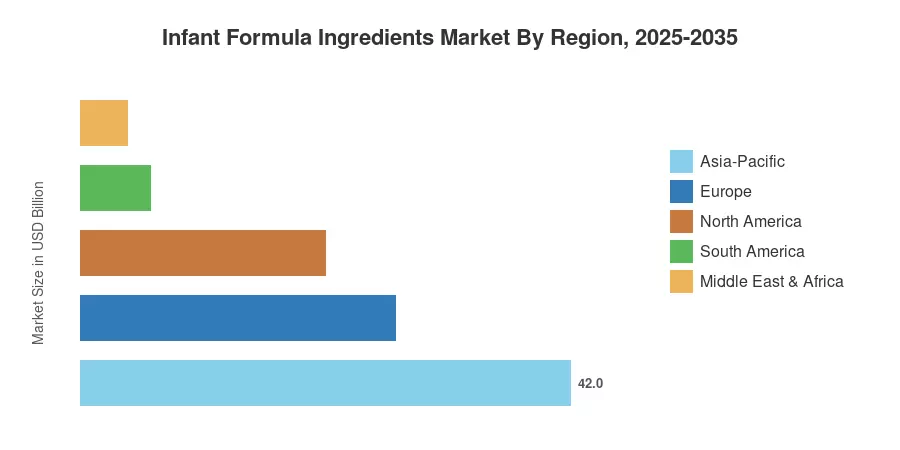
The infant formula ingredients market is dominated by Asia-Pacific, with an estimated 42% revenue share. This dominance is attributed to the premium-formula growth in China and the increasingly widespread organized retail presence in India. The region also exhibits the highest compound annual growth rate (CAGR). Europe, which holds the second-largest share at approximately 27%, is characterized by stringent EU compositional regulations that prioritize high-specification ingredients. North America's contribution is approximately 21%, which is supported by a renewed regulatory push and clinical-grade ingredient research and development. Newer demand corridors are expected to intensify competition through 2035 as birth-rate dynamics shift across Latin America and the Middle East.


Key Report Takeaways

• By Ingredient

  • Carbohydrates captured 41.0% of the infant formula ingredients market in 2024, reflecting the dominance of lactose as the primary energy source in stage-1 products.
  • Prebiotics and probiotics are forecast to grow at an 8.90% CAGR through 2035, fueled by clinical evidence linking gut-microbiome support to long-term infant health.


• By Source

  • Goat milk as a source ingredient is on track for a 10.6% CAGR, as parents in Europe and Asia seek alternatives to cow-milk protein for infants with sensitivities.

• By Form, Nature

  • Powder-form ingredients accounted for 78.8% of 2024 revenue, underpinned by supply-chain efficiencies and extended shelf life.


• By Nature

  • The organic certification segment is projected to expand at a 10.2% CAGR as clean-label expectations rise across premium retail channels.


• By Application

  • Specialty formulas — including hypoallergenic and anti-reflux variants — will accelerate at a 10.6% CAGR, reflecting the infant formula ingredients market shift toward clinical-grade nutrition.

• By Region

  • Asia-Pacific commands the largest share of the infant formula ingredients market, with China alone accounting for over half of regional demand.
  • Europe's regulatory rigor ensures high-value ingredient sourcing, making it the second-largest revenue contributor.
  • The Middle East & Africa region presents emerging growth potential, driven by rising urbanization and expanding infant-nutrition awareness programs.


Market Size and Forecast (2021–2035)

Market Research Future's estimates combine primary interviews with ingredient manufacturers, formula brand procurement teams, and regulatory agencies alongside secondary validation from trade databases, customs data, and published financial disclosures. Historical figures reflect reported revenues; forecast values apply the calibrated CAGR of 7.30% from the base year.
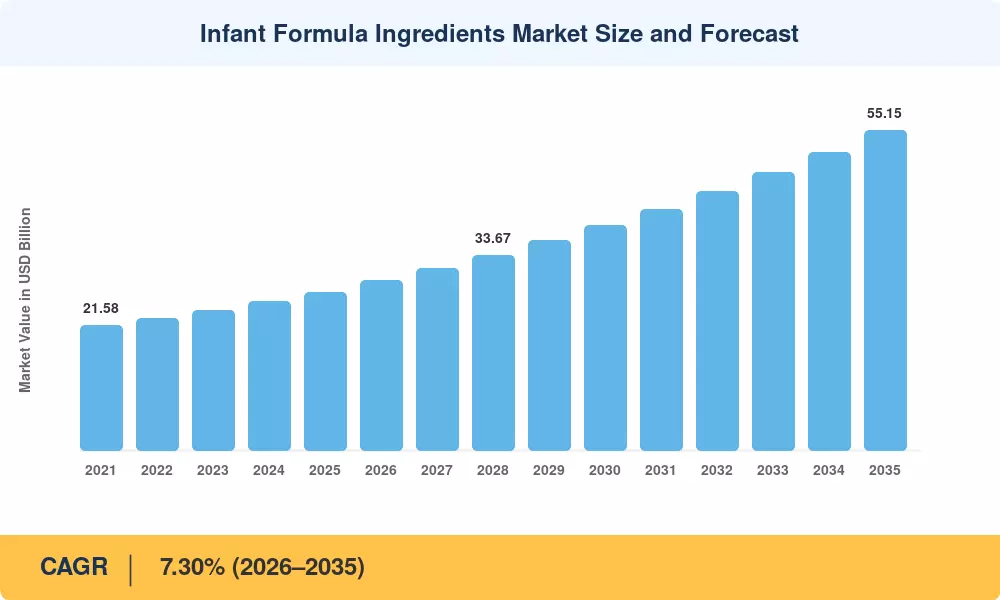
Infant Formula Ingredients Market Size and Forecast
Our Impact
Enabled $4.3B Revenue Impact for Fortune 500 and Leading Multinationals
Partnering with 2000+ Global Organizations Each Year
30K+ Citations by Top-Tier Firms in the Industry

Driver Impact Analysis

Driver ~% Impact on CAGR Geographic Relevance Impact Timeline
Tightening global infant-formula nutrient standards ~18% Global Short-term (≤2 yr)
Expansion of HMO fermentation capacity ~16% North America, Europe Medium-term (2–4 yr)
Rising female workforce participation rates ~14% Asia-Pacific, MEA Long-term (≥4 yr)
Growing middle-class purchasing power ~13% Asia-Pacific, South America Long-term (≥4 yr)
Premiumization toward organic and clean-label formulas ~12% Europe, North America Medium-term (2–4 yr)
Clinical evidence linking gut-health ingredients to immunity ~10% Global Medium-term (2–4 yr)
E-commerce penetration for specialty infant nutrition ~9% China, India, ASEAN Short-term (≤2 yr)


Regulatory Modernization of Nutrient Standards

The FDA's 2025 request for information on infant-formula nutrient requirements marks the agency's first substantive re-examination in over 25 years [1]. Parallel updates in China (GB 10765-2021) raised mandatory DHA levels from zero to 3.6 mg per 100 kJ and introduced minimum selenium thresholds, compelling ingredient suppliers to re-engineer premix compositions [2]. These regulatory shifts create binding demand for higher-specification raw materials and effectively raise switching costs for brands already invested in compliant supply chains.

HMO Fermentation Scale-Up

Human Milk Oligosaccharide (HMO) commercial production has scaled globally following major approvals in key regions like China (NHC approvals for 2'-FL), the EU, and the US, driving massive industry investments in fermentation lines by major suppliers such as DSM-Firmenich, DuPont/Danisco, and Kirin/Kyowa Hakko Bio.


Rising Female Workforce Participation

According to World Bank and International Labour Organization (ILO) modeled databases, female labor force participation rates across developing South and Southeast Asian economies (such as India and Bangladesh) show continuous structural evolution. Government workforce tracking highlights increasing economic engagement among women, driving rising commercial infant formula adoption in urban centers


Restraints Impact Analysis

Estimated restraint impacts below are directional, reflecting the degree to which each factor moderates growth. They are not linearly deductible from the CAGR.

Restraint ~% Drag on CAGR Geographic Relevance Impact Timeline
Prolonged regulatory-approval timelines for novel ingredients ~–6% Global Medium-term (2–4 yr)
Raw-material price volatility (dairy commodities) ~–5% Global Short-term (≤2 yr)
Government breastfeeding-promotion campaigns ~–5% Europe, ASEAN Long-term (≥4 yr)
Supply-chain concentration risk in specialty lipids ~–4% North America, Europe Medium-term (2–4 yr)
Consumer skepticism toward bioengineered ingredients ~–3% Europe, Japan Long-term (≥4 yr)


Novel-Ingredient Approval Bottlenecks

EU Novel Food Regulation (2015/2283) requires a minimum 18-month evaluation cycle for new bioactive ingredients, and the average effective timeline stretches beyond 24 months when EFSA requests supplementary toxicological data [12]. For ingredient companies investing in next-generation oligosaccharides and structured lipids, these timelines delay revenue realization and inflate R&D carrying costs, dampening near-term returns in the infant formula ingredients market.

Dairy Commodity Price Swings

Global skim-milk-powder prices fluctuated between USD 2,400 and USD 3,100 per metric ton across 2023–2025, creating margin uncertainty for ingredient blenders who operate on fixed-price supply agreements with formula manufacturers [13]. Whey-protein-concentrate prices tracked a similar band. Such volatility compresses margins for mid-tier suppliers lacking hedging capacity and discourages long-term contracting.

Breastfeeding-Promotion Policies

The WHO International Code of Marketing of Breast-milk Substitutes continues to inform national advertising restrictions in over 130 countries [14]. Stricter enforcement in ASEAN nations — Thailand banned cross-promotional formula marketing in 2024 — limits brand-level pull-through for premium ingredients. While these policies do not reduce medical-necessity formula demand, they temper volume growth in the discretionary segment of the infant formula ingredients market.


Infant Formula Ingredients Market Opportunities

Next-Generation HMO Portfolio Expansion

Only two HMO structures — 2'-FL and LNnT — are commercially available at scale. More than ten additional HMOs identified in human breast milk remain in preclinical or pilot-production phases [3]. Companies that secure early regulatory clearance for structures such as 3'-sialyllactose and 6'-sialyllactose will capture first-mover premiums in a differentiated infant formula ingredients market segment.

Organic Ingredient Premiumization

Organic infant formula retails at a 35–60% premium over conventional variants in Western Europe. Yet, certified-organic ingredient supply remains constrained, with organic lactose production covering less than 8% of total lactose output globally [9]. Expanding organic dairy supply chains in New Zealand, Ireland, and Austria presents a clear capacity arbitrage for ingredient processors.

Emerging-Market Penetration in Africa and South Asia

Sub-Saharan Africa's under-five population will exceed 200 million by 2030, according to UNICEF projections, yet per-capita formula ingredient consumption remains a fraction of Asian levels [17]. Joint ventures with local dairy cooperatives and government-backed nutrition programs in Nigeria, Kenya, and Bangladesh can unlock high-growth corridors within the infant formula ingredients market.

AI-Driven Formulation and Data Monetization

Machine-learning platforms are enabling ingredient suppliers to model nutrient bioavailability, stability interactions, and sensory profiles across thousands of formulation permutations in hours rather than months [18]. Suppliers that offer formulation-as-a-service — bundling ingredient supply with digital optimization tools — can deepen customer lock-in and generate recurring licensing revenue alongside commodity sales.

Plant-Based and Alternative Protein Ingredients

Soy, rice, and pea protein isolates are gaining traction in specialty-formula applications targeting cow-milk-protein-allergy populations. Regulatory pathways for plant-based infant formula ingredients remain nascent in most jurisdictions. However, early movers in the US and Australian markets are already piloting clinical trials to support GRAS and TGA submissions [19].


Infant Formula Ingredients Market Future Outlook


Regulatory Harmonization Across Jurisdictions

Codex Alimentarius is revising its Standard for Infant Formula (CXS 72-1981) with expected finalization by 2028, which will influence national-level compositional requirements in over 180 member states [21]. Harmonized standards reduce duplicative testing and registration costs for ingredient exporters. The infant formula ingredients market stands to benefit as cross-border trade barriers decline and smaller ingredient innovators gain access to global distribution without maintaining parallel regulatory dossiers.


Sustainability and Clean-Label Ingredient Sourcing

Life-cycle-assessment (LCA) disclosure is becoming a procurement criterion for major formula brands. Arla and Fonterra have committed to scope-3 carbon-intensity reductions of 30% by 2030 across their ingredient portfolios [23]. Ingredient suppliers that invest in renewable-energy-powered spray drying, water-recycling systems, and regenerative agriculture feedstock programs will secure preferential supplier status in the infant formula ingredients market.


Infant Formula Ingredients Market Segmentation

By Ingredient

Segment Key Metric Primary Demand Driver
Carbohydrates 41.0% share (2024) Lactose as the principal energy substrate in stage-1 formulas
Fats and Oils CAGR 7.6% Structured-lipid innovation for brain development claims
Proteins USD 5.18 Billion (2025) Whey-dominant formulations gaining regulatory preference
Prebiotics and Probiotics CAGR 8.90% Clinical gut-health evidence and HMO commercialization


Carbohydrates remain the volumetric backbone of the infant formula ingredients market, with lactose accounting for the overwhelming majority of carbohydrate-ingredient tonnage. Maltodextrin and corn-syrup solids occupy a smaller niche in cost-optimized formulations, though regulatory pressure in the EU has curtailed their use in premium tiers. Prebiotics and probiotics represent the fastest-evolving category: the commercial availability of human-identical HMOs is restructuring the functional-carbohydrate landscape, and clinical trials demonstrating reduced infection rates in HMO-supplemented infants are accelerating brand adoption [10].

Fats and oils — including palm olein, high-oleic sunflower oil, and DHA/ARA concentrates — are critical to infant neurological development claims. Structured lipids that mimic the sn-2 palmitate position found in human breast milk are gaining traction among premium brands in China and Europe, commanding ingredient-level price premia of 20–35% over conventional blends.

By Source

Segment Key Metric Primary Demand Driver
Cow Milk 72.6% share (2024) Established supply chains and regulatory familiarity
Goat Milk CAGR 10.6% Perceived digestibility benefits and allergy-alternative positioning


Cow-milk derivatives — whey protein concentrate, skim-milk powder, and lactose — dominate the infant formula ingredients market by source, supported by deep global dairy-processing infrastructure. Goat-milk ingredients are the standout growth story, with Kabrita, Holle, and Bubs Australia driving consumer awareness of goat-milk formula as a gentler alternative. Regulatory recognition of goat milk as a standalone protein source in EU and Chinese standards has removed a key barrier to commercial scale.

By Form

Segment Key Metric Primary Demand Driver
Powder 78.8% share (2024) Shelf stability, transport efficiency, global distribution
Liquid and Semi-Liquid CAGR 8.10% Convenience-driven demand in North America and Europe


Powder-form ingredients underpin the infant formula ingredients market because spray-dried formats offer 12–24-month shelf life and significantly reduce per-unit logistics costs. Liquid and semi-liquid formats are gaining share in developed markets where ready-to-feed convenience outweighs price sensitivity, particularly in hospital and on-the-go channels.

By Certification/Nature

Segment Key Metric Primary Demand Driver
Conventional 87.1% share (2024) Cost competitiveness and established supplier base
Organic CAGR 10.2% Consumer willingness to pay premiums for certified-clean sourcing


Conventional ingredients retain a commanding share, but the organic segment is reshaping supplier investment priorities across the infant formula ingredients market. Certified-organic whey and lactose require segregated processing lines and third-party auditing, creating supply constraints that sustain price premia and protect margins for early-committed producers.

By Application

Segment Key Metric Primary Demand Driver
Standard Infant Formula (Stage 1) 49.4% share (2024) Universal newborn-nutrition baseline
Follow-On Formula (Stage 2) USD 6.95 Billion (2025) Transition feeding from 6–12 months
Specialty Formulas CAGR 10.6% Hypoallergenic, anti-reflux, and metabolic-disorder applications


Standard infant formula drives the largest ingredient pull-through because every formula-fed newborn begins with a stage-1 product. Specialty formulas, however, represent the highest-growth and highest-margin application within the infant formula ingredients market. Extensively hydrolyzed whey, amino-acid-based proteins, and MCT oils for metabolic indications command ingredient-level prices several multiples above standard-grade equivalents.


Regional Market Share Analysis

Region Key Metric Primary Investment Themes
Asia-Pacific 42% share (2025) Premium formula demand, HMO adoption, government nutrition programs
Europe 27% share (2025) Organic certification, regulatory leadership, clean-label R&D
North America 21% share (2025) FDA modernization, clinical-grade ingredients, fermentation scale-up
South America 6% share (2025) Middle-class expansion, local dairy partnerships
Middle East & Africa 4% share (2025) Urbanization, import-driven demand, public health campaigns
Total 100%

The infant formula ingredients market exhibits distinct regional dynamics shaped by regulatory frameworks, demographic profiles, and dairy supply-chain infrastructure.


North America

Country Key Metric Key Driver
US 78% of regional revenue FDA nutrient-standard overhaul and fermentation-derived ingredient R&D
Canada CAGR 7.1% Health Canada alignment with Codex Alimentarius updates
Mexico USD 0.43 Billion (2025) Rising organized retail penetration and working-mother demographics


The US drives the North American infant formula ingredients market through a combination of regulatory pull and innovation push. Post-2022 formula-shortage reforms prompted domestic ingredient-capacity expansion, with three new spray-drying facilities commissioned between 2023 and 2025 [6]. Canada's regulatory alignment with Codex standards supports cross-border ingredient trade, while Mexico's growing modern-trade channel is pulling premium imported ingredients into mainstream distribution.

Europe

Country Key Metric Key Driver
Germany 24% of regional share Strong organic dairy infrastructure and EFSA-aligned R&D
UK CAGR 6.9% Post-Brexit independent ingredient-approval pathway
France USD 1.12 Billion (2025) Danone and Lactalis domestic ingredient sourcing
Italy CAGR 7.0% Specialty formula growth in pediatric allergy segment
Spain 8% of regional share Private-label formula expansion
Nordic Countries CAGR 6.6% High organic adoption and sustainability mandates
Russia USD 0.48 Billion (2025) Import substitution and local dairy investment
Rest of Europe 12% of regional share Diverse regulatory environments


Europe's stringent Delegated Regulation (EU) 2016/127 sets some of the world's most prescriptive compositional requirements for infant formula, which translates into high-specification ingredient sourcing. Germany's organic-dairy ecosystem and France's vertically integrated formula giants anchor regional demand. The UK's post-Brexit regulatory divergence is opening an independent novel-food approval route that could accelerate ingredient innovation timelines for the infant formula ingredients market.

Asia-Pacific

Country Key Metric Key Driver
China 54% of regional revenue GB standard enforcement and premium-formula consumer culture
India CAGR 9.8% Expanding organized retail and rising disposable incomes
Japan USD 1.34 Billion (2025) Aging population offset by ultra-premium niche formulas
South Korea CAGR 7.8% Low birth rate drives per-infant premium spending
ASEAN 14% of regional share Population growth and urbanization in Indonesia and Vietnam
Rest of Asia-Pacific CAGR 8.2% Diverse emerging-market demand


China's infant formula ingredients market alone exceeds USD 6 billion in estimated ingredient value, propelled by the country's cross-border e-commerce channels and stringent domestic registration requirements that favor established ingredient suppliers with CFSA-approved dossiers [2]. India's trajectory is the steepest in the region: rising female workforce participation and an expanding pediatrician-recommendation culture are shifting infant feeding patterns toward formula supplementation at a rapid clip [7].

South America

Country Key Metric Key Driver
Brazil 62% of regional share Largest consumer base, domestic dairy processing capacity
Argentina CAGR 7.5% Dairy-export infrastructure repurposed for specialty ingredients
Rest of South America USD 0.39 Billion (2025) Fragmented markets with import dependence


A mature dairy sector and a growing premium-tier retail presence support Brazil's formula-ingredient demand. Argentine ingredient processors are increasingly channeling whey and casein output toward infant-grade specifications as export margins outperform commodity dairy returns. Across the region, the infant formula ingredients market remains price-sensitive, but urbanization trends are gradually expanding the premium-accessible consumer base.

Middle East & Africa

Country Key Metric Key Driver
Saudi Arabia 29% of regional share High per-capita formula spending and import dependence
UAE CAGR 8.4% Premium-retail hub and re-export gateway
South Africa USD 0.14 Billion (2025) Government feeding programs and local blending facilities
Egypt CAGR 7.9% Population growth and subsidy-reform impacts
Rest of MEA 24% of regional share Fragmented distribution and humanitarian-channel demand


The Gulf states import virtually all infant formula ingredients, creating a concentrated but high-value market for European and Australasian suppliers. Sub-Saharan Africa represents a longer-horizon growth story: UNICEF-backed fortification programs are raising awareness of infant nutritional requirements, and several multinational formula brands have announced localized manufacturing partnerships in Nigeria and Kenya [17]. These dynamics position MEA as a strategically important frontier for the infant formula ingredients market.


Infant Formula Ingredients Market By Region, 2025-2035

Competitive Benchmarking

The infant formula ingredients market exhibits medium concentration, with an estimated top five revenue share of 38–44% and a Herfindahl-Hirschman Index below 1,200. The landscape blends large, diversified ingredient conglomerates with specialized dairy and bioactive producers. Strategic M&A — particularly in HMO and specialty-lipid capabilities — has intensified since 2023 as companies race to secure regulatory-approved bioactive portfolios.

Company Est. Revenue Share Range Key Offerings Strategic Positioning
BASF SE ~8–11% Vitamins, DHA/ARA oils, carotenoids Vertically integrated nutrition-ingredient platform
DSM-Firmenich ~7–10% HMOs, vitamins, lipid systems Fermentation-led bioactive innovation
Kerry Group ~5–8% Protein systems, taste solutions, premixes End-to-end formulation partnerships
Fonterra Co-operative Group ~5–8% Whey proteins, lactose, lactoferrin Scale dairy sourcing from New Zealand pasture
FrieslandCampina Ingredients ~4–7% Specialty proteins, lactose, GOS Clinical-evidence-backed ingredient marketing
Arla Foods Ingredients ~4–6% Whey peptides, organic lactose, alpha-lactalbumin Organic and sustainability-differentiated positioning
AAK AB ~3–5% Specialty fats, OPO structured lipids Lipid-science focus for infant-brain-development claims
Corbion N.V. ~3–5% Algal DHA/ARA, emulsifiers Plant-based omega sourcing
IFF (International Flavors & Fragrances) ~2–4% Probiotics, cultures, nutritional lipids Microbiome science platform via Danisco acquisition
Cargill, Inc. ~2–4% Vegetable oils, starches, sweetener systems Global supply-chain breadth and cost leadership


Recent News & Developments

  • Bobbie (July 2023): Acquired pediatric nutrition company Nature's One alongside a $70 million Series C funding round to expand domestic manufacturing capabilities.
  • Nestlé- (February 2026): Invested in scaling digital nutrition and AI-assisted formulation platforms to customize early-life nutrition and optimize bioactive ingredient delivery.
  • Danone (January 2026): Expanded its specialized infant formula production lines in Europe to scale up commercial output of certified human milk oligosaccharides (HMOs).


Infant Formula Ingredients Market Report Scope

Parameter Detail
Market Scope Infant formula ingredients including carbohydrates, fats and oils, proteins, prebiotics, probiotics, vitamins, and minerals
Study Period 2021–2035
CAGR 7.30% (2026–2035)
Base Year Market Size USD 27.26 Billion (2025)
Forecast End Market Size USD 55.15 Billion (2035)
Fastest Growing Segment Specialty Formulas (by application, CAGR 10.6%)
Companies Profiled 10 (BASF, DSM-Firmenich, Kerry, Fonterra, FrieslandCampina, Arla, AAK, Corbion, IFF, Cargill)
Valuation Currency USD Billion

FAQs

How do HMO purity grades affect pricing for formula manufacturers?
Pharmaceutical-grade 2'-FL (≥95% purity) commands USD 180–220 per kilogram, while food-grade (≥90% purity) trades at USD 120–150 per kilogram [3]. Purity selection depends on the clinical claims a brand intends to substantiate.
What insurance and liability considerations apply to novel infant ingredients?
Product-liability premiums for novel bioactive ingredients typically run 2–4% of ingredient revenue, compared with under 1% for conventional dairy inputs [15]. Suppliers mitigate exposure through indemnification clauses tied to regulatory-dossier warranties.
How long does EFSA novel-food authorization typically take for a new infant-formula bioactive?
The statutory clock is 18 months, but supplementary data requests extend average timelines to 26–30 months [12]. Companies often begin the EU process concurrently with FDA GRAS self-determination filings.
What minimum order volumes do specialty-lipid suppliers require for infant-grade OPO fats?
Most OPO producers set minimum annual commitments at 50–100 metric tons, reflecting the dedicated fractionation and enzymatic-interesterification capacity required [24]. Smaller brands often source through ingredient distributors.
How are carbon-footprint disclosures reshaping ingredient procurement criteria?
Leading formula brands now require scope-3 LCA data as a qualification criterion, disqualifying suppliers without verified emissions profiles [23]. Spray-drying energy source and dairy-farm methane intensity are the two most scrutinized metrics.
What role do contract research organizations play in infant-ingredient clinical validation?
CROs manage roughly 70% of randomized controlled trials for novel infant-formula ingredients, handling protocol design, multi-site enrollment, and regulatory submission packaging [10]. Outsourcing reduces supplier fixed costs.
How do cross-border e-commerce channels influence ingredient-specification requirements?
Daigou and cross-border platforms require formulas to meet the destination country's compositional standard, effectively forcing ingredient suppliers to maintain multi-jurisdictional compliance inventories [11]. This raises working-capital requirements.    
Author
Author
Author Profile
Harshita Gorde LinkedIn
Research Analyst
Harshita Post graduate MBA in Business Administration from Welingkar Institute, Mumbai and 5 years of experience in the field of product market research. As a Research Analyst, I have cross-domain experience in packaging, and industrial Automation & Equipment. I am currently looking after the research process of packaging, logistics & transportation, and industrial automation & equipment at Market Research Future Reports. My responsibilities at the organization involve handling syndicate and custom reports as well as responding to client inquiries, and organize, co-ordinate with a group of 5 to 6 persons to manage all workflows.
Share::
Request Free Sample
Download Free Sample

Kindly complete the form below to receive a free sample of this Report

* Please use a valid business email

Share::
Request Free Sample
Download PDF ×

We do not share your information with anyone. However, we may send you emails based on your report interest from time to time. You may contact us at any time to opt-out.
















