Influenza Diagnostics Market (2026 - 2035)

Influenza Diagnostics Market Research Report: Size, Share, Trend Analysis By Types (PCR Tests, Antigen Tests, Serology Tests, Viral Culture, Rapid Diagnostic Tests), By Product (Reagents, Kits, Instruments, Consumables), By End Users (Hospitals, Clinics, Laboratories, Home Care), By Technique (Molecular Diagnostics, Immunodiagnostics, Cell Culture) and By Regional (North America, Europe, South America, Asia Pacific, Middle East and Africa) - Growth Outlook & Industry Forecast 2025 To 2035
ID: MRFR/MED/2264-CR
153 Pages
Satyendra Maurya, Rahul Gotadki
Last Updated: June 27, 2026
Influenza Diagnostics Market
Market Size
Forecast Period2026-2035
CAGR (2026-2035)6.15%
2025 Market SizeUSD 1.94 Billion
2035 Market SizeUSD 3.53 Billion
Key Players
Roche Diagnostics
Abbott Laboratories
QuidelOrtho Corporation
Hologic Inc.
bioMérieux SA
Cepheid
Opportunities
  • Multiplex Respiratory Panel Expansion
  • Emerging Market Laboratory Buildout
  • Data Monetization through Syndromic Surveillance

Influenza Diagnostics Market Summary

The Global Influenza Diagnostics Market size was valued at USD 1.94 Billion in 2025, and the market is projected to grow from USD 2.06 Billion in 2026 to USD 3.53 Billion by 2035, registering a CAGR of 6.15% during the forecast period 2026–2035. This expansion reflects a structural shift in global healthcare spending toward routine respiratory surveillance, catalyzed by post-pandemic investments in pathogen preparedness. Governments across more than 40 countries have committed incremental funding to sentinel surveillance networks, with the U.S. CDC alone allocating over USD 900 million annually for influenza monitoring and vaccine strain selection [1].

Technology is the accelerant. The gold standard used to be the legacy culture-based approaches, and now molecular platforms are replacing them, which may get you an answer in less than 60 minutes. RT-PCR platforms, loop-mediated isothermal amplification (LAMP) devices, and CRISPR-based assays are displacing slower workflows and cutting hospital turnaround times by 40–60% [2]. At the same time, AI-enhanced quality control software is enabling labs to handle more samples without a commensurate increase in personnel, a key benefit as clinical labor shortages continue around the world [3].


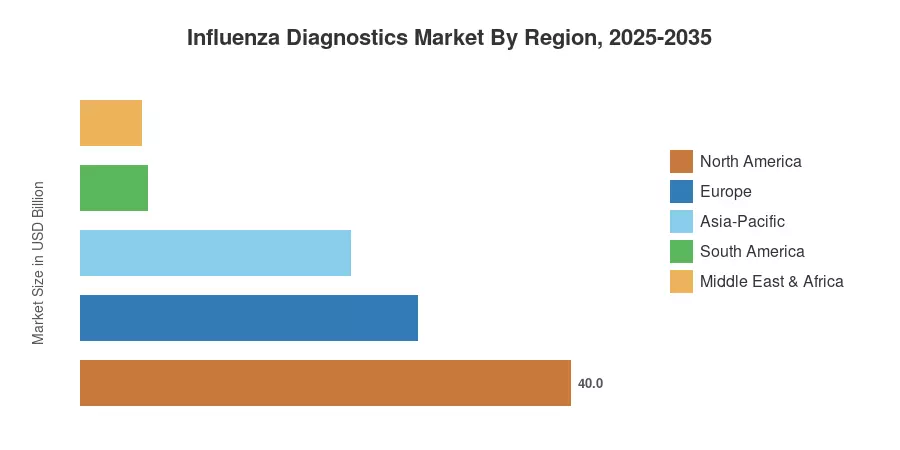
North America has around 40.0% of the Influenza Diagnostics Market due to a large installed base and a conducive reimbursement scenario. The Asia-Pacific region is the fastest-developing region with a CAGR of 8.40% through 2035. China, India and ASEAN countries are building laboratory infrastructure. Europe comes second with 27.5% through the EU’s integrated Epidemic Intelligence system and harmonized IVD regulation [4]. As co-circulation of influenza with other respiratory viruses becomes an annual planning assumption, diagnostic demand will stay structurally elevated through 2035.


Key Report Takeaways

• By Test Type

  • Rapid Influenza Diagnostic Tests captured 44.0% of the Influenza Diagnostics Market share in 2025, remaining the highest-volume test category despite lower sensitivity than molecular alternatives.
  • CRISPR-based assays are projected to grow at a 10.0% CAGR through 2035, the fastest among all test type sub-segments.
  • RT-PCR platforms accounted for USD 0.54 billion in 2025 revenue, underpinned by hospital laboratory procurement cycles.

• By End User

  • Hospitals and Clinical Laboratories held 45.0% of the Influenza Diagnostics Market in 2025, reflecting centralized testing workflows.
  • Point-of-care settings are forecast to expand at a 9.85% CAGR to 2035, supported by decentralized care models.

• By Geography

  • North America commanded 40.0% of revenue in 2025, led by U.S. reimbursement clarity and laboratory density.
  • Asia-Pacific is anticipated to grow at an 8.40% CAGR to 2035, the fastest among all regions.


Influenza Diagnostics Market Size and Forecast (2021–2035)

Market Research Future (MRFR) follows a triangulated approach that includes initial interviews with hospital procurement officers and laboratory directors, secondary research of IVD regulatory submissions, and proprietary demand modeling based on seasonal influenza monitoring data. Historical data are derived from actual diagnostic volumes scaled for average selling price deflation, and forecast estimates include pipeline product launches and announced reimbursement policy changes through Q1 2025.
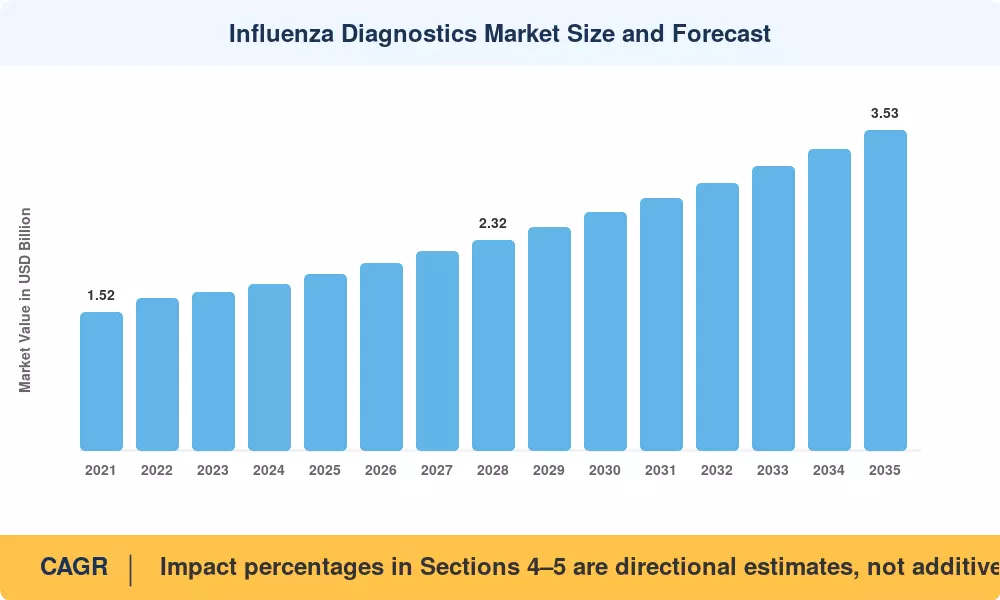
Influenza Diagnostics Market Size and Forecast
Our Impact
Enabled $4.3B Revenue Impact for Fortune 500 and Leading Multinationals
Partnering with 2000+ Global Organizations Each Year
30K+ Citations by Top-Tier Firms in the Industry

Driver Impact Analysis

Driver ~% Impact on CAGR Geographic Relevance Impact Timeline
Molecular platform migration +1.4% Global Medium-term (2–4 yr)
Government surveillance funding +1.1% North America, Europe Short-term (≤2 yr)
At-home and POC test adoption +0.9% North America, Asia-Pacific Medium-term (2–4 yr)
AI-enabled lab workflow optimization +0.6% North America, Europe Long-term (≥4 yr)
Multiplex respiratory panel expansion +0.5% Global Medium-term (2–4 yr)
Seasonal flu vaccine mismatch episodes +0.4% Global Short-term (≤2 yr)
Emerging market lab infrastructure buildout +0.8% Asia-Pacific, South America Long-term (≥4 yr)


Molecular Platform Migration

Hospital systems worldwide are retiring first-generation rapid antigen tests in favor of RT-PCR and isothermal amplification platforms that deliver sensitivities above 95%, compared with 50–70% for lateral-flow antigen devices [2]. The U.S. Hospital Preparedness Program allocated USD 385 million in 2024 for laboratory modernization, with molecular influenza testing explicitly listed as an eligible expenditure [5]. This replacement cycle is compressing legacy test volumes while expanding per-test revenue for the Influenza Diagnostics Market.

Government Surveillance Funding

National influenza surveillance remains a pillar of pandemic preparedness. The WHO Global Influenza Surveillance and Response System (GISRS) coordinates data from 148 national influenza centers, each requiring validated diagnostic capacity [1]. In 2024, the European Commission earmarked EUR 220 million under Horizon Europe for respiratory pathogen surveillance, directly stimulating demand for WHO-prequalified influenza assays across 27 member states [7].

At-Home and POC Test Adoption

Consumer comfort with self-testing—forged during the COVID-19 era—has transferred to influenza. The U.S. FDA cleared three new over-the-counter flu/COVID combination tests during 2024, collectively capturing an estimated 8% of all influenza tests performed in the U.S. that year [6]. Pharmacy chains are stocking these products seasonally, converting what was once a clinical encounter into a retail transaction and expanding the addressable Influenza Diagnostics Market.

AI-Enabled Laboratory Workflow Optimization

Machine-learning algorithms embedded in molecular analyzers are reducing hands-on technician time by an average of 25% per batch, according to a 2024 benchmarking study across 38 U.S. reference laboratories [3]. Automated result interpretation and quality-flag detection cut repeat testing rates by 12%, lowering per-sample costs and making high-throughput molecular testing economically viable even for mid-tier hospital laboratories.


Restraints Impact Analysis

The restraint impact percentages below represent directional estimates of how each factor dampens the Influenza Diagnostics Market growth trajectory. These figures are not directly subtracted from the headline CAGR; they reflect qualitative magnitude assessments.

Restraint ~% Impact on CAGR Geographic Relevance Impact Timeline
Reimbursement compression for rapid tests –0.6% North America, Europe Short-term (≤2 yr)
Seasonal demand volatility –0.5% Global Short-term (≤2 yr)
Regulatory approval timelines for novel assays –0.4% Global Medium-term (2–4 yr)
Limited cold-chain infrastructure in LMICs –0.4% Africa, South America Long-term (≥4 yr)
Competitive displacement by multiplex panels –0.3% North America, Europe Medium-term (2–4 yr)


Reimbursement Compression

Medicare's 2025 Clinical Laboratory Fee Schedule reduced reimbursement for rapid influenza tests by approximately 8%, squeezing margins for hospital outpatient departments and independent laboratories [11]. When payers lower per-test payments, laboratories face pressure to consolidate testing volumes onto fewer platforms, slowing the pace of new instrument adoption and constraining revenue growth in the Influenza Diagnostics Market.

Seasonal Demand Volatility

Influenza diagnostic volumes remain inherently seasonal, with 60–70% of annual testing concentrated in a 16-week Northern Hemisphere window from November through February [16]. This creates procurement uncertainty, strains supply chains during peak periods, and leaves installed capacity underutilized for roughly six months each year—a pattern that discourages capital-intensive instrument placements in cost-sensitive settings.

Regulatory Approval Timelines

The EU's In Vitro Diagnostic Regulation (IVDR), fully enforced since May 2022, requires Class D self-test and high-risk diagnostic products to undergo Notified Body review—a process averaging 18–24 months for novel influenza assays [7]. Several manufacturers have delayed European launches of CRISPR-based and next-generation LAMP products, temporarily limiting the addressable competitive landscape in a market representing over a quarter of global demand.


Influenza Diagnostics Market Opportunities

Multiplex Respiratory Panel Expansion

Combination flu/COVID/RSV panels represent the single largest near-term revenue opportunity for the Influenza Diagnostics Market. U.S. CMS issued a dedicated CPT billing code for triplex respiratory panels in January 2025, removing a key reimbursement barrier [10]. Manufacturers that embed influenza targets within broader respiratory menus will capture incremental testing occasions that standalone flu assays cannot reach.

Emerging Market Laboratory Buildout

India's National Health Mission plans to equip 12,000 primary health centers with rapid molecular testing capability by 2028, creating a greenfield Influenza Diagnostics Market worth an estimated USD 85 million annually [12]. Similar investments are underway in Indonesia, Nigeria, and Brazil, where WHO-supported sentinel sites require validated diagnostic products.

Data Monetization through Syndromic Surveillance

Connected diagnostic platforms generate real-time geolocation-tagged testing data that pharmaceutical companies, public-health agencies, and insurers are willing to license. Vendors offering anonymized flu prevalence dashboards alongside their instrument placements can build recurring SaaS revenue streams, diversifying beyond consumable margins.

CRISPR-Based Assay Commercialization

CRISPR diagnostics combine molecular-level sensitivity with lateral-flow simplicity, targeting a price point 30–40% below RT-PCR while maintaining specificity above 97% [6]. As manufacturing scale improves through 2028, CRISPR platforms could disrupt both the rapid antigen and molecular segments of the Influenza Diagnostics Market simultaneously.

Veterinary and Agricultural Influenza Screening

Avian influenza outbreaks—H5N1 circulated in U.S. dairy herds during 2024—have created demand for high-throughput veterinary screening [18]. Diagnostic manufacturers with dual-use (human/veterinary) platform clearances can access a supplementary revenue channel estimated at USD 150 million globally by 2030.


Influenza Diagnostics Market Future Outlook

AI-Integrated Diagnostic Workflows

By 2030, an estimated 35% of high-volume clinical laboratories will employ AI-driven pre-analytical sorting and result interpretation systems, according to KLAS Research projections [3]. For the Influenza Diagnostics Market, this translates into higher throughput per instrument, reduced error rates, and lower staffing costs—factors that expand the economic viability of molecular testing in facilities that previously relied on cheaper antigen tests.

Platform Convergence and Multiplex Economics

The diagnostic industry is converging toward modular platforms capable of running influenza, COVID-19, RSV, and strep panels on a single cartridge [10]. This platform economics model favors vendors who control both the analyzer and consumable supply chain, reshaping competitive dynamics within the Influenza Diagnostics Market. By 2032, multiplex panels could represent over 30% of all influenza tests performed globally.

Decentralized and At-Home Testing Expansion

Consumer self-testing for influenza will expand beyond the U.S. and Europe into middle-income markets as manufacturing costs for lateral-flow and CRISPR-based devices decline below USD 5 per unit by 2028 [6]. This channel broadens the Influenza Diagnostics Market beyond traditional institutional buyers and introduces retail pharmacy chains and e-commerce platforms as significant distribution partners.

One Health Surveillance Integration

The convergence of human and veterinary influenza surveillance—accelerated by H5N1 spillover events—will create demand for dual-use diagnostic platforms validated for both clinical and agricultural samples [18]. The WHO One Health framework, supported by a USD 1.5 billion quadripartite investment through 2030, positions influenza diagnostics as a cross-sectoral budget line rather than a purely clinical expenditure.


Influenza Diagnostics Market Segmentation

By Test Type

Segment Share of Market (2025) Primary Demand Driver
Traditional Diagnostic Tests    
Rapid Influenza Diagnostic Tests 44.0% Speed, low cost, pharmacy/POC accessibility
Viral Culture 6.5% Reference laboratory strain characterization
Other Traditional Tests 4.5% Immunofluorescence for hospital confirmation
Molecular Diagnostic Tests    
RT-PCR USD 0.54 Billion Gold-standard sensitivity for hospital labs
LAMP 6.20% CAGR Isothermal simplicity for decentralized sites
Other Molecular Tests (incl. CRISPR) 10.0% CAGR Emerging platforms with field-deployable form factors


Rapid Influenza Diagnostic Tests remain the volume leader in the Influenza Diagnostics Market, deployed across emergency departments, urgent care clinics, and retail pharmacies where turnaround time under 15 minutes outweighs sensitivity limitations. Their 44.0% share reflects the sheer breadth of point-of-care testing occasions during each flu season, even as molecular alternatives gain clinical preference.

RT-PCR continues to anchor the molecular segment with revenue of USD 0.54 billion in 2025. Hospital laboratory procurement cycles favor established RT-PCR platforms from vendors like Roche and Cepheid, where the existing installed base reduces switching costs. The Influenza Diagnostics Market is witnessing growing competition from CRISPR-based assays, which are projected to grow at a 10.0% CAGR and could disrupt the mid-tier testing space by offering molecular accuracy at near-antigen pricing.

By End User

Segment Metric Primary Demand Driver
Hospitals and Clinical Laboratories 45.0% share (2025) Centralized high-volume testing workflows
Independent Diagnostic Laboratories USD 0.37 Billion (2025) Reference testing and insurance-billed panels
Point-of-Care Settings 9.85% CAGR Retail pharmacy, urgent care, at-home testing
Other End Users 4.0% share (2025) Research institutions, veterinary labs


Hospitals and clinical laboratories dominate the Influenza Diagnostics Market with a 45.0% share, functioning as the primary gatekeepers for molecular test ordering during flu season. Large health systems increasingly standardize on a single molecular platform across all sites, creating sticky vendor relationships and multi-year reagent rental contracts.

Point-of-care settings represent the most dynamic growth vector, expanding at a 9.85% CAGR. The convergence of FDA-cleared OTC flu tests, telehealth-initiated test-and-treat pathways, and employer-sponsored workplace testing programs is pulling diagnostic volume out of centralized laboratories and into decentralized channels across the Influenza Diagnostics Market.


Regional Market Share Analysis

Region Share of Global Revenue (2025) Primary Investment Themes
North America 40.0% Laboratory modernization, OTC flu test adoption
Europe 27.5% IVDR compliance, EU surveillance harmonization
Asia-Pacific 22.0% Public-health lab buildout, multiplex adoption
South America 5.5% WHO sentinel site expansion, PAHO procurement
Middle East & Africa 5.0% Infectious disease program funding, cold-chain development
Total 100.0%

The Influenza Diagnostics Market exhibits distinct regional demand patterns shaped by healthcare infrastructure maturity, reimbursement frameworks, and seasonal epidemiology.


North America

Country CAGR (2026–2035) Key Driver
United States 5.80% CMS reimbursement clarity and a large hospital installed base
Canada 5.45% Provincial public-health laboratory network upgrades
Mexico 6.70% IMSS diagnostic modernization program


The U.S. accounts for over 85% of the North American Influenza Diagnostics Market revenue, supported by approximately 260,000 CLIA-certified laboratories and an established seasonal testing workflow [1]. Canada's interprovincial NML reference network and Mexico's expanding IMSS infrastructure contribute incremental growth, though both remain price-sensitive relative to the U.S. market.

Europe

Country Share of Regional Revenue (2025) Key Driver
Germany 22.0% University Hospital Molecular Platform Procurement
United Kingdom 18.5% NHS respiratory testing integration
France 15.0% Santé Publique France surveillance mandates
Italy 11.5% InfluNet sentinel laboratory network
Spain 9.0% Sistema Nacional de Salud diagnostic reforms
Nordic Countries 8.5% High per-capita testing rates
Russia 7.0% Federal flu surveillance program
Rest of Europe 8.5% Mixed adoption across CEE markets


Europe's Influenza Diagnostics Market is shaped by the IVDR regulatory transition, which has consolidated the vendor landscape around manufacturers with the resources to navigate Class D conformity assessment. Germany and the UK together represent over 40% of regional demand, with both markets actively shifting from antigen-based to molecular-first testing algorithms in acute-care settings [7].

Asia-Pacific

Country CAGR (2026–2035) Key Driver
China 8.60% CDC-mandated provincial laboratory upgrades
India 9.50% National Health Mission rapid test deployment
Japan 5.90% An aging population and high flu vaccination awareness
South Korea 6.80% HIRA reimbursement for molecular flu tests
ASEAN 9.10% WHO-supported sentinel surveillance scale-up
Rest of Asia-Pacific 7.40% Heterogeneous public-health investments


Asia-Pacific is the fastest-growing region in the Influenza Diagnostics Market, powered by government-led laboratory buildout programs across China and India. Japan maintains the highest per-capita testing rate in the region, driven by a culturally embedded flu-awareness campaign and universal health coverage that reimburses both rapid and molecular tests [9].

South America

Country Share of Regional Revenue (2025) Key Driver
Brazil 52.0% SUS public-health system procurement
Argentina 22.0% ANLIS Malbrán reference laboratory network
Rest of South America 26.0% PAHO-assisted flu sentinel programs


Brazil dominates the South American Influenza Diagnostics Market through its Unified Health System (SUS), which procures centralized diagnostic kits for over 5,500 public hospitals. PAHO's revolving fund mechanism enables smaller economies to access WHO-prequalified rapid tests at discounted pricing, sustaining baseline demand across the region [17].

Middle East & Africa

Country CAGR (2026–2035) Key Driver
Saudi Arabia 7.20% Vision 2030 healthcare infrastructure investment
UAE 6.90% Medical tourism and private hospital density
South Africa 7.80% NICD respiratory surveillance program
Egypt 8.10% WHO Eastern Mediterranean regional hub
Rest of MEA 6.50% Donor-funded infectious disease programs


The Middle East & Africa represent the smallest but a strategically significant portion of the Influenza Diagnostics Market. Saudi Arabia's Vision 2030 is funding 22 new hospital complexes with integrated molecular laboratories, while South Africa's NICD operates the continent's most advanced influenza surveillance network with over 40 sentinel sites [17].


Influenza Diagnostics Market By Region, 2025-2035

Competitive Benchmarking

The Influenza Diagnostics Market is moderately concentrated, with the top five players anticipated to possess a 55-60% revenue share. The Herfindahl-Hirschman Index (HHI) is between 1,200 and 1,500, representing a fairly competitive structure with prominent molecular platform providers and niche quick test producers. Recent M&A activity has sped up vendor consolidation with the merging of Quidel and Ortho Clinical Diagnostics.

Company Est. Revenue Share Range Key Offerings Strategic Positioning
Roche Diagnostics ~12–15% cobas Liat Flu/COVID, cobas 6800/8800 respiratory panels Full-spectrum molecular with global distribution
Abbott Laboratories ~10–13% ID NOW Influenza A&B, BinaxNOW Flu Rapid molecular and antigen dual portfolio
QuidelOrtho Corporation ~8–11% Sofia Influenza A+B FIA, Solana Influenza Integrated immunoassay-to-molecular migration
Hologic Inc. ~6–9% Panther Fusion Flu A/B/RSV High-throughput automated molecular
bioMérieux SA ~5–8% BioFire FilmArray Respiratory Panel Multiplex syndromic panel leader
Becton, Dickinson and Company ~4–7% BD Veritor Plus Flu A+B, BD MAX Respiratory Point-of-care antigen with molecular backup
Cepheid (Danaher) ~4–6% Xpert Xpress Flu/RSV CLIA-waived molecular for near-patient use
Thermo Fisher Scientific ~3–5% Applied Biosystems TaqPath Flu assays Laboratory reference and surveillance focus
Meridian Bioscience ~2–4% Alethia Influenza A&B Isothermal molecular for mid-tier labs
Siemens Healthineers ~2–3% FLU A/B assay for Atellica platform Integrated laboratory automation ecosystem


Recent News & Developments


  • Thermo Fisher Scientific (June 2025): Thermo Fisher Scientific announced plans to divest parts of its diagnostics business for approximately USD 4 billion, including its microbiology division that generates USD 1.4 billion in annual sales.
  • HealthTrackRx (April 2025): HealthTrackRx and the CDC unveiled a rapid H5N1 PCR test to strengthen outbreak readiness.


Influenza Diagnostics Market Report Scope

Parameter Detail
Market Scope Global Influenza Diagnostics Market across test type, end user, and geography
Study Period 2021–2035
CAGR (Forecast Period) 6.15% (2026–2035)
Market Size (2025) USD 1.94 Billion
Market Size (2035) USD 3.53 Billion
Fastest Growing Segment (Test Type) CRISPR-based / Other Molecular Tests (10.0% CAGR)
Fastest Growing Segment (End User) Point-of-Care Settings (9.85% CAGR)
Companies Profiled 10 (Roche, Abbott, QuidelOrtho, Hologic, bioMérieux, BD, Cepheid, Thermo Fisher, Meridian, Siemens)
Valuation Currency USD Billion
CAGR Driver Disclaimer Impact percentages in Sections 4–5 are directional estimates, not additive components of the headline CAGR.


FAQs

How do CRISPR-based flu assays differ from RT-PCR in clinical workflow requirements?
CRISPR assays run at constant temperature and need no thermocycler, cutting instrument costs by roughly 60% versus RT-PCR setups [21]. Results are typically available in 45 minutes with minimal hands-on steps.
What procurement model offers the best total cost of ownership for mid-size hospital laboratories?
Reagent-rental agreements bundle analyzer placement with per-test consumable pricing, eliminating upfront capital expenditure [14]. This model favors facilities running 20–50 influenza tests daily during peak season.
How does the WHO prequalification process affect market entry timelines for new influenza diagnostics?
WHO prequalification requires 12–18 months of clinical validation data from at least two geographic regions [9]. Manufacturers targeting LMIC procurement channels cannot access PAHO or Global Fund purchasing without this certification.
What impact do flu vaccine mismatch seasons have on diagnostic testing volumes?
Mismatch years increase symptomatic patient presentations by 15–25%, driving proportional rises in diagnostic test orders [16]. Laboratories typically see peak-week volumes spike 30% above matched-season averages.
How are telehealth platforms integrating influenza diagnostic pathways?
Several U.S. telehealth providers now ship OTC flu test kits to patients and initiate antiviral prescriptions based on positive results within a single virtual visit [6]. This test-and-treat model bypasses traditional laboratory workflows entirely.
What cybersecurity considerations apply to connected influenza diagnostic instruments?
Network-connected analyzers transmit patient health information requiring HIPAA-compliant encryption and access controls [3]. FDA's 2024 premarket cybersecurity guidance mandates threat modeling for all Class II connected diagnostic devices.
How does the Influenza Diagnostics Market address co-infection scenarios with RSV and COVID-19?
Multiplex panels detect all three pathogens from a single specimen, reducing swab burden and enabling targeted antiviral therapy within one clinical encounter [10]. Reimbursement parity for triplex panels was established in the U.S. in January 2025.    
What is the current size of the influenza diagnostics market?
The influenza diagnostics market reached USD 1.94 billion in 2025 and is projected to reach USD 3.53 billion by 2035.
What is the CAGR of the influenza diagnostics market?
The influenza diagnostics market is projected to grow at a CAGR of 6.15% during the forecast period 2026–2035.
Which region leads the influenza diagnostics market?
North America holds the largest share at 40.0%, while Asia-Pacific is the fastest-growing region at 8.40% CAGR.
What is driving growth in the influenza diagnostics market?
Growth in the influenza diagnostics market is primarily driven by the migration from traditional culture-based methods to molecular diagnostic platforms, rising government surveillance funding, and growing adoption of at-home and point-of-care testing.
Author
Author
Author Profile
Satyendra Maurya LinkedIn
Research Analyst
An accomplished research analyst with high proficiency in market forecasting, data visualization, competitive benchmarking, and others. He holds a pronounced track record in research and consulting projects for sectors such as life sciences, medical devices, and healthcare IT. His capabilities in qualitative and quantitative analysis have resulted in positive client outcomes. Working on niche market trends, opportunities, sales, and forecasted value is part of his skill set.
Co-Author
Co-Author Profile
Rahul Gotadki LinkedIn
Research Manager
He holds an experience of about 9+ years in Market Research and Business Consulting, working under the spectrum of Life Sciences and Healthcare domains. Rahul conceptualizes and implements a scalable business strategy and provides strategic leadership to the clients. His expertise lies in market estimation, competitive intelligence, pipeline analysis, customer assessment, etc.

Research Approach


Secondary Research

The secondary research process involved comprehensive analysis of infectious disease surveillance databases, regulatory filings, peer-reviewed virology journals, clinical microbiology publications, and authoritative public health organizations. Key sources included the Centers for Disease Control and Prevention (CDC) including FluView surveillance data and Influenza Hospitalization Surveillance Network (FluSurv-NET), World Health Organization (WHO) Global Influenza Programme (GIP) and Global Influenza Surveillance and Response System (GISRS), European Centre for Disease Prevention and Control (ECDC), US Food & Drug Administration (FDA) in vitro diagnostic device clearances and Emergency Use Authorizations (EUAs), Biomedical Advanced Research and Development Authority (BARDA), National Institute of Allergy and Infectious Diseases (NIAID), National Institutes of Health (NIH), Health and Human Services (HHS) ASPR division, Public Health England (UK Health Security Agency), EU Eurostat Health Database, WHO FluNet, CDC Outpatient Influenza-like Illness Surveillance Network (ILINet), National Respiratory and Enteric Virus Surveillance System (NREVSS), and national health ministry surveillance reports from key markets.

These sources were employed to gather epidemiological statistics, regulatory approval data for RIDTs and molecular assays, clinical sensitivity/specificity studies, seasonal outbreak trends, and competitive landscape analysis for rapid antigen tests, RT-PCR platforms, loop-mediated isothermal amplification (LAMP), and emerging CRISPR-based diagnostics.


Primary Research

Qualitative and quantitative insights were obtained by interviewing supply-side and demand-side stakeholders during the primary research process. CEOs, VPs of Research & Development, regulatory affairs chiefs, and commercial directors from in vitro diagnostic (IVD) manufacturers, molecular diagnostic platform developers, and rapid test kit producers comprised supply-side sources. Demand-side sources included procurement leads from hospitals, independent diagnostic laboratories, urgent care centers, and academic medical institutions, as well as laboratory directors, infectious disease specialists, clinical microbiologists, and point-of-care testing coordinators. Primary research has confirmed product development pipelines for multiplex respiratory panels, validated market segmentation across test types (RIDT, molecular, viral culture), and gathered insights on laboratory adoption patterns, CLIA-waived testing expansion, pricing strategies for rapid vs. molecular assays, and reimbursement dynamics for influenza testing.

Primary Respondent Breakdown:

• By Designation: C-level Primaries (32%), Director Level (34%), Others (34%)

• By Region: North America (32%), Europe (30%), Asia-Pacific (28%), Rest of World (10%)


Market Size Estimation

Revenue mapping and testing volume analysis were employed to determine the global market valuation. The methodology comprised the following:

• The identification of over 50 main diagnostic manufacturers in North America, Europe, Asia-Pacific, and Latin America

• Product mapping between rapid influenza diagnostic tests (RIDTs), RT-PCR assays, isothermal amplification tests, viral culture media, and emerging CRISPR-based diagnostic platforms

• Examination of influenza diagnostic portfolios and respiratory panel assays' annual revenues, as reported and modeled

• In 2024, the coverage of manufacturers will account for 75-80% of the global market share.

• Segment-specific valuations across hospital laboratories, point-of-care settings, and home-based testing environments are derived through extrapolation using bottom-up (test volume × ASP by country/setting) and top-down (manufacturer revenue validation) approaches.

Download Free Sample

Kindly complete the form below to receive a free sample of this Report

Download PDF ×

We do not share your information with anyone. However, we may send you emails based on your report interest from time to time. You may contact us at any time to opt-out.
















