×
Request Free Sample ×

Kindly complete the form below to receive a free sample of this Report

* Please use a valid business email

Leading companies partner with us for data-driven Insights

clients tt-cursor
Hero Background

Integrated Operating Room Management Systems Market

ID: MRFR/HC/5441-CR
160 Pages
Rahul Gotadki
December 2018

Integrated Operating Room Management Systems Market Trends, Growth and Size Analysis by Device (Operating Tables Types, Operating Room Lights, Intraoperative Diagnostic Devices, Operating Room Communication Systems), Surgical Application (Therapeutics Application, Diagnostics Imaging Application), Type (Operating Room and Procedure Scheduling System, Recording and Documentation System, Instrument Tracking System, Audio and Video Management System, Operating Room Inventory Management System, Anesthesia Information Management), and Region - Fo... read more

Share:
Download PDF ×

We do not share your information with anyone. However, we may send you emails based on your report interest from time to time. You may contact us at any time to opt-out.

Integrated Operating Room Management Systems Market Infographic
Purchase Options

Integrated Operating Room Management Systems Market Summary

As per MRFR analysis, the Integrated Operating Room Management Systems Market was estimated at 1.72 USD Million in 2024. The Integrated Operating Room Management Systems industry is projected to grow from 1.87 USD Million in 2025 to 3.81 USD Million by 2035, exhibiting a compound annual growth rate (CAGR) of 7.47 during the forecast period 2025 - 2035.

Key Market Trends & Highlights

The Integrated Operating Room Management Systems Market is poised for substantial growth driven by technological advancements and increasing demand for efficiency.

  • Technological advancements are reshaping the Integrated Operating Room Management Systems Market, enhancing surgical workflows and data management.
  • North America remains the largest market, while the Asia-Pacific region is emerging as the fastest-growing area for integrated operating room solutions.
  • Surgical Workflow Management is the largest segment, whereas Resource Management is witnessing the fastest growth in adoption.
  • Key market drivers include technological integration and increased surgical volume, which are pivotal in shaping market dynamics.

Market Size & Forecast

2024 Market Size 1.72 (USD Million)
2035 Market Size 3.81 (USD Million)
CAGR (2025 - 2035) 7.47%

Major Players

Stryker (US), Siemens Healthineers (DE), GE Healthcare (US), Philips Healthcare (NL), Medtronic (US), Johnson & Johnson (US), Olympus Corporation (JP), Getinge (SE), B. Braun Melsungen AG (DE)

Integrated Operating Room Management Systems Market Trends

The Integrated Operating Room Management Systems Market is currently experiencing a transformative phase, driven by advancements in technology and the increasing demand for efficiency in surgical environments. These systems integrate various components, including scheduling, inventory management, and real-time data analytics, to streamline operations within operating rooms. As healthcare facilities strive to enhance patient outcomes and optimize resource utilization, the adoption of these integrated solutions appears to be gaining momentum. Furthermore, the emphasis on patient safety and the need for compliance with regulatory standards are likely to propel the market forward, as hospitals seek to implement systems that ensure high-quality care. In addition, the growing trend towards minimally invasive surgeries and the rising complexity of surgical procedures necessitate sophisticated management systems that can adapt to evolving needs. The integration of artificial intelligence and machine learning into these platforms may further enhance decision-making processes, allowing for more precise surgical planning and execution. As the healthcare landscape continues to evolve, the Integrated Operating Room Management Systems Market is poised for significant growth, reflecting the ongoing commitment to improving surgical efficiency and patient care across the globe.

Technological Advancements

The integration of cutting-edge technologies, such as artificial intelligence and machine learning, is reshaping the landscape of the Integrated Operating Room Management Systems Market. These innovations facilitate enhanced data analysis and decision-making, potentially leading to improved surgical outcomes.

Focus on Patient Safety

An increasing emphasis on patient safety is driving the demand for integrated systems that ensure compliance with regulatory standards. Healthcare facilities are likely to adopt solutions that prioritize safety protocols and streamline processes to minimize risks during surgical procedures.

Rising Demand for Efficiency

The need for operational efficiency within surgical environments is propelling the adoption of integrated management systems. As healthcare providers seek to optimize resource allocation and reduce costs, these systems may become essential for maintaining high standards of care.

Integrated Operating Room Management Systems Market Drivers

Rising Demand for Surgical Efficiency

The Global Integrated Operating Room Management System Industry experiences a notable increase in demand for surgical efficiency. Hospitals and surgical centers are increasingly adopting integrated systems to streamline operations, reduce delays, and enhance patient outcomes. This trend is driven by the need to optimize resource utilization and minimize surgical errors. As of 2024, the market is valued at 5.79 USD Billion, reflecting a growing recognition of the importance of efficient surgical workflows. The integration of advanced technologies such as real-time data analytics and automated scheduling further supports this demand, positioning the industry for substantial growth.

Market Segment Insights

By Application: Surgical Workflow Management (Largest) vs. Resource Management (Fastest-Growing)

In the Integrated Operating Room Management Systems Market, Surgical Workflow Management holds the largest share among the application segments, showcasing its critical importance in enhancing surgical efficiency and patient outcomes. This segment optimizes surgical schedules, minimizes delays, and manages the entire workflow seamlessly, which contributes to its dominance in the market. In contrast, Resource Management, while currently smaller in market share, is rapidly gaining traction due to the increasing demand for resource optimization in hospitals. This segment focuses on ensuring that surgical instruments and personnel are effectively utilized, directly impacting operational efficiency. The growth of the Integrated Operating Room Management Systems Market is being significantly driven by technological advancements and the increasing need for streamlined processes in surgical environments. Hospitals are increasingly adopting innovative solutions to enhance their surgical workflows, driven by the need for improved patient care and operational efficiency. The Resource Management segment is emerging as a key player, contributing to faster growth as healthcare facilities recognize the importance of managing resources effectively, leading to reduced costs and enhanced service delivery. Overall, the combination of Surgical Workflow Management's established presence and Resource Management's rapid growth reflects the evolving demands of the healthcare industry.

Surgical Workflow Management (Dominant) vs. Resource Management (Emerging)

Surgical Workflow Management is a dominant force in the Integrated Operating Room Management Systems Market, characterized by its focus on optimizing surgical processes and enhancing overall efficiency. This segment plays a vital role in scheduling, staffing, and real-time monitoring, enabling surgical teams to work cohesively and effectively. Its established presence stems from its ability to significantly improve patient outcomes and operational efficiency. On the other hand, Resource Management is emerging as a key segment, offering innovative solutions that address the pressing need for optimal use of surgical resources. This includes managing inventory, staff allocation, and surgical equipment, which reduces waste and saves costs. As healthcare facilities face increasing pressures to deliver high-quality care with limited resources, the Resource Management segment is poised for substantial growth, creating a strong competitive landscape within the Integrated Operating Room Management Systems.

By End Use: Hospitals (Largest) vs. Ambulatory Surgical Centers (Fastest-Growing)

The Integrated Operating Room Management Systems Market is notably dominated by hospitals, which account for a significant portion of the overall market share. This segment leverages advanced technology to streamline operations, enhance patient outcomes, and optimize surgical workflows. In comparison, ambulatory surgical centers, while smaller in market share, are rapidly gaining traction as they offer cost-effective and efficient surgical solutions, appealing to a growing number of patients seeking outpatient care. Recent trends indicate that hospitals continue to invest heavily in integrated operating room management systems as they seek to improve operational efficiency and patient safety. Conversely, ambulatory surgical centers are expanding their services to include more complex procedures, thereby propelling their growth. As awareness of the advantages of outpatient surgeries increases, the demand for advanced technologies in these facilities is expected to surge significantly over the coming years.

Hospitals (Dominant) vs. Ambulatory Surgical Centers (Emerging)

Hospitals represent the dominant force in the Integrated Operating Room Management Systems Market, characterized by their large capacity and diverse range of surgeries performed. They integrate cutting-edge technologies into their operating rooms to enhance efficiency, patient outcomes, and surgical precision. With complex procedures being a hallmark of hospital environments, the demand for sophisticated management systems is crucial for ensuring streamlined operations and high-quality care. Meanwhile, ambulatory surgical centers are emerging as a competitive segment, providing a more flexible and cost-effective option for surgical procedures. These centers focus on outpatient care, allowing for quicker patient turnover and reduced hospital stay requirements, which appeals to both patients and insurers. Their adaptability and efficiency in managing less complex surgeries position them well for significant growth in this evolving market.

By Deployment Type: Cloud-Based (Largest) vs. Hybrid (Fastest-Growing)

In the Integrated Operating Room Management Systems Market, the deployment type segment is marked by a diverse distribution of solutions. The Cloud-Based deployment type has emerged as the largest segment, capitalizing on its flexibility and accessibility. Organizations are increasingly opting for cloud solutions due to their scalability and cost-effectiveness, establishing a significant share within the market. On the other hand, the Hybrid deployment model is gaining traction, offering a blend of on-premise and cloud services. This adaptability is resonating well with healthcare institutions seeking tailored solutions that fit their unique needs. Growth trends indicate a robust shift towards cloud-based solutions stemming from the rising demand for remote access and telemedicine integration in healthcare. The COVID-19 pandemic has accelerated this transition, highlighting the need for adaptable and efficient operating room management systems. Furthermore, advances in technology, such as improved cybersecurity and data management practices, are driving the adoption of Hybrid models, as institutions look for ways to strike a balance between control and flexibility. Overall, the deployment type segment is expected to continue evolving as healthcare providers seek innovative solutions for enhanced operational efficiency.

Cloud-Based (Dominant) vs. Hybrid (Emerging)

The Cloud-Based deployment type is characterized by its dominance in the Integrated Operating Room Management Systems Market due to numerous benefits, including ease of access, reduced IT overhead, and seamless updates. This deployment plays a critical role in promoting interoperability among different systems, enabling healthcare professionals to access real-time data and analytics from various locations. Meanwhile, the Hybrid deployment model is emerging as a vital player, blending the best of both on-premise and cloud environments. This approach caters to diverse needs, allowing organizations to utilize existing infrastructure while benefiting from cloud scalability and efficiency. As healthcare entities continue to prioritize data security, regulatory compliance, and tailored solutions, the Hybrid model is well-positioned to meet these demands, thus driving its growth in the market.

By Component: Software (Largest) vs. Services (Fastest-Growing)

In the Integrated Operating Room Management Systems Market, the component segment is primarily divided into three categories: Software, Hardware, and Services. Among these, Software holds the largest market share, driven by the increasing adoption of digital solutions in healthcare settings. Hardware, while essential, lags behind the software segment due to the ongoing trend towards virtualization and cloud-based applications. Services, however, are gaining traction as healthcare providers seek comprehensive support and integration solutions that enhance operational efficiency.

Services (Dominant) vs. Hardware (Emerging)

In the current market landscape, Services have emerged as the dominant force within the Integrated Operating Room Management Systems. This is largely due to an increasing need for maintenance, training, and support as hospitals and surgical centers transition to more sophisticated operating room management systems. In contrast, Hardware remains an emerging segment, as advancements in technology spur innovation but also create a lag in adoption. As system capabilities improve, hardware components are expected to evolve to meet evolving needs, providing a promising outlook for future growth. The shift towards integrated solutions underscores the importance of both segments in creating seamless operating room experiences.

Get more detailed insights about Integrated Operating Room Management Systems Market

Regional Insights

North America : Market Leader in Innovation

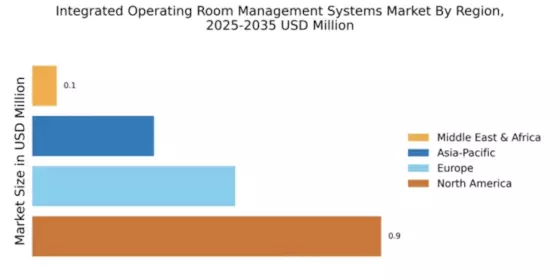
North America is poised to maintain its leadership in the Integrated Operating Room Management Systems market, holding a significant market share of 86% in 2024. The region's growth is driven by advanced healthcare infrastructure, increasing surgical procedures, and a strong emphasis on technological innovation. Regulatory support for healthcare digitization further propels demand, ensuring that hospitals adopt integrated solutions for improved efficiency and patient outcomes. The competitive landscape in North America is robust, featuring key players such as Stryker, GE Healthcare, and Medtronic. These companies are at the forefront of developing cutting-edge technologies that enhance surgical workflows. The U.S. remains the largest market, supported by substantial investments in healthcare technology and a growing trend towards minimally invasive surgeries, which require sophisticated operating room management systems.

Europe : Emerging Market with Growth Potential

Europe's Integrated Operating Room Management Systems market is projected to grow significantly, with a market size of €0.5 billion. The region benefits from stringent healthcare regulations that promote the adoption of advanced surgical technologies. Increased funding for healthcare infrastructure and a rising number of surgical procedures are key drivers of market growth. Additionally, the focus on improving patient safety and operational efficiency is pushing hospitals to invest in integrated systems. Leading countries in Europe include Germany, France, and the UK, where major players like Siemens Healthineers and Philips Healthcare are actively expanding their market presence. The competitive landscape is characterized by collaborations and partnerships aimed at enhancing product offerings. As hospitals seek to optimize surgical workflows, the demand for integrated solutions is expected to rise, positioning Europe as a significant player in the global market.

Asia-Pacific : Rapidly Growing Healthcare Sector

The Asia-Pacific region is witnessing rapid growth in the Integrated Operating Room Management Systems market, with a market size of $0.3 billion. Factors such as increasing healthcare expenditure, a growing aging population, and rising surgical procedures are driving demand for integrated solutions. Governments are also investing in healthcare infrastructure, which is crucial for the adoption of advanced operating room technologies. Regulatory frameworks are evolving to support innovation in healthcare delivery. Countries like Japan, China, and India are leading the charge in adopting integrated operating room systems. The competitive landscape features both global players and local companies, with significant investments in R&D to cater to the unique needs of the region. As healthcare providers focus on improving operational efficiency and patient care, the demand for integrated systems is expected to surge, making Asia-Pacific a key market to watch.

Middle East and Africa : Emerging Market with Challenges

The Integrated Operating Room Management Systems market in the Middle East and Africa is still in its nascent stages, with a market size of $0.06 billion. Despite challenges such as limited healthcare budgets and regulatory hurdles, the region is gradually recognizing the importance of integrated systems. Increasing investments in healthcare infrastructure and a growing focus on improving surgical outcomes are driving demand. Governments are beginning to implement policies that encourage the adoption of advanced technologies in healthcare. Countries like South Africa and the UAE are leading the way in adopting integrated operating room solutions. The competitive landscape is characterized by a mix of local and international players, with companies like Getinge and B. Braun Melsungen AG making significant inroads. As healthcare providers strive to enhance operational efficiency, the demand for integrated systems is expected to grow, albeit at a slower pace compared to other regions.

Key Players and Competitive Insights

The Integrated Operating Room Management Systems Market is characterized by a dynamic competitive landscape, driven by technological advancements and the increasing demand for efficient surgical environments. Key players such as Stryker (US), Siemens Healthineers (DE), and GE Healthcare (US) are at the forefront, each adopting distinct strategies to enhance their market positioning. Stryker (US) focuses on innovation through the development of advanced surgical instruments and integrated solutions, while Siemens Healthineers (DE) emphasizes digital transformation and data analytics to improve surgical outcomes. GE Healthcare (US) is leveraging partnerships with healthcare providers to expand its reach and enhance service delivery, collectively shaping a competitive environment that prioritizes technological integration and operational efficiency.

In terms of business tactics, companies are increasingly localizing manufacturing to reduce costs and optimize supply chains. The market appears moderately fragmented, with several key players exerting influence over various segments. This structure allows for a diverse range of offerings, catering to the specific needs of healthcare facilities worldwide. The collective strategies of these companies indicate a trend towards collaboration and innovation, which is likely to enhance overall market growth.

In November 2025, Stryker (US) announced the launch of its latest integrated operating room solution, which incorporates AI-driven analytics to streamline surgical workflows. This strategic move is significant as it positions Stryker at the cutting edge of technology, potentially improving surgical efficiency and patient outcomes. The integration of AI into operating room management systems may also set a new standard for operational excellence in the industry.

In October 2025, Siemens Healthineers (DE) expanded its partnership with a leading hospital network to implement its digital operating room solutions across multiple facilities. This collaboration is crucial as it not only enhances Siemens' market presence but also demonstrates the growing importance of digital solutions in modern surgical environments. By aligning with healthcare providers, Siemens is likely to gain valuable insights into user needs, further refining its offerings.

In September 2025, GE Healthcare (US) secured a multi-million dollar contract with a prominent healthcare institution to provide its integrated operating room management systems. This contract underscores GE's commitment to expanding its footprint in the market and highlights the increasing reliance on comprehensive solutions that enhance surgical efficiency. Such strategic contracts may bolster GE's competitive edge by ensuring long-term partnerships with key healthcare players.

As of December 2025, current trends in the Integrated Operating Room Management Systems Market include a pronounced shift towards digitalization, sustainability, and AI integration. Strategic alliances are increasingly shaping the competitive landscape, fostering innovation and collaboration among key players. The evolution of competitive differentiation appears to be moving away from price-based competition towards a focus on technological innovation, reliability in supply chains, and enhanced service delivery. This shift suggests that companies that prioritize these aspects may be better positioned to thrive in the future.

Key Companies in the Integrated Operating Room Management Systems Market market include

Industry Developments

However, the operating room management system assists to reduce surgical times develops coordination between healthcare providers and develops patient security. On the basis of uses, the market is classified into general surgery, orthopedic surgery, neurosurgery, thoracic surgery, cardiovascular surgery, and other uses. In 2019 the general surgery section consider the largest share of the integrated operating room management system market. Elements such as the rising cases of breast cancer, liver cancer, colorectal cancer, GI disorder, and endocrine disorder as well as the increasing number of general surgical procedures carried out worldwide are boosting the growth of the general surgery section.

Based on end-users, the OR market is divided into ambulatory, hospitals, surgery centers, and clinics. In 2019, the hospital section was considered for the widest share of the market. The large share of this section can be ascribed to the increasing emphasis on timely disease management.

Intended Audience:

    • Medical devices companies
    • Healthcare service providers
    • Research Organizations
    • Market research and consulting firms
    • Venture capitalists and investors

Future Outlook

Integrated Operating Room Management Systems Market Future Outlook

The Integrated Operating Room Management Systems Market is projected to grow at a 7.47% CAGR from 2024 to 2035, driven by technological advancements, increasing surgical procedures, and demand for operational efficiency.

New opportunities lie in:

  • Development of AI-driven surgical workflow optimization tools.
  • Integration of telemedicine capabilities for remote surgical consultations.
  • Expansion of customizable modular OR management solutions for diverse healthcare settings.

By 2035, the market is expected to achieve substantial growth, reflecting evolving healthcare demands and technological integration.

Market Segmentation

Integrated Operating Room Management Systems Market End Use Outlook

  • Hospitals
  • Ambulatory Surgical Centers
  • Specialty Clinics

Integrated Operating Room Management Systems Market Component Outlook

  • Software
  • Hardware
  • Services

Integrated Operating Room Management Systems Market Application Outlook

  • Surgical Workflow Management
  • Resource Management
  • Data Management
  • Communication Management

Integrated Operating Room Management Systems Market Deployment Type Outlook

  • On-Premise
  • Cloud-Based
  • Hybrid

Report Scope

MARKET SIZE 20241.72(USD Million)
MARKET SIZE 20251.87(USD Million)
MARKET SIZE 20353.81(USD Million)
COMPOUND ANNUAL GROWTH RATE (CAGR)7.47% (2024 - 2035)
REPORT COVERAGERevenue Forecast, Competitive Landscape, Growth Factors, and Trends
BASE YEAR2024
Market Forecast Period2025 - 2035
Historical Data2019 - 2024
Market Forecast UnitsUSD Million
Key Companies ProfiledStryker (US), Siemens Healthineers (DE), GE Healthcare (US), Philips Healthcare (NL), Medtronic (US), Johnson & Johnson (US), Olympus Corporation (JP), Getinge (SE), B. Braun Melsungen AG (DE)
Segments CoveredApplication, End Use, Deployment Type, Component
Key Market OpportunitiesIntegration of artificial intelligence enhances efficiency and decision-making in the Integrated Operating Room Management Systems Market.
Key Market DynamicsRising demand for efficiency drives technological advancements in Integrated Operating Room Management Systems, enhancing surgical workflows.
Countries CoveredNorth America, Europe, APAC, South America, MEA

Market Highlights

Author
Rahul Gotadki
Assistant Manager

He holds an experience of about 7+ years in Market Research and Business Consulting, working under the spectrum of Life Sciences and Healthcare domains. Rahul conceptualizes and implements a scalable business strategy and provides strategic leadership to the clients. His expertise lies in market estimation, competitive intelligence, pipeline analysis, customer assessment, etc. In addition to the above, his other responsibility includes strategic tracking of high growth markets & advising clients on the potential areas of focus they could direct their business initiatives

Leave a Comment

FAQs

At what CAGR is the integrated operating room management systems market projected to grow during the forecast period?

Integrated operating room management systems market projected to grow at a 10.9% CAGR between 2023-2032.

What will be the value of the integrated operating room management systems market during the forecast period?

Integrated operating room management systems market is predicted to touch USD 5.21 billion by 2032.

Which region is expected to lead the integrated operating room management systems market?

The Americas is expected to lead the integrated operating room management systems market.

Which surgical application will lead the integrated operating room management systems market?

The therapeutics segment will lead the integrated operating room management systems market.

What are the factors that may limit the integrated operating room management systems market growth?

High cost and risk factors may limit the integrated operating room management systems market growth.

Download Free Sample

Kindly complete the form below to receive a free sample of this Report

Compare Licence

×
Features License Type
Single User Multiuser License Enterprise User
Price $4,950 $5,950 $7,250
Maximum User Access Limit 1 User Upto 10 Users Unrestricted Access Throughout the Organization
Free Customization
Direct Access to Analyst
Deliverable Format
Platform Access
Discount on Next Purchase 10% 15% 15%
Printable Versions