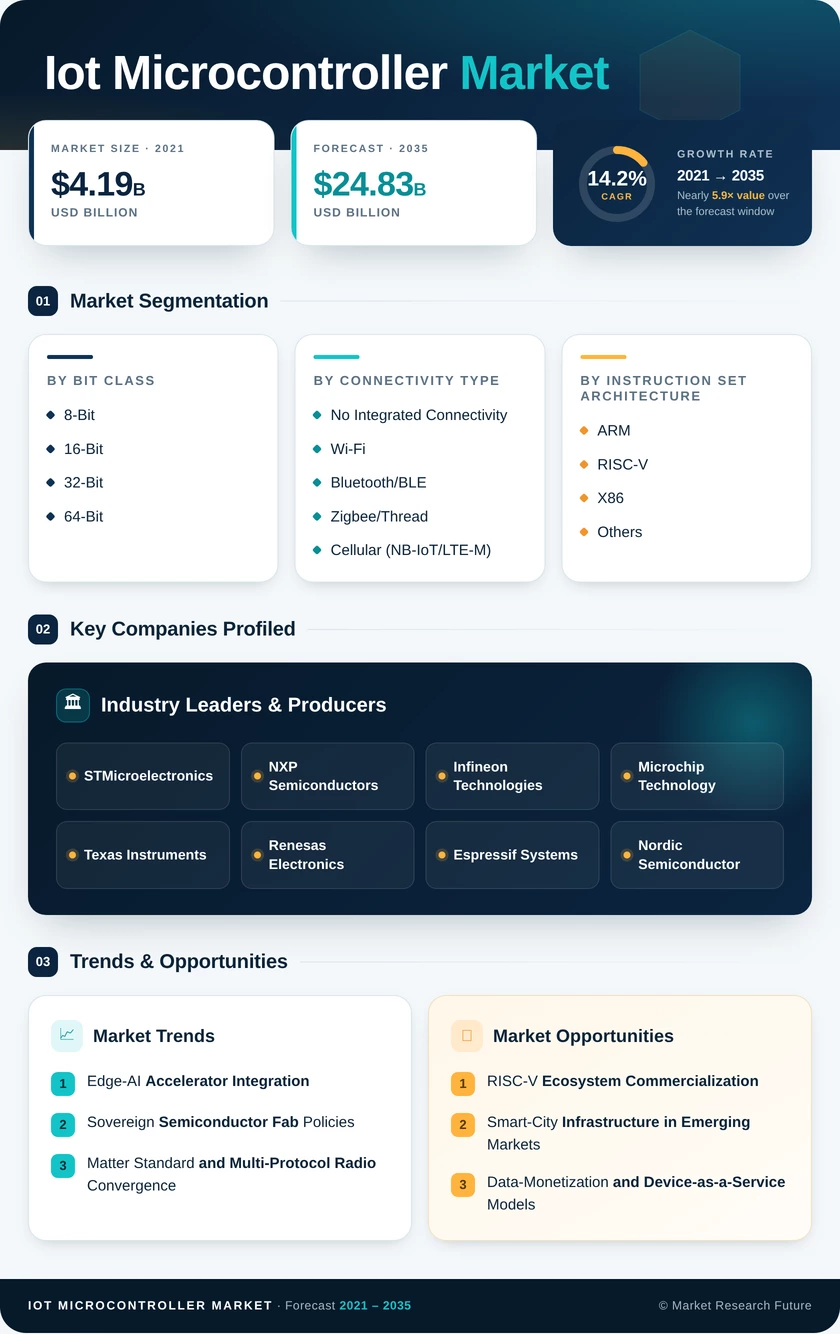
IoT Microcontroller Market (2025 - 2035)

ID: MRFR/SEM/4432-HCR
100 Pages
Ankit Gupta
Last Updated: July 02, 2026
IoT Microcontroller Market Size, Share and Research Report By Type (8-bit, 16 bits, and 32 bits), By End-User (Consumer Electronics, Automotive, Industrial Automation, and Healthcare), And By Region (North America, Europe, Asia-Pacific, And Rest Of The World) –Industry Forecast Till 2035
IoT Microcontroller Market
Market Size
Forecast Period2025-2035
CAGR (2025-2035)14.2%
2025 Market SizeUSD 6.58 Billion
2035 Market SizeUSD 24.83 Billion
Key Players
STMicroelectronics
NXP Semiconductors
Infineon Technologies
Microchip Technology
Texas Instruments
Renesas Electronics
Opportunities
  • RISC-V Ecosystem Commercialization
  • Smart-City Infrastructure in Emerging Markets
  • Data-Monetization and Device-as-a-Service Models
  1. 1 Market Overview |
    1. 1.1 Study Assumptions & Market Definition |
    2. 1.2 Scope of the Study |
    3. 1.3 Research Methodology
  2. 2 Market Summary & Key Takeaways
  3. 3 Market Dynamics |
    1. 3.1 Market Drivers Analysis | |
      1. 3.1.1 Edge-AI Accelerator Integration | |
      2. 3.1.2 Sovereign Semiconductor Fab Policies | |
      3. 3.1.3 Matter Standard and Multi-Protocol Radio Convergence | |
      4. 3.1.4 Automotive V2X and ADAS Expansion | |
      5. 3.1.5 Smart-City Infrastructure Mandates | |
      6. 3.1.6 Industrial-IoT Brownfield Retrofits | |
      7. 3.1.7 Wearable Health-Monitoring Regulations |
    2. 3.2 Market Restraints Analysis | |
      1. 3.2.1 Power-Budget Constraints in Battery Devices | |
      2. 3.2.2 Semiconductor Supply-Chain Concentration | |
      3. 3.2.3 Fragmented Wireless-Protocol Ecosystem | |
      4. 3.2.4 Cybersecurity Certification Complexity | |
      5. 3.2.5 Skilled Embedded-Firmware Talent Shortage |
    3. 3.3 Market Opportunity Analysis | |
      1. 3.3.1 RISC-V Ecosystem Commercialization | |
      2. 3.3.2 Smart-City Infrastructure in Emerging Markets | |
      3. 3.3.3 Data-Monetization and Device-as-a-Service Models | |
      4. 3.3.4 Healthcare Wearable Regulatory Tailwinds | |
      5. 3.3.5 Industrial Brownfield Retrofit Wave |
    4. 3.4 Industry Value Chain Analysis |
    5. 3.5 Porter's Five Forces Analysis
  4. 4 Global IoT Microcontroller Market Size & Forecast (2021–2035) |
    1. 4.1 Historical Market Size (2021–2025) |
    2. 4.2 Current & Forecast Market Size (2026–2035) |
    3. 4.3 Market Size by Revenue (USD Billion) |
    4. 4.4 Year-over-Year Growth Analysis
  5. 5 Segmentation Analysis |
    1. 5.1 By Bit Class | |
      1. 5.1.1 8-Bit | |
      2. 5.1.2 16-Bit | |
      3. 5.1.3 32-Bit | |
      4. 5.1.4 64-Bit |
    2. 5.2 By Connectivity Type | |
      1. 5.2.1 No Integrated Connectivity | |
      2. 5.2.2 Wi-Fi | |
      3. 5.2.3 Bluetooth/BLE | |
      4. 5.2.4 Zigbee/Thread | |
      5. 5.2.5 Cellular (NB-IoT/LTE-M) |
    3. 5.3 By Instruction Set Architecture | |
      1. 5.3.1 ARM | |
      2. 5.3.2 RISC-V | |
      3. 5.3.3 X86 | |
      4. 5.3.4 Others |
    4. 5.4 By Application | |
      1. 5.4.1 Smart Home and Wearables | |
      2. 5.4.2 Industrial Automation and IIoT | |
      3. 5.4.3 Automotive and Transportation | |
      4. 5.4.4 Smart City Infrastructure | |
      5. 5.4.5 Healthcare IoT
  6. 6 Regional Analysis |
    1. 6.1 North America | |
      1. 6.1.1 United States | |
      2. 6.1.2 Canada | |
      3. 6.1.3 Mexico |
    2. 6.2 Europe | |
      1. 6.2.1 Germany | |
      2. 6.2.2 United Kingdom | |
      3. 6.2.3 France | |
      4. 6.2.4 Italy | |
      5. 6.2.5 Spain | |
      6. 6.2.6 Nordic Countries | |
      7. 6.2.7 Russia | |
      8. 6.2.8 Rest of Europe |
    3. 6.3 Asia-Pacific | |
      1. 6.3.1 China | |
      2. 6.3.2 India | |
      3. 6.3.3 Japan | |
      4. 6.3.4 South Korea | |
      5. 6.3.5 ASEAN | |
      6. 6.3.6 Rest of Asia-Pacific |
    4. 6.4 South America | |
      1. 6.4.1 Brazil | |
      2. 6.4.2 Argentina | |
      3. 6.4.3 Rest of South America |
    5. 6.5 Middle East & Africa | |
      1. 6.5.1 Saudi Arabia | |
      2. 6.5.2 UAE | |
      3. 6.5.3 South Africa | |
      4. 6.5.4 Egypt | |
      5. 6.5.5 Rest of MEA
  7. 7 Competitive Landscape |
    1. 7.1 Market Share Analysis (2025) |
    2. 7.2 Competitive Benchmarking Matrix |
    3. 7.3 Company Profiles | |
      1. 7.3.1 STMicroelectronics | |
      2. 7.3.2 NXP Semiconductors | |
      3. 7.3.3 Infineon Technologies | |
      4. 7.3.4 Microchip Technology | |
      5. 7.3.5 Texas Instruments | |
      6. 7.3.6 Renesas Electronics | |
      7. 7.3.7 Espressif Systems | |
      8. 7.3.8 Nordic Semiconductor | |
      9. 7.3.9 Silicon Labs | |
      10. 7.3.10 Realtek Semiconductor
  8. 8 Future Outlook & Strategic Recommendations (2026–2035) |
    1. 8.1 On-Device Generative AI at the Edge |
    2. 8.2 Platform Economics and Silicon-as-a-Service |
    3. 8.3 Automotive Electrification Supercycle |
    4. 8.4 Sustainability Reporting and Green-Silicon Mandates
  9. 9 Recent Developments & News
  10. 10 Frequently Asked Questions (FAQs)
  11. 11 Report Scope & Methodology |
    1. 11.1 Study Period & Base Year |
    2. 11.2 Data Sources & Citations |
    3. 11.3 Abbreviations
  12. 12 LIST OF TABLES |
  13. TABLE 1 Global IoT Microcontroller Market Size & Forecast, by Revenue (USD Billion), 2021–2035 |
  14. TABLE 2 Global IoT Microcontroller Market – Year-over-Year Growth Analysis, 2021–2035 |
  15. TABLE 3 Driver Impact Analysis – IoT Microcontroller Market, 2026–2035 |
  16. TABLE 4 Restraints Impact Analysis – IoT Microcontroller Market, 2026–2035 |
  17. TABLE 5 Global IoT Microcontroller Market Size, by Bit Class, 2021–2035 (USD Billion) |
  18. TABLE 6 Global IoT Microcontroller Market Size, by Connectivity Type, 2021–2035 (USD Billion) |
  19. TABLE 7 Global IoT Microcontroller Market Size, by Instruction Set Architecture, 2021–2035 (USD Billion) |
  20. TABLE 8 Global IoT Microcontroller Market Size, by Application, 2021–2035 (USD Billion) |
  21. TABLE 9 Global IoT Microcontroller Market Size, by Region, 2021–2035 (USD Billion) |
  22. TABLE 10 North America IoT Microcontroller Market Size, by Country, 2021–2035 (USD Billion) |
  23. TABLE 11 Europe IoT Microcontroller Market Size, by Country, 2021–2035 (USD Billion) |
  24. TABLE 12 Asia-Pacific IoT Microcontroller Market Size, by Country, 2021–2035 (USD Billion) |
  25. TABLE 13 South America IoT Microcontroller Market Size, by Country, 2021–2035 (USD Billion) |
  26. TABLE 14 Middle East & Africa IoT Microcontroller Market Size, by Country, 2021–2035 (USD Billion) |
  27. TABLE 15 Competitive Benchmarking Matrix – Global IoT Microcontroller Market, 2025 |
  28. TABLE 16 Company Profiles – Key Players, Global IoT Microcontroller Market |
  29. TABLE 17 Recent Developments & Strategic Announcements, 2024–2025 |
  30. TABLE 18 Report Scope & Methodology Summary |
  31. TABLE 19 Detailed Sources and Citations |
  32. TABLE 20 North America IoT Microcontroller Market Size, by Bit Class, 2021–2035 (USD Billion) |
  33. TABLE 21 North America IoT Microcontroller Market Size, by Connectivity Type, 2021–2035 (USD Billion) |
  34. TABLE 22 North America IoT Microcontroller Market Size, by Instruction Set Architecture, 2021–2035 (USD Billion) |
  35. TABLE 23 North America IoT Microcontroller Market Size, by Application, 2021–2035 (USD Billion) |
  36. TABLE 24 Europe IoT Microcontroller Market Size, by Bit Class, 2021–2035 (USD Billion) |
  37. TABLE 25 Europe IoT Microcontroller Market Size, by Connectivity Type, 2021–2035 (USD Billion) |
  38. TABLE 26 Europe IoT Microcontroller Market Size, by Instruction Set Architecture, 2021–2035 (USD Billion) |
  39. TABLE 27 Europe IoT Microcontroller Market Size, by Application, 2021–2035 (USD Billion) |
  40. TABLE 28 Asia-Pacific IoT Microcontroller Market Size, by Bit Class, 2021–2035 (USD Billion) |
  41. TABLE 29 Asia-Pacific IoT Microcontroller Market Size, by Connectivity Type, 2021–2035 (USD Billion) |
  42. TABLE 30 Asia-Pacific IoT Microcontroller Market Size, by Instruction Set Architecture, 2021–2035 (USD Billion) |
  43. TABLE 31 Asia-Pacific IoT Microcontroller Market Size, by Application, 2021–2035 (USD Billion) |
  44. TABLE 32 South America IoT Microcontroller Market Size, by Bit Class, 2021–2035 (USD Billion) |
  45. TABLE 33 South America IoT Microcontroller Market Size, by Connectivity Type, 2021–2035 (USD Billion) |
  46. TABLE 34 South America IoT Microcontroller Market Size, by Instruction Set Architecture, 2021–2035 (USD Billion) |
  47. TABLE 35 South America IoT Microcontroller Market Size, by Application, 2021–2035 (USD Billion) |
  48. TABLE 36 Middle East & Africa IoT Microcontroller Market Size, by Bit Class, 2021–2035 (USD Billion) |
  49. TABLE 37 Middle East & Africa IoT Microcontroller Market Size, by Connectivity Type, 2021–2035 (USD Billion) |
  50. TABLE 38 Middle East & Africa IoT Microcontroller Market Size, by Instruction Set Architecture, 2021–2035 (USD Billion) |
  51. TABLE 39 Middle East & Africa IoT Microcontroller Market Size, by Application, 2021–2035 (USD Billion)
  52. 13 LIST OF FIGURES |
  53. FIGURE 1 IoT Microcontroller Market Dynamics Framework |
  54. FIGURE 2 Industry Value Chain Analysis |
  55. FIGURE 3 Porter's Five Forces Analysis |
  56. FIGURE 4 Global IoT Microcontroller Market Size Trend, 2021–2035 (USD Billion) |
  57. FIGURE 5 IoT Microcontroller Market Share, by Bit Class, 2025 (%) |
  58. FIGURE 6 IoT Microcontroller Market Share, by Connectivity Type, 2025 (%) |
  59. FIGURE 7 IoT Microcontroller Market Share, by Instruction Set Architecture, 2025 (%) |
  60. FIGURE 8 IoT Microcontroller Market Share, by Application, 2025 (%) |
  61. FIGURE 9 IoT Microcontroller Market Share, by Region, 2025 (%) |
  62. FIGURE 10 North America IoT Microcontroller Market Size, by Country, 2025 (%) |
  63. FIGURE 11 Europe IoT Microcontroller Market Size, by Country, 2025 (%) |
  64. FIGURE 12 Asia-Pacific IoT Microcontroller Market Size, by Country, 2025 (%) |
  65. FIGURE 13 South America IoT Microcontroller Market Size, by Country, 2025 (%) |
  66. FIGURE 14 Middle East & Africa IoT Microcontroller Market Size, by Country, 2025 (%) |
  67. FIGURE 15 Competitive Landscape – Market Concentration Map, 2025

Segmentation Quick Reference

DimensionSub-SegmentsDominant SegmentFastest Growing Segment
Bit Class8-Bit, 16-Bit, 32-Bit, 64-Bit32-Bit64-Bit
Connectivity TypeNo Integrated Connectivity, Wi-Fi, Bluetooth/BLE, Zigbee/Thread, Cellular (NB-IoT/LTE-M)Wi-FiCellular (NB-IoT/LTE-M)
Instruction Set ArchitectureARM, RISC-V, X86, OthersARMRISC-V
ApplicationSmart Home and Wearables, Industrial Automation and IIoT, Automotive and Transportation, Smart City Infrastructure, IoT Microcontroller Market IoTIndustrial Automation and IIoTSmart City Infrastructure
RegionNorth America, Europe, Asia-Pacific, South America, Middle East & AfricaAsia-PacificMiddle East & Africa


Market Segmentation Overview

By Bit Class

Sub-SegmentKey Trend
8-BitDeclining share but stable volumes in cost-sensitive appliance and toy applications
16-BitSteady demand in metering, motor control, and legacy industrial replacements
32-BitDominant architecture driven by ARM Cortex-M ecosystem and edge-AI capabilities
64-BitRapid growth in gateway, vision, and multi-sensor fusion applications requiring Linux-class processing


The transition from 8-bit to 32-bit architectures has been the defining structural shift in the IoT Microcontroller Market over the past five years. As on-device intelligence requirements scale, 64-bit devices are carving out a premium niche for compute-intensive edge applications.

By Connectivity Type

Sub-SegmentKey Trend
No Integrated ConnectivityPersistent demand in industrial fieldbus and bare-sensor designs requiring external radio modules
Wi-FiLargest revenue share; driven by smart-home and commercial-building deployments
Bluetooth/BLEStrong in wearables, asset tracking, and proximity-sensing applications
Zigbee/ThreadGrowing with Matter standard adoption for mesh-networked smart-home ecosystems
Cellular (NB-IoT/LTE-M)Fastest-growing sub-segment for wide-area utility metering and asset monitoring


Multi-protocol integration is reshaping connectivity-type purchasing decisions. OEMs increasingly select MCUs capable of running Wi-Fi and Thread concurrently to future-proof designs against evolving interoperability standards.

By Instruction Set Architecture

Sub-SegmentKey Trend
ARMEcosystem maturity and broadest toolchain support sustain market leadership
RISC-VOpen-source licensing and customization flexibility accelerate adoption in cost-sensitive and security-hardened designs
X86Niche presence in legacy industrial-PC retrofit and edge-gateway modules
OthersProprietary cores persist in specialized automotive and military MCUs


ARM's dominance reflects three decades of ecosystem investment, but RISC-V's royalty-free model and government backing in China and the EU are steadily eroding that lead in specific application pockets.

By Application

Sub-SegmentKey Trend
Smart Home and WearablesMatter standard driving design-win cycles; wearable health devices expanding regulatory clearances
Industrial Automation and IIoTBrownfield retrofit demand and predictive-maintenance deployments sustain segment leadership
Automotive and TransportationEV content growth and V2X mandates create high-ASP design-in opportunities
Smart City InfrastructureMunicipal investment programs in GCC, ASEAN, and India accelerate connected-infrastructure rollouts
IoT Microcontroller Market IoTFDA and EU MDR clearances for continuous-monitoring wearables drive premium-MCU demand


Application-level segmentation reflects the breadth of the IoT Microcontroller Market across consumer, industrial, and public-sector verticals. Industrial automation retains the largest share, while smart-city infrastructure leads in growth rate driven by sovereign investment commitments.


 

Download PDF ×

We do not share your information with anyone. However, we may send you emails based on your report interest from time to time. You may contact us at any time to opt-out.