IT Asset Disposition (ITAD) Market Summary
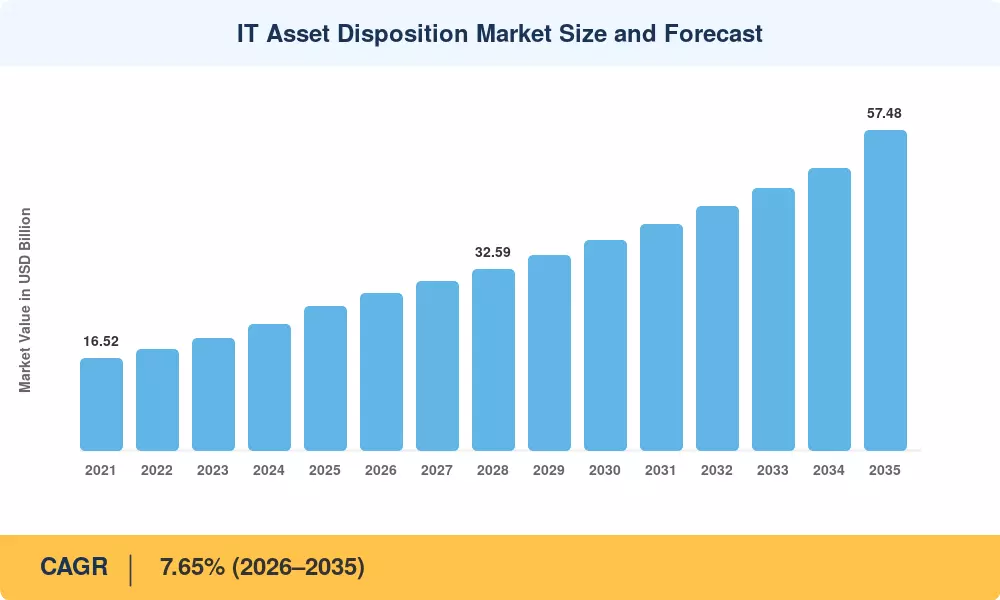
The IT Asset Disposition Market stood at USD 25.86 billion in 2025 and is projected to reach USD 28.12 billion by the close of 2026 before climbing to USD 57.48 billion by 2035, registering a CAGR of 7.65% across the forecast window. Two catalysts are doing the heavy lifting: mandatory Scope 3 carbon disclosure under the SEC's climate-risk rule and the EU's Corporate Sustainability Reporting Directive (CSRD), both of which force enterprises to document every retired asset from cradle to grave [2]. At the same time, Device-as-a-Service contracts now embed reverse-logistics commitments that lock in predictable volumes for certified ITAD data destruction and e-waste recycling services providers.
A technology-level shakeup is accelerating the pipeline. Hyperscalers are offloading legacy servers to free capital for AI accelerators, compressing enterprise refresh cycles from five-to-seven years down to three-to-four years. That compression is funneling record volumes of end-of-life equipment into secure IT equipment disposal channels, End-of-life asset management programs are evolving from cost centers into profit contributors as IT hardware remarketing revenue climbs alongside rising demand for certified refurbished infrastructure.
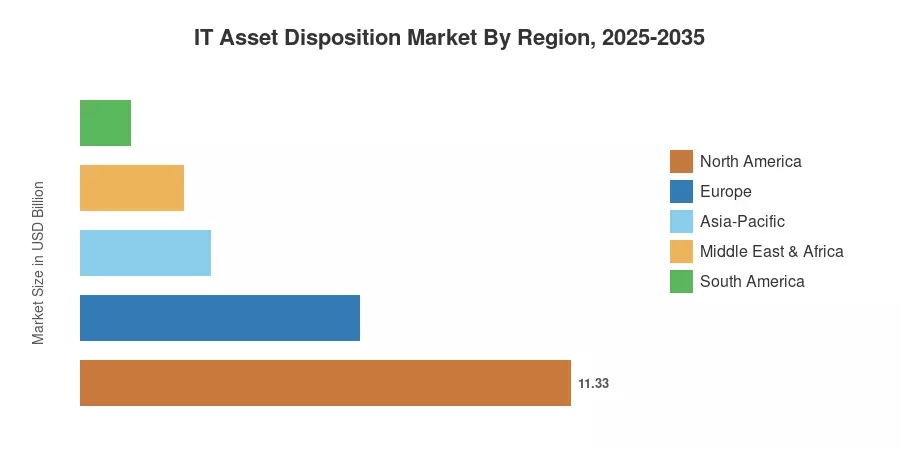
North America commands a 43.8% revenue share of the IT Asset Disposition Market, anchored by rigorous federal data-sanitization mandates and a mature secondary-equipment ecosystem Asia-Pacific is the fastest-growing region at a 11.6% CAGR, propelled by India's e-waste management rules and China's extended-producer-responsibility policies. Europe holds the second-largest position, driven by the WEEE Directive's tightening collection targets. As regulatory pressure intensifies globally, the IT Asset Disposition Market is entering its most consequential growth decade.
Key Report Takeaways
• By Service
- Resale/Remarketing captured the leading revenue position in 2025, reflecting strong demand for IT hardware remarketing across enterprise and hyperscaler channels
- Full-Stack Asset Lifecycle Management is forecast to expand at an 11.1% CAGR through 2035, as organizations consolidate end-of-life asset management under single-vendor contracts
- Data Sanitisation and Destruction generated USD 5.94 billion in 2025, driven by tightening regulatory mandates around ITAD data destruction
• By Asset Type
- Desktop/Laptop equipment accounted for 32.4% of the IT Asset Disposition Market in 2025, led by corporate PC refresh programs
- Server disposition is forecast to grow at a 10.9% CAGR as hyperscaler AI infrastructure upgrades push legacy racks into secure IT equipment disposal pipelines
- Enterprise Size
- Large Enterprises held 57.2% of the IT Asset Disposition Market in 2025, while SMEs are advancing at a 9.6% CAGR to 2035
• By Region
- North America dominated the IT Asset Disposition Market with a 43.8% share in 2025, underpinned by federal data-protection statutes and mature e-waste recycling services infrastructure
- Asia-Pacific is the fastest-growing region at an 11.6% CAGR, fueled by India's and China's escalating environmental regulations
Market Size and Forecast (2021–2035)
MRFR's market sizing integrates bottom-up revenue analysis from over 120 ITAD vendors, validated against top-down macroeconomic indicators including global IT spending, device shipment volumes, and regulatory compliance expenditure data.