Download Free Sample
Kindly complete the form below to receive a free sample of this Report
Japan Blockchain in Insurance Market Size, Share and Research Report By Application (Claims Management, Policy Administration, Fraud Detection, Reinsurance, Identity Management), By Deployment Type (Public Blockchain, Private Blockchain, Hybrid Blockchain), By End User (Insurance Companies, Brokers, Reinsurers) and By Functionality (Smart Contracts, Asset Management, Data Security)-Forecast to 2035
As per Market Research Future analysis, the Japan Blockchain Insurance Market Size was estimated at 300.0 USD Million in 2024. The Japan blockchain insurance market is projected to grow from 340.29 USD Million in 2025 to 1200.0 USD Million by 2035, exhibiting a compound annual growth rate (CAGR) of 13.4% during the forecast period 2025 - 2035
The Japan blockchain insurance market is experiencing a transformative shift towards greater efficiency and security.
| 2024 Market Size | 300.0 (USD Million) |
| 2035 Market Size | 1200.0 (USD Million) |
| CAGR (2025 - 2035) | 13.43% |
Etherisc (DE), Insurwave (GB), Aigang (CN), Lemonade (US), ChainThat (GB), Guardtime (EE), Cyborg (US), B3i (CH)
Our Impact
Enabled $4.3B Revenue Impact for Fortune 500 and Leading Multinationals
Partnering with 2000+ Global Organizations Each Year
30K+ Citations by Top-Tier Firms in the Industry
The blockchain insurance market is currently experiencing a transformative phase, driven by advancements in technology and a growing demand for transparency and efficiency. In Japan, the integration of blockchain technology into insurance processes appears to enhance trust among consumers and streamline operations for insurers. This shift is likely to foster a more competitive landscape, as companies leverage decentralized systems to reduce fraud and improve claims processing. Furthermore, regulatory bodies in Japan are increasingly recognizing the potential of blockchain, which may lead to supportive frameworks that encourage innovation within the sector. Moreover, the blockchain insurance market in Japan seems to be influenced by the rising interest in digital assets and cryptocurrencies. As more individuals and businesses engage with these technologies, the need for insurance products that cater to this new landscape becomes apparent. Insurers are exploring ways to develop tailored offerings that address the unique risks associated with blockchain and digital currencies. This evolving environment suggests that the market is poised for growth, with opportunities for both established players and new entrants to capitalize on emerging trends.
The use of smart contracts in the blockchain insurance market is gaining traction. These self-executing contracts facilitate automatic claims processing and payment, reducing the need for intermediaries. This trend may lead to faster settlements and enhanced customer satisfaction, as policyholders experience a more efficient claims process.
Data security remains a critical concern in the insurance sector. The blockchain insurance market is likely to benefit from the inherent security features of blockchain technology, which offers improved data integrity and privacy. This could attract more customers who prioritize the protection of their personal information.
Regulatory bodies in Japan are beginning to establish frameworks that support the integration of blockchain technology in insurance. These developments may encourage insurers to innovate and adopt new technologies, potentially leading to a more dynamic and responsive market.
Consumer awareness regarding blockchain technology is on the rise in Japan, which is positively influencing the blockchain insurance market. Educational initiatives and media coverage have contributed to a better understanding of how blockchain can enhance security and efficiency in insurance transactions. Surveys indicate that over 60% of Japanese consumers are now familiar with blockchain concepts, leading to a growing interest in insurance products that leverage this technology. This heightened awareness is expected to drive demand for innovative insurance solutions, thereby fostering growth in the blockchain insurance market.
The blockchain insurance market in Japan is experiencing a notable increase in demand for transparency among consumers and businesses. This demand is driven by the inherent characteristics of blockchain technology, which offers immutable records and traceability. As consumers become more aware of their rights and the importance of transparency in transactions, insurance providers are compelled to adopt blockchain solutions. According to recent studies, approximately 70% of Japanese consumers express a preference for insurance products that utilize blockchain for enhanced transparency. This shift is likely to foster trust and confidence in the insurance sector, thereby propelling the growth of the blockchain insurance market.
Regulatory frameworks in Japan are increasingly supportive of innovations in the blockchain insurance market. The Japanese government has recognized the potential of blockchain technology to enhance the efficiency and security of financial services, including insurance. Recent regulatory developments aim to create a conducive environment for blockchain adoption, which may include guidelines for smart contracts and data privacy. This supportive regulatory landscape is likely to encourage more insurance companies to explore blockchain solutions, thereby accelerating the growth of the blockchain insurance market.
Cost efficiency is emerging as a critical driver in the blockchain insurance market in Japan. The automation of processes through smart contracts can significantly reduce operational costs for insurance companies. By minimizing the need for intermediaries and streamlining claims processing, blockchain technology can lead to savings that may reach up to 30% in administrative expenses. This potential for cost reduction is particularly appealing in a competitive market where profit margins are often tight. As insurers seek to enhance their operational efficiency, the adoption of blockchain solutions is likely to accelerate, further stimulating the blockchain insurance market.
Collaboration between insurance companies and technology providers is becoming a prominent driver in the blockchain insurance market in Japan. Insurers are increasingly partnering with blockchain startups and tech firms to leverage their expertise in developing innovative solutions. These collaborations can lead to the creation of tailored insurance products that meet the specific needs of consumers. As a result, the blockchain insurance market is likely to benefit from enhanced product offerings and improved customer experiences, further driving its growth.
In the Japan blockchain insurance market, the distribution of market share reveals that Claims Management holds the largest share, embodying a significant portion of overall applications utilized within the industry. Following closely, Fraud Detection is emerging as a vital contender, gaining traction and gradually increasing its presence due to the rising importance of security and trust in insurance processes, especially amidst a growing digital landscape. The growth trends in the Japan blockchain insurance market, particularly in the application segment, are driven by the increasing adoption of blockchain technology for enhancing transparency and efficiency in operations. Claims Management continues to evolve as insurers enhance their processes, while Fraud Detection presents itself as the fastest-growing application, propelled by the necessity to mitigate fraud risks associated with digital transactions. Industry players are significantly investing in these areas, indicating a vibrant and responsive market landscape.
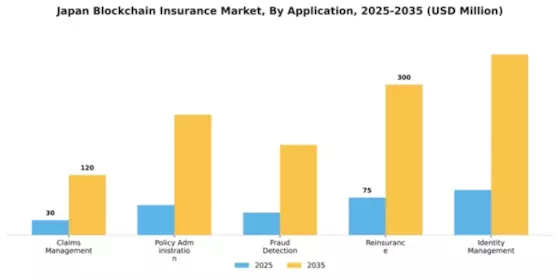
Claims Management (Dominant) vs. Fraud Detection (Emerging)
Claims Management is a dominant application within the Japan blockchain insurance market, renowned for its ability to streamline claims processes, eliminate redundancies, and enhance customer satisfaction through quicker resolutions. This application leverages immutable ledger technology to ensure transparency and traceability in claims, fostering trust among stakeholders. Conversely, Fraud Detection is characterized as an emerging application, gaining momentum as the insurance sector grapples with increasing fraud cases in a digitized environment. Utilizing smart contracts and advanced analytics, it aims to identify suspicious activities proactively, thereby protecting the market's integrity. As both segments evolve, they highlight the critical need for efficiency and security within the blockchain insurance ecosystem.
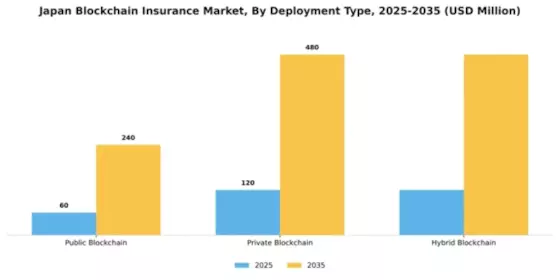
In the Japan blockchain insurance market, the distribution of market share among deployment types reveals that public blockchain is currently the largest segment, driven by its transparency and security features that appeal to a wide range of insurers. This segment's robustness in facilitating trustless transactions has been instrumental in attracting numerous stakeholders. Conversely, private blockchain is recognized as the fastest-growing segment, gaining traction due to its ability to provide controlled access and enhanced privacy benefits. Many insurance companies are increasingly adopting private solutions to streamline their internal processes and ensure data security. Factors such as regulatory compliance, desire for operational efficiency, and improved customer engagement are propelling this growth.
Public Blockchain (Dominant) vs. Private Blockchain (Emerging)
Public blockchain stands as the dominant deployment type in the Japan blockchain insurance market, characterized by its open and decentralized nature. It facilitates transparency and trust, making it an attractive option for businesses seeking to enhance customer confidence. In contrast, private blockchain, while being an emerging player, offers tailored solutions with restricted access, ensuring greater privacy and security for sensitive insurance data. The versatility of private blockchain allows insurance companies to innovate without compromising on regulatory compliance, thus fostering a new wave of digital transformation within the industry. Both segments are pivotal in shaping the future of insurance solutions, catering to different needs and establishing unique value propositions.
In the Japan blockchain insurance market, the distribution of market share reveals that Insurance Companies hold the largest segment, leveraging their established networks and customer bases. Brokers are emerging strongly, reflecting a growing acceptance of blockchain technology to streamline operations and enhance customer trust. Reinsurers also contribute to the market but currently lag behind in both share and growth dynamics. Growth trends in this segment are primarily driven by increasing demands for transparency and efficiency in insurance processes. The adoption of blockchain by Brokers, in particular, signifies a shift towards more agile and customer-centric offerings, while Insurance Companies slowly integrate this technology to maintain competitiveness. Overall, the shift towards blockchain adoption is indicative of the broader digital transformation taking place within the industry.
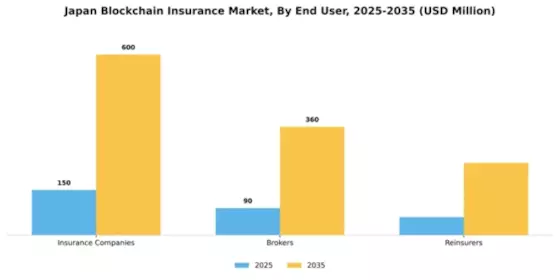
Insurance Companies (Dominant) vs. Brokers (Emerging)
Insurance Companies in the Japan blockchain insurance market dominate the landscape with their robust infrastructure and extensive experience in risk management. They focus on enhancing operational efficiency through blockchain, thus creating a more seamless user experience. In contrast, Brokers are emerging players that leverage blockchain to enhance transparency and speed in transactions, appealing to tech-savvy consumers. As they adopt innovative approaches such as smart contracts and automated claims processes, Brokers are positioning themselves as attractive alternatives, especially for younger customers seeking greater engagement. The competition between these segments is leading to significant advancements in service offerings, ultimately benefiting the end consumers.
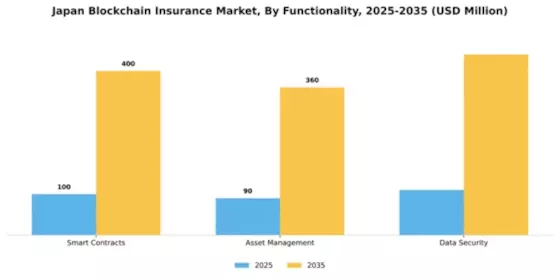
In the Japan blockchain insurance market, the segment is predominantly characterized by Smart Contracts, which hold the largest market share due to their efficiency and automation capabilities. Following closely are Asset Management and Data Security, the latter being recognized for its essential role in safeguarding sensitive information in insurance transactions. Growth trends indicate that Data Security is emerging as the fastest-growing segment as organizations increasingly prioritize the protection of data privacy and compliance with regulatory frameworks. Smart Contracts continue to strengthen their foothold, driven by their capacity to streamline claims processing and reduce administrative costs, thus enhancing operational efficiencies across the sector.
Smart Contracts (Dominant) vs. Data Security (Emerging)
Smart Contracts represent the dominant force within the functionality segment, showcasing their advantages in automating processes and reducing reliance on intermediaries. Their ability to facilitate agreements under specified conditions permits quicker settlements and enhances transparency. In contrast, Data Security, though currently in an emerging stage, is gaining traction rapidly as businesses face escalating cyber threats and seek robust solutions to protect customer data. The growing emphasis on regulatory compliance bolsters this trend, prompting technologies that ensure secure transactions and data integrity, thus making Data Security a critical focal point for future growth in the insurance space.
Get more detailed insights about Japan Blockchain Insurance Market Request Free Sample
The blockchain insurance market in Japan is currently characterized by a dynamic competitive landscape, driven by technological advancements and a growing demand for transparency and efficiency in insurance processes. Key players such as Etherisc (DE), Lemonade (US), and B3i (CH) are actively shaping the market through innovative solutions and strategic partnerships. Etherisc (DE) focuses on decentralized insurance applications, aiming to enhance customer experience and reduce operational costs. Meanwhile, Lemonade (US) leverages artificial intelligence to streamline claims processing, positioning itself as a leader in digital transformation within the sector. B3i (CH) emphasizes collaboration among insurers to develop blockchain-based solutions, indicating a trend towards collective innovation in the industry. The business tactics employed by these companies reflect a moderately fragmented market structure, where collaboration and innovation are paramount. Localizing operations and optimizing supply chains are common strategies, allowing firms to respond swiftly to market demands. The collective influence of these key players fosters a competitive environment that encourages continuous improvement and adaptation to emerging technologies. In October 2025, Etherisc (DE) announced a partnership with a major Japanese insurance provider to pilot a blockchain-based crop insurance product. This strategic move is significant as it not only expands Etherisc's footprint in the Japanese market but also addresses the growing need for agricultural insurance solutions in the region. The collaboration is expected to enhance risk assessment and claims processing efficiency, showcasing the potential of blockchain technology in traditional insurance sectors. In September 2025, Lemonade (US) launched a new feature that utilizes blockchain to provide real-time policy updates and claims tracking for its customers in Japan. This initiative is crucial as it enhances transparency and customer engagement, aligning with the increasing consumer demand for digital solutions. By integrating blockchain into its operations, Lemonade (US) reinforces its commitment to innovation and customer-centric services, potentially setting a new standard in the market. In August 2025, B3i (CH) successfully completed a pilot project with several Japanese insurers, demonstrating the viability of blockchain for reinsurance transactions. This development is noteworthy as it highlights the collaborative efforts among insurers to streamline processes and reduce costs. The pilot's success may lead to broader adoption of blockchain solutions across the industry, indicating a shift towards more efficient operational frameworks. As of November 2025, the competitive trends in the blockchain insurance market are increasingly defined by digitalization, sustainability, and the integration of artificial intelligence. Strategic alliances among key players are shaping the landscape, fostering innovation and enhancing service delivery. Looking ahead, competitive differentiation is likely to evolve from traditional price-based competition to a focus on technological innovation and supply chain reliability. Companies that prioritize these aspects may gain a competitive edge, positioning themselves favorably in a rapidly changing market.



Recent developments in the Japan Blockchain in Insurance Market have showcased a growing interest among leading companies in leveraging blockchain technology to enhance operational efficiency and improve customer experiences. Notably, firms like MetLife Japan, AXA Life Insurance, and Tokio Marine Holdings are actively exploring blockchain-based solutions for streamlining claims processes and data management.
In terms of mergers and acquisitions, in July 2023, Aioi Nissay Dowa Insurance announced the acquisition of a blockchain startup to bolster its technological capabilities, a move echoed by Mitsubishi UFJ Insurance Group in August 2023, which aimed to integrate blockchain into its service offerings. The market has experienced significant growth, with key players reporting increases in market valuation as they adopt innovative technologies, thereby positively impacting insurance products and delivery.
Additionally, in September 2022, Fujitsu partnered with Sompo Japan Insurance to launch a blockchain initiative focused on improving transparency in the insurance sector. This momentum reflects a broader trend within Japan's tech-savvy landscape, where firms are rapidly evolving to meet modern consumer demands. Overall, Japan's approach to blockchain in insurance signifies a transformative shift, leveraging technology to address traditional challenges in the industry.
The blockchain insurance market in Japan is projected to grow at a 13.43% CAGR from 2025 to 2035, driven by technological advancements, regulatory support, and increasing demand for transparency.
New opportunities lie in:
By 2035, the blockchain insurance market is expected to achieve substantial growth and innovation.
| MARKET SIZE 2024 | 300.0(USD Million) |
| MARKET SIZE 2025 | 340.29(USD Million) |
| MARKET SIZE 2035 | 1200.0(USD Million) |
| COMPOUND ANNUAL GROWTH RATE (CAGR) | 13.43% (2025 - 2035) |
| REPORT COVERAGE | Revenue Forecast, Competitive Landscape, Growth Factors, and Trends |
| BASE YEAR | 2024 |
| Market Forecast Period | 2025 - 2035 |
| Historical Data | 2019 - 2024 |
| Market Forecast Units | USD Million |
| Key Companies Profiled | Etherisc (DE), Insurwave (GB), Aigang (CN), Lemonade (US), ChainThat (GB), Guardtime (EE), Cyborg (US), B3i (CH) |
| Segments Covered | Application, Deployment Type, End User, Functionality |
| Key Market Opportunities | Integration of smart contracts enhances efficiency and transparency in the blockchain insurance market. |
| Key Market Dynamics | Rising adoption of blockchain technology in insurance enhances transparency and efficiency in claims processing. |
| Countries Covered | Japan |
The projected market valuation for the Japan blockchain insurance market is $1200.0 Million by 2035.
The market valuation for the Japan blockchain insurance market was $300.0 Million in 2024.
The expected CAGR for the Japan blockchain insurance market during the forecast period 2025 - 2035 is 13.43%.
The Identity Management application segment is projected to reach $360.0 Million by 2035.
Key players in the Japan blockchain insurance market include Etherisc, Insurwave, Aigang, Lemonade, ChainThat, Guardtime, Cyborg, and B3i.
The Reinsurance segment is projected to reach $300.0 Million by 2035, indicating strong growth compared to other segments.
The projected valuation for the Private Blockchain deployment type is $480.0 Million by 2035.
The Insurance Companies end user segment is expected to dominate with a projected valuation of $600.0 Million by 2035.
The Data Security functionality segment is anticipated to show significant growth, reaching $440.0 Million by 2035.
The Smart Contracts functionality segment is projected to reach $400.0 Million by 2035, indicating robust growth relative to other functionalities.


Kindly complete the form below to receive a free sample of this Report

“This is really good guys. Excellent work on a tight deadline. I will continue to use you going forward and recommend you to others. Nice job”


“Thanks. It’s been a pleasure working with you, please use me as reference with any other Intel employees.”


“Thanks for sending the report it gives us a good global view of the Betaïne market.”


“Thank you, this will be very helpful for OQS.”


“We found the report very insightful! we found your research firm very helpful. I'm sending this email to secure our future business.”


“I am very pleased with how market segments have been defined in a relevant way for my purposes (such as "Portable Freezers & refrigerators" and "last-mile"). In general the report is well structured. Thanks very much for your efforts.”


“I have been reading the first document or the study, ,the Global HVAC and FP market report 2021 till 2026. Must say, good info! I have not gone in depth at all parts, but got a good indication of the data inside!”


“We got the report in time, we really thank you for your support in this process. I also thank to all of your team as they did a great job.”


“The Automotive 48V ECU Components Procurement Intelligence Study” was a complex project, but the Market Research Future (MRFR) team handled it with quality, agility, and customer-centricity. They delivered all requested data on time and within the agreed scope. The team, including Shubhendra Anand and Rahul Gotadki, was always readily available to clarify questions and swiftly implement necessary adjustments, driving the project to a successful conclusion within a very demanding timeframe.
I would also like to specifically commend Akshay Agarwal for his responsiveness and support at every stage—from our initial inquiry on May 6th through to final delivery on June 18th. His dedication made the entire process seamless.”



