×
Request Free Sample ×

Kindly complete the form below to receive a free sample of this Report

* Please use a valid business email

Leading companies partner with us for data-driven Insights

clients tt-cursor
Hero Background

Japan Halitosis Treatment Market

ID: MRFR/MED/54790-HCR
200 Pages
Rahul Gotadki
October 2025

Japan Halitosis Treatment Market Research Report By Indication (Respiratory, Liver, Kidney, Gastrointestinal, Systemic, Others), By Diagnostic Tests (Halimeter, Gas Chromatography, BANA Test, -Galactosidase Activity Assay, Others) and By Drug Treatment (Antacids, Antiseptics, Ranitidine, Others)- Forecast to 2035

Share:
Download PDF ×

We do not share your information with anyone. However, we may send you emails based on your report interest from time to time. You may contact us at any time to opt-out.

Japan Halitosis Treatment Market Infographic
Purchase Options

Japan Halitosis Treatment Market Summary

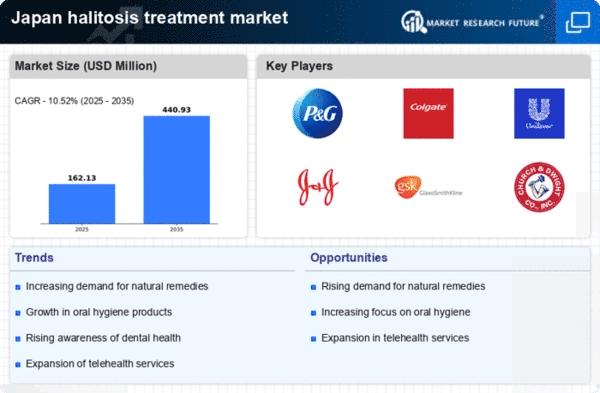
As per MRFR analysis, the halitosis treatment market size was estimated at 146.7 USD Million in 2024.. The halitosis treatment market is projected to grow from 162.13 USD Million in 2025 to 440.93 USD Million by 2035, exhibiting a compound annual growth rate (CAGR) of 10.52% during the forecast period 2025 - 2035.

Key Market Trends & Highlights

The Japan halitosis treatment market is experiencing a shift towards innovative and natural solutions driven by health consciousness.

  • The market is witnessing a rising demand for innovative products that address halitosis effectively.
  • There is a notable focus on natural ingredients, reflecting consumer preferences for safer oral care options.
  • Increased awareness and education regarding oral hygiene are contributing to market growth.
  • Key drivers include growing health consciousness and technological advancements in oral care, particularly among the aging population.

Market Size & Forecast

2024 Market Size 146.7 (USD Million)
2035 Market Size 440.93 (USD Million)
CAGR (2025 - 2035) 10.52%

Major Players

Procter & Gamble (US), Colgate-Palmolive (US), Unilever (GB), Johnson & Johnson (US), GlaxoSmithKline (GB), Church & Dwight (US), Henkel (DE), Listerine (US)

Japan Halitosis Treatment Market Trends

The halitosis treatment market is currently experiencing notable developments. This growth is driven by increasing awareness of oral hygiene and the rising prevalence of halitosis among various demographics.. In Japan, The cultural emphasis on personal grooming and social interactions has led to a heightened focus on maintaining fresh breath.. This trend is further supported by educational campaigns and initiatives from health organizations. These aim to inform the public about the causes and treatments of halitosis.. As a result, consumers are becoming more proactive in seeking solutions. This is likely to influence product innovation and marketing strategies within the sector.. Moreover, The halitosis treatment market is witnessing a shift towards natural and organic products.. Japanese consumers are increasingly inclined to choose remedies that are perceived as safe and effective. They often favor those with minimal chemical additives.. This inclination aligns with broader health trends that emphasize holistic approaches to wellness.. Consequently, manufacturers are adapting their offerings to meet these preferences. This could potentially lead to a diversification of product lines that cater to the growing demand for natural alternatives.. Overall, the market appears poised for growth. It adapts to changing consumer behaviors and preferences..

Rising Demand for Innovative Products

The halitosis treatment market is seeing a surge in demand for innovative solutions that address the issue more effectively. This trend is characterized by the introduction of advanced formulations and delivery systems, such as mints, sprays, and mouthwashes that offer long-lasting freshness. Manufacturers are investing in research and development to create products that not only mask bad breath but also target the underlying causes, such as bacteria and oral health conditions.

Focus on Natural Ingredients

There is a growing preference for products that utilize natural ingredients in the halitosis treatment market. Consumers are increasingly aware of the potential side effects of synthetic additives and are seeking alternatives that are perceived as safer. This trend is prompting companies to reformulate existing products and develop new ones that highlight natural components, such as herbal extracts and essential oils, appealing to health-conscious individuals.

Increased Awareness and Education

The halitosis treatment market is benefiting from enhanced awareness and education initiatives aimed at the public. Health organizations and dental associations are actively promoting information about oral hygiene and the importance of addressing halitosis. This increased focus on education is likely to lead to more individuals recognizing the condition and seeking appropriate treatments, thereby expanding the market.

Japan Halitosis Treatment Market Drivers

Growing Health Consciousness

The increasing health consciousness among the Japanese population appears to be a significant driver for the halitosis treatment market. As individuals become more aware of the implications of oral health on overall well-being, the demand for effective halitosis treatments is likely to rise. Recent surveys indicate that approximately 70% of Japanese adults express concern about their breath freshness, which suggests a strong market potential. This trend is further supported by the rise in preventive healthcare measures, leading to a greater emphasis on oral hygiene products. Consequently, manufacturers are focusing on developing innovative solutions that cater to this growing demand, thereby enhancing their market presence in the halitosis treatment market.

Aging Population and Oral Health Needs

Japan's aging population is a crucial factor influencing the halitosis treatment market. With a significant portion of the population over the age of 65, there is a growing need for specialized oral care products that address age-related issues, including halitosis. Older adults often experience dry mouth and other oral health challenges, which can exacerbate bad breath. This demographic shift suggests a potential increase in demand for tailored halitosis treatments that cater to the unique needs of seniors. Market data indicates that the elderly population is expected to reach 36% by 2040, highlighting the urgency for companies to innovate and adapt their offerings in the halitosis treatment market.

Technological Advancements in Oral Care

Technological advancements in oral care products are transforming the halitosis treatment market. Innovations such as smart toothbrushes and advanced mouthwashes that utilize nanotechnology are gaining traction among consumers. These products not only promise better breath control but also offer additional benefits such as plaque reduction and gum health improvement. The integration of technology into oral care routines is appealing to tech-savvy consumers, particularly in urban areas of Japan. As a result, the market is witnessing a shift towards high-tech solutions, which could potentially increase the overall market size. The introduction of these advanced products may lead to a competitive edge for companies operating in the halitosis treatment market.

Rising Influence of E-commerce Platforms

The rise of e-commerce platforms is reshaping the distribution landscape of the halitosis treatment market. With the increasing penetration of the internet and mobile devices, consumers in Japan are increasingly turning to online shopping for their oral care needs. This shift not only provides convenience but also allows for a wider selection of products, including niche halitosis treatments that may not be available in physical stores. Market analysis indicates that online sales of health and wellness products have surged by over 30% in recent years, suggesting a robust opportunity for companies to expand their reach. As e-commerce continues to grow, it is likely to play a crucial role in the evolution of the halitosis treatment market.

Cultural Influences on Oral Hygiene Practices

Cultural influences play a pivotal role in shaping consumer behavior regarding oral hygiene in Japan. The traditional emphasis on cleanliness and personal grooming has led to a heightened awareness of oral health, which directly impacts the halitosis treatment market. Many Japanese consumers prioritize fresh breath as a social norm, driving the demand for effective treatment options. Furthermore, the popularity of oral care rituals, such as the use of mouthwash and breath fresheners, indicates a strong market inclination towards products that ensure oral freshness. This cultural backdrop suggests that companies must align their marketing strategies with local customs to effectively penetrate the halitosis treatment market.


Market Segment Insights

By Indication: Gastrointestinal (Largest) vs. Respiratory (Fastest-Growing)

In the Japan halitosis treatment market, the indication segment is primarily led by the gastrointestinal category, holding a significant market share due to the prevalent link between digestive health and bad breath. Following gastrointestinal are the respiratory and liver segments, which depict moderate shares, with kidney and systemic indications trailing behind. The overall distribution reflects varying consumer awareness and the correlation of halitosis with different health conditions, influencing treatment preferences among patients and practitioners alike. Growth trends for the indication segment indicate a notable rise in the respiratory category, which is becoming the fastest-growing area fueled by increasing awareness of respiratory health impacts on oral hygiene. Consumer education regarding the connections between various systemic conditions and bad breath has also spurred demand for specialized treatments. Furthermore, advancements in treatment efficacy and the emergence of new therapies in the gastrointestinal segment continue to solidify its dominance, highlighting the dynamic behavior of the market driven by both health trends and consumer preferences.

Gastrointestinal (Dominant) vs. Respiratory (Emerging)

The gastrointestinal segment remains the dominant force within the Japan halitosis treatment market, attributed to its strong association with digestive disorders which are known contributors to halitosis. This category benefits from widespread awareness among consumers of the digestive-breath connection, thereby leading to higher treatment utilization. In contrast, the respiratory segment is characterized as emerging, reflecting a surge in interest as consumers become more informed about the influences of respiratory conditions on oral health. The growth of this segment is fuelled by innovative treatment options and increased public discourse surrounding respiratory hygiene. As awareness escalates, both segments are likely to adapt, with the respiratory segment anticipated to capture a larger portion of market share in the coming years.

By Diagnostic Tests: Halimeter (Largest) vs. Gas Chromatography (Fastest-Growing)

The diagnostic tests segment of the Japan halitosis treatment market showcases a diverse array of methodologies, with the Halimeter leading in market share due to its user-friendly interface and efficiency in detecting volatile sulfur compounds. Following closely, Gas Chromatography is gaining traction because of its accuracy, but it still represents a smaller share in comparison to Halimeter. BANA Test, Β-Galactosidase Activity Assay, and Others also contribute to the segmentation, although their market share is relatively minor compared to the leading tests. Growth trends in this segment are primarily driven by increasing awareness about oral health and the rising prevalence of halitosis among the population. As consumers seek reliable diagnostic solutions, Halimeter maintains its dominance, while Gas Chromatography emerges as a favored choice due to its precision and potential for further innovations. The ongoing research and development in this sector are expected to enhance these tests, further propelling their acceptance and usage in clinical and home settings.

Halimeter (Dominant) vs. Gas Chromatography (Emerging)

Halimeter is recognized as the dominant player in the diagnostic tests segment of the Japan halitosis treatment market, owing to its cost-effectiveness and ease of use. It offers quick results and is highly accessible to both healthcare providers and patients. On the other hand, Gas Chromatography is an emerging technology noted for its high accuracy and detailed analysis capabilities. While it is not as widely adopted as Halimeter, its precision and advanced features are attracting attention, especially in research and specialized dental practices. The ability of Gas Chromatography to separate and quantify multiple gases simultaneously makes it a valuable tool for in-depth studies of halitosis, paving the way for improved diagnostic accuracy.

By Drug Treatment: Antiseptics (Largest) vs. Antacids (Fastest-Growing)

In the Japan halitosis treatment market, the segment values exhibit distinct market share distributions. Antiseptics hold the largest share, leveraging their efficiency in targeting oral bacteria that contribute to halitosis. Antacids and Ranitidine also play crucial roles, though their shares are comparatively smaller, as they address secondary symptoms related to digestive health that can influence breath freshness. Others encompass various niche products, which collectively represent a minor segment of the market. Growth trends within the segment indicate a notable rise in demand for Antacids, identified as the fastest-growing category. This increase is largely driven by a rising awareness of digestive health impacts on oral hygiene and breath freshness. Meanwhile, Antiseptics remain stable, bolstered by ongoing research and development that continually enhances their efficacy. Consumer preferences are evolving, prioritizing more natural, effective treatments, which affects the dynamics of the entire segment.

Antiseptics (Dominant) vs. Antacids (Emerging)

Antiseptics are recognized as the dominant force within the Japan halitosis treatment market, known for their targeted action against the bacteria responsible for bad breath. These products utilize advanced formulations to deliver effective results and are widely trusted by consumers. In contrast, Antacids, though emerging, are capturing attention as they address underlying gastrointestinal issues that can lead to halitosis. Their growth is supported by increased consumer education regarding the link between digestion and oral health. Both segments exhibit unique characteristics: while Antiseptics focus on immediate breath improvement, Antacids offer a broader approach by tackling related digestive concerns, thus appealing to a diverse consumer base.

Get more detailed insights about Japan Halitosis Treatment Market

Key Players and Competitive Insights

The halitosis treatment market exhibits a dynamic competitive landscape, characterized by a blend of established players and emerging innovators. Key growth drivers include increasing consumer awareness regarding oral hygiene, the rising prevalence of halitosis, and a growing demand for effective treatment solutions. Major companies such as Procter & Gamble (US), Colgate-Palmolive (US), and Unilever (GB) are strategically positioned to leverage their extensive distribution networks and brand recognition. These companies focus on innovation and product diversification, which collectively shape a competitive environment that is both robust and evolving.

In terms of business tactics, companies are increasingly localizing manufacturing to enhance supply chain efficiency and reduce costs. The market structure appears moderately fragmented, with several key players holding substantial market shares. This fragmentation allows for a variety of product offerings, catering to diverse consumer preferences. The collective influence of these major players fosters a competitive atmosphere where innovation and customer engagement are paramount.

In October 2025, Procter & Gamble (US) launched a new line of halitosis treatment products that incorporate advanced technology for breath freshening. This strategic move is significant as it not only enhances their product portfolio but also aligns with the growing consumer demand for technologically advanced oral care solutions. The introduction of these products is likely to strengthen their market position and attract a tech-savvy demographic.

In September 2025, Colgate-Palmolive (US) announced a partnership with a leading dental health app to provide personalized oral care recommendations. This collaboration is indicative of a broader trend towards digital integration in the oral care sector. By leveraging technology, Colgate-Palmolive (US) aims to enhance customer engagement and provide tailored solutions, which could potentially lead to increased brand loyalty and market share.

In August 2025, Unilever (GB) expanded its product line to include eco-friendly halitosis treatments, reflecting a growing consumer preference for sustainable products. This strategic initiative not only addresses environmental concerns but also positions Unilever (GB) as a leader in sustainability within the oral care market. The move is likely to resonate with environmentally conscious consumers, thereby enhancing brand reputation and market competitiveness.

As of November 2025, current competitive trends indicate a strong emphasis on digitalization, sustainability, and the integration of artificial intelligence in product development and marketing strategies. Strategic alliances are increasingly shaping the landscape, allowing companies to pool resources and expertise. Looking ahead, competitive differentiation is expected to evolve, with a notable shift from price-based competition to a focus on innovation, technology, and supply chain reliability. This transition underscores the importance of adapting to consumer preferences and market demands in a rapidly changing environment.

Key Companies in the Japan Halitosis Treatment Market market include

Industry Developments

Recent developments in the Japan Halitosis Treatment Market indicate a growing focus on innovative products and therapies. Companies like GSK Consumer Healthcare have been expanding their range of oral care products tailored to counter halitosis. Takeda Pharmaceutical and Sunstar are investing in Research and Development to improve the effectiveness of their treatments while ensuring consumer safety. 

In terms of acquisitions, Johnson and Johnson has recently acquired a smaller company specializing in halitosis solutions, further strengthening their position in the market as of May 2023. Additionally, the government of Japan is increasingly prioritizing oral health, leading to a surge in public awareness campaigns about halitosis and its treatments. This has subsequently contributed to a favorable market environment. 

The market valuation for companies like Colgate-Palmolive and Procter and Gamble is witnessing positive growth as consumer demand for effective halitosis treatments rises. In the past few years, significant mergers including Lion Corporation's acquisition of a niche brand in the oral care space in January 2022 have also played a crucial role in reshaping the competitive landscape of the halitosis treatment sector in Japan.


Future Outlook

Japan Halitosis Treatment Market Future Outlook

The Halitosis Treatment Market in Japan is projected to grow at a 10.52% CAGR from 2024 to 2035, driven by increasing awareness and innovative product development.

New opportunities lie in:

  • Development of subscription-based oral care kits
  • Expansion of telehealth consultations for halitosis treatment
  • Investment in R&D for natural ingredient formulations

By 2035, the market is expected to achieve robust growth and enhanced consumer engagement.

Market Segmentation

Japan Halitosis Treatment Market Indication Outlook

  • Respiratory
  • Liver
  • Kidney
  • Gastrointestinal
  • Systemic
  • Others

Japan Halitosis Treatment Market Drug Treatment Outlook

  • Antacids
  • Antiseptics
  • Ranitidine
  • Others

Japan Halitosis Treatment Market Diagnostic Tests Outlook

  • Halimeter
  • Gas Chromatography
  • BANA Test
  • Β-Galactosidase Activity Assay
  • Others

Report Scope

MARKET SIZE 2024 146.7(USD Million)
MARKET SIZE 2025 162.13(USD Million)
MARKET SIZE 2035 440.93(USD Million)
COMPOUND ANNUAL GROWTH RATE (CAGR) 10.52% (2024 - 2035)
REPORT COVERAGE Revenue Forecast, Competitive Landscape, Growth Factors, and Trends
BASE YEAR 2024
Market Forecast Period 2025 - 2035
Historical Data 2019 - 2024
Market Forecast Units USD Million
Key Companies Profiled Procter & Gamble (US), Colgate-Palmolive (US), Unilever (GB), Johnson & Johnson (US), GlaxoSmithKline (GB), Church & Dwight (US), Henkel (DE), Listerine (US)
Segments Covered Indication, Diagnostic Tests, Drug Treatment
Key Market Opportunities Emerging natural ingredients in halitosis treatment products cater to increasing consumer demand for organic solutions.
Key Market Dynamics Rising consumer awareness drives demand for innovative halitosis treatments amid evolving regulatory standards in Japan.
Countries Covered Japan

Leave a Comment

FAQs

What is the expected market size of the Japan Halitosis Treatment Market in 2024?

The Japan Halitosis Treatment Market is expected to be valued at 146.7 million USD in 2024.

What will the market size be in 2035 for the Japan Halitosis Treatment Market?

In 2035, the Japan Halitosis Treatment Market is projected to reach 390.8 million USD.

What is the expected compound annual growth rate (CAGR) for the Japan Halitosis Treatment Market from 2025 to 2035?

The Japan Halitosis Treatment Market is expected to grow at a CAGR of 9.316% from 2025 to 2035.

Which indication has the largest market value in 2024 within the Japan Halitosis Treatment Market?

In 2024, the Gastrointestinal indication holds the largest market value at 35.0 million USD.

What will be the market size for the Respiratory indication by 2035?

By 2035, the market size for the Respiratory indication is expected to reach 80.0 million USD.

Who are the major players in the Japan Halitosis Treatment Market?

Key players include Gsk Consumer Healthcare, Rakuten, Takeda Pharmaceutical, and Sunstar among others.

What is the projected market value for the Kidney indication in 2035?

The projected market value for the Kidney indication in 2035 is 70.0 million USD.

What are the expected growth drivers for the Japan Halitosis Treatment Market?

The growth drivers include increasing awareness of oral health and innovative treatment options.

How much is the market for Liver indication expected to be valued in 2035?

The market for the Liver indication is expected to be valued at 55.0 million USD in 2035.

What market size is projected for the Systemic indication in 2024?

In 2024, the market size for the Systemic indication is projected to be 36.7 million USD.

Download Free Sample

Kindly complete the form below to receive a free sample of this Report

Compare Licence

×
Features License Type
Single User Multiuser License Enterprise User
Price $4,950 $5,950 $7,250
Maximum User Access Limit 1 User Upto 10 Users Unrestricted Access Throughout the Organization
Free Customization
Direct Access to Analyst
Deliverable Format
Platform Access
Discount on Next Purchase 10% 15% 15%
Printable Versions