×
Request Free Sample ×

Kindly complete the form below to receive a free sample of this Report

* Please use a valid business email

Leading companies partner with us for data-driven Insights

clients tt-cursor
Hero Background

Japan Helium Market

ID: MRFR/CnM/47552-HCR
111 Pages
Chitranshi Jaiswal
October 2025

Japan Helium Market Research Report By Form (Liquid, Gas), By Application (Cryogenics, Pressurizing and Purging, Welding, Leak Detection, Breathing Mixtures, Controlled Atmosphere, Others) and By End-Use Industry (Aerospace & Defense, Electrical & Electronics, Medical, Automotive, Energy, Leisure/Recreational, Welding & Metal Fabrication, others) - Forecast to 2035

Share:
Download PDF ×

We do not share your information with anyone. However, we may send you emails based on your report interest from time to time. You may contact us at any time to opt-out.

Japan Helium Market Infographic
Purchase Options

Japan Helium Market Summary

As per analysis, the Japan helium market is projected to grow from USD 1.50 Billion in 2025 to USD 2.29 Billion by 2035, exhibiting a compound annual growth rate (CAGR) of 4.33% during the forecast period (2025 - 2035).

Key Market Trends & Highlights

The Japan helium market is experiencing a robust upward trajectory driven by diverse industrial applications and technological advancements.

  • The electronics sector remains the largest consumer of helium, reflecting its critical role in manufacturing semiconductors and other components.
  • Cryogenics is the largest segment, while medical imaging is the fastest-growing segment, indicating a shift towards advanced healthcare technologies.
  • Strategic supply partnerships are becoming increasingly vital as companies seek to secure reliable helium sources amid fluctuating availability.
  • Growing industrial applications and rising research and development activities are key drivers propelling the market forward.

Market Size & Forecast

2024 Market Size 1.43 (USD Billion)
2035 Market Size 2.29 (USD Billion)
CAGR (2025 - 2035) 4.33%

Major Players

Air Products and Chemicals (US), Linde (DE), Messer Group (DE), Showa Denko (JP), Sumitomo Seika Chemicals (JP), Taiyo Nippon Sanso Corporation (JP), Nippon Sanso Holdings Corporation (JP), Helium One Global (GB)

Japan Helium Market Trends

The Japan helium market is characterized by a complex interplay of supply and demand dynamics, influenced by both domestic consumption patterns and international trade relationships. Japan, being one of the leading consumers of helium, utilizes this noble gas across various sectors, including electronics, healthcare, and scientific research. The demand for helium in Japan is driven by its essential role in cooling superconducting magnets in MRI machines and in the production of semiconductors, which are critical to the country's advanced technology sector. Furthermore, the increasing focus on renewable energy technologies and the development of hydrogen fuel cells may further augment the need for helium in the coming years. Despite the challenges posed by limited domestic production, Japan has established strategic partnerships with helium-producing nations to secure its supply. The government has been proactive in addressing potential shortages by exploring alternative sources and encouraging recycling initiatives. Additionally, the rising awareness of helium's finite nature has prompted discussions around sustainable usage practices. As the Japan helium market continues to evolve, stakeholders are likely to adapt to changing regulations and market conditions, ensuring a stable supply chain while meeting the growing demand across various industries.

Increased Demand in Electronics Sector

The electronics sector in Japan is experiencing heightened demand for helium, primarily due to its critical role in semiconductor manufacturing. As technology advances, the need for high-purity helium for cooling and other applications is becoming more pronounced, driving market growth.

Strategic Supply Partnerships

Japan is actively forming strategic partnerships with helium-producing countries to secure a stable supply. These collaborations are essential for mitigating risks associated with supply shortages and ensuring that the domestic market can meet its consumption needs.

Focus on Sustainable Practices

There is a growing emphasis on sustainable practices within the Japan helium market. Stakeholders are increasingly exploring recycling methods and alternative sources to address the finite nature of helium, aiming to promote responsible usage and conservation.

Market Segment Insights

By Application: Cryogenics (Largest) vs. Medical Imaging (Fastest-Growing)

In the Japan helium market, the application segments showcase a varied distribution of share among different uses. Cryogenics stands out as the largest segment, driving a significant portion of helium consumption due to its essential role in superconductors, cooling magnets, and other high-demand applications. Following cryogenics, other sectors such as medical imaging and semiconductor manufacturing also contribute to the overall demand, although with a smaller share compared to cryogenics. As technology advances and the need for innovative solutions grows, the medical imaging sector is emerging as one of the fastest-growing applications for helium in Japan. The aging population and increased healthcare investments drive this trend. Additionally, the semiconductor manufacturing sector is seeing consistent enhancement in processes that require helium, leading to a robust growth outlook in the coming years.

Cryogenics (Dominant) vs. Medical Imaging (Emerging)

Cryogenics plays a dominant role in the Japanese helium market due to its necessity in high-tech applications, including MRI machines and various scientific research. It is instrumental in achieving the ultra-cold temperatures required for superconductivity. Conversely, medical imaging is rapidly emerging as a key growth segment. Advancements in medical technology are enhancing demand for helium in imaging processes such as MRI, driven by the increasing focus on healthcare services and rising number of medical facilities. While cryogenics remains crucial, the growth in medical imaging reflects changing dynamics in consumer demand and healthcare advancements, indicating a shift towards innovation in technology.

By End Use: Electronics (Largest) vs. Aerospace (Fastest-Growing)

In the Japan helium market, various end use segments show distinct market share distributions. The electronics sector leads significantly, benefiting from the growing demand for circuit manufacturing and semiconductor production. Other notable segments include healthcare and automotive, contributing to the overall market yet trailing behind electronics. Research applications are also relevant but occupy a smaller share compared to the other sectors. The growth trends in the helium market, particularly in aerospace, are propelled by advancements in aerospace technologies and an increase in space exploration initiatives. Additionally, the electronics sector maintains its dominance due to the continuous technological innovations that fuel demand for helium applications in various electronic components. As companies invest more in these areas, the market is expected to evolve, particularly favoring fast-growing segments like aerospace.

Electronics (Dominant) vs. Aerospace (Emerging)

The electronics segment in the Japan helium market is characterized by its substantial use in the manufacturing of semiconductors and integrated circuits. With the rise of advanced technologies and an increasing number of electronic devices, this segment has secured its position as the dominant force in the market. In contrast, the aerospace segment, while emerging, is quickly gaining traction. Driven by the expanding interest in satellite technologies and space exploration, aerospace's demand for helium is on the rise, as it serves various purposes, including buoyancy in lifting gas applications and as a cryogen for cooling systems. This duality highlights the dynamic nature of the market, where electronics remains at the forefront while aerospace positions itself as an important player for the future.

By Distribution Channel: Direct Sales (Largest) vs. Online Sales (Fastest-Growing)

In the Japan helium market, distribution channels are key to reaching diverse customer segments effectively. Direct Sales holds the largest market share, enabling companies to maintain close relationships with large-scale users, such as industrial manufacturers and research facilities. In contrast, Online Sales is gaining momentum, particularly among smaller businesses and end-users seeking convenience and efficiency. This trend reflects the shifting consumer preference towards digital buying platforms, driven by increased internet penetration and e-commerce growth. The dynamics of growth in the distribution channel segment are influenced by various factors, including technological advancements and changing purchasing behaviors. Online Sales, in particular, is proving to be the fastest-growing channel, as businesses adopt digital strategies to cater to a tech-savvy clientele. Distributors and Retailers also play vital roles, providing localized support and accessibility, ensuring that helium products meet the specific needs of regional markets across Japan.

Direct Sales (Dominant) vs. Online Sales (Emerging)

Direct Sales has established itself as the dominant distribution channel in the Japan helium market, characterized by personalized service and a tailored approach to customer needs. This channel enables suppliers to engage directly with customers, ensuring high levels of satisfaction and repeat business. Direct Sales is particularly beneficial for large industrial clients requiring consistent supply and tailored solutions. In contrast, Online Sales is emerging rapidly, appealing to a younger demographic and businesses seeking agility in their purchasing processes. This channel allows for easy price comparisons and broader accessibility to helium products, which is attracting an increasing number of customers who prefer the convenience of online transactions over traditional methods. As both channels evolve, their characteristics will likely shape the future landscape of helium distribution in Japan.

By Purity Level: High Purity (Largest) vs. Ultra High Purity (Fastest-Growing)

In the Japan helium market, the purity level segment is characterized by a varied distribution of market share among Standard Purity, High Purity, and Ultra High Purity categories. High Purity helium holds the largest share, primarily due to its extensive applications in sectors such as electronics and healthcare. Standard Purity helium, while still significant, caters to less demanding applications, hence its smaller market presence. Ultra High Purity helium, targeted for specialized applications in laboratories and research facilities, although currently having a smaller share, is rapidly gaining traction.

High Purity (Dominant) vs. Ultra High Purity (Emerging)

High Purity helium is recognized for its exceptional quality and reliability, making it the dominant choice among manufacturers in the Japan helium market. It serves critical applications in the semiconductor industry, where precision and purity are vital. On the other hand, Ultra High Purity helium is an emerging segment, experiencing swift growth driven by increasing demand in research environments and advanced medical procedures. Its stringent specifications cater to highly sensitive applications, positioning it as a key player for future innovations in technology and healthcare. As industries evolve, both purity levels will continue to play crucial roles in meeting the market's diverse requirements.

By Storage Type: Compressed Gas Cylinders (Largest) vs. Liquid Helium Tanks (Fastest-Growing)

In the Japan helium market, the storage type segment is primarily dominated by Compressed Gas Cylinders, which account for a significant share among storage options. This preference stems from the ease of transport and versatility of compressed gas cylinders, making them a favored choice not only in industrial applications but also in laboratories and medical facilities. Liquid Helium Tanks and Helium Dewars, while crucial components of the market, hold smaller shares, reflecting a more specialized usage in fields such as scientific research and cryogenics. However, the growth trajectory of these segment values reveals intriguing trends. Liquid Helium Tanks are emerging as the fastest-growing segment driven by the increasing demand for liquid helium in applications like MRI machines and semiconductor manufacturing. Moreover, advancements in technology and the need for efficient storage solutions are fueling the adoption of Helium Dewars, making them a competitive alternative. The overall market landscape indicates a dynamic shift towards evolving storage solutions, meeting the diverse needs of various sectors in Japan.

Compressed Gas Cylinders (Dominant) vs. Liquid Helium Tanks (Emerging)

Compressed Gas Cylinders have established themselves as the dominant storage solution in the Japan helium market, favored for their portability and ease of use. They are commonly employed across multiple sectors, including healthcare, electronics, and manufacturing, making them highly versatile. The longevity and reliability of compressed gas cylinders also contribute to their preferred status among consumers. On the other hand, Liquid Helium Tanks represent an emerging segment, driven by specific applications that require liquid helium, such as cryogenics and cutting-edge research facilities. The innovative designs of modern liquid helium tanks address challenges such as insulation and evaporation rate control, making them increasingly efficient and popular among specialists. This diversification in storage type preferences highlights the evolving landscape of the helium market in Japan.

Get more detailed insights about Japan Helium Market

Key Players and Competitive Insights

The helium market in Japan is characterized by a competitive landscape that is increasingly shaped by innovation, strategic partnerships, and a focus on sustainability. Key players such as Air Products and Chemicals (US), Linde (DE), and Showa Denko (JP) are actively pursuing strategies that enhance their operational capabilities and market presence. Air Products and Chemicals (US) has been focusing on expanding its production capacity and enhancing its supply chain efficiency, which appears to be a response to the growing demand for helium in various applications, including electronics and healthcare. Meanwhile, Linde (DE) is leveraging its technological expertise to optimize helium extraction processes, thereby positioning itself as a leader in sustainable practices within the industry. Showa Denko (JP) is also making strides in regional expansion, aiming to strengthen its foothold in the domestic market while exploring opportunities for international collaboration.

The business tactics employed by these companies reflect a concerted effort to localize manufacturing and optimize supply chains. The market structure is moderately fragmented, with several players vying for market share, yet the influence of major companies remains pronounced. This competitive dynamic fosters an environment where innovation and operational efficiency are paramount, as companies seek to differentiate themselves in a crowded marketplace.

In November 2025, Linde (DE) announced a strategic partnership with a leading semiconductor manufacturer to supply high-purity helium for advanced chip production. This collaboration is significant as it not only secures a steady demand for Linde's helium but also aligns with the growing trend of integrating high-tech applications into the helium market. The partnership underscores Linde's commitment to supporting industries that are increasingly reliant on helium, thereby enhancing its market position.

In October 2025, Showa Denko (JP) unveiled plans to invest approximately ¥5 billion in expanding its helium production facilities in Japan. This investment is crucial as it aims to double the company's output capacity, responding to the rising demand from various sectors, including healthcare and aerospace. Such a move indicates Showa Denko's proactive approach to meeting market needs and solidifying its competitive edge.

In September 2025, Air Products and Chemicals (US) launched a new digital platform designed to streamline helium distribution and enhance customer engagement. This initiative reflects a broader trend towards digitalization in the helium market, as companies seek to leverage technology to improve operational efficiency and customer service. By adopting such innovative solutions, Air Products is likely to enhance its competitive positioning in an increasingly tech-driven market.

As of December 2025, the competitive trends in the helium market are heavily influenced by digitalization, sustainability, and the integration of advanced technologies. Strategic alliances are becoming more prevalent, as companies recognize the value of collaboration in navigating the complexities of the market. Looking ahead, it is anticipated that competitive differentiation will increasingly hinge on innovation and technological advancements rather than solely on price. The focus on supply chain reliability and sustainable practices will likely define the future landscape of the helium market.


Key Companies in the Japan Helium Market market include

Industry Developments

The Japan Helium Market has seen notable developments recently, focusing on the increasing demand for helium in various applications such as electronics and healthcare. Companies like Showa Denko and Taiyo Nippon Sanso Corporation are actively expanding their helium production capacities to meet this rising demand.

In October 2023, Showa Denko announced plans to enhance its helium extraction techniques to optimize its supply chain. Meanwhile, in August 2023, Air Products and Chemicals formed a strategic partnership with ExxonMobil to develop a more efficient helium supply strategy in the region, which is expected to improve market accessibility alongside operational efficiency.

Mergers and acquisitions have also shaped the landscape, with notable activity in recent years. In May 2023, Air Liquide acquired a significant stake in a helium production facility, strengthening its market position. The growth in valuation among these companies reflects the ongoing demand surge, with analysts noting a projected market growth rate of around 8% annually in the helium sector through 2025 within Japan.

Additionally, the government has recognized helium as a critical resource, prompting initiatives to secure local and foreign helium supplies to enhance national industrial capabilities, thereby ensuring stability in this vital market segment.

Future Outlook

Japan Helium Market Future Outlook

The Japan helium market is projected to grow at a 4.33% CAGR from 2024 to 2035, driven by industrial demand, technological advancements, and increased applications in healthcare.

New opportunities lie in:

  • Expansion of helium recycling technologies for sustainable supply chains.
  • Development of specialized helium applications in semiconductor manufacturing.
  • Investment in helium storage and distribution infrastructure to enhance market reach.

By 2035, the helium market in Japan is expected to be robust, driven by innovation and strategic investments.

Market Segmentation

Japan Helium Market End Use Outlook

  • Aerospace
  • Electronics
  • Healthcare
  • Automotive
  • Research

Japan Helium Market Application Outlook

  • Cryogenics
  • Welding
  • Leak Detection
  • Medical Imaging
  • Semiconductor Manufacturing

Japan Helium Market Purity Level Outlook

  • Standard Purity
  • High Purity
  • Ultra High Purity

Japan Helium Market Storage Type Outlook

  • Compressed Gas Cylinders
  • Liquid Helium Tanks
  • Helium Dewars

Japan Helium Market Distribution Channel Outlook

  • Direct Sales
  • Online Sales
  • Distributors
  • Retailers

Report Scope

MARKET SIZE 20241.43(USD Billion)
MARKET SIZE 20251.5(USD Billion)
MARKET SIZE 20352.29(USD Billion)
COMPOUND ANNUAL GROWTH RATE (CAGR)4.33% (2024 - 2035)
REPORT COVERAGERevenue Forecast, Competitive Landscape, Growth Factors, and Trends
BASE YEAR2024
Market Forecast Period2025 - 2035
Historical Data2019 - 2024
Market Forecast UnitsUSD Billion
Key Companies ProfiledAir Products and Chemicals (US), Linde (DE), Messer Group (DE), Showa Denko (JP), Sumitomo Seika Chemicals (JP), Taiyo Nippon Sanso Corporation (JP), Nippon Sanso Holdings Corporation (JP), Helium One Global (GB)
Segments CoveredApplication, End Use, Distribution Channel, Purity Level, Storage Type
Key Market OpportunitiesGrowing demand for helium in electronics and healthcare sectors drives opportunities in the Japan helium market.

Key Market DynamicsRising demand for helium in electronics and healthcare sectors drives competitive dynamics in Japan's helium market.

Countries CoveredJapan

Leave a Comment

FAQs

What was the market size of the Japan Helium Market in 2024?

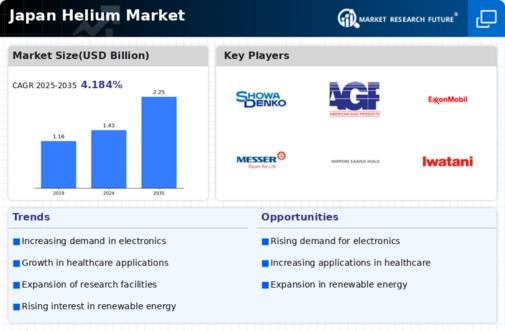
The Japan Helium Market was valued at 1.43 billion USD in 2024.

What is the projected value of the Japan Helium Market by 2035?

By 2035, the Japan Helium Market is projected to reach a value of 2.25 billion USD.

What is the expected compound annual growth rate (CAGR) for the Japan Helium Market from 2025 to 2035?

The expected CAGR for the Japan Helium Market from 2025 to 2035 is approximately 4.184%.

Which form of helium is expected to dominate the Japan Helium Market by 2035?

Liquid helium is expected to dominate the market, valued at 1.0 billion USD by 2035.

What was the market size for gas helium in 2024 in Japan?

The market size for gas helium in Japan was 0.83 billion USD in 2024.

Who are the key players in the Japan Helium Market?

Some of the key players include Showa Denko, Air Products and Chemicals, and Linde.

What growth opportunities are present in the Japan Helium Market?

Growth opportunities are driven by increasing demand in industries such as healthcare and electronics.

How is the market for helium expected to change in terms of liquid and gas segments by 2035?

By 2035, the liquid segment will be valued at 1.0 billion USD, while the gas segment will reach 1.25 billion USD.

What are the key applications driving the growth of the Japan Helium Market?

Key applications include medical imaging, semiconductor manufacturing, and cryogenics.

What is the impact of global market trends on the Japan Helium Market?

Global trends, such as technological advancements are positively influencing the growth of the Japan Helium Market.

Download Free Sample

Kindly complete the form below to receive a free sample of this Report

Compare Licence

×
Features License Type
Single User Multiuser License Enterprise User
Price $4,950 $ $7,250
Maximum User Access Limit 1 User Upto 10 Users Unrestricted Access Throughout the Organization
Free Customization
Direct Access to Analyst
Deliverable Format
Platform Access
Discount on Next Purchase 10% 15% 15%
Printable Versions