×
Request Free Sample ×

Kindly complete the form below to receive a free sample of this Report

* Please use a valid business email

Leading companies partner with us for data-driven Insights

clients tt-cursor
Hero Background

Japan IVD Contract Manufacturing Market

ID: MRFR/MED/50820-HCR
200 Pages
Rahul Gotadki
October 2025

Japan IVD Contract Manufacturing Market Research Report By Product Type (Reagents, Diagnostic Devices, Assay Kits, Consumables), By Technology (Molecular Diagnostics, Immunoassays, Clinical Chemistry, Microbiology), By End-user (Hospitals, Diagnostic Laboratories, Research Institutions, Home Care), and By Service Type (Manufacturing Services, Research and Development Services, Packaging Services)- Forecast to 2035

Share:
Download PDF ×

We do not share your information with anyone. However, we may send you emails based on your report interest from time to time. You may contact us at any time to opt-out.

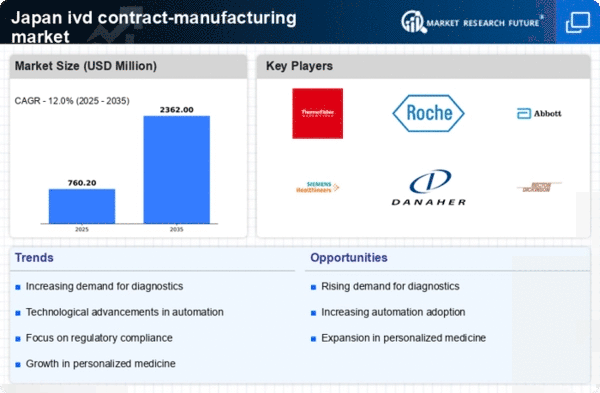
Japan IVD Contract Manufacturing Market Infographic
Purchase Options

Japan IVD Contract Manufacturing Market Summary

As per MRFR analysis, the ivd contract-manufacturing market size was estimated at 678.75 USD Million in 2024. The ivd contract-manufacturing market is projected to grow from 760.2 USD Million in 2025 to 2362.0 USD Million by 2035, exhibiting a compound annual growth rate (CAGR) of 12.0% during the forecast period 2025 - 2035.

Key Market Trends & Highlights

The Japan IVD contract-manufacturing market is poised for growth driven by technological advancements and increasing demand for diagnostic solutions.

  • Technological advancements are reshaping the IVD contract-manufacturing landscape, enhancing efficiency and accuracy.
  • Regulatory compliance remains a critical focus, ensuring that products meet stringent quality standards.
  • Collaborative partnerships are emerging as a strategic approach to leverage expertise and resources in the market.
  • The rising demand for diagnostic testing and growing investment in research and development are key drivers propelling market expansion.

Market Size & Forecast

2024 Market Size 678.75 (USD Million)
2035 Market Size 2362.0 (USD Million)
CAGR (2025 - 2035) 12.0%

Major Players

Thermo Fisher Scientific (US), Roche Diagnostics (CH), Abbott Laboratories (US), Siemens Healthineers (DE), Danaher Corporation (US), Becton Dickinson and Company (US), bioMérieux (FR), Ortho Clinical Diagnostics (US), Hologic (US)

Japan IVD Contract Manufacturing Market Trends

The ivd contract-manufacturing market is currently experiencing notable growth, driven by advancements in technology and increasing demand for diagnostic solutions. In Japan, the emphasis on precision medicine and personalized healthcare is influencing the development of innovative in vitro diagnostic products. This trend is further supported by government initiatives aimed at enhancing healthcare infrastructure and promoting research and development in the life sciences sector. As a result, contract manufacturers are increasingly collaborating with diagnostic companies to streamline production processes and improve product quality. Moreover, the regulatory landscape in Japan is evolving, with authorities focusing on ensuring the safety and efficacy of diagnostic devices. This regulatory scrutiny encourages manufacturers to adopt stringent quality control measures, thereby enhancing the overall reliability of products in the ivd contract-manufacturing market. The interplay between technological advancements and regulatory requirements is likely to shape the future of this market, fostering an environment conducive to innovation and growth. As the demand for rapid and accurate diagnostic solutions continues to rise, the ivd contract-manufacturing market is poised for further expansion, reflecting the dynamic nature of the healthcare landscape in Japan.

Technological Advancements

The ivd contract-manufacturing market is witnessing a surge in technological innovations, particularly in automation and digitalization. These advancements facilitate efficient production processes, reduce lead times, and enhance product quality. Manufacturers are increasingly adopting advanced manufacturing techniques, such as microfluidics and lab-on-a-chip technologies, to meet the growing demand for rapid diagnostic solutions.

Regulatory Compliance

Regulatory compliance remains a critical focus within the ivd contract-manufacturing market. Japanese authorities are implementing stringent regulations to ensure the safety and efficacy of diagnostic products. This regulatory environment compels manufacturers to invest in quality assurance and control measures, thereby enhancing the reliability of their offerings and fostering consumer trust.

Collaborative Partnerships

Collaborative partnerships between contract manufacturers and diagnostic companies are becoming more prevalent in the ivd contract-manufacturing market. These alliances enable companies to leverage each other's strengths, streamline production processes, and accelerate the development of innovative diagnostic solutions. Such collaborations are essential for addressing the evolving needs of the healthcare sector.

Japan IVD Contract Manufacturing Market Drivers

Rising Demand for Diagnostic Testing

The increasing prevalence of chronic diseases and the aging population in Japan are driving the demand for diagnostic testing. This trend is particularly evident in the ivd contract-manufacturing market, where the need for rapid and accurate testing solutions is paramount. According to recent data, the market for in vitro diagnostics in Japan is projected to grow at a CAGR of approximately 6.5% over the next few years. This growth is likely to spur investments in contract manufacturing services, as companies seek to enhance their production capabilities to meet the rising demand for diagnostic products. Furthermore, the emphasis on early disease detection and personalized medicine is expected to further fuel the expansion of the ivd contract-manufacturing market, as manufacturers strive to develop innovative testing solutions that cater to these evolving healthcare needs.

Expansion of Healthcare Infrastructure

The expansion of healthcare infrastructure in Japan is poised to impact the ivd contract-manufacturing market positively. As healthcare facilities upgrade their diagnostic capabilities, the demand for high-quality in vitro diagnostic products is likely to increase. This expansion includes the establishment of new hospitals, laboratories, and diagnostic centers, which may require a diverse range of diagnostic tests and equipment. Consequently, contract manufacturers that can provide tailored solutions to meet the specific needs of these facilities may find lucrative opportunities. Moreover, the government's initiatives to enhance healthcare access and quality may further stimulate growth in the ivd contract-manufacturing market. This trend indicates a favorable environment for manufacturers to expand their operations and develop innovative products that align with the evolving healthcare landscape in Japan.

Focus on Quality Assurance and Compliance

Quality assurance and regulatory compliance are critical components of the ivd contract-manufacturing market. In Japan, stringent regulations govern the manufacturing and distribution of in vitro diagnostic products, necessitating that contract manufacturers adhere to high standards of quality. The Japanese Pharmaceuticals and Medical Devices Agency (PMDA) enforces these regulations, which can be complex and demanding. As a result, companies that prioritize quality assurance processes and invest in compliance measures are likely to thrive in this market. The emphasis on quality not only ensures patient safety but also enhances the reputation of manufacturers, potentially leading to increased business opportunities. Furthermore, adherence to international quality standards can facilitate access to global markets, thereby expanding the reach of Japanese contract manufacturers in the ivd sector.

Growing Investment in Research and Development

Investment in research and development (R&D) is a significant driver of innovation within the ivd contract-manufacturing market. In Japan, the government and private sector are increasingly allocating resources to R&D initiatives aimed at developing novel diagnostic technologies. This focus on innovation is crucial for staying competitive in a market characterized by rapid advancements. For instance, the Japanese government has set ambitious targets for healthcare innovation, which may lead to increased funding for R&D projects. As a result, contract manufacturers that engage in collaborative R&D efforts with research institutions and healthcare providers may benefit from enhanced product offerings and improved market positioning. This trend suggests that the ivd contract-manufacturing market will continue to evolve, driven by a commitment to innovation and the development of cutting-edge diagnostic solutions.

Technological Integration in Manufacturing Processes

The integration of advanced technologies such as automation, artificial intelligence, and data analytics is transforming the ivd contract-manufacturing market. These technologies enhance production efficiency, reduce costs, and improve product quality. For instance, the adoption of automated systems in manufacturing processes can lead to a reduction in human error and increased throughput. In Japan, where precision and quality are paramount, the implementation of such technologies is likely to be a key driver for contract manufacturers. Additionally, the ability to leverage data analytics for predictive maintenance and quality control can further optimize operations. As a result, companies that invest in technological advancements may gain a competitive edge in the ivd contract-manufacturing market, positioning themselves favorably in a rapidly evolving landscape.


Market Segment Insights

By Product Type: Reagents (Largest) vs. Assay Kits (Fastest-Growing)

In the Japan ivd contract-manufacturing market, the product segments show a diverse distribution of market share. Reagents emerge as the largest segment, capturing a significant portion of the market thanks to their essential role in various diagnostic processes. Diagnostic Devices also hold a considerable market share, driven by advancements in technology and increasing demand for accurate diagnostics across multiple healthcare settings. Consumables represent a stable segment, supporting the ongoing usage of other products, but their contribution is not as prominent as the leading segments. The growth trends within this market reflect a mixture of technological innovation and rising healthcare demands. Assay Kits, regarded as the fastest-growing segment, benefit from increasing investments in R&D, which enhance their capabilities and applications. The expanding aging population and heightened awareness regarding early disease detection further propel this segment's growth. Additionally, the continuous development in reagents and diagnostic devices supports their sustained relevance in the market, responding to the evolving needs of healthcare providers.

Reagents (Dominant) vs. Assay Kits (Emerging)

Reagents dominate the Japan ivd contract-manufacturing market, providing crucial components for numerous diagnostic tests and procedures. Characterized by their widespread usage and critical nature in laboratory settings, reagents are essential for accurate test results, thus sustaining their dominant market position. On the other hand, Assay Kits represent an emerging segment gaining traction due to their versatility and comprehensive diagnostic capabilities. As healthcare providers seek efficient and reliable testing solutions, the increased adoption of Assay Kits is observed. Their fast-paced innovation driven by technological advancements positions them as vital tools in modern diagnostics, indicating a shift in market dynamics as they gain a larger market share compared to traditional products.

By Technology: Molecular Diagnostics (Largest) vs. Immunoassays (Fastest-Growing)

In the Japan ivd contract-manufacturing market, the technology segment showcases a diverse array of value distributions. Molecular Diagnostics leads the market, capturing a significant share due to its advanced capabilities in detecting genetic diseases and infections. Immunoassays follow closely, driven by widespread applications in clinical laboratories, emphasizing their importance in the overall technological landscape. The growth trends in this segment reveal a robust evolution influenced by technological advancements and rising healthcare demands. Molecular Diagnostics is propelled by innovation in test accuracy and efficiency, while Immunoassays are expanding rapidly as healthcare providers seek cost-effective and reliable diagnostic tools. Key drivers include the rising prevalence of chronic diseases and the increasing focus on personalized medicine, shaping the future of the market significantly.

Technology: Molecular Diagnostics (Dominant) vs. Immunoassays (Emerging)

Molecular Diagnostics stands as the dominant player in the technology segment, characterized by its ability to deliver precise results for complex medical conditions. Its market position is supported by a strong R&D focus, facilitating the development of cutting-edge diagnostic tools. In contrast, Immunoassays, classified as an emerging technology, are witnessing exceptional growth due to their flexibility and ease of use in various clinical settings. These assays are becoming increasingly popular for their ability to process multiple samples efficiently, making them a preferred choice for routine diagnostics. As the healthcare landscape evolves, both segments complement each other, catering to diverse diagnostic needs and enhancing patient care.

By End User: Hospitals (Largest) vs. Diagnostic Laboratories (Fastest-Growing)

In the Japan ivd contract-manufacturing market, hospitals dominate the end-user segment, capturing the largest share due to their extensive need for diagnostic services and patient monitoring. Their reliance on advanced diagnostic tools has positioned them as key players in the market, significantly influencing purchasing trends and shaping service offerings. Diagnostic laboratories, on the other hand, are witnessing rapid growth as they expand capabilities and invest in innovative technologies to meet increasing demand for accurate and timely testing. The growth in the end-user segment is driven by an aging population, rising prevalence of chronic diseases, and the increasing importance of early diagnosis. Hospitals continue to adapt to emerging healthcare needs, while diagnostic laboratories leverage technological advancements such as automation and digital health solutions. This dynamic landscape presents new opportunities for contract manufacturers to cater to the evolving preferences of these end users.

Hospitals (Dominant) vs. Research Institutions (Emerging)

Hospitals remain the dominant end user in the market, driven by their extensive infrastructure and consistent demand for in vitro diagnostics to support clinical decisions. They have an established relationship with manufacturers, which enhances their bargaining power and access to the latest technologies. Conversely, research institutions represent an emerging segment as they increasingly rely on contract manufacturing for specialized diagnostic products in support of research initiatives. This trend is fueled by the need for customized solutions that drive innovation in diagnostics, particularly in the fields of biotechnology and genomics. Their collaboration with manufacturers facilitates the rapid development and testing of new products, making them crucial to future advancements in the industry.

By Service Type: Manufacturing Services (Largest) vs. Research and Development Services (Fastest-Growing)

In the Japan ivd contract-manufacturing market, the service type segment is primarily dominated by Manufacturing Services, which holds the largest share. This segment benefits from the growing need for high-quality diagnostic products and has been bolstered by significant advancements in technology and production capabilities. Research and Development Services, while smaller in market share, are recognized as the fastest-growing area, driven by increased investments in innovative diagnostic solutions and personalized medicine. The growth trends in this segment highlight a robust demand for tailored services that enhance the development of diagnostic and therapeutic products. Factors such as evolving healthcare regulations and the rise of biotechnology firms contribute to the expansion of both Manufacturing and Research and Development Services. Moreover, the push towards automation and high-throughput manufacturing processes supports efficiency, further enhancing competitiveness within the market.

Manufacturing Services (Dominant) vs. Research and Development Services (Emerging)

Manufacturing Services in the Japan ivd contract-manufacturing market are characterized by their established role and extensive capabilities, allowing for efficient production of diagnostic devices. These services are crucial for meeting the burgeoning demand for reliable healthcare solutions. In contrast, Research and Development Services are emerging as a key player, emphasizing innovation and collaboration with diagnostic companies to develop new technologies. This segment is increasingly recognized for its potential to navigate the complexities of regulatory environments and accelerate product development cycles. As companies seek to enhance their competitive advantage, both segments play pivotal roles, with Manufacturing Services providing stability and Research and Development opening doors to groundbreaking advancements.

Get more detailed insights about Japan IVD Contract Manufacturing Market

Key Players and Competitive Insights

The ivd contract-manufacturing market in Japan exhibits a dynamic competitive landscape, characterized by a blend of innovation, strategic partnerships, and regional expansion. Key players such as Thermo Fisher Scientific (US), Roche Diagnostics (CH), and Abbott Laboratories (US) are at the forefront, each adopting distinct strategies to enhance their market presence. For instance, Thermo Fisher Scientific (US) emphasizes innovation through continuous investment in R&D, aiming to develop cutting-edge diagnostic solutions. Meanwhile, Roche Diagnostics (CH) focuses on strategic partnerships to bolster its product offerings and expand its market reach, indicating a collaborative approach to growth. Abbott Laboratories (US) appears to prioritize digital transformation, integrating advanced technologies into its manufacturing processes to improve efficiency and product quality. Collectively, these strategies shape a competitive environment that is increasingly focused on technological advancement and collaborative growth.

In terms of business tactics, localizing manufacturing and optimizing supply chains are pivotal for success in this market. The competitive structure is moderately fragmented, with several key players exerting influence over various segments. This fragmentation allows for niche players to thrive, while larger companies leverage their scale to optimize operations and reduce costs. The collective influence of these key players fosters a competitive atmosphere where innovation and operational efficiency are paramount.

In October 2025, Roche Diagnostics (CH) announced a strategic partnership with a local Japanese biotech firm to co-develop next-generation diagnostic tests. This collaboration is significant as it not only enhances Roche's product portfolio but also allows for localized development, which is crucial in meeting specific market needs. Such partnerships are likely to accelerate innovation and improve market responsiveness.

In September 2025, Abbott Laboratories (US) unveiled a new manufacturing facility in Japan, aimed at increasing production capacity for its diagnostic products. This move is strategically important as it positions Abbott to better serve the growing demand for diagnostic solutions in the region, while also reducing lead times and enhancing supply chain reliability. The establishment of local manufacturing capabilities reflects a broader trend towards regional production in the industry.

In August 2025, Thermo Fisher Scientific (US) launched a new digital platform designed to streamline the contract-manufacturing process for its clients. This initiative underscores the company's commitment to digital transformation, enabling more efficient project management and communication. By leveraging technology, Thermo Fisher aims to enhance customer satisfaction and operational efficiency, which are critical in a competitive market.

As of November 2025, current trends in the ivd contract-manufacturing market are increasingly defined by digitalization, sustainability, and the integration of artificial intelligence (AI). Strategic alliances are becoming more prevalent, as companies recognize the value of collaboration in driving innovation and expanding market reach. Looking ahead, competitive differentiation is likely to evolve from traditional price-based competition to a focus on innovation, technological advancement, and supply chain reliability. This shift suggests that companies will need to invest in R&D and forge strategic partnerships to maintain a competitive edge in an ever-evolving market.

Key Companies in the Japan IVD Contract Manufacturing Market market include

Industry Developments

The Japan In Vitro Diagnostics (IVD) Contract Manufacturing Market is currently experiencing notable developments. In September 2023, Thermo Fisher Scientific announced plans to expand its manufacturing footprint in Japan to better serve local demand for diagnostic kits. Mizuho Medy has also been active, having launched a series of advanced diagnostic solutions aimed at enhancing patient diagnosis in August 2023.

Recent market growth has been attributed to increased healthcare investments and a rise in chronic disease prevalence, leading to a projected valuation increase across several major players, including Nihon Kohden and Sysmex Corporation. In a significant merger, Fujifilm Holdings acquired a leading IVD provider in July 2023 to bolster its portfolio, as reported by industry sources.

Meanwhile, the demand for innovative diagnostic solutions has led to collaborations among companies like Sakura Finetek Japan and Roche Diagnostics, focusing on research and product development initiatives.

Current affairs indicate a shift towards automation and digital technologies in manufacturing processes, as stakeholders like BioRad Laboratories explore smart manufacturing solutions to increase efficiency and reliability. These developments indicate a dynamic landscape for the Japan IVD Contract Manufacturing Market, characterized by strategic investments and innovations that are shaping its future.

Future Outlook

Japan IVD Contract Manufacturing Market Future Outlook

The IVD Contract Manufacturing Market in Japan is projected to grow at a 12.0% CAGR from 2024 to 2035, driven by technological advancements and increasing demand for diagnostics.

New opportunities lie in:

  • Development of customized diagnostic kits for niche markets.
  • Investment in automation technologies to enhance production efficiency.
  • Expansion of partnerships with biotech firms for innovative product development.

By 2035, the market is expected to achieve substantial growth, positioning itself as a leader in the diagnostics sector.

Market Segmentation

Japan IVD Contract Manufacturing Market End User Outlook

  • Hospitals
  • Diagnostic Laboratories
  • Research Institutions
  • Home Care

Japan IVD Contract Manufacturing Market Technology Outlook

  • Molecular Diagnostics
  • Immunoassays
  • Clinical Chemistry
  • Microbiology

Japan IVD Contract Manufacturing Market Product Type Outlook

  • Reagents
  • Diagnostic Devices
  • Assay Kits
  • Consumables

Japan IVD Contract Manufacturing Market Service Type Outlook

  • Manufacturing Services
  • Research and Development Services
  • Packaging Services

Report Scope

MARKET SIZE 2024 678.75(USD Million)
MARKET SIZE 2025 760.2(USD Million)
MARKET SIZE 2035 2362.0(USD Million)
COMPOUND ANNUAL GROWTH RATE (CAGR) 12.0% (2024 - 2035)
REPORT COVERAGE Revenue Forecast, Competitive Landscape, Growth Factors, and Trends
BASE YEAR 2024
Market Forecast Period 2025 - 2035
Historical Data 2019 - 2024
Market Forecast Units USD Million
Key Companies Profiled Thermo Fisher Scientific (US), Roche Diagnostics (CH), Abbott Laboratories (US), Siemens Healthineers (DE), Danaher Corporation (US), Becton Dickinson and Company (US), bioMérieux (FR), Ortho Clinical Diagnostics (US), Hologic (US)
Segments Covered Product Type, Technology, End User, Service Type
Key Market Opportunities Adoption of advanced automation technologies enhances efficiency in the ivd contract-manufacturing market.
Key Market Dynamics Rising demand for personalized diagnostics drives innovation and competition in the IVD contract-manufacturing market.
Countries Covered Japan

Leave a Comment

FAQs

What is the expected market size of the Japan IVD Contract Manufacturing Market in 2024?

The Japan IVD Contract Manufacturing Market is expected to be valued at 278.25 million USD in 2024.

What will be the market size of the Japan IVD Contract Manufacturing Market in 2035?

By 2035, the market is projected to reach a value of 417.02 million USD.

What is the expected CAGR for the Japan IVD Contract Manufacturing Market between 2025 and 2035?

The market is expected to grow at a CAGR of 3.747% from 2025 to 2035.

Which product type accounts for the largest share in the Japan IVD Contract Manufacturing Market?

Reagents are anticipated to dominate the market, valued at 83.5 million USD in 2024.

What are the market values for diagnostic devices in the Japan IVD Contract Manufacturing Market by 2035?

The value of diagnostic devices is expected to reach 105.92 million USD by 2035.

How significant is the market value for assay kits in 2024?

In 2024, assay kits are expected to be valued at 62.0 million USD.

What is the projected market value for consumables in the Japan IVD Contract Manufacturing Market by 2035?

Consumables are expected to be valued at 85.98 million USD by 2035.

Who are the major players in the Japan IVD Contract Manufacturing Market?

Key players include Fujifilm Holdings, Thermo Fisher Scientific, and Roche Diagnostics among others.

What growth opportunities exist in the Japan IVD Contract Manufacturing Market?

Emerging trends and technological advancements provide significant growth opportunities in the market.

How do regional dynamics affect the Japan IVD Contract Manufacturing Market?

The Japan IVD Contract Manufacturing Market is influenced by regional shifts in healthcare demands and regulations.

Download Free Sample

Kindly complete the form below to receive a free sample of this Report

Compare Licence

×
Features License Type
Single User Multiuser License Enterprise User
Price $4,950 $5,950 $7,250
Maximum User Access Limit 1 User Upto 10 Users Unrestricted Access Throughout the Organization
Free Customization
Direct Access to Analyst
Deliverable Format
Platform Access
Discount on Next Purchase 10% 15% 15%
Printable Versions