Laser Welding Machine Market (2026 - 2035)

Laser Welding Machine Market Size, Share & Growth Analysis Report By Laser Type (Fiber Laser, CO₂ Laser, Nd:YAG Laser, Diode Laser, Others), By Application (Automotive & Transportation, Electronics & Semiconductors, Medical Devices, Aerospace & Defense, Energy, Others), By Operation Mode (Fully Automatic, Semi-Automatic, Manual / Handheld) and By Regional (North America, Europe, South America, Asia Pacific, Middle East and Africa) – Industry Growth & Forecast to 2035
ID: MRFR/Equip/2887-HCR
111 Pages
Snehal Singh
Last Updated: July 03, 2026
Laser Welding Machine Market
Market Size
Forecast Period2026-2035
CAGR (2026-2035)7.5%
2025 Market SizeUSD 2.80 Billion
2035 Market SizeUSD 5.77 Billion
Key Players
Trumpf GmbH
IPG Photonics
Coherent Corp.
FANUC Corporation
Panasonic Connect
Amada Holdings
Opportunities
  • Green and Blue Laser Commercialization
  • Machine-as-a-Service and Pay-Per-Weld Models
  • Emerging-Market Industrialization

Laser Welding Machine Market Summary

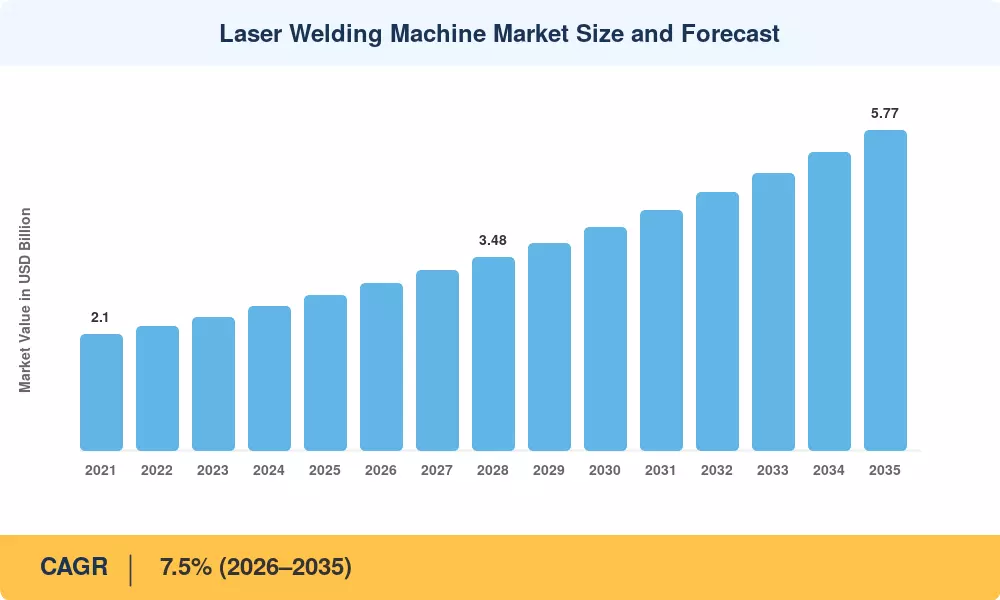
The global Laser Welding Machine Market was valued at USD 2.80 billion in 2025 and is projected to grow from USD 3.01 billion in 2026 to USD 5.77 billion by 2035, registering a CAGR of 7.5% during 2026–2035. Two catalysts stand behind this trajectory: the accelerating shift toward lightweight materials in automotive manufacturing — driven by emissions targets under the EU's Euro 7 standards and the U.S. EPA's Multi-Pollutant Emissions Standards [1] — and the electronics industry's relentless push toward miniaturized, hermetically sealed components that only non-contact joining can reliably produce.

Legacy resistance welding and TIG welding setups are yielding ground to fiber and diode laser platforms that deliver higher beam quality, lower per-watt costs, and dramatically smaller heat-affected zones. The automotive sector alone is channeling an estimated USD 12 billion globally into body-in-white laser joining lines through 2030, according to the International Energy Agency's EV industrial readiness reports [2]. Battery module assembly for electric vehicles has emerged as a particularly high-growth niche, where weld consistency directly affects cell safety and cycle life.

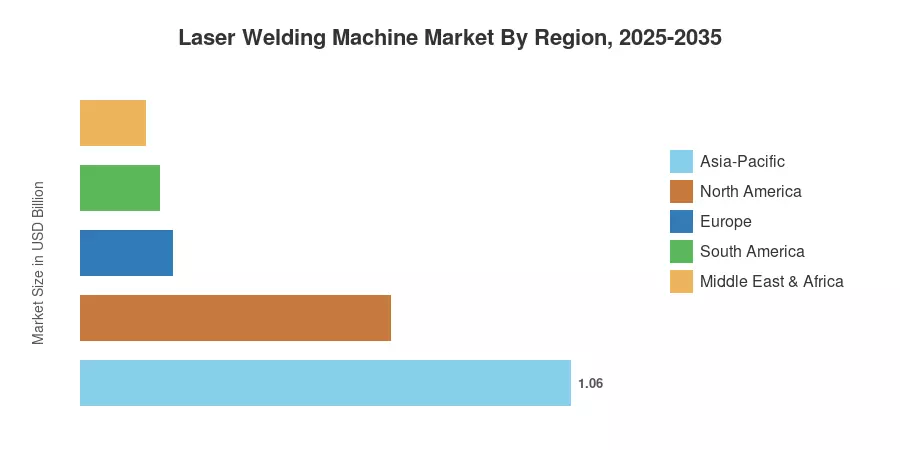
Asia-Pacific commands roughly 38% of the Laser Welding Machine Market, propelled by China's dominance in EV production and consumer electronics assembly. The region also registers the fastest CAGR at 8.8% through 2035. Europe holds the second-largest share at 28%, underpinned by Germany's advanced automotive OEMs and Tier-1 suppliers. North America contributes 24%, with aerospace and medical device manufacturing driving demand. As additive-manufacturing and digital-twin integration deepen, the Laser Welding Machine Market is positioned for sustained double-digit expansion in select verticals through the early 2030s.


Key Report Takeaways

• By Technology

  • Fiber laser systems account for approximately 44% of the Laser Welding Machine Market, owing to superior wall-plug efficiency and maintenance simplicity.
  • Diode laser welding platforms are growing at a CAGR of 9.2%, the fastest among technology types.
  • CO₂ laser machines still hold USD 0.39 billion in annual revenue, concentrated in thick-section industrial cutting and joining.

• By Application

  • Automotive and transportation represent roughly 32% of global demand within the Laser Welding Machine Market.
  • Electronics and semiconductor packaging are projected to reach a CAGR of 8.6% during the forecast period.
  • Medical device manufacturing contributes USD 0.34 billion, driven by Class III implantable device regulations.

• By Region

  • Asia-Pacific leads with 38% revenue share, anchored by China, Japan, and South Korea.
  • Europe's Laser Welding Machine Market benefits from a CAGR of 7.1%, led by Germany and France.
  • The Middle East & Africa is the smallest region at roughly 5% share but shows rising adoption in the energy sector fabrication.


Laser Welding Machine Market Size and Forecast (2021–2035)

Market sizing relies on a bottom-up methodology that aggregates machine-level shipment data from OEM disclosures, customs trade databases (UN Comtrade HS 8515.80), and proprietary primary interviews with 120+ industry stakeholders across 18 countries. Top-down validation cross-references end-user capital expenditure filings and laser source supplier revenue breakdowns [3].
Laser Welding Machine Market Size and Forecast
Our Impact
Enabled $4.3B Revenue Impact for Fortune 500 and Leading Multinationals
Partnering with 2000+ Global Organizations Each Year
30K+ Citations by Top-Tier Firms in the Industry

Driver Impact Analysis

Driver ~% Impact on CAGR Geographic Relevance Impact Timeline
EV battery module & pack assembly +1.8% Global Short-term (≤2 yr)
Lightweighting mandates (aluminum/CFRP joining) +1.4% Europe, North America Medium-term (2–4 yr)
Electronics miniaturization & 5G infrastructure +1.2% Asia-Pacific Short-term (≤2 yr)
Industry 4.0 & smart factory integration +0.9% Global Medium-term (2–4 yr)
Aerospace MRO & next-gen engine manufacturing +0.7% North America, Europe Long-term (≥4 yr)
Medical device regulatory tightening (EU MDR) +0.5% Europe, North America Medium-term (2–4 yr)
Emerging-market industrialization (India, ASEAN) +0.6% Asia-Pacific Long-term (≥4 yr)


EV Battery Module and Pack Assembly

The global push toward electrified transport has turned battery welding into the single largest growth vector for the Laser Welding Machine Market. According to BloombergNEF, global battery manufacturing capacity will exceed 7 TWh by 2030 [2]. Each GWh of cell-to-pack capacity requires approximately USD 3–5 million in laser joining equipment for busbar welding, tab connections, and housing seals. China's CATL, BYD, and European entrants like Northvolt have collectively committed over USD 90 billion in gigafactory investments, creating a predictable multi-year procurement pipeline.

Automotive Lightweighting Mandates

Euro 7 and U.S. CAFE standards are compelling OEMs to substitute steel with aluminum, magnesium, and carbon-fiber-reinforced composites in body structures. Laser joining is often the only technically viable method for dissimilar-material lap joints without filler material, giving the Laser Welding Machine Market a structural advantage over conventional arc processes. The European Aluminium Association projects that automotive aluminum content per vehicle will rise from 180 kg in 2024 to 250 kg by 2030 [1].

Electronics Miniaturization and 5G Build-Out

Semiconductor packaging, MEMS sensor encapsulation, and 5G antenna module assembly require micron-scale weld precision with minimal thermal input. The Semiconductor Industry Association reports that global chip capital expenditure reached USD 190 billion in 2024, with a growing share allocated to advanced packaging lines that incorporate laser micro-welding stations [8]. This driver disproportionately benefits the Asia-Pacific Laser Welding Machine Market, where Taiwan, South Korea, and China concentrate over 75% of global semiconductor fabrication capacity.

Industry 4.0 and Smart Factory Integration

Real-time weld-quality monitoring via inline OCT sensors, AI-driven parameter optimization, and digital-twin process simulation are transforming laser welding from a standalone operation into an integrated data node within smart factories. estimates that digital manufacturing platforms can reduce rework costs by 15–20% [9], making capital approval for new laser cells easier to justify. This driver sustains mid-term demand across all regions of the Laser Welding Machine Market.


Restraints Impact Analysis

Restraint ~% Impact on CAGR Geographic Relevance Impact Timeline
High upfront capital cost vs. conventional welding −0.9% Emerging markets Short-term (≤2 yr)
Skilled-operator and laser-safety training gaps −0.6% Global Medium-term (2–4 yr)
Reflective-material processing limitations −0.4% Asia-Pacific, Europe Long-term (≥4 yr)
Stringent laser-safety regulations (IEC 60825) −0.3% Europe, North America Medium-term (2–4 yr)
Supply-chain concentration of high-power diode bars −0.3% Global Short-term (≤2 yr)


High Upfront Capital Cost

A fully equipped fiber laser welding cell with integrated robotics, safety enclosure, and fume extraction can cost USD 250,000–800,000, compared with USD 40,000–100,000 for an equivalent resistance or MIG welding station [13]. For small and medium enterprises — particularly in India, Southeast Asia, and Latin America — this price gap remains the primary barrier to adoption. Leasing models and machine-as-a-service offerings are beginning to close this gap, but penetration of such financing structures sits below 12% of total shipments globally.

Skilled-Operator and Laser-Safety Training Deficits

If you are going to operate high power laser systems, you need to know a lot about beam physics, metallurgy and Class 4 laser safety regulations. According to the American Welding Society, the U.S. would face a shortage of 360,000 skilled welding experts by 2027 alone [14]. The same scarcity exists for conventional procedures, but it is compounded in laser systems since technicians need additional certification for laser-specific dangers. The restriction restricts the growth of the Laser Welding Machine Market in areas with poor vocational training infrastructure.


Reflective-Material Processing Challenges

Copper, gold and some aluminum alloys reflect near-infrared wavelengths typical of fiber lasers, which can cause instability in the process and risk back-reflection that can damage optical components. This constraint is somewhat solved by green (515 nm) and blue (450 nm) laser sources, which are expensive and not economically mature at multi-kilowatt power levels [15]. A technology ceiling will hit the Laser Welding Machine Market in copper-heavy applications like EV motor hairpin welding until the cost of green lasers comes down.


Laser Welding Machine Market Opportunities

Green and Blue Laser Commercialization

The fast price decline of GaN-based blue diode lasers (35% since 2022) provides a clear route to efficient copper and precious-metal welding. Trumpf, Laserline, and NUBURU are scaling multi-kilowatt blue-laser technologies that could unleash an estimated USD 400 million incremental addressable market by 2030 in motor winding, power electronics, and battery interconnects [15].


Machine-as-a-Service and Pay-Per-Weld Models

In SME heavy economies, capital intensity is the major adoption obstacle for the Laser Welding Machine Market. Equipment vendors cooperating with leasing companies and industrial IoT platforms can offer outcome-based pricing linked to weld counts or uptime guarantees. This approach is in line with the development of CNC machine tools, where subscription revenue already accounts for more than 18% of total OEM sales in Europe [9].


Emerging-Market Industrialization

India's Production-Linked Incentive scheme has allocated USD 2.5 billion to electronics and automotive component manufacturing, directly stimulating demand for laser joining equipment [12]. Vietnam, Indonesia, and Thailand are similarly attracting FDI in EV component and consumer electronics assembly. These markets present a greenfield opportunity for the Laser Welding Machine Market, particularly for compact, cost-optimized systems.

Additive-Hybrid Manufacturing Platforms

Directed energy deposition systems that combine laser cladding with subtractive machining represent a frontier for the Laser Welding Machine Market. The U.S. Department of Energy has invested USD 60 million in hybrid manufacturing R&D through the Manufacturing USA institutes [10]. Vendors that integrate welding and additive capabilities into a single cell can capture higher-margin, longer-cycle revenue.

AI-Driven Weld Quality Assurance

Inline optical coherence tomography and high-speed camera systems, coupled with machine-learning defect classifiers, enable 100% non-destructive inspection at weld speed. This capability converts quality assurance from a cost center into a value proposition, accelerating ROI justification for end users across automotive and aerospace sectors.


Laser Welding Machine Market Future Outlook

AI-Autonomous Laser Welding Operations

Machine-learning algorithms trained on millions of weld signatures will enable fully autonomous parameter adjustment in real time by 2030. NVIDIA's Omniverse digital-twin platform and Siemens' Xcelerator ecosystem are already being piloted in laser cell commissioning, reducing setup time by up to 40% [9]. This trend will compress the skilled-labor bottleneck described in Section 5 and accelerate the adoption of the Laser Welding Machine Market across mid-tier manufacturers.

Electrification Supercycle and Battery Evolution

The transition from liquid-electrolyte to solid-state batteries between 2028 and 2032 will reshape laser welding requirements. Solid-state cells demand tighter thermal budgets and novel electrode-stack joining methods. Toyota, Samsung SDI, and QuantumScape have each announced pilot lines that incorporate specialized laser sealing processes [2]. The Laser Welding Machine Market stands to benefit from a replacement cycle as existing gigafactory lines retrofit for new cell chemistries.

Platform Economics and Modular Laser Cells

Vendors are shifting from monolithic machine sales to configurable platform architectures where beam sources, optics modules, and automation packages can be mixed and matched. This modularity lowers the entry price for smaller fabricators and creates recurring revenue through upgrade paths. IPG Photonics and Coherent have both launched modular-cell product lines since 2024, and this trend will define competitive differentiation in the Laser Welding Machine Market through the 2030s.

Sustainability and ESG-Driven Procurement

Corporate ESG mandates increasingly require suppliers to demonstrate lower energy consumption and reduced material waste in manufacturing processes. Laser welding consumes 50–70% less energy per joint than resistance welding at comparable throughput and produces near-zero spatter waste [11]. As Scope 3 emissions reporting becomes mandatory under the EU Corporate Sustainability Reporting Directive, OEMs will preferentially specify laser joining, reinforcing demand in the Laser Welding Machine Market.


Laser Welding Machine Market Segmentation

By Laser Type

Segment Key Metric Primary Demand Driver
Fiber Laser 44% market share High efficiency, low maintenance, versatile material range
CO₂ Laser USD 0.39 B (2025) Thick-section cutting and joining
Nd:YAG Laser CAGR 5.8% Legacy precision applications, pulsed micro-welding
Diode Laser CAGR 9.2% Direct-diode cost advantage for brazing and cladding
Others (Disk, Green, Blue) 4% market share Emerging copper-welding applications


Fiber laser systems dominate the Laser Welding Machine Market because they combine the highest wall-plug efficiency (above 45%) with near-zero alignment maintenance requirements. Their broad power range — from 200 W micro-welding units to 20 kW deep-penetration systems — serves applications from jewelry manufacturing to shipbuilding. IPG Photonics, Trumpf, and nLIGHT collectively control the majority of fiber-laser source supply, giving them significant upstream leverage.

Diode laser platforms are gaining share rapidly, particularly in automotive brazing of roof seams and zinc-coated steel lap joints. Their rectangular beam profile creates wider, more cosmetically appealing seams without filler wire, making them the technology of choice for visible automotive joints. Laserline GmbH has been the primary innovator in high-power direct-diode systems, with competitors now entering at aggressive price points.

By Application

Segment Key Metric Primary Demand Driver
Automotive & Transportation 32% market share EV battery, body-in-white, powertrain components
Electronics & Semiconductors CAGR 8.6% Chip packaging, MEMS, 5G module assembly
Medical Devices USD 0.34 B (2025) Implantable devices, surgical instruments, EU MDR
Aerospace & Defense CAGR 7.8% Engine components, fuselage panels, defense systems
Energy (Solar, Nuclear, Oil & Gas) 8% market share PV cell interconnection, pipe welding
Others (Jewelry, Tooling, General Fabrication) USD 0.18 B (2025) Custom fabrication, repair, prototyping


Automotive remains the anchor segment for the Laser Welding Machine Market, driven by the convergence of lightweighting imperatives and EV battery assembly. A single EV battery pack can require 300–500 individual laser welds for cell-to-module and module-to-pack connections. Quality standards are exacting: Tesla's weld acceptance criteria reportedly permit less than 0.1% defect rates on busbar connections, pushing demand toward high-speed scanning heads with integrated monitoring.

Electronics and semiconductor packaging is the fastest-growing application, propelled by advanced packaging architectures such as chiplets, fan-out wafer-level packaging, and 2.5D/3D stacking. These processes require hermetic laser sealing at a sub-100-micron scale, where competing technologies simply cannot match the spatial precision and thermal control offered by pulsed laser sources [8].

By Operation Mode

Segment Key Metric Primary Demand Driver
Fully Automatic (Robotic) 56% market share High-volume OEM production lines
Semi-Automatic CAGR 8.1% Job shops, flexible batch production
Manual / Handheld USD 0.31 B (2025) Field repair, small-batch, maintenance


Fully automatic robotic cells dominate the Laser Welding Machine Market by volume, concentrated in automotive body shops and battery assembly lines, where cycle-time consistency justifies higher capital investment. Semi-automatic platforms are the fastest-growing mode, as handheld fiber laser welding devices have democratized access for small fabricators and field-service technicians since 2020. These portable units, priced between USD 5,000 and USD 25,000, have expanded the addressable market beyond traditional factory settings.


Regional Market Share Analysis

Region Key Metric Primary Investment Themes
Asia-Pacific 38% revenue share EV battery assembly, electronics packaging, shipbuilding
Europe CAGR 7.1% Automotive lightweighting, medical devices, aerospace
North America USD 0.67 B (2025) Aerospace MRO, defense, semiconductor fab
South America CAGR 6.2% Automotive parts, energy infrastructure
Middle East & Africa 5% revenue share Oil & gas fabrication, desalination, construction
Total USD 2.80 B (2025)

The Laser Welding Machine Market exhibits clear regional stratification, with Asia-Pacific anchoring both the largest and fastest-growing demand pool, while Europe and North America maintain premium-application leadership.


Asia-Pacific

Country Key Metric Key Driver
China 52% of regional share World's largest EV and electronics manufacturer
Japan USD 0.14 B Precision automotive and semiconductor equipment
South Korea CAGR 8.4% Display panel and battery cell production
India CAGR 10.1% PLI scheme manufacturing investment
Rest of APAC 8% of regional share ASEAN FDI in electronics assembly


China's position as the world's largest producer of EVs, consumer electronics, and photovoltaic modules makes it the single most important country for the Laser Welding Machine Market. CATL's six domestic gigafactories and BYD's vertically integrated production complexes consume several hundred laser welding cells annually. Japan's strength lies in ultra-precision systems for semiconductor and automotive powertrain components, while South Korea's investments in next-generation OLED and battery technologies sustain robust equipment procurement cycles [5][6].

Europe

Country Key Metric Key Driver
Germany 36% of the regional share Automotive OEMs and Tier-1 supplier ecosystem
France CAGR 7.3% Aerospace (Airbus supply chain) and nuclear
United Kingdom USD 0.07 B Medical device and defense manufacturing
Rest of Europe 28% of the regional share Eastern European automotive expansion


Germany's dense network of automotive OEMs — Volkswagen, BMW, Mercedes-Benz — and their Tier-1 suppliers constitutes the backbone of European demand for the Laser Welding Machine Market. The country's Fraunhofer ILT institute continues to set global standards in laser process research, facilitating rapid commercialization of new beam sources and welding strategies. France contributes growing volumes through Airbus's transition to laser-welded fuselage panels, while Eastern European plants serve as cost-competitive production hubs for laser-joined automotive subassemblies [1][10].

North America

Country Key Metric Key Driver
United States 78% of regional share Aerospace, defense, EV gigafactories
Canada CAGR 7.0% Automotive parts, natural resources equipment
Mexico USD 0.04 B Nearshoring of automotive assembly


The United States anchors North American demand through its aerospace-defense industrial base and the recent wave of EV battery plant construction. The DOE Loan Programs Office has facilitated over USD 40 billion in clean-energy manufacturing loans since 2022, many of which include laser welding line items for battery and fuel-cell production [6]. Canada benefits from cross-border automotive supply chains, while Mexico's nearshoring trend is drawing laser equipment into newly established maquiladora plants.

South America

Country Key Metric Key Driver
Brazil 62% of regional share Automotive and agricultural equipment
Argentina CAGR 6.5% Energy sector fabrication
Rest of South America USD 0.02 B Mining equipment, construction


Brazil dominates South American demand, supported by Stellantis, Volkswagen, and Toyota assembly plants that are progressively integrating laser joining into body shop operations. Argentina's nascent lithium-battery value chain — fed by the Lithium Triangle reserves — presents a future growth vector for the Laser Welding Machine Market in the region [12].

Middle East & Africa

Country Key Metric Key Driver
UAE 30% of regional share Industrial diversification (Abu Dhabi Vision 2030)
Saudi Arabia CAGR 7.8% NEOM and defense localization
Rest of MEA USD 0.05 B Oil & gas, desalination plant fabrication


Saudi Arabia's Vision 2030 and the NEOM megaproject are injecting substantial capital into advanced manufacturing infrastructure, creating new demand for the Laser Welding Machine Market. The UAE's push to diversify beyond hydrocarbons includes aerospace MRO hubs in Abu Dhabi that require precision laser joining capabilities. Across Sub-Saharan Africa, adoption remains nascent but is rising in mining-equipment fabrication and power-generation infrastructure [12].


Laser Welding Machine Market By Region, 2025-2035

Competitive Benchmarking

The Laser Welding Machine Market exhibits moderate concentration, with an estimated HHI of approximately 1,100 and the top five players commanding a combined 40–48% revenue share. The landscape blends vertically integrated laser-source manufacturers with specialized system integrators, creating a two-tier competitive dynamic where beam-source control confers significant pricing power.

Company Est. Revenue Share Range Key Offerings for Laser Welding Machine Market Strategic Positioning
Trumpf GmbH 12–15% TruLaser Weld series; disk and fiber welding cells Full-stack laser source + system integrator
IPG Photonics 10–13% LightWELD handheld; high-power fiber welding heads Upstream fiber-laser source leader
Coherent Corp. 6–9% ExactWeld, HighLight FL series Broad photonics portfolio; semiconductor focus
FANUC Corporation 5–7% Robot-integrated laser welding cells Robotics ecosystem leverage
Panasonic Connect 4–6% LAPRISS fiber laser welding systems Automotive OEM relationships
Amada Holdings 3–5% FLW-3000 ENSIS fiber welding Sheet metal fabrication specialist
Han's Laser Technology 4–6% PCB, battery, and consumer electronics welding lines Cost leadership in Chinese domestic market
Jenoptik AG 2–4% VOTAN laser welding for automotive plastics Niche automotive plastic welding
Laserline GmbH 2–3% High-power diode laser systems for brazing Direct-diode technology pioneer
EMAG Group 1–3% ELC series laser welding machines for powertrain Powertrain and gear component specialist


Recent News & Developments

  • Trumpf (February 2025) Group purchased EHRT Maschinenbau, adding ultrasonic capability for hybrid aluminum-to-copper battery tabs.
  • IPG Photonics (May 2024 ): Introduced LightWELD XR, a next-generation handheld unit with 2.5 kW output and wobble-weld functionality, expanding the addressable market for field repair and small-batch production [19].
  • Coherent Corp (January 2025) to invest USD 50 million to increase multi-kilowatt laser production at Saxonburg by 2026.


Laser Welding Machine Market Report Scope

Parameter Detail
Market Scope Global Laser Welding Machine Market — equipment revenue (excluding consumables and aftermarket services)
Study Period 2021–2035
CAGR 7.5% (2026–2035)
Market Size Checkpoints USD 2.80 B (2025 base); USD 3.01 B (2026); USD 5.77 B (2035)
Fastest Growing Segments Diode laser (by type, 9.2% CAGR); Electronics & Semiconductors (by application, 8.6% CAGR)
Companies Profiled 10 (Trumpf, IPG Photonics, Coherent, FANUC, Panasonic, Amada, Han's Laser, Jenoptik, Laserline, EMAG)
Valuation Currency USD (constant 2025 dollars)


FAQs

What is the typical payback period for a fiber laser welding system in an automotive job shop?
Most mid-range fiber laser cells (1–4 kW) achieve payback within 18–30 months at utilization rates above 60%, driven by faster cycle times, lower consumable costs, and reduced rework compared with MIG or TIG setups [13].
How do green and blue laser sources compare for copper welding applications?
Green lasers (515 nm) offer higher beam quality and tighter focus, while blue lasers (450 nm) provide higher absorption efficiency in copper. Blue sources are currently more cost-effective at multi-kilowatt power but lag in beam quality [15].
Which safety certifications are required for deploying a Class 4 laser welding system in the EU?
Systems must comply with the Machinery Regulation 2023/1230, EN ISO 11553-1 for laser safety on machines, and IEC 60825-1 for laser product classification. CE marking is mandatory before installation [16].
How does laser welding quality monitoring integrate with existing MES platforms?
Modern laser welding heads output standardized OPC-UA data streams that plug directly into manufacturing execution systems. Most Tier-1 suppliers now offer pre-built MES connectors for Siemens Opcenter and similar platforms [9].
What role does shielding gas play in laser welding compared with traditional arc processes?
Laser welding uses significantly less shielding gas — often argon or nitrogen at 10–15 L/min versus 15–25 L/min for MIG — and some thin-material applications eliminate shielding gas entirely, reducing per-part operating costs [13].
Are handheld laser welding devices suitable for structural load-bearing joints?
Handheld units produce cosmetically clean welds on sheet metal up to 4 mm, but most lack the penetration depth and process consistency certifications required for structural aerospace or pressure-vessel applications [19].
How do trade restrictions on photonics components affect laser welding machine procurement?
U.S. and EU export controls on high-power diode bars and fiber components have lengthened lead times by 4–8 weeks for certain Chinese-origin systems, pushing some buyers toward European or Japanese alternatives [17].    
Author
Author
Author Profile
Snehal Singh LinkedIn
Manager - Research
High acumen in analyzing complex macro & micro markets with more than 6 years of work experience in the field of market research. By implementing her analytical skills in forecasting and estimation into market research reports, she has expertise in Packaging, Construction, and Equipment domains. She handles a team size of 20-25 resources and ensures smooth running of the projects, associated marketing activities, and client servicing.

Research Approach


Secondary Research

The secondary research process involved comprehensive analysis of industrial manufacturing databases, peer-reviewed engineering journals, technical standards publications, and authoritative industry organizations. Key sources included the International Organization for Standardization (ISO), International Electrotechnical Commission (IEC), U.S. Department of Commerce Bureau of Industry and Security, European Committee for Standardization (CEN), German Mechanical Engineering Industry Association (VDMA), China Machinery Industry Federation (CMIF), Japan Machine Tool Builders' Association (JMTBA), Laser Institute of America (LIA), European Laser Institute (ELI), IEEE Xplore Digital Library, ScienceDirect (Elsevier), Springer Nature Engineering Collection, U.S. Census Bureau Annual Survey of Manufactures, Eurostat Industrial Production Database, UN Comtrade Database for machinery imports/exports, World Trade Organization (WTO) Trade Statistics, OECD Industrial Production Indices, national statistics bureaus of China (NBS), Japan (METI), and Germany (Destatis), as well as patent databases including USPTO, EPO, and WIPO. These sources were utilized to collect industrial production statistics, machinery shipment data, technology adoption rates, import/export trade flows, safety compliance standards, and competitive landscape analysis for fiber laser systems, CO₂ lasers, solid-state lasers, and automated welding technologies.


Primary Research

To gather both qualitative and quantitative insights, supply-side and demand-side stakeholders were interviewed during the primary research phase. CEOs, VPs of engineering, heads of product development, regulatory compliance officers, and commercial directors from companies that build laser welding machines, supply laser sources, and integrate automation systems were examples of supply-side sources. Manufacturing vice presidents, production directors, plant managers, welding engineers, and procurement leaders from jewelry manufacturing facilities, electronics contract manufacturers, automobile OEMs, aerospace Tier-1 suppliers, and medical device manufacturers were examples of demand-side sources. Market segmentation was established, R&D pipeline timings were verified, and information on capital expenditure cycles, aftermarket service dynamics, and technology adoption trends was obtained through primary research.

Primary Respondent Breakdown:

By Designation: C-level Primaries 28%, Director Level 33%, Others (Managers/Engineers/Specialists) 39%

By Region: North America 28%, Europe 32%, Asia-Pacific 34%, Rest of World 6%


Market Size Estimation

Global market valuation was derived through revenue mapping and equipment shipment analysis. The methodology included:

Identification of 55+ key manufacturers across North America, Europe, Asia-Pacific, and Latin America, including specialized laser system providers and industrial automation conglomerates

Product mapping across fiber laser, CO₂ laser, solid-state laser, diode laser, and hybrid welding technologies

Analysis of reported and modeled annual revenues specific to laser welding equipment portfolios, including systems, components, and service contracts

Coverage of manufacturers representing 75-80% of global market share in 2024

Extrapolation using bottom-up (equipment unit shipments × Average Selling Price by country/region) and top-down (manufacturer revenue validation) approaches to derive segment-specific valuations for automated robotic systems, handheld portable units, and integrated welding cells across automotive, electronics, and aerospace end-use verticals

Download Free Sample

Kindly complete the form below to receive a free sample of this Report

Download PDF ×

We do not share your information with anyone. However, we may send you emails based on your report interest from time to time. You may contact us at any time to opt-out.
















