×
Request Free Sample ×

Kindly complete the form below to receive a free sample of this Report

* Please use a valid business email

Leading companies partner with us for data-driven Insights

clients tt-cursor
Hero Background

LIDAR Market

ID: MRFR/SEM/1827-CR
108 Pages
Aarti Dhapte
February 2020

LiDAR Market Size, Share and Research Report: By Product Type (Airborne LiDAR, and Terrestrial LiDAR), By Type (Metal, Polymer, And Others), By Technology (1D, 2D, and 3D), By Component (Laser Scanner, Navigation & Positioning Systems, and Other Component), By Functional Areas (Engineering, and Corridor Mapping, Environment, ADAS & Driverless Car, Urban Planning, Cartography, Meteorology), And By Region (North America, Europe, Asia-Pacific, And Rest Of The World) – Industry Forecast Till 2035

Share:
Download PDF ×

We do not share your information with anyone. However, we may send you emails based on your report interest from time to time. You may contact us at any time to opt-out.

LIDAR Market Infographic
Purchase Options

LIDAR Market Summary

As per MRFR analysis, the LIDAR Market Size was estimated at 1679.41 USD Million in 2024. The LIDAR industry is projected to grow from 1977.71 in 2025 to 10144.13 by 2035, exhibiting a compound annual growth rate (CAGR) of 17.76 during the forecast period 2025 - 2035.

Key Market Trends & Highlights

The LIDAR market is experiencing robust growth driven by technological advancements and increasing applications across various sectors.

  • The North American region remains the largest market for LIDAR technology, primarily due to its extensive use in geospatial applications.
  • The Asia-Pacific region is emerging as the fastest-growing market, fueled by rising investments in smart city initiatives and autonomous vehicles.
  • The geospatial segment continues to dominate the market, while the automotive segment is witnessing the fastest growth as demand for autonomous driving solutions escalates.
  • Technological advancements in LIDAR systems and the growing demand for 3D mapping solutions are key drivers propelling market expansion.

Market Size & Forecast

2024 Market Size 1679.41 (USD Million)
2035 Market Size 10144.13 (USD Million)
CAGR (2025 - 2035) 17.76%

Major Players

Velodyne Lidar (US), Luminar Technologies (US), Waymo (US), Teledyne Technologies (US), Leica Geosystems (CH), Riegl Laser Measurement Systems (AT), Quanergy Systems (US), Ouster (US), Innoviz Technologies (IL)

LIDAR Market Trends

The LIDAR Market is currently experiencing a transformative phase, characterized by rapid advancements in technology and increasing applications across various sectors. The integration of LIDAR systems into autonomous vehicles, urban planning, and environmental monitoring appears to be driving demand. As industries recognize the potential of LIDAR for enhancing precision and efficiency, investments in research and development are likely to surge. Furthermore, the growing emphasis on smart city initiatives and infrastructure development suggests a promising outlook for LIDAR technologies. In addition, the LIDAR Market is witnessing a shift towards miniaturization and cost reduction, which may broaden accessibility for smaller enterprises and emerging markets. The advent of solid-state LIDAR systems indicates a potential evolution in performance and reliability, which could further stimulate adoption. As the market evolves, collaboration among technology providers, government entities, and end-users seems essential for fostering innovation and addressing regulatory challenges. Overall, the LIDAR Market is poised for substantial growth, driven by technological advancements and an expanding range of applications.

Increased Adoption in Autonomous Vehicles

The LIDAR Market is seeing heightened interest from the automotive sector, particularly in the development of autonomous vehicles. This trend indicates a growing reliance on LIDAR technology for navigation and obstacle detection, enhancing safety and operational efficiency.

Expansion in Environmental Monitoring

There is a notable trend towards utilizing LIDAR for environmental applications, such as forestry management and climate change studies. This shift suggests that stakeholders are increasingly recognizing the value of LIDAR in providing detailed spatial data for ecological assessments.

Integration with Geographic Information Systems (GIS)

The convergence of LIDAR technology with GIS platforms appears to be gaining traction. This integration may facilitate more comprehensive data analysis and visualization, thereby enhancing decision-making processes across various industries.

LIDAR Market Drivers

Technological Advancements

The LiDAR Industry is experiencing rapid technological advancements, particularly in sensor technology and data processing capabilities. Innovations such as solid-state LiDAR and aerial LiDAR systems are enhancing the accuracy and efficiency of data collection. For instance, the integration of artificial intelligence in LiDAR systems is enabling real-time data analysis, which is crucial for applications in autonomous vehicles and urban planning. As these technologies evolve, they are expected to drive the market's growth, contributing to an estimated market value of 1.68 USD Billion in 2024 and a projected increase to 10.1 USD Billion by 2035.

Growing Demand in Various Sectors

The LiDAR Industry is witnessing a surge in demand across multiple sectors, including transportation, construction, and environmental monitoring. The increasing need for precise mapping and surveying in infrastructure projects is particularly noteworthy. For example, LiDAR technology is utilized in road construction to ensure accurate topographical data, which aids in project planning and execution. This growing demand is likely to propel the market forward, with a projected compound annual growth rate of 17.76% from 2025 to 2035, indicating a robust expansion in the coming years.

Government Initiatives and Funding

Government initiatives play a pivotal role in the expansion of the LiDAR Industry. Various countries are investing in LiDAR technology for applications such as disaster management, urban planning, and environmental conservation. For instance, the United States government has allocated significant funding for LiDAR projects aimed at improving flood risk assessments and enhancing infrastructure resilience. Such initiatives not only promote the adoption of LiDAR technology but also stimulate market growth, as public sector investments often lead to increased private sector interest and innovation.

Increased Adoption of Autonomous Systems

The rise of autonomous systems, particularly in the automotive and drone industries, is significantly influencing the LiDAR Industry. LiDAR technology is essential for the navigation and obstacle detection capabilities of autonomous vehicles. Companies like Waymo and Tesla are integrating advanced LiDAR systems to enhance safety and efficiency in their vehicles. This trend is expected to continue, with the market for LiDAR in autonomous applications likely to expand rapidly, contributing to the overall market growth and the anticipated valuation of 10.1 USD Billion by 2035.

Environmental Monitoring and Conservation

The LiDAR Industry is increasingly being utilized for environmental monitoring and conservation efforts. LiDAR technology enables detailed analysis of forest structures, land use changes, and habitat mapping, which are crucial for biodiversity conservation. For example, LiDAR is employed in forestry management to assess tree heights and biomass, aiding in sustainable practices. As environmental concerns grow globally, the demand for such applications is likely to rise, further driving the market's expansion and contributing to the projected CAGR of 17.76% from 2025 to 2035.
Market Segment Insights

By Application: Geospatial (Largest) vs. Automotive (Fastest-Growing)

In the LIDAR market, the Geospatial application segment holds the largest share, leveraging its strong demand from mapping and surveying industries. It is utilized extensively for geographic information systems (GIS) and urban planning purposes. The precision and reliability of LIDAR technology enhance the accuracy of data collected in geospatial tasks, making it the favored choice for many organizations. On the other hand, the Automotive segment is experiencing rapid growth, primarily due to advancements in autonomous driving technologies. Increasing investments in vehicle automation and safety regulations are driving the demand for LIDAR solutions within this space, promoting significant market dynamics.

Geospatial (Dominant) vs. Automotive (Emerging)

The Geospatial application remains dominant in the LIDAR market, widely recognized for its essential role in data gathering for a variety of sectors including urban planning, environmental monitoring, and infrastructure management. Its established usage in creating high-resolution maps and models facilitates urban developments and disaster management strategies. Conversely, the Automotive segment is emerging quickly due to the growing shift towards autonomous vehicles and smart infrastructure. Automotive LIDAR systems are crucial for real-time environmental perception, enabling vehicles to navigate safely and efficiently. This emerging segment not only reflects technological advancement but also showcases a growing acceptance of autonomous systems in everyday life.

By End Use: Mapping (Largest) vs. Surveying (Fastest-Growing)

In the LIDAR market, the end-use segment reveals a diverse distribution, with mapping taking the lead as the largest segment primarily driven by demand across various applications including urban planning and geological studies. Surveying follows closely, emerging as a vital and rapidly growing segment, particularly due to advancements in technology that enhance accuracy and efficiency in land assessments. Environmental monitoring, infrastructure development, and mining also contribute to the landscape but hold smaller shares compared to these two pivotal areas.

Mapping (Dominant) vs. Surveying (Emerging)

Mapping dominates the LIDAR market with its extensive application range, significantly benefiting from integration in smart city projects, terrain analysis, and geospatial data collection. Its established presence is characterized by consistent demand and a robust infrastructure supporting traditional mapping techniques. In contrast, surveying is recognized as an emerging segment, witnessing exponential growth fueled by innovations such as drone technology and real-time data processing. This segment caters to sectors requiring precision and efficiency, making it a critical player in the evolving landscape of LIDAR applications.

By Technology: Solid State Lidar (Largest) vs. Mechanical Lidar (Fastest-Growing)

The LIDAR market exhibits a diverse technological landscape, with Solid State Lidar leading in market share. This technology is favored for its compact design and robustness, contributing significantly to various applications, including automotive and robotics. In contrast, Mechanical Lidar, known for its ability to provide high-definition maps, is experiencing rapid growth due to increasing demand in autonomous vehicles and urban planning. Both technologies showcase distinct advantages that cater to differing market needs, resulting in a competitive but balanced segment distribution. As the market evolves, growth trends indicate that Mechanical Lidar is becoming increasingly popular, especially among startups innovating in autonomous delivery and navigation systems. Factors driving this trend include advancements in sensor accuracy and a decrease in production costs, making the technology more accessible. Meanwhile, Solid State Lidar remains dominant, propelled by its integration in safety systems and smart infrastructure, ensuring continued relevance in the growing LIDAR landscape.

Technology: Solid State Lidar (Dominant) vs. Mechanical Lidar (Emerging)

Solid State Lidar is marked by its durable, compact design, which eliminates moving parts, making it more reliable and affordable for various applications. This technology is particularly impactful in sectors such as automotive, where safety and performance are paramount. On the other hand, Mechanical Lidar, despite its complexity, delivers superior resolution and range capabilities. As an emerging technology, it captures the attention of developers focusing on high-accuracy mapping for autonomous systems. The integration of both technologies indicates a dynamic market, where Solid State Lidar represents the established standard while Mechanical Lidar pursues growth through innovation to secure its foothold as a valuable alternative.

By Component: Laser Source (Largest) vs. Receiver (Fastest-Growing)

In the LIDAR market, the component segment showcases significant diversity with critical values including Laser Source, Receiver, Scanner, GPS Unit, and Inertial Measurement Unit. Among these, the Laser Source holds the largest market share, owing to its foundational role in generating the laser beams that are essential for LIDAR operations. The Receiver, on the other hand, has demonstrated exceptional growth, reflecting the increasing demand for high-precision data acquisition and enhancements in sensor technologies that amplify its functionality.

Scanner (Dominant) vs. GPS Unit (Emerging)

The Scanner component represents a dominant force in the LIDAR market, primarily due to its capability to acquire detailed spatial data with rapid scanning speeds. Its established technology and critical applications in various industries solidify its market position. Conversely, the GPS Unit is emerging as a crucial player, supported by advancements in localization technology. Its ability to ensure accurate positioning in real-time enhances the overall efficiency of LIDAR systems, appealing to sectors like autonomous vehicles and mapping services where precision is paramount.

By Range: Short Range (Largest) vs. Ultra Long Range (Fastest-Growing)

In the LIDAR industry, the short range segment dominates the landscape, capturing the largest share due to its widespread application in automotive, robotics, and drone technologies. This segment benefits from advancements that enhance accuracy and reduce costs, making it a preferred choice for short-distance mapping and obstacle detection. On the other hand, the ultra-long range segment, while currently smaller in market share, is witnessing robust growth driven by demand in autonomous vehicles and large-scale surveying applications. As industries evolve, the requirement for long-distance, precise measurements is becoming increasingly essential.

Short Range (Dominant) vs. Ultra Long Range (Emerging)

The short range LIDAR technology is characterized by its ability to provide high-resolution data over distances typically up to 200 meters. It is extensively utilized in applications such as robotics, where accuracy and speed are crucial. As industries focus on creating automated solutions, short-range LIDAR remains a cornerstone for safety and navigation. Conversely, ultra-long range LIDAR, with capabilities exceeding several kilometers, is emerging as a vital technology for surveying and autonomous driving. This segment harnesses advanced laser technologies that allow for greater accuracy and detail, positioning itself as essential for future developments in smart transportation and environmental monitoring.

Get more detailed insights about LIDAR Market

Regional Insights

North America : Market Leader in LIDAR Technology

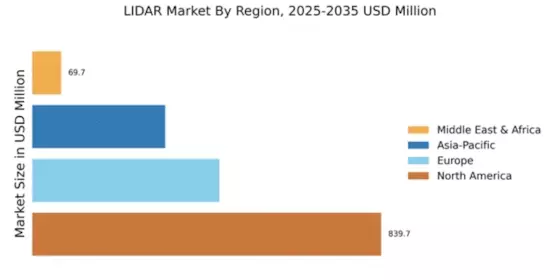
North America continues to lead the LIDAR market, holding a significant share of 839.7M in 2025. The growth is driven by advancements in autonomous vehicles, smart city initiatives, and increased demand for precision mapping. Regulatory support, particularly from the U.S. government, is fostering innovation and investment in LIDAR technologies, enhancing safety and efficiency in various applications. The competitive landscape is robust, with key players like Velodyne Lidar, Luminar Technologies, and Waymo spearheading advancements. The U.S. is the primary market, supported by a strong ecosystem of technology firms and research institutions. This region's focus on R&D and strategic partnerships is expected to further solidify its market position, making it a hub for LIDAR innovation.

Europe : Emerging LIDAR Innovations

Europe's LIDAR market is projected to reach 450.0M by 2025, driven by increasing investments in infrastructure and environmental monitoring. The region is witnessing a surge in demand for LIDAR applications in sectors like transportation and agriculture, supported by EU regulations promoting sustainable practices. The integration of LIDAR in autonomous vehicles is also a significant growth catalyst, enhancing safety and operational efficiency. Leading countries such as Germany, France, and the UK are at the forefront of this growth, with a competitive landscape featuring companies like Leica Geosystems and Riegl Laser Measurement Systems. The presence of strong regulatory frameworks and funding initiatives from the EU is fostering innovation, making Europe a key player in The LIDAR. "The European Commission is committed to supporting the development of advanced technologies, including LIDAR, to enhance safety and efficiency in transportation."

Asia-Pacific : Rapidly Growing LIDAR Sector

The Asia-Pacific LIDAR market is expected to grow significantly, reaching 320.0M by 2025. This growth is fueled by increasing urbanization, infrastructure development, and the rising adoption of autonomous vehicles. Countries like China and Japan are leading the charge, with government initiatives promoting smart city projects and advanced transportation systems. Regulatory frameworks are evolving to support the integration of LIDAR technologies in various sectors. China is emerging as a dominant player, with numerous startups and established companies investing heavily in LIDAR technology. The competitive landscape is characterized by a mix of local and international firms, including Ouster and Innoviz Technologies. As the region continues to innovate and expand its technological capabilities, the demand for LIDAR solutions is expected to rise, positioning Asia-Pacific as a key market in the global landscape.

Middle East and Africa : Developing LIDAR Applications

The Middle East and Africa LIDAR market is projected to reach 69.71M by 2025, driven by increasing investments in infrastructure and urban development. The region is beginning to recognize the potential of LIDAR technology in applications such as surveying, mapping, and environmental monitoring. Government initiatives aimed at enhancing smart city projects are also contributing to market growth, creating a favorable environment for LIDAR adoption. Countries like South Africa and the UAE are leading the way in LIDAR implementation, with a growing number of projects focusing on urban planning and resource management. The competitive landscape is still developing, with opportunities for both local and international players to establish a presence. As awareness of LIDAR benefits increases, the market is expected to expand significantly in the coming years.

Key Players and Competitive Insights

The LIDAR Market is currently characterized by a dynamic competitive landscape, driven by advancements in technology and increasing demand across various sectors, including automotive, aerospace, and urban planning. Key players such as Velodyne Lidar (US), Luminar Technologies (US), and Waymo (US) are at the forefront, each adopting distinct strategies to enhance their market positioning. Velodyne Lidar (US) focuses on innovation through continuous product development, while Luminar Technologies (US) emphasizes strategic partnerships with automotive manufacturers to integrate LIDAR systems into next-generation vehicles. Waymo (US), a leader in autonomous driving technology, leverages its extensive data collection capabilities to refine its LIDAR applications, thereby shaping the competitive environment through technological superiority and operational efficiency.

The business tactics employed by these companies reflect a concerted effort to optimize supply chains and localize manufacturing processes. The market structure appears moderately fragmented, with several players vying for dominance. However, the collective influence of major companies is significant, as they drive technological advancements and set industry standards. This competitive interplay fosters an environment where innovation is paramount, compelling smaller firms to adapt or collaborate to remain relevant.

In November 2025, Luminar Technologies (US) announced a strategic partnership with a leading automotive manufacturer to develop advanced LIDAR systems tailored for electric vehicles. This collaboration is poised to enhance Luminar's market reach and solidify its position as a key supplier in the rapidly evolving EV sector. The strategic importance of this partnership lies in its potential to accelerate the adoption of LIDAR technology in mainstream automotive applications, thereby expanding the overall market.

In October 2025, Velodyne Lidar (US) unveiled a new line of compact LIDAR sensors designed for urban mapping and infrastructure monitoring. This product launch is significant as it addresses the growing demand for high-resolution mapping solutions in smart city initiatives. By diversifying its product offerings, Velodyne aims to capture a larger share of the market, particularly in sectors beyond automotive, such as construction and urban planning.

In September 2025, Waymo (US) expanded its autonomous vehicle testing program to include a wider range of urban environments, utilizing its proprietary LIDAR technology. This expansion is crucial as it allows Waymo to gather more diverse data, enhancing the robustness of its algorithms and improving the safety and efficiency of its autonomous systems. Such strategic moves not only reinforce Waymo's leadership in the autonomous driving space but also highlight the importance of real-world testing in refining LIDAR applications.

As of December 2025, the LIDAR Market is witnessing trends that emphasize digitalization, sustainability, and the integration of artificial intelligence. Strategic alliances among key players are increasingly shaping the competitive landscape, fostering innovation and collaboration. The shift from price-based competition to a focus on technological advancement and supply chain reliability is evident, suggesting that future differentiation will hinge on the ability to innovate and adapt to emerging market demands.

Key Companies in the LIDAR Market market include

Industry Developments

  • Q2 2025: Luminar Technologies: Navigating the LiDAR Crossroads in 2025 Luminar Technologies accelerated production of its Halo LiDAR platform in Thailand in 2025, targeting B-sample delivery in 2026 and shifting strategic focus toward commercial and defense markets to diversify revenue amid automotive sector headwinds.
  • Q1 2025: Lidar firms Luminar and Ouster set 2025 targets amid tariff uncertainty Luminar announced it will narrow its focus to the new 'Halo' platform, aiming to reduce costs and achieve long-term profitability, while Ouster plans to transform its product portfolio in 2025 to target broader applications.
  • Q3 2025: Chinese providers continue to dominate automotive lidar 'arms race' Hesai Technology maintained its leadership in the automotive LiDAR sector in 2025, shipping over half a million units in the previous year and benefiting from rapid product cycles and strong integration strategies in China.

Future Outlook

LIDAR Market Future Outlook

The LIDAR market share is projected to grow at a 17.76% CAGR from 2024 to 2035, driven by advancements in autonomous vehicles, urban planning, and environmental monitoring.

New opportunities lie in:

  • Development of LIDAR-integrated drones for precision agriculture
  • Expansion of LIDAR applications in smart city infrastructure
  • Creation of subscription-based LIDAR data analytics services

By 2035, the LIDAR market is expected to be a pivotal technology across multiple industries.

Market Segmentation

LIDAR Market Range Outlook

  • Short Range
  • Medium Range
  • Long Range
  • Ultra Long Range

LIDAR Market End Use Outlook

  • Mapping
  • Surveying
  • Environmental Monitoring
  • Infrastructure Development
  • Mining

LIDAR Market Component Outlook

  • Laser Source
  • Receiver
  • Scanner
  • GPS Unit
  • Inertial Measurement Unit

LIDAR Market Technology Outlook

  • Solid State Lidar
  • Mechanical Lidar
  • Frequency Modulated Continuous Wave Lidar
  • Time of Flight Lidar
  • Hybrid Lidar

LIDAR Market Application Outlook

  • Geospatial
  • Automotive
  • Aerospace
  • Agriculture
  • Construction

Report Scope

MARKET SIZE 2024 1679.41(USD Million)
MARKET SIZE 2025 1977.71(USD Million)
MARKET SIZE 2035 10144.13(USD Million)
COMPOUND ANNUAL GROWTH RATE (CAGR) 17.76% (2024 - 2035)
REPORT COVERAGE Revenue Forecast, Competitive Landscape, Growth Factors, and Trends
BASE YEAR 2024
Market Forecast Period 2025 - 2035
Historical Data 2019 - 2024
Market Forecast Units USD Million
Key Companies Profiled Velodyne Lidar (US), Luminar Technologies (US), Waymo (US), Teledyne Technologies (US), Leica Geosystems (CH), Riegl Laser Measurement Systems (AT), Quanergy Systems (US), Ouster (US), Innoviz Technologies (IL)
Segments Covered Application, End Use, Technology, Component, Range
Key Market Opportunities Integration of LIDAR technology in autonomous vehicles enhances navigation and safety capabilities.
Key Market Dynamics Rising demand for autonomous vehicles drives innovation and competition in the LIDAR market, enhancing technological advancements.
Countries Covered North America, Europe, APAC, South America, MEA

Market Highlights

Author
Aarti Dhapte
Team Lead - Research

She holds an experience of about 6+ years in Market Research and Business Consulting, working under the spectrum of Information Communication Technology, Telecommunications and Semiconductor domains. Aarti conceptualizes and implements a scalable business strategy and provides strategic leadership to the clients. Her expertise lies in market estimation, competitive intelligence, pipeline analysis, customer assessment, etc.

Leave a Comment

FAQs

How much is the LiDAR Market?

The LiDAR Market size was valued at USD 1679.41 billion in 2024.

What is the growth rate of the LiDAR market?

The global market is projected to grow at a CAGR of 17.76% during the forecast period, 2025 to 2035.

Which region held the largest market share in the LiDAR Market?

North America had the largest share in the global LiDAR market

Who are the key players in the LiDAR market?

The key players in the market are Beike Tianhui Technology Co. Ltd (China), Hexagon AB (Sweden), and others .

Which product type led the LiDAR market?

The airborne Lidar category dominated the market in 2021.

Which technology had the largest market share in the LiDAR market?

The 3D technology had the largest share in the global LiDAR market.

Download Free Sample

Kindly complete the form below to receive a free sample of this Report

Compare Licence

×
Features License Type
Single User Multiuser License Enterprise User
Price $4,950 $5,950 $7,250
Maximum User Access Limit 1 User Upto 10 Users Unrestricted Access Throughout the Organization
Free Customization
Direct Access to Analyst
Deliverable Format
Platform Access
Discount on Next Purchase 10% 15% 15%
Printable Versions