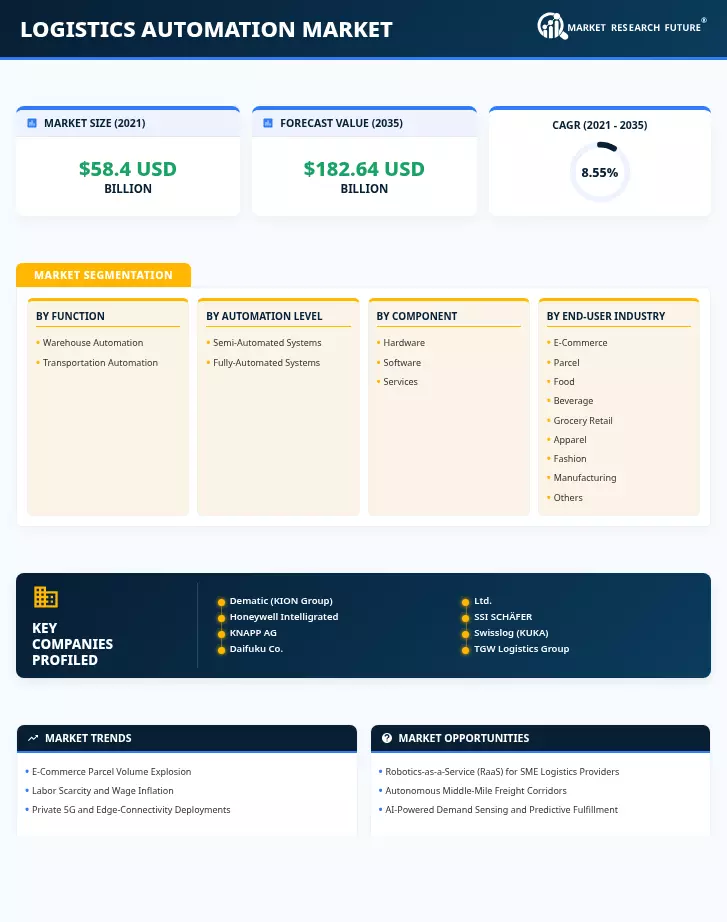
Segmentation Quick Reference
| Dimension | Sub-Segments | Dominant Segment | Fastest Growing Segment |
| Function | Warehouse Automation, Transportation Automation | Warehouse Automation | Transportation Automation |
| Automation Level | Semi-Automated Systems, Fully-Automated Systems | Semi-Automated Systems | Fully-Automated Systems |
| Component | Hardware, Logistics Automation Market, Services | Hardware | Logistics Automation Market |
| End-User Industry | E-Commerce and Parcel, Food and Beverage, Grocery Retail, Apparel and Fashion, Manufacturing, Others | E-Commerce and Parcel | Grocery Retail |
| Geography | North America, Europe, Asia-Pacific, South America, Middle East & Africa | North America | Asia-Pacific |
Market Segmentation Overview
By Function
| Sub-Segment | Key Trend |
| Warehouse Automation | Shift from conveyor-centric to AMR-first floor designs; goods-to-person robotics scaling rapidly |
| Transportation Automation | Autonomous middle-mile trucking pilots transitioning to commercial routes; TMS-freight platform consolidation |
Warehouse automation remains the revenue center of the Logistics Automation Market, but transportation automation is converging with autonomous vehicle technology to create integrated door-to-door freight automation platforms.
By Automation Level
| Sub-Segment | Key Trend |
| Semi-Automated Systems | Brownfield retrofits adding AMR fleets and pick-to-light overlays to existing infrastructure |
| Fully-Automated Systems | Greenfield mega-warehouses designed around lights-out operation with embedded digital-twin capability |
Semi-automated deployments dominate today's installed base, but fully-automated greenfield projects are setting the design template for next-generation supply chain automation facilities.
By Component
| Sub-Segment | Key Trend |
| Hardware | AMR unit costs declining 12–15% annually; AS/RS modular designs enabling phased installation |
| Logistics Automation Market | SaaS orchestration platforms replacing on-premise WCS; AI-powered demand sensing driving premium pricing |
| Services | System integration and lifecycle maintenance creating sticky recurring-revenue relationships |
The component mix is shifting as software orchestration captures a growing share of total automation spending, reflecting the Logistics Automation Market's transition from hardware-first to platform-first business models.
By End-User Industry
| Sub-Segment | Key Trend |
| E-Commerce and Parcel | Hyper-fulfillment centers with 100,000+ daily orders driving large-scale robotic logistics solutions adoption |
| Food and Beverage | Temperature-controlled automation for regulatory compliance and spoilage reduction |
| Grocery Retail | Micro-fulfillment centers inside or adjacent to stores enabling 15-minute delivery windows |
| Apparel and Fashion | Returns-processing automation addressing 25–30% online return rates |
| Manufacturing | Just-in-time inbound logistics automation integrating with factory-floor MES systems |
| Others | Logistics Automation Market cold-chain, aerospace MRO parts, and humanitarian logistics |
E-commerce remains the volume leader, but grocery retail's rapid micro-fulfillment expansion is creating the highest incremental growth opportunity in the Logistics Automation Market through 2035.