Download Free Sample
Kindly complete the form below to receive a free sample of this Report
Malaria Vaccine Market Research Report: Size, Share, Trend Analysis By Vaccine Type (RTS, S/AS01, R21/Matrix-M, PfSPZ), By Administration Route (Intramuscular, Subcutaneous), By Target Population (Children under 5 years, Pregnant women, Travelers to endemic areas), By Immunization Schedule (Single dose, Multi-dose, Booster doses), By Development Stage (Preclinical, Clinical Trials, Marketed) and By Regional (North America, Europe, South America, Asia-Pacific, Middle East and Africa) - Growth Outlook & Industry Forecast 2025 To 2035
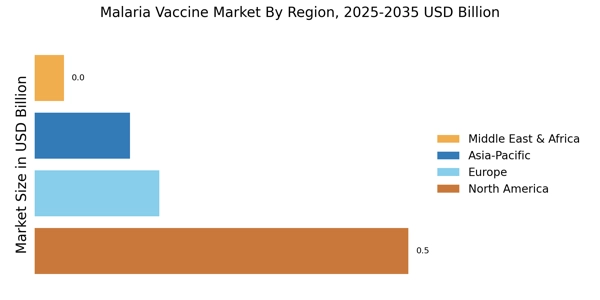
According to MRFR analysis, the Malaria Vaccine Market size was valued at USD 0.85 Billion in 2024. The market is projected to grow from USD 1.05 Billion in 2025 to USD 8.40 Billion by 2035, exhibiting a CAGR of 23.1% during the forecast period 2025-2035. North America led the market with over 58.84% share, generating around USD 0.5 billion in revenue.
Rising malaria burden and global immunization initiatives are accelerating malaria vaccine adoption. Increasing WHO-recommended vaccine rollouts, expanding pediatric immunization programs, and growing funding from global health organizations are driving demand, supporting market expansion and improving prevention strategies across endemic regions.
WHO reported 282 million malaria cases and 610,000 deaths globally in 2024, with 438,000 child deaths. Over 20 African countries introduced malaria vaccines targeting 10 million children annually, while pilot programs vaccinating 2 million children reduced mortality by 13%.
The Malaria Vaccine Market is poised for substantial growth driven by technological advancements and increased funding.
| 2024 Market Size | 0.8498 (USD Billion) |
| 2035 Market Size | 8.404 (USD Billion) |
| CAGR (2025 - 2035) | 23.16% |
The Malaria Vaccine Market is currently experiencing a transformative phase, driven by a confluence of scientific advancements and heightened global awareness regarding malaria's impact on public health. The ongoing research and development efforts are yielding promising candidates that may significantly reduce malaria incidence, particularly in endemic regions.
Furthermore, collaborations between governments, non-governmental organizations, and pharmaceutical companies appear to be fostering an environment conducive to innovation and accessibility. This synergy is likely to enhance vaccine distribution and uptake, potentially leading to a decline in malaria-related morbidity and mortality.
In addition, the Malaria Vaccine Market is witnessing an increase in funding and investment, as stakeholders recognize the urgent need for effective preventive measures. The focus on integrating vaccination with existing malaria control strategies, such as insecticide-treated nets and antimalarial medications, suggests a holistic approach to combating the disease. As the global health community continues to prioritize malaria eradication, the market is poised for growth, with new entrants and established players alike striving to contribute to this critical public health challenge.
The Malaria Vaccine Market is seeing a surge in research initiatives aimed at developing effective vaccines. This trend is characterized by innovative approaches, including mRNA technology and viral vector platforms, which may enhance vaccine efficacy and safety. Collaborative efforts among academic institutions, biotech firms, and global health organizations are likely to accelerate the pace of discovery and clinical trials.
Growing R&D investment is accelerating malaria vaccine innovation. WHO data shows two recommended vaccines (RTS,S and R21) demonstrating over 50% efficacy in first-year protection, with seasonal deployment achieving approximately 75% effectiveness, encouraging continued research expansion and clinical development pipelines globally.
There is a growing trend of public-private partnerships within the Malaria Vaccine Market. These collaborations are designed to pool resources, expertise, and funding to expedite vaccine development and distribution. Such alliances may facilitate access to vaccines in low-income countries, ensuring that vulnerable populations receive timely interventions.
Public-private collaborations are strengthening vaccine development and distribution. The Global Fund contributes 59% of international malaria financing and invested over USD 20.3 billion, supporting prevention, treatment, and vaccination initiatives, accelerating vaccine access and expanding protection for millions in endemic regions.
The integration of malaria vaccination with existing health strategies is becoming increasingly prominent. This trend suggests a comprehensive approach to malaria control, where vaccination efforts are combined with preventive measures like insecticide-treated nets and rapid diagnostic tests. Such integration may enhance overall effectiveness and sustainability of malaria control programs.
Integrated malaria control strategies are improving outcomes. WHO pilot programs vaccinating over 2 million children achieved 13% reduction in child mortality and improved prevention access exceeding 90%, demonstrating effectiveness when vaccines combine with insecticide-treated nets and other interventions.
The rising incidence of malaria in various regions appears to be a primary driver for the Malaria Vaccine Market. According to the World Health Organization, there were an estimated 241 million cases of malaria worldwide in 2020, with a significant proportion occurring in sub-Saharan Africa. This alarming trend underscores the urgent need for effective vaccination strategies.
As malaria continues to pose a substantial public health challenge, the demand for vaccines is likely to increase. The Malaria Vaccine Market is thus positioned to expand as governments and health organizations prioritize the development and distribution of vaccines to combat this pervasive disease. The increasing burden of malaria on healthcare systems may further incentivize investments in vaccine research and development, potentially leading to innovative solutions that could transform the landscape of malaria prevention.
Advancements in vaccine technology are playing a crucial role in shaping the Malaria Vaccine Market. Recent innovations, such as mRNA technology and viral vector platforms, have shown promise in enhancing vaccine efficacy and safety. These technological breakthroughs may facilitate the development of more effective malaria vaccines, which could significantly reduce the incidence of the disease.
For instance, the RTS,S/AS01 vaccine, which has been piloted in several African countries, demonstrates the potential of modern vaccine approaches. As research continues to evolve, the Malaria Vaccine Market is likely to benefit from these advancements, leading to a broader range of vaccine options. The integration of cutting-edge technology into vaccine development may also attract increased funding and collaboration among stakeholders, further accelerating progress in the fight against malaria.
Government initiatives and policies aimed at malaria control are significantly influencing the Malaria Vaccine Market. Many countries are implementing comprehensive malaria control strategies that include vaccination as a key component. For example, national health policies are increasingly prioritizing the integration of malaria vaccines into existing immunization programs.
This strategic alignment not only enhances vaccine accessibility but also promotes public awareness about malaria prevention. Furthermore, governments are collaborating with international organizations to establish regulatory frameworks that facilitate the approval and distribution of malaria vaccines. Such initiatives are likely to create a conducive environment for the Malaria Vaccine Market to thrive, as they encourage the development and deployment of innovative vaccine solutions. The proactive stance of governments in addressing malaria may lead to improved health outcomes and a reduction in malaria-related morbidity and mortality.
Increased funding for malaria research is a pivotal driver for the Malaria Vaccine Market. Various governments, non-governmental organizations, and philanthropic entities are recognizing the critical need to allocate resources towards malaria prevention and treatment. For instance, the Global Fund and the Bill and Melinda Gates Foundation have committed substantial financial support to combat malaria, which includes funding for vaccine development.
This influx of capital is likely to enhance research capabilities and facilitate clinical trials, ultimately leading to the introduction of new vaccines. As funding continues to grow, the Malaria Vaccine Market may experience accelerated innovation and a more robust pipeline of vaccine candidates. This financial commitment reflects a broader understanding of the economic and social implications of malaria, thereby reinforcing the importance of investing in effective vaccination strategies.
Growing awareness of malaria prevention among communities is emerging as a significant driver for the Malaria Vaccine Market. Public health campaigns and educational initiatives are increasingly informing populations about the risks associated with malaria and the importance of vaccination. This heightened awareness is likely to foster greater acceptance of malaria vaccines, thereby increasing demand.
As communities become more informed, they may actively seek vaccination options, contributing to higher vaccination rates. Additionally, the involvement of local health organizations in promoting malaria prevention strategies can further enhance community engagement. The Malaria Vaccine Market stands to benefit from this trend, as increased public awareness may lead to a more robust market for malaria vaccines. Ultimately, the collective efforts to educate and empower communities could play a vital role in reducing malaria transmission and improving overall public health.
In the Malaria Vaccine Market, the RTS,S/AS01 vaccine currently holds the largest share, accounting for 63.2% of the market share, being the first malaria vaccine to receive a positive recommendation from the World Health Organization. Its established efficacy and long-term use in pilot programs have solidified its position, attracting healthcare providers and funding from global health organizations. Meanwhile, the R21/Matrix-M vaccine is emerging rapidly, capturing the attention of researchers and investors due to its favorable efficacy results and potential for broader implementation in the future.
Vaccines: RTS,S/AS01 (Dominant) vs. R21/Matrix-M (Emerging)
RTS,S/AS01 serves as the dominant vaccine in the market share, benefiting from extensive clinical trials and endorsement from global health bodies. It provides a proven approach in immunization campaigns across endemic regions, allowing it to enjoy a significant foothold among stakeholders. On the other hand, R21/Matrix-M is rapidly gaining recognition as an emerging contender, characterized by a robust safety profile and the promise of lower production costs. Its innovative formulation aims to enhance immune response, making it a preferred candidate for future malaria vaccination strategies. This competition drives innovation and may alter the landscape of malaria prevention.
In the Malaria Vaccine Market, the administration route plays a crucial role in determining vaccine acceptance and efficacy. Currently, the intramuscular route holds the largest share, accounting for 68.4% of the market share, as it is the preferred method among healthcare professionals due to its established effectiveness and strong patient compliance. On the other hand, the subcutaneous route, while smaller in market share, is gaining traction as advancements in technology are made, illustrating a significant growth potential.
Administration Route: Intramuscular (Dominant) vs. Subcutaneous (Emerging)
The intramuscular administration route remains dominant in the market share, primarily due to its long-established use in vaccinations, which ensures reliability and strong immunogenic responses. This approach is favored for its ability to deliver higher volumes of vaccines effectively and its faster absorption into the bloodstream. Conversely, the subcutaneous route is emerging as a competitive alternative, driven by innovations in vaccine formulation and delivery mechanisms. With an increasing focus on patient comfort and ease of administration, subcutaneous vaccines are being developed to minimize discomfort, thereby enhancing acceptance among patients. This trend is expected to enrich the vaccine portfolio available for malaria prevention.
In the Malaria Vaccine Market, the target population segment is primarily characterized by three key groups: children under 5 years, pregnant women, and travelers to endemic areas. Children under 5 years represent the largest segment, accounting for 57.9% of the market share, reflecting the heightened vulnerability of this age group to malaria. Pregnant women also constitute a significant portion of the market, driven by the increased risk of severe malaria in this demographic. Travelers to endemic areas are rapidly emerging as a critical segment, owing to rising global travel and increasing awareness of malaria prevention among tourists. The growth trends in the Malaria Vaccine Market are influenced by several factors, including the rising incidence of malaria in endemic regions and a greater focus on preventive healthcare strategies. The largest segment, children under 5 years, is propelled by public health initiatives aimed at reducing child mortality rates caused by malaria. The travel segment is experiencing the fastest growth due to the surge in travels to endemic regions, coupled with heightened awareness of preventive measures to avoid health risks associated with malaria.
Children under 5 years (Dominant) vs. Pregnant women (Emerging)
Children under 5 years represent the dominant target population in the market share, often prioritized in vaccination campaigns due to their high susceptibility to malaria’s severe effects. Public health policies frequently focus on this demographic, as reducing malaria-related deaths in children is critical for improving overall child health outcomes. In contrast, pregnant women, while less numerous, are considered an emerging segment due to the unique health risks they face, including the possibility of maternal and fetal complications stemming from malaria. This segment is gaining attention as healthcare providers recognize the need for tailored vaccination strategies that address the specific vulnerabilities of pregnant women, thus fostering growth in this area.
In the Malaria Vaccine Market, the immunization schedule is crucial in determining the effectiveness of vaccination campaigns. The single-dose regimen currently holds the largest share, accounting for 61.3% of the market share, appealing to both healthcare providers and patients due to its simplicity and ease of administration. In contrast, multi-dose vaccines are rapidly gaining traction, driven by advancements in vaccine technology and a growing understanding of immune response sustainability. These trends underscore the shifting preferences among healthcare stakeholders.
Single dose (Dominant) vs. Multi-dose (Emerging)
The single-dose Malaria vaccine is characterized by its straightforward administration, which significantly enhances patient compliance and broader acceptance in various regions, especially in remote areas with limited healthcare access. This segment has established dominance in the market due to its logistical benefits and ease of integration into existing healthcare systems. On the other hand, the multi-dose vaccine presents an emerging opportunity, as it is designed to boost and prolong immunity against malaria. This approach is gaining popularity, particularly in regions experiencing high transmission rates, where prolonged protection is essential. As researchers continue to explore optimal dosages and schedules, the multi-dose segment is expected to evolve, catering to dynamic public health needs.
In the Malaria Vaccine Market, the development stage exhibits a diverse landscape, with the leading segment accounting for 64.8% of the market share across its segments. Notably, the Clinical Trials phase commands the largest share, as it includes multiple candidates actively undergoing evaluation, signaling substantial investment and interest. On the other hand, the Marketed segment represents a rapidly evolving area with growing acceptance and accessibility of malaria vaccines, reflecting a shift toward real-world application and implementation in endemic regions.
Clinical Trials (Dominant) vs. Marketed (Emerging)
The Clinical Trials segment plays a dominant role in the market share, due to its ongoing research efforts and substantial funding from both public and private entities. This segment encompasses numerous vaccine candidates that are undergoing rigorous testing to prove their safety and efficacy. Conversely, the Marketed segment, while currently smaller, is recognized as an emerging area due to the successful rollout of malaria vaccines, leveraging advancements in immunology and manufacturing processes. This segment is characterized by increasing distribution networks and strategic partnerships aiming to enhance vaccine accessibility in high-burden countries, ultimately contributing to malaria eradication efforts.
North America leads in the Malaria Vaccine Market Size, accounting for over 58.84% of the global revenue in 2024.
As the market evolves, regional dynamics play a critical role in shaping its trajectory.
In North America, a growing focus on research and development in malaria vaccine technologies is anticipated to drive market growth. Europe is likely to witness a steady increase in investment aimed at combatting malaria amid rising awareness and health initiatives.The Asia-Pacific (APAC) region is expected to emerge as a key player, particularly due to the high prevalence of malaria and increasing funding for vaccine research, which is projected to contribute to the Malaria Vaccine Market revenue significantly.
In South America, the focus on improving healthcare infrastructure presents opportunities for vaccine adoption, while the Middle East and Africa (MEA) region, with its considerable malaria burden, is likely to see enhanced governmental and non-governmental collaboration, supporting the market's expansion.
Within this landscape, specific sub-segments such as RTS, S/AS01, valued at 1.9 USD billion in 2032, R21/Matrix-M at 1.5 USD billion, and PfSPZ at 1.1 USD billion, are increasingly vital to the overall market growth, demonstrating the varied potential across different vaccine candidates. As market dynamics shift, challenges such as distribution logistics and regional healthcare disparities remain, yet they also open up avenues for innovation and targeted interventions. Comprehensive Malaria Vaccine Market data illustrates the intricate interdependencies between these regions and their respective strategies in combating malaria through effective vaccination programs.
The Malaria Vaccine Market is characterized by a competitive landscape that is rapidly evolving in response to increasing incidences of malaria and the urgent need for effective prevention strategies. The market is driven by advancements in vaccine technology, ongoing research and development activities, and the collaboration between public and private sectors aimed at eradicating malaria.
Key players in the industry are focusing on innovation and strategic partnerships to enhance their market presence, which has led to the introduction of novel vaccine candidates. As the demand for effective malaria vaccines continues to grow, companies operating in this market are engaging in competitive strategies that include mergers and acquisitions, expanding their product portfolios, and addressing the diverse needs of malaria-endemic regions.Merck possesses notable strengths within the Malaria Vaccine Market due to its strong commitment to research and development, which has resulted in advanced vaccine candidates.
The company has a robust portfolio of vaccines and is known for its extensive expertise in immunology and vaccine science. Merck's collaborative approach, often partnering with academic institutions and various health organizations, has enabled it to accelerate the development of innovative malaria vaccines. Furthermore, the company's experience in navigating regulatory environments and establishing extensive distribution channels contributes to its strong market presence, making it a key player in the race against malaria.
Its commitment to addressing global health challenges further solidifies Merck's role as a leading contender in the malaria vaccine sector. GSK is another significant player in the Malaria Vaccine Market, recognized for its extensive experience in vaccine development and an established reputation in public health. The company stands out for its pioneering work in creating and bringing to market one of the first malaria vaccines, showcasing its dedication to combating this critical disease. GSK's strong emphasis on research and development has led to continued investments in innovative vaccine candidates, allowing the company to remain at the forefront of malaria prevention efforts.
Additionally, GSK's strong partnerships with international health organizations facilitate access to its products in malaria-endemic regions, underscoring its commitment to global health initiatives. The company's strategic focus on sustainability and addressing healthcare disparities enhances its competitive edge in the malaria vaccine landscape, reinforcing GSK's status as a leader in the fight against malaria.




The Malaria Vaccine Market size is projected to reach USD 8.404 Billion by 2035, growing at a CAGR of 23.1%
New opportunities lie in:
By 2035, the Malaria Vaccine Market is poised for substantial growth, enhancing global health outcomes.
| MARKET SIZE 2024 | 0.8498(USD Billion) |
| MARKET SIZE 2025 | 1.047(USD Billion) |
| MARKET SIZE 2035 | 8.404(USD Billion) |
| COMPOUND ANNUAL GROWTH RATE (CAGR) | 23.16% (2025 - 2035) |
| REPORT COVERAGE | Revenue Forecast, Competitive Landscape, Growth Factors, and Trends |
| BASE YEAR | 2024 |
| Market Forecast Period | 2025 - 2035 |
| Historical Data | 2019 - 2024 |
| Market Forecast Units | USD Billion |
| Key Companies Profiled | GlaxoSmithKline (GB), Pfizer (US), Sanofi (FR), Merck & Co. (US), Novartis (CH), Johnson & Johnson (US), Bharat Biotech (IN), Takeda Pharmaceutical Company (JP), Medicago (CA) |
| Segments Covered | Vaccine Type, Administration Route, Target Population, Immunization Schedule, Development Stage, Regional |
| Key Market Opportunities | Advancements in mRNA technology may enhance efficacy and accessibility in the Malaria Vaccine Market. |
| Key Market Dynamics | Rising investments in Research and Development are driving innovation in malaria vaccine technologies and competitive market dynamics. |
| Countries Covered | North America, Europe, APAC, South America, MEA |
The Malaria Vaccine Market was valued at 0.8498 USD Billion in 2024.
The market is projected to reach 8.404 USD Billion by 2035.
The expected CAGR for the Malaria Vaccine Market during 2025 - 2035 is 23.16%.
The main types include RTS, S/AS01, R21/Matrix-M, and PfSPZ, with valuations of 0.4249, 0.2549, and 0.1699 USD Billion respectively.
The primary administration routes are intramuscular and subcutaneous, each valued at 0.4249 USD Billion.
Target populations include children under 5 years, pregnant women, and travelers to endemic areas, with valuations of 0.425, 0.2, and 0.224 USD Billion respectively.
Immunization schedules include single dose, multi-dose, and booster doses, with valuations of 0.2549, 0.3398, and 0.2551 USD Billion respectively.
Malaria vaccines are in various stages, including preclinical, clinical trials, and marketed, with valuations of 0.2549, 0.3399, and 0.2549 USD Billion respectively.
The Malaria Vaccine Market's growth appears robust, with a projected valuation increase from 0.8498 USD Billion in 2024 to 8.404 USD Billion by 2035.


Kindly complete the form below to receive a free sample of this Report

“This is really good guys. Excellent work on a tight deadline. I will continue to use you going forward and recommend you to others. Nice job”


“Thanks. It’s been a pleasure working with you, please use me as reference with any other Intel employees.”


“Thanks for sending the report it gives us a good global view of the Betaïne market.”


“Thank you, this will be very helpful for OQS.”


“We found the report very insightful! we found your research firm very helpful. I'm sending this email to secure our future business.”


“I am very pleased with how market segments have been defined in a relevant way for my purposes (such as "Portable Freezers & refrigerators" and "last-mile"). In general the report is well structured. Thanks very much for your efforts.”


“I have been reading the first document or the study, ,the Global HVAC and FP market report 2021 till 2026. Must say, good info! I have not gone in depth at all parts, but got a good indication of the data inside!”


“We got the report in time, we really thank you for your support in this process. I also thank to all of your team as they did a great job.”


“The Automotive 48V ECU Components Procurement Intelligence Study” was a complex project, but the Market Research Future (MRFR) team handled it with quality, agility, and customer-centricity. They delivered all requested data on time and within the agreed scope. The team, including Shubhendra Anand and Rahul Gotadki, was always readily available to clarify questions and swiftly implement necessary adjustments, driving the project to a successful conclusion within a very demanding timeframe.
I would also like to specifically commend Akshay Agarwal for his responsiveness and support at every stage—from our initial inquiry on May 6th through to final delivery on June 18th. His dedication made the entire process seamless.”



