×
Request Free Sample ×

Kindly complete the form below to receive a free sample of this Report

* Please use a valid business email

Leading companies partner with us for data-driven Insights

clients tt-cursor
Hero Background

Masterbatch Market

ID: MRFR/CnM/4129-CR
111 Pages
Chitranshi Jaiswal
February 2026

Masterbatch Market Research Report Information by Type (White Masterbatch, Filler Masterbatch, Color Masterbatch [Standard Color, Specialty Color, Tailor Made Colors], Black Masterbatch, UV Masterbatch, Additive Masterbatch), By Polymer (PP (Polypropyle, PE (Polyethylene) [HDPE (High-Density Polyethylene), LDPE (Low-Density Polyethylene), Others], PVC (Polyvinyl Chloride), PS (Polystyrene), Others), By Application (Packaging [Rigid, Flexible], Construction Material [Doors & Windows, Pipes & Fittings, Sidings, Others], Automotive Components, Electrical and Electronic Components, Agricultural Films, Consumer Goods, Others) and By Region (North America, Europe, Asia-Pacific, South America, And Middle East & Africa) –Market Forecast Till 2035

Share:
Download PDF ×

We do not share your information with anyone. However, we may send you emails based on your report interest from time to time. You may contact us at any time to opt-out.

Masterbatch Market Infographic
Purchase Options

Masterbatch Market Summary

As per Market Research Future analysis, the Masterbatch Market Size Was Valued at USD 13,091.27 Million In 2024. The Global Masterbatch Industry Is Projected to grow from USD 13,811.29 Million in 2025 to USD 23,591.68 Million by 2035, Exhibiting A Compound Annual Growth Rate (CAGR) of 5.5% during the Forecast Period 2025 – 2035

Key Market Trends & Highlights

The Masterbatch Market is experiencing steady evolution driven by plastics demand across industries, with sustainability and advanced functionalities emerging as dominant trends.

  • Recycling and bio-based masterbatches are gaining traction amid regulatory pressures like EU plastics directives. Producers are developing masterbatches compatible with post-consumer recycled (PCR) resins, maintaining color consistency and properties without degradation.
  • Nanotechnology integration enhances dispersion and performance, enabling thinner films with superior barrier properties.
  • Trends include high-barrier masterbatches for extended shelf life and printable variants for branded pouches. Shrink films and laminates benefit from UV-stabilized options, with Asia-Pacific converters scaling production rapidly.
  • Modular building and infrastructure in emerging markets spur additive masterbatches for weather resistance and durability. Anti-slip and wood-effect colorants enhance flooring and facades.

Market Size & Forecast

2024 Market Size 13,091.27 (USD Million)
2035 Market Size 23,591.68 (USD Million)
CAGR (2025 - 2035) 5.5%

Major Players

Avient Corporation, Ampacet, Cabot Corporation, Plastika Kritis, Tosaf, Penn Color and Americhem Inc., LyondellBasell Industries Holdings B.V, Europlas, RTP Company

Our Impact
Enabled $4.3B Revenue Impact for Fortune 500 and Leading Multinationals
Partnering with 2000+ Global Organizations Each Year
30K+ Citations by Top-Tier Firms in the Industry

Masterbatch Market Trends

The expanding use of plastics in significant sectors such as packaging, automotive, construction, consumer goods, agriculture, and electronics is driving the Masterbatch Market. Supported by growing consumer demand for improved product aesthetics, rising standards for food safety and preservation, and the expanding e-commerce industry, packaging remains the most common application area among these. The need for color, additive, and combination masterbatches is also being driven by the growth of flexible packaging formats and high-performance films, especially in the food, personal care, and pharmaceutical industries.


On the other hand, as automakers anticipate reducing weight and increase fuel efficiency, automotive applications are benefiting from a move toward lighter and more resilient materials. In this context, masterbatches are frequently used to provide wiring, bumpers, under-the-hood parts, and car interiors color, UV resistance, flame retardancy, and anti-static qualities. Due to branding and aesthetic considerations, color masterbatch remain most significantly common type, particularly in consumer goods and packaging. But because of its superior UV resistance, opacity, and extensive use in construction, agriculture, and industrial applications such as pipes, cables, and geomembranes, black masterbatch is becoming more well-known. With respect to its high brightness and opacity, white masterbatch is widely used in packaging films and containers, while additive masterbatches are becoming increasingly important in a variety of industries due to their antimicrobial, anti-fog, anti-blocking, slip-enhancing, and flame-retardant properties. As industries look to simplify compounding and lower processing costs, the growing popularity of multifunctional masterbatches—which combine colouring with additives that improve performance—is also influencing market dynamics.


With strong manufacturing activity, rapidly industrialization, and growing urban infrastructure, especially in China, India, Indonesia, and Vietnam, Asia-Pacific geographically dominates the world's masterbatch landscape. Numerous forces at both the macro and micro levels impact market dynamics. One of the most significant factors is the ongoing global expansion of plastic use, as polymers are displacing more conventional materials like metal, glass, and wood in newer applications. Masterbatch is positioned as a crucial link in the plastics value chain as the demand for both functional and aesthetic improvements rise along with plastic volumes.

Masterbatch Market Drivers

Increasing demand for plastics in automotive industry

The Masterbatch Market is being driven by the growing demand for plastics in the automotive sector, which is revolutionizing the design, production, and performance, efficiency, and sustainability optimization of automobiles. Plastics are quickly taking the place of more conventional materials like metal, rubber, and glass in a variety of vehicle components as automakers around the world concentrate on lightweighting, energy efficiency, and design flexibility. The need for proficient masterbatches to alter and improve the qualities of plastic materials used throughout the automotive supply chain has increased because of this structural change. In the production of automotive interior and exterior components, masterbatches are essential because they give polymers their color, mechanical strength, thermal stability, UV resistance, flame retardancy, and other functional properties. The need for high-performance, application-specific masterbatches is growing because modern cars now contain anywhere from 10% to 15% plastic by weight, with a large portion of that plastic found in parts like fuel tanks, dashboards, door panels, under-the-hood components, wire insulation, and lighting components.

Surging demand from the rapidly growing packaging industry

One of the most important and revolutionary factors influencing the Masterbatch Market is the rising demand from the rapidly growing packaging sector. Plastics—and consequently, masterbatches—have a bigger role than ever before as global consumption patterns change and industries increasingly appear to flexible, long-lasting, and aesthetically pleasing packaging solutions. The packaging industry, which includes a wide range of uses such as food and drink containers, personal care packaging, pharmaceuticals, household goods, industrial packaging, and e-commerce logistics, is responsible for most of the plastic consumption globally.
 
The need for masterbatches, which are crucial for adding color, boosting functionality, and enhancing the processability of packaging materials, is being directly increased by this upward trend in plastic usage. Packaging is now viewed as a brand touchpoint that must communicate identity, safety, sustainability, and innovation—all areas where masterbatches are essential—rather than just a container as consumer expectations rise. Packaging in the food and beverage industry must guarantee product protection, shelf-life extension, and regulatory compliance in addition to drawing in customers. Manufacturers use color masterbatches for brand consistency and differentiation, white masterbatches for opacity and barrier enhancement, and additive masterbatches for features such as oxygen or moisture resistance, UV protection, anti-fog, and anti-microbial action to meet these demands. The use of specialized masterbatches that can provide both practical and aesthetic benefits without sacrificing sustainability goals is also being encouraged by the move toward high-performance multilayer films and mono-material structures for recyclability.

Market Segment Insights

By Polymer: Standard Seats (Largest) vs. Powered Seats (Fastest-Growing)

On Polymer, the Masterbatch Market has been segmented into: PP (Polypropylene), PE (Polyethylene), PVC (Polyvinyl Chloride), PS (Polystyrene), Others. The Standard Seats held the largest market in 2024, and the Powered Seats segment is the fastest growing segment during the forecast period. One of the most responsive and popular thermoplastics in the masterbatch sector is polypropylene (PP). It is perfect for applications ranging from textiles and household goods to automotive components and rigid packaging because of its high melting point, chemical resistance, and lightweight nature. To ensure even dispersion of pigments and additives, masterbatches used with PP must be designed to match its non-polar nature. Colourants, UV stabilisers, anti-fog agents, nucleating agents, and anti-static substances are examples of common masterbatches for PP. Demand for PP-compatible masterbatches that work with post-consumer recycled (PCR) or bio-based PP resins is rising because of the rise in sustainability initiatives. The most widely used plastic resin globally, polyethylene, which includes HDPE, LDPE, and LLDPE, makes up a sizable portion of masterbatch usage. Given the variety of PE grades and processing methods, masterbatches for PE need to be extremely flexible. Films, containers, liners, caps, coatings, insulation, and woven sacks are examples of common uses. PE is compatible with a wide variety of color and additive masterbatches, such as UV stabilizers, anti-fog, flame retardants, and antioxidants, due to its exceptional chemical resistance and processability. PVC is a strong and adaptable plastic that is found in a variety of rigid and flexible applications, such as wire insulation, flooring, medical tubing, window frames, and pipes. Because PVC has a polar structure and is more heat-sensitive than polyolefins, it needs specific masterbatch formulations. Polystyrene's rigidity, clarity, and ease of processing make it a popular material for disposable goods, packaging, appliances, and electronics housings. Both general-purpose PS (GPPS) and high-impact PS (HIPS) are available; HIPS has rubber modifiers for added toughness.

By Application: Packaging (Largest) vs. Construction Material (Fastest-growing)

Based on Application, the Masterbatch Market has been segmented into: Packaging, Construction Material, Automotive Components, Electrical and Electronic Components, Agricultural Films, Consumer Goods, Others. The Structure segment held the largest market in 2024 and Trim is the fastest growing segment during the forecast period. Packaging, which includes both rigid and flexible forms used in industries such as food and beverage, personal care, pharmaceuticals, household goods, and industrial shipping, is the largest and most dynamic application segment in the Masterbatch Market. Masterbatch plays a wide range of roles in packaging, including adding color, enhancing appearance, and integrating essential functional additives that improve sustainability, performance, and safety. Many polymer-based construction products, including pipes, conduits, cables, panels, films, sheets, profiles, tanks, sealants, membranes, and insulation materials, use them extensively to improve their longevity, performance, and appearance. The need for masterbatches in consumer goods, such as toys, kitchenware, electronics, personal care containers, and home appliances, includes tactile finishes (such as matte or soft-touch), bright, scratch-resistant colors, and antimicrobial or antibacterial additives for products that are sensitive to hygienic conditions. Color masterbatches must adhere to standards for cosmetic quality, child safety (such as EN 71 compliance), and food contact safety. As companies seek eco-credentials without sacrificing functionality or finish, the trend toward PCR-compatible and bio-based carriers is still going strong. For high-end toys or grooming products, specialty finishes like pastel, metallic, or pearlescent effects are popular.

By Type: White Masterbatch (Largest) vs. Color Masterbatch (Fastest-Growing)

Based on Type, the Masterbatch Market has been segmented into White Masterbatch, Filler Masterbatch, Color Masterbatch, Black Masterbatch, UV Masterbatch, Additive Masterbatch. The White Masterbatch segment held the largest market share in 2024, and the Color Masterbatch is the fastest-growing segment during the forecast period (2025 -2035). Although recent trends are changing the formulation and positioning of white masterbatch, it is still essential in consumer goods, packaging, and engineering plastics. Sustainability issues and regulatory scrutiny of titanium dioxide are driving innovation toward eco-friendly or low-titania alternatives, such as bio-based white carriers that work with PLA and PCR resins. Manufacturers are improving opacity and lowering pigment load while increasing brightness retention under UV light. New finishes, such as soft-touch whites or matte, are popular, particularly in consumer electronics and high-end packaging. Flexible packaging is increasingly using anti-fog or barrier-integrated white masterbatches, which eliminate the need for distinct additive layers. Color masterbatch is still an active segment of the masterbatch market, changing rapidly in response to sustainability regulations, material compatibility, and brand aesthetics. Although the main purpose of color masterbatch is to give plastics a consistent, vivid, and long-lasting color, the current trend places more emphasis on functionality than aesthetics. Modern formulations are being created to work with biodegradable resins (like PLA), recycled polymers (like rPET and PCR PP), and sophisticated manufacturing techniques like multilayer extrusion and 3D printing. To comply with REACH, RoHS, and FDA regulations, there is an increasing need for low-VOC, heavy metal-free, and food-contact-approved pigments as global brands place a higher priority on visual identity and circularity.

Get more detailed insights about Masterbatch Market

Regional Insights

North America : Innovation and Demand Surge

North America is witnessing robust growth in the Masterbatch Market, driven by increasing demand from the packaging, automotive, and consumer goods sectors. The region holds approximately 35% of the global market share, making it the largest market. Regulatory support for sustainable materials and innovations in production processes are further propelling this growth. The shift towards eco-friendly solutions is a significant catalyst for market expansion. The United States leads the North American market, with key players like Clariant, BASF, and DOW establishing a strong presence. The competitive landscape is characterized by continuous innovation and strategic partnerships among major companies. Canada also contributes to the market, focusing on sustainable practices and advanced manufacturing technologies. The presence of these key players ensures a dynamic and competitive environment in the region.

Europe : Sustainability and Innovation Focus

Europe is emerging as a significant player in the Masterbatch Market, driven by stringent regulations on plastic usage and a strong emphasis on sustainability. The region accounts for approximately 30% of the global market share, making it the second-largest market. Regulatory frameworks, such as the EU Plastics Strategy, are catalyzing the shift towards biodegradable and recyclable materials, enhancing market growth. The demand for high-quality masterbatches in various applications is also on the rise. Germany, France, and the UK are leading countries in this market, with companies like BASF and Evonik at the forefront. The competitive landscape is marked by innovation in product offerings and a focus on sustainable solutions. The presence of numerous small and medium enterprises alongside major players fosters a dynamic market environment. This competitive edge is crucial for meeting the evolving demands of consumers and regulatory bodies alike.

Asia-Pacific : Emerging Markets and Growth Potential

The Asia-Pacific region is experiencing rapid growth in the Masterbatch Market, fueled by increasing industrialization and urbanization. This region holds approximately 25% of the global market share, driven by countries like China and India, which are witnessing a surge in demand for packaging and automotive applications. Government initiatives promoting manufacturing and infrastructure development are significant growth drivers, alongside rising consumer awareness regarding product quality and sustainability. China is the largest market in the region, with a strong presence of key players such as SABIC and A. Schulman. India is also emerging as a vital market, with increasing investments in manufacturing capabilities. The competitive landscape is characterized by a mix of local and international players, fostering innovation and competitive pricing strategies. This dynamic environment is essential for meeting the diverse needs of various industries in the region.

Middle East and Africa : Resource-Rich and Growing Demand

The Middle East and Africa region is witnessing a gradual increase in the Masterbatch Market, driven by growing industrial activities and a rising demand for plastic products. This region currently holds about 10% of the global market share. The growth is supported by government initiatives aimed at diversifying economies and enhancing manufacturing capabilities. Additionally, the increasing focus on sustainable practices is shaping market dynamics, with a shift towards eco-friendly masterbatches. Countries like South Africa and the UAE are leading the market, with investments in infrastructure and manufacturing facilities. The competitive landscape is evolving, with both local and international players vying for market share. Key companies such as Kraton and Ampacet are establishing a foothold in the region, contributing to the overall growth and innovation in the masterbatch market. This competitive environment is crucial for addressing the unique demands of the region's diverse industries.

South America: Rapidly Develop Masterbatch

The South America, the packaging sector continues to be the primary user of masterbatches, mostly for use in household, personal care, and food and beverage products. Due to financial constraints, there is a noticeable shift toward value-added functionalities like UV protection, anti-fog, and antimicrobial additives, but the demand is still primarily for standard color masterbatches (such as white, black, and primary colors). There is pressure to meet global packaging standards for food contact safety, recyclability, and even traceability because many regional converters serve multinational FMCG companies. Because of this, masterbatch suppliers are now trying to create formulations that comply with FDA and EU standards, even in cases where local laws do not yet require them. Adoption of sustainability is still in its early stages, but it is gaining traction. Some nations are advancing extended producer responsibility (EPR) legislation, plastic bag bans, and packaging targets for recycled content, especially Chile and Colombia.
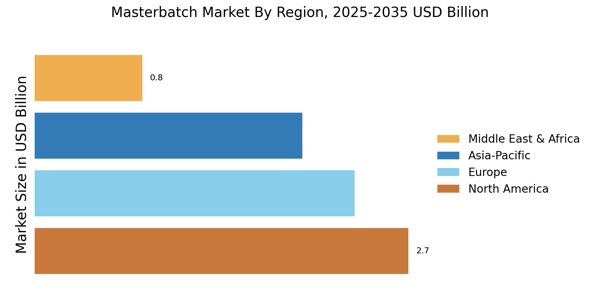
Masterbatch Market Regional Image

Key Players and Competitive Insights

Many global, regional, and local vendors characterize the Masterbatch Market. The market is highly competitive, with all the players competing to gain market share. Intense competition, rapid advances in technology, frequent changes in government policies, and environmental regulations are key factors that confront market growth. The vendors compete based on cost, product quality, reliability, and government regulations. Vendors must provide cost-efficient, high-quality products to survive and succeed in an intensely competitive market.
The major players in the market include Avient Corporation, Ampacet, Cabot Corporation, Plastika Kritis, Tosaf, Penn Color and Americhem Inc., LyondellBasell Industries Holdings B.V, Europlas, RTP Company strategic market developments and decisions to improve operational effectiveness.

Key Companies in the Masterbatch Market include

Industry Developments

In 2023, A newly developed, universally applicable masterbatch carrier system from Tosaf Color Service now complies with all common food contact requirements. 

Future Outlook

Masterbatch Market Future Outlook

The Masterbatch Market size is projected to grow at a 4.6% CAGR from 2025 to 2035, driven by increasing demand for sustainable packaging and advanced color solutions.
The future outlook for the Masterbatch Market is strong, driven by the shift toward high-performance additives and sustainable solutions. Growth focuses on biodegradable carriers, NIR-detectable black pigments for improved recyclability, and lightweighting in electric vehicles.

New opportunities lie in:

  • Sustainable masterbatch creates opportunities for market growth
  • Rising demand for sustainable and biodegradable masterbatch solutions

By 2035, the Masterbatch Market  is expected to achieve robust growth, driven by innovation and sustainability.

Market Segmentation

Masterbatch Market by Type Outlook

  • White Masterbatch

  • Filler Masterbatch

  • Color Masterbatch [Standard Color

  • Specialty Color

  • Tailor Made Colors]

  • Black Masterbatch

  • UV Masterbatch

  • Additive Masterbatch

Masterbatch Market by Polymer Outlook

  • Polypropyle

  • PE (Polyethylene) [HDPE (High-Density Polyethylene)

  • LDPE (Low-Density Polyethylene)

  • Others]

  • PVC (Polyvinyl Chloride)

  • PS (Polystyrene)

  • Others

Masterbatch Market by Application Outlook

  • Packaging [Rigid

  • Flexible]

  • Construction Material [Doors & Windows

  • Pipes & Fittings

  • Sidings

  • Others]

  • Automotive Components

  • Electrical and Electronic Components

  • Agricultural Films

  • Consumer Goods

  • Others

Report Scope

Market Size 2024 13,091.27 (USD Million)
Market Size 2025 13,811.29 (USD Million)
Market Size 2035 23,591.68 (USD Million)
Compound Annual Growth Rate (CAGR) 5.5% (2025 - 2035)
Report Coverage Revenue Forecast, Competitive Landscape, Growth Factors, and Trends
Base Year 2024
Market Forecast Period 2025 - 2035
Historical Data 2019 - 2023
Market Forecast Units USD Million
Key Companies Profiled Avient Corporation, Ampacet, Cabot Corporation, Plastika Kritis, Tosaf, Penn Color and Americhem Inc., LyondellBasell Industries Holdings B.V, Europlas, RTP Company.
Segments Covered By Type, By Polymer, By Application
Key Market Opportunities ·         Sustainable masterbatch creates opportunities for market growth ·         Rising demand for sustainable and biodegradable masterbatch solutions     
Key Market Dynamics ·      Automakers anticipate reducing weight and increase fuel efficiency ·      Automotive applications are benefiting from a move toward lighter and more resilient materials
Regional Covered North America, Europe, Asia Pacific, Latin America, Middle East & Africa.

Market Highlights

Author
Chitranshi Jaiswal
Research Analyst Level I

In her 3 years of experience in the market research field, she has handled critical cross-domain projects. She has an in-depth knowledge of market estimation & analysis, problem-solving, primary as well as secondary research, and team management.She holds an engineering degree and is an MBA professional from a well-known university, capable of evaluating the market and competitive conditions. An exceptional strategist with excellent communication skills and a passion for delivering cutting-edge & practical insights for the market. Proficient in multi-tasking, and can successfully deal with competing demands, while maintaining complete confidentiality. Generated business through active client and project development, networking, and high-quality responses. Her knowledge and skills have helped in making solid business decisions, securing funding from investors, and avoiding business failures.

Leave a Comment

FAQs

How much is the Masterbatch Market?

The Masterbatch Marketis expected to be valued at USD 23,591.68 Million in 2035.

What is the growth rate of the Global Automotive Seating System and Components Market?

The global market is projected to grow at a CAGR of 5.5% during the forecast period, 2025-2035.

Which region holds the largest market share in Masterbatch Market?

Asia Pacific had the largest share of the global market.

Who are the key players in the Masterbatch Market?

The key players in the market are including Avient Corporation, Ampacet, Cabot Corporation, Plastika Kritis, Tosaf, Penn Color and Americhem Inc., LyondellBasell Industries Holdings B.V, Europlas, RTP Company.

Which By Application had the largest market share in the Masterbatch Market?

The packaging Segment had the largest revenue share of the global market

Research Approach

Secondary Research

The secondary research process involved comprehensive analysis of regulatory databases, industry publications, technical journals, and authoritative organizations in the plastics and chemicals sector. Key sources included the US Environmental Protection Agency (EPA), European Chemicals Agency (ECHA), Food and Drug Administration (FDA) for food-contact plastics regulations, American Chemistry Council (ACC), Plastics Industry Association (PLASTICS), European Plastics Association (Plastics Europe), Society of Plastics Engineers (SPE), National Institute of Standards and Technology (NIST), Occupational Safety and Health Administration (OSHA), International Organization for Standardization (ISO) technical committees, US Bureau of Labor Statistics (BLS) manufacturing data, Eurostat Industrial Production Database, China Petroleum and Chemical Industry Federation (CPCIF), Ministry of Environment, Forest and Climate Change (India) plastic waste management reports, and national statistics offices from key manufacturing markets. These sources were used to collect production statistics, regulatory compliance data, resin pricing trends, sustainability initiatives, and market landscape analysis for white, black, color, and additive masterbatches across polypropylene (PP), polyethylene (PE), PVC, and polystyrene (PS) resin systems.

Primary Research

As part of the initial research process, stakeholders from both the supply and demand sides were interviewed to get both qualitative and quantitative information. CEOs, VPs of Manufacturing, heads of R&D, regulatory compliance officers, and marketing directors from masterbatch manufacturers, compounders, and resin suppliers were some of the supply-side sources. Demand-side sources included purchasing managers from companies that change packaging, Tier 1 suppliers for the car industry, companies that make building materials, companies that make films for agriculture, and sustainability officers from consumer goods companies. Primary study confirmed market segmentation across resin types (PP, PE, HDPE, PS, and PVC), product development pipelines, and learned more about how to adopt sustainable masterbatches, how to deal with price changes caused by raw material costs, and how to follow circular economy compliance strategies.

Primary Respondent Breakdown:

By Designation: C-level Primaries (32%), Director Level (30%), Others (38%)

By Region: North America (32%), Europe (30%), Asia-Pacific (33%), Rest of World (5%)

Market Size Estimation

Global market valuation was derived through revenue mapping and production volume analysis. The methodology included:

Identification of 50+ key manufacturers across North America, Europe, Asia-Pacific, Latin America, and Middle East & Africa

Product mapping across white, black, color, and additive masterbatch categories by carrier resin (PP, PE, HDPE, PS, PVC, PET, others)

Analysis of reported and modeled annual revenues specific to masterbatch product portfolios

Coverage of manufacturers representing 72-78% of global market share in 2024

Extrapolation using bottom-up (production volume × ASP by country/region) and top-down (manufacturer revenue validation) approaches to derive segment-specific valuations for packaging (38%+ market share), automotive, building & construction, consumer goods, and agriculture end-use sectors

Key Modifications Made:

Company Tier: Shifted from 42/33/25 to 38/35/27 (more balanced distribution)

Designation: Changed from 35/28/37 to 32/30/38 (slightly higher representation at operational levels)

Region: Adjusted from 35/27/30/8 to 32/30/33/5 (higher Asia-Pacific focus given 35.68% market dominance, reduced RoW)

Download Free Sample

Kindly complete the form below to receive a free sample of this Report

Compare Licence

×
Features License Type
Single User Multiuser License Enterprise User
Price $4,950 $5,950 $7,250
Maximum User Access Limit 1 User Upto 10 Users Unrestricted Access Throughout the Organization
Free Customization
Direct Access to Analyst
Deliverable Format
Platform Access
Discount on Next Purchase 10% 15% 15%
Printable Versions