×
Request Free Sample ×

Kindly complete the form below to receive a free sample of this Report

* Please use a valid business email

Leading companies partner with us for data-driven Insights

clients tt-cursor
Hero Background

Mechanical Control Cables Market

ID: MRFR/AD/8046-HCR
173 Pages
Sejal Akre
October 2025

Mechanical Control Cables Market Research Report By Application (Automotive, Aerospace, Industrial Equipment, Marine, Home Appliances), By Cable Type (Push Pull Cables, Throttle Cables, Brake Cables, Control Cables, Transmission Cables), By Material (Steel, Plastic, Aluminum, Composite, Rubber), By End Use (OEM, Aftermarket) and By Regional (North America, Europe, South America, Asia Pacific, Middle East and Africa) - Forecast to 2035

Share:
Download PDF ×

We do not share your information with anyone. However, we may send you emails based on your report interest from time to time. You may contact us at any time to opt-out.

Mechanical Control Cables Market Infographic
Purchase Options

Mechanical Control Cables Market Summary

As per MRFR analysis, the Mechanical Control Cables Market Size was estimated at 14.2 USD Billion in 2024. The Mechanical Control Cables industry is projected to grow from 15.4 in 2025 to 27.2 by 2035, exhibiting a compound annual growth rate (CAGR) of 5.85 during the forecast period 2025 - 2035.

Key Market Trends & Highlights

The Mechanical Control Cables Market is poised for robust growth driven by technological advancements and increasing demand across various sectors.

  • North America remains the largest market for mechanical control cables, driven by its established automotive and industrial sectors.
  • The Asia-Pacific region is emerging as the fastest-growing market, fueled by rapid industrialization and urbanization.
  • The automotive segment continues to dominate the market, while the aerospace segment is witnessing the highest growth rates due to increasing air travel.
  • Key market drivers include rising demand in the automotive sector and technological innovations in cable design, which enhance performance and safety.

Market Size & Forecast

2024 Market Size 14.2 (USD Billion)
2035 Market Size 27.2 (USD Billion)
CAGR (2025 - 2035) 5.85%

Major Players

Parker Hannifin (US), Teleflex (US), Bennett Marine (US), Mecalac (FR), Cablecraft (GB), Meyer Industries (US), Sierra Instruments (US), Hawke International (GB), Gates Corporation (US)

Mechanical Control Cables Market Trends

The Mechanical Control Cables Market is currently experiencing a dynamic evolution, driven by advancements in technology and increasing demand across various sectors. Industries such as automotive, aerospace, and industrial machinery are integrating these cables into their systems, enhancing operational efficiency and safety. The shift towards automation and smart technologies appears to be a significant factor influencing market growth, as manufacturers seek reliable and precise control solutions. Furthermore, the emphasis on lightweight materials and durability is reshaping product offerings, leading to innovations that cater to specific industry needs. In addition, the global focus on sustainability and environmental considerations is prompting manufacturers to explore eco-friendly materials and production processes. This trend may lead to the development of cables that not only meet performance standards but also align with regulatory requirements and consumer preferences for greener alternatives. As the Mechanical Control Cables Market continues to expand, it seems poised for further transformation, with potential opportunities arising from emerging technologies and evolving market demands.

Technological Advancements

The Mechanical Control Cables Market is witnessing a surge in technological innovations, particularly in materials and manufacturing processes. Enhanced cable designs are being developed to improve performance and reliability, catering to the needs of various industries. This trend indicates a shift towards more sophisticated solutions that can withstand demanding operational environments.

Sustainability Initiatives

There is a growing emphasis on sustainability within the Mechanical Control Cables Market, as manufacturers increasingly prioritize eco-friendly materials and practices. This shift reflects a broader industry trend towards reducing environmental impact, which may influence product development and consumer choices in the coming years.

Increased Automation

The rise of automation across multiple sectors is significantly impacting the Mechanical Control Cables Market. As industries adopt automated systems, the demand for precise and reliable control mechanisms is likely to increase. This trend suggests a potential for growth as companies seek to enhance efficiency and reduce operational risks.

Mechanical Control Cables Market Drivers

Market Growth Projections

The Global Mechanical Control Cables Industry is projected to witness substantial growth in the coming years. With a market value expected to reach 5.54 USD Billion in 2024 and further expand to 7.91 USD Billion by 2035, the industry is on a promising trajectory. The anticipated CAGR of 3.29% from 2025 to 2035 indicates a steady increase in demand driven by various sectors, including automotive, industrial, and construction. This growth is likely to be fueled by technological advancements, regulatory changes, and the ongoing expansion of global infrastructure projects, positioning the mechanical control cables market as a vital component of modern industry.

Growth in Industrial Automation

The Global Mechanical Control Cables Industry is significantly influenced by the ongoing growth in industrial automation. As industries adopt automated processes to enhance efficiency and reduce operational costs, the reliance on mechanical control cables for machinery and equipment becomes increasingly critical. This trend is evident in sectors such as manufacturing, where precision and reliability are essential. The market is expected to grow at a CAGR of 3.29% from 2025 to 2035, indicating a sustained demand for mechanical control cables as industries continue to modernize their operations. The integration of these cables in automated systems underscores their importance in the evolving industrial landscape.

Rising Demand in Automotive Sector

The Global Mechanical Control Cables Industry is experiencing a surge in demand driven by the automotive sector. As vehicles increasingly incorporate advanced control systems, the need for reliable mechanical control cables becomes paramount. In 2024, the market is projected to reach 5.54 USD Billion, reflecting the automotive industry's shift towards enhanced safety and performance features. This trend is likely to continue, with the automotive sector accounting for a substantial portion of the market share. The integration of mechanical control cables in electric and hybrid vehicles further amplifies this demand, suggesting a robust growth trajectory for the industry.

Expansion of Construction Activities

The Global Mechanical Control Cables Industry is poised for growth due to the expansion of construction activities worldwide. As urbanization accelerates, the demand for construction machinery and equipment rises, necessitating the use of mechanical control cables for various applications. These cables are integral to cranes, elevators, and other heavy machinery, ensuring operational safety and efficiency. The construction sector's recovery and expansion are likely to contribute to the market's growth, with projections indicating a market size of 7.91 USD Billion by 2035. This upward trend highlights the essential role of mechanical control cables in supporting infrastructure development.

Increased Focus on Safety Regulations

The Global Mechanical Control Cables Industry is also driven by an increased focus on safety regulations across various sectors. Governments and regulatory bodies are implementing stringent safety standards that necessitate the use of reliable mechanical control cables in machinery and vehicles. This trend is particularly evident in the automotive and industrial sectors, where compliance with safety regulations is critical. As companies strive to meet these standards, the demand for high-quality mechanical control cables is expected to rise. This regulatory environment not only supports market growth but also encourages manufacturers to innovate and improve their product offerings to ensure compliance.

Technological Advancements in Cable Manufacturing

The Global Mechanical Control Cables Industry benefits from technological advancements in cable manufacturing processes. Innovations such as improved materials and production techniques enhance the durability and performance of mechanical control cables. These advancements not only increase the lifespan of the cables but also reduce maintenance costs for end-users. As industries seek to optimize their operations, the demand for high-quality, reliable cables is likely to rise. The ongoing research and development efforts in cable technology suggest a positive outlook for the market, as manufacturers strive to meet the evolving needs of various sectors, including automotive and industrial applications.

Market Segment Insights

By Application: Automotive (Largest) vs. Aerospace (Fastest-Growing)

The Mechanical Control Cables Market displays a diverse application landscape, primarily driven by the automotive sector, which holds the largest share. This segment's prominence is attributed to the increasing demand for advanced vehicular technologies and enhanced safety features. The automotive industry has continually incorporated mechanical control cables into its design, ensuring reliable performance and durability. Other segments, such as industrial equipment and marine applications, also contribute to market dynamics but remain overshadowed by automotive demand. Aerospace is emerging as the fastest-growing segment within the Mechanical Control Cables Market. This growth is fueled by the rising need for lightweight and high-performance materials capable of withstanding extreme conditions. Innovations in aerospace technology are pushing manufacturers to adopt advanced mechanical control cables, contributing to substantial growth. As the industry grapples with modernization and sustainability challenges, the demand for these specialized applications is expected to escalate dramatically.

Aerospace (Dominant) vs. Agricultural Equipment (Emerging)

In the Mechanical Control Cables Market, the aerospace segment stands out as a dominant force, characterized by the necessity for high precision and reliability in control systems. Aerospace applications require cables that can endure harsh environments, making strength-to-weight ratio a critical factor. Conversely, the agricultural equipment segment represents an emerging opportunity, driven by innovation in farming technologies. As modern agricultural practices incorporate automation and smart machinery, demand for mechanical control cables in this sector is increasing. This burgeoning interest reflects a shift towards efficiency and enhanced productivity in agriculture, setting the stage for significant growth in this area. The distinct needs and rapid developments in both sectors highlight the diverse applicability of mechanical control cables.

By End Use: Original Equipment Manufacturer (Largest) vs. Aftermarket (Fastest-Growing)

The Mechanical Control Cables Market is significantly influenced by its end use segments, particularly Original Equipment Manufacturer (OEM) and Aftermarket. OEM holds the largest share within this market, driven by consistent demand for mechanical control cables in various manufactured goods including vehicles, machinery, and appliances. In contrast, the Aftermarket segment has also been gaining traction, fueled by the growing trend of maintenance and repair activities, allowing it to capture a substantial market share over recent years.

Original Equipment Manufacturer (Dominant) vs. Aftermarket (Emerging)

The Original Equipment Manufacturer (OEM) segment is dominant in the Mechanical Control Cables Market due to its crucial role in the production of new equipment, accounting for a significant portion of total sales. This segment is characterized by long-term contracts, stable demand, and close partnerships with manufacturers. On the other hand, the Aftermarket segment is emerging rapidly, catering to consumers seeking replacements or upgrades for existing equipment. It thrives on the need for servicing and maintaining older machinery, benefiting from ongoing technological advancements and a shift towards customizable, user-friendly products. As manufacturers increasingly focus on quality and durability, the aftermarket's growth is expected to continue, offering varied product enhancements.

By Material Type: Steel (Largest) vs. Plastic (Fastest-Growing)

In the Mechanical Control Cables Market, the material type segment exhibits a diverse range of options, with Steel holding the largest market share. Steel cables are favored for their strength, durability, and resistance to wear and tear, making them ideal for heavy-duty applications. Meanwhile, Plastic has emerged as the fastest-growing segment due to its lightweight properties and cost-effectiveness, appealing to a broader range of industries looking for efficiency and innovation in their cable solutions.

Steel (Dominant) vs. Plastic (Emerging)

Steel cables dominate the Mechanical Control Cables Market due to their superior strength and reliability, making them a preferred choice for manufacturers in the automotive and aerospace industries. Their resistance to extreme conditions and exceptional tensile strength contribute to their widespread adoption in mechanical controls. Conversely, the Plastic segment is rapidly gaining traction as an emerging material, driven by advancements in polymer technology and an increasing demand for lightweight and corrosion-resistant options. Plastic cables provide flexibility and ease of installation, making them suitable for various applications, particularly in environments where weight reduction is critical.

By Cable Type: Push-Pull Cables (Largest) vs. Throttle Cables (Fastest-Growing)

The Mechanical Control Cables Market is characterized by a diverse range of cable types, with Push-Pull Cables leading the market in share. These cables are widely used due to their reliability and versatility in various mechanical systems. Throttle Cables and Brake Cables follow, with significant contributions to the market, signaling their importance in engine control and vehicle safety, respectively. As industries evolve, Control Cables are also making a notable impact, adapting to new applications in modern machinery.

Push-Pull Cables (Dominant) vs. Throttle Cables (Emerging)

Push-Pull Cables have established themselves as the dominant force in the Mechanical Control Cables Market due to their widespread use in industrial machinery and automotive applications. Their design allows for efficient transmission of force, making them ideal for various mechanical functions. On the other hand, Throttle Cables are emerging as a vital component in contemporary vehicle designs, driven by the need for improved fuel efficiency and performance. With advancements in technology, these cables are evolving to meet the stringent demands of new engine technologies, making them an important area for growth in the market.

Get more detailed insights about Mechanical Control Cables Market

Regional Insights

North America : Market Leader in Innovation

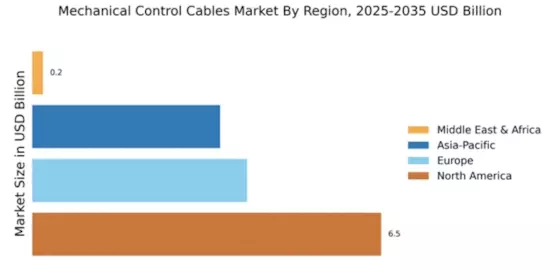
North America continues to lead the Mechanical Control Cables market, holding a significant share of 6.5 in 2024. The region's growth is driven by increasing demand in automotive and aerospace sectors, alongside stringent safety regulations that necessitate high-quality control cables. The presence of major manufacturers and technological advancements further bolster market expansion, making it a hub for innovation and development. The United States is the primary contributor to this market, with key players like Parker Hannifin, Teleflex, and Gates Corporation leading the charge. The competitive landscape is characterized by continuous product innovation and strategic partnerships among manufacturers. As the market evolves, companies are focusing on enhancing product performance and sustainability, ensuring they meet the growing demands of various industries.

Europe : Emerging Market with Growth Potential

Europe's Mechanical Control Cables market is poised for growth, with a market size of 4.0 in 2024. The region benefits from a robust manufacturing base and increasing investments in infrastructure and transportation. Regulatory frameworks promoting safety and efficiency in machinery are key drivers of demand, pushing manufacturers to innovate and comply with stringent standards. Leading countries such as Germany, France, and the UK are at the forefront of this market, hosting major players like Mecalac and Cablecraft. The competitive landscape is marked by a mix of established companies and emerging startups, all vying for market share. As the region focuses on sustainability, manufacturers are increasingly adopting eco-friendly practices and materials, enhancing their market appeal.

Asia-Pacific : Rapidly Growing Market Dynamics

The Asia-Pacific region is experiencing rapid growth in the Mechanical Control Cables market, with a size of 3.5 in 2024. This growth is fueled by increasing industrialization, urbanization, and rising demand from the automotive and construction sectors. Government initiatives aimed at enhancing infrastructure and manufacturing capabilities are also significant catalysts for market expansion, creating a favorable environment for investment. Countries like China, Japan, and India are leading the charge, with a mix of local and international players competing for market share. The competitive landscape is characterized by aggressive pricing strategies and innovation, as companies strive to meet the diverse needs of various industries. As the market matures, there is a growing emphasis on quality and compliance with international standards, shaping the future of the industry.

Middle East and Africa : Emerging Market with Challenges

The Middle East and Africa region represents a nascent market for Mechanical Control Cables, with a size of 0.2 in 2024. The growth in this region is hindered by economic challenges and limited industrialization. However, increasing investments in infrastructure and energy sectors are expected to drive demand for mechanical control cables in the coming years, as governments focus on modernization and development. Countries like South Africa and the UAE are beginning to see growth in this sector, with a few local manufacturers emerging. The competitive landscape is still developing, with opportunities for international players to enter the market. As the region continues to evolve, there is potential for significant growth, particularly as infrastructure projects gain momentum and regulatory frameworks improve.

Key Players and Competitive Insights

The Mechanical Control Cables Market is currently characterized by a dynamic competitive landscape, driven by innovation, technological advancements, and strategic partnerships. Key players such as Parker Hannifin (US), Teleflex (US), and Gates Corporation (US) are actively shaping the market through their distinct operational focuses. Parker Hannifin (US) emphasizes innovation in product development, particularly in enhancing the performance and reliability of control cables, which positions it favorably against competitors. Teleflex (US), on the other hand, has been focusing on expanding its product portfolio to cater to diverse applications, thereby enhancing its market presence. Gates Corporation (US) is leveraging its expertise in materials science to develop advanced cable solutions, which further solidifies its competitive edge. Collectively, these strategies contribute to a robust competitive environment, where differentiation is increasingly based on technological superiority and customer-centric solutions.

In terms of business tactics, companies are increasingly localizing manufacturing to reduce lead times and optimize supply chains. This approach not only enhances operational efficiency but also allows for better responsiveness to regional market demands. The market structure appears moderately fragmented, with several players vying for market share, yet the influence of major companies remains significant. Their strategic initiatives often set the tone for industry standards and practices, thereby shaping the overall market dynamics.

In November 2025, Parker Hannifin (US) announced the launch of a new line of environmentally friendly control cables designed to reduce carbon emissions during production. This strategic move not only aligns with global sustainability trends but also positions the company as a leader in eco-friendly innovations within the sector. The introduction of these products is likely to attract environmentally conscious consumers and businesses, enhancing Parker Hannifin's market share.

In October 2025, Teleflex (US) expanded its manufacturing capabilities by acquiring a facility in Eastern Europe, aimed at increasing production efficiency and meeting rising demand in the region. This acquisition is strategically significant as it allows Teleflex to tap into new markets while optimizing its supply chain, potentially leading to reduced costs and improved service delivery.

In September 2025, Gates Corporation (US) entered into a strategic partnership with a leading automotive manufacturer to develop advanced control cable systems for electric vehicles. This collaboration is indicative of the growing trend towards electrification in the automotive sector and positions Gates Corporation to capitalize on the burgeoning demand for innovative solutions in this space. Such partnerships are likely to enhance the company's technological capabilities and market reach.

As of December 2025, the Mechanical Control Cables Market is witnessing trends that emphasize digitalization, sustainability, and the integration of AI technologies. Strategic alliances among key players are increasingly shaping the competitive landscape, fostering innovation and collaborative development. The shift from price-based competition to a focus on technological advancement and supply chain reliability is becoming more pronounced. Companies that prioritize innovation and sustainability are likely to emerge as leaders in this evolving market, as they align their strategies with the growing expectations of consumers and regulatory bodies.

Key Companies in the Mechanical Control Cables Market market include

Industry Developments

The  Mechanical Control Cables Market has witnessed several significant recent developments. Major players like Eaton Corporation and Schneider Electric are focusing on expanding their product ranges to cater to the evolving demands from industries such as aerospace and automotive, which rely heavily on mechanical control solutions.

Kongsberg Gruppen and Wabtec Corporation are also enhancing their offerings to support more advanced and efficient systems. The market has experienced notable growth, particularly driven by increased automation and technological advancements across various sectors.

In terms of mergers and acquisitions, the recent acquisition trends have seen companies like Mersen and Parker Hannifin strategically acquiring smaller firms to bolster their technological capabilities and market reach.

Furthermore, Baldor Electric and GKN Aerospace are investing in research and development to innovate new cable technologies that improve performance and reliability. Such activities contribute to the increasing valuation of these companies, creating a more competitive landscape within the mechanical control cables market.

As a result, the collective efforts of these companies have a significant impact on industry dynamics, pushing the boundaries of product development and market expansion.

Future Outlook

Mechanical Control Cables Market Future Outlook

The Mechanical Control Cables Market is projected to grow at a 5.85% CAGR from 2024 to 2035, driven by increasing automation, demand for precision control, and advancements in materials.

New opportunities lie in:

  • Development of smart control cable systems for automation applications.
  • Expansion into renewable energy sectors with specialized cable solutions.
  • Partnerships with automotive manufacturers for integrated control systems.

By 2035, the Mechanical Control Cables Market is expected to achieve robust growth and innovation.

Market Segmentation

Mechanical Control Cables Market End Use Outlook

  • Original Equipment Manufacturer
  • Aftermarket
  • Construction
  • Transportation
  • Energy

Mechanical Control Cables Market Cable Type Outlook

  • Push-Pull Cables
  • Throttle Cables
  • Brake Cables
  • Transmission Cables
  • Control Cables

Mechanical Control Cables Market Application Outlook

  • Automotive
  • Aerospace
  • Industrial Equipment
  • Marine
  • Agricultural Equipment

Mechanical Control Cables Market Material Type Outlook

  • Steel
  • Aluminum
  • Plastic
  • Composite
  • Rubber

Report Scope

MARKET SIZE 2024 14.2(USD Billion)
MARKET SIZE 2025 15.4(USD Billion)
MARKET SIZE 2035 27.2(USD Billion)
COMPOUND ANNUAL GROWTH RATE (CAGR) 5.85% (2024 - 2035)
REPORT COVERAGE Revenue Forecast, Competitive Landscape, Growth Factors, and Trends
BASE YEAR 2024
Market Forecast Period 2025 - 2035
Historical Data 2019 - 2024
Market Forecast Units USD Billion
Key Companies Profiled Parker Hannifin (US), Teleflex (US), Bennett Marine (US), Mecalac (FR), Cablecraft (GB), Meyer Industries (US), Sierra Instruments (US), Hawke International (GB), Gates Corporation (US)
Segments Covered Application, End Use, Material Type, Cable Type
Key Market Opportunities Integration of smart technologies enhances efficiency in the Mechanical Control Cables Market.
Key Market Dynamics Rising demand for automation in various industries drives innovation and competition in the Mechanical Control Cables market.
Countries Covered North America, Europe, APAC, South America, MEA

Market Highlights

Author
Sejal Akre
Senior Research Analyst

She has over 5 years of rich experience, in market research and consulting providing valuable market insights to client. Hands on expertise in management consulting, and extensive knowledge in domain including ICT, Automotive & Transportation and Aerospace & Defense. She is skilled in Go-to market strategy, industry analysis, market sizing, in depth company profiling, competitive intelligence & benchmarking and value chain amongst others.

Leave a Comment

FAQs

What is the projected market size of the Mechanical Control Cables Market by 2032?

The Mechanical Control Cables Market is expected to be valued at 7.91 USD Billion by 2035.

What is the expected compound annual growth rate (CAGR) for the Mechanical Control Cables Market from 2024 to 2032?

The market is expected to witness a CAGR of 3.29% from 2025 to 2035.

What segment is projected to have the largest value in the Mechanical Control Cables Market in 2032?

The Automotive segment is projected to have the largest value at 2.7 USD Billion in 2032.

Which region is expected to hold a significant market value in 2032 for the Mechanical Control Cables Market?

North America is expected to hold a significant market value at 2.4 USD Billion in 2032.

What will be the market size for the Aerospace segment in 2032?

The Aerospace segment is expected to be valued at 1.3 USD Billion in 2032.

Who are the major players in the Mechanical Control Cables Market?

Major players include Eaton Corporation, General Cable, Kongsberg Gruppen, Schneider Electric, and Wabtec Corporation.

What is the market size of the Industrial Equipment segment in 2032?

The Industrial Equipment segment is expected to reach a market size of 1.7 USD Billion in 2032.

Which application segment is expected to show growth in the Mechanical Control Cables Market by 2032?

The Home Appliances segment is expected to grow to a market size of 0.6 USD Billion by 2032.

What will be the expected market value for the Marine application by 2032?

The Marine application is projected to be valued at 0.9 USD Billion in 2032.

How is the MEA region expected to perform in the Mechanical Control Cables Market by 2032?

The MEA region is expected to maintain a steady market value of 0.2 USD Billion by 2032.

Download Free Sample

Kindly complete the form below to receive a free sample of this Report

Compare Licence

×
Features License Type
Single User Multiuser License Enterprise User
Price $4,950 $5,950 $7,250
Maximum User Access Limit 1 User Upto 10 Users Unrestricted Access Throughout the Organization
Free Customization
Direct Access to Analyst
Deliverable Format
Platform Access
Discount on Next Purchase 10% 15% 15%
Printable Versions